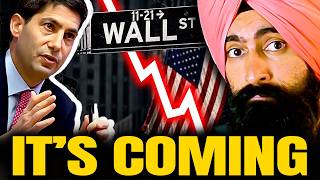

Fed admits banking system worries
45sGrabs attention by revealing the Fed's hidden concerns about private credit and commercial real estate defaults.
▶ Play Clip"The title accurately reflects the Fed's quiet confirmation of risks, though it slightly overstates the immediacy of a crisis."
The Federal Reserve's semiannual banking report states that the US banking system is well-capitalized and profitable, but it highlights three key concerns: private credit defaults, commercial real estate loan defaults, and large paper losses at banks. The video analyzes these risks and notes that the Fed is simultaneously loosening bank supervision, potentially allowing problems to grow unnoticed.
The Fed's semiannual report says 99% of US banks are well-capitalized and profits are healthy, but there are three specific concerns.
Private credit (non-bank lending) has boomed to over $1 trillion. Rising interest rates and AI disruption have led to defaults and fund freezes by Blackstone, BlackRock, and Blue Owl. Banks are exposed via loans to these funds.
Delinquencies on CRE loans remain above decade averages due to low office demand post-pandemic. A wave of loan readjustments in 2026 at higher rates could increase defaults, especially for smaller regional banks.
Banks hold ~$98 billion in unrealized losses on treasuries bought when rates were low. A proposed rule in March 2026 would require large banks to report these losses, potentially revealing worse financial health.
Despite these concerns, the Fed is loosening supervision: deprioritizing procedural shortcomings, closing supervisory findings, and redefining 'well-managed' to make it easier for banks to qualify.
The Fed acknowledges three systemic risks—private credit, CRE, and paper losses—yet is simultaneously reducing oversight. This creates a scenario where problems may only be caught after they become significant threats.
What percentage of US banks does the Fed consider well-capitalized?
99%
1:09
What are the three main concerns the Fed highlighted in its semiannual report?
Private credit defaults, commercial real estate loan defaults, and large paper losses at banks.
0:18
What is private credit?
Loans made by non-bank financial institutions (like hedge funds) to businesses that are too large for small banks but too small for big banks.
2:13
How much have banks lent to non-bank financial institutions (private credit funds)?
Over $1 trillion.
6:19
Why are commercial real estate loans at risk in 2026?
A large wave of loan readjustments is coming, and interest rates remain high, increasing default risk for office and multifamily properties.
8:40
What caused Silicon Valley Bank to collapse?
It held treasuries that lost value as interest rates rose; a bank run forced it to realize those losses.
10:28
How much in paper losses do US banks currently hold on treasuries?
About $98 billion.
12:18
What regulatory change did the Fed propose in March 2026?
A rule requiring certain large banks to reflect unrealized gains and losses on their financial statements.
13:01
How is the Fed changing its definition of a 'well-managed' bank?
It is making the definition easier for banks to qualify as well-managed.
15:22
Private Credit as Fastest-Growing Loan Category
Highlights a systemic risk that has doubled since 2021 and involves over $1 trillion in bank exposure.
1:35CRE Loan Readjustment Wave in 2026
Explains a specific, imminent trigger for potential defaults in commercial real estate.
7:27Paper Losses and SVB Precedent
Connects current unrealized losses to the mechanism that caused Silicon Valley Bank's collapse.
10:19Fed Loosening Supervision Despite Risks
Reveals a contradictory policy that may allow problems to escalate unnoticed.
13:53[00:00] The Federal Reserve Bank just published
[00:02] their semianual banking system report
[00:04] card and they said that the US banking
[00:07] system looks good, but there are some
[00:09] things that they're worried about.
[00:10] Here's what they said. Quote, "The US
[00:12] banking system continues to maintain
[00:14] strong capital and liquidity levels, but
[00:17] there are three things that they're
[00:18] watching. Number one is private credit
[00:21] potential defaults. Number two are
[00:23] commercial real estate loan defaults.
[00:25] And number three, are banks sitting on
[00:28] large paper losses? So, in this video, I
[00:31] want to break down my analysis of what
[00:33] the Federal Reserve Bank just published
[00:35] in their semiannual banking system
[00:36] report, and then I want to go over some
[00:38] of their concerns. That way, you can
[00:40] understand what the Federal Reserve Bank
[00:41] is paying attention to. That way, you
[00:43] can be a smarter investor. So, let's
[00:45] break this all down. Now, the Federal
[00:47] Reserve Bank publishes the semiannual
[00:49] report where they take a look at how
[00:51] healthy banks are in the United States.
[00:53] And this has become more popular because
[00:55] of the banking crisis that we saw after
[00:58] the 2008 great financial crisis. And
[01:00] what the Federal Reserve Bank is taking
[01:02] a look at is number one, are banks
[01:05] making money and do they have cash in
[01:07] case of a downturn? And according to the
[01:09] Fed, 99% of banks in the United States
[01:12] today are quote well capitalized,
[01:15] meaning they have money in case there
[01:17] was a downturn. And then they went on to
[01:19] say that bank profits are healthy, which
[01:22] shows that banks in the United States
[01:24] are doing good. But then if you dig
[01:27] deeper into their analysis, which I'll
[01:28] also link for you down in the
[01:30] description, the Federal Reserve Bank
[01:31] then goes on to talk about three things
[01:33] that they are worried about. Number one
[01:35] is private credit. Let me read you what
[01:37] they said and then I'll break down what
[01:39] this means. The Federal Reserve closely
[01:42] monitors bank exposures to NDFIs,
[01:45] that is a non-depository financial
[01:48] institution, so private credit. Through
[01:51] regulatory data shows limited
[01:53] delinquencies in this category, several
[01:56] high-profile NDFI defaults have led to
[02:00] concerns about the private credit
[02:02] sector. Supervisory work shows that some
[02:05] banks are revisiting collateral
[02:08] management practices for these
[02:10] exposures. What that means is after the
[02:13] 2008 crash, there was this whole new
[02:16] industry called private credit. Because
[02:18] if you are a business and you wanted to
[02:20] borrow, let's say, $200 million, well,
[02:22] it might not be enough for some of these
[02:24] big banks, but it was too big for some
[02:26] of the smaller banks. And so, you were
[02:28] kind of in this weird market. And
[02:30] depending on what industry you were in,
[02:31] it might have been difficult for you to
[02:33] go out and raise a $200 million. That
[02:35] was when these private credit funds
[02:37] started, hedge funds said, "Oh, we can
[02:40] take advantage of this opportunity
[02:41] because these businesses need money.
[02:44] Banks are not lending them that money.
[02:46] How about we lend them that money at a
[02:48] high interest rate, 7 8 9 10%. It is a
[02:52] healthy return on our investment. the
[02:54] business gets the money that they want
[02:56] and we get to serve this market that was
[02:58] otherwise not being served. This then
[03:02] started what was called the private
[03:03] credit industry. Now the interesting
[03:05] thing about this, it's not a banking
[03:08] industry because these hedge funds are
[03:10] not banks. You and I can't go there and
[03:11] deposit money. They're just these
[03:13] investment institutions that are lending
[03:15] money. So they act like banks, but
[03:17] they're not actually banks.
[03:19] So because they're not banks, they're
[03:21] not regulated the way banks are. This is
[03:24] where things start to get really
[03:25] interesting because this industry
[03:27] started to boom. Hedge funds said, "Hey,
[03:29] we're making so much money on these
[03:31] private credit loans. You should invest
[03:33] in us." Talking to regular investors,
[03:35] talking to other banks, talking to other
[03:37] investment institutions, and everyone
[03:39] said, "Oh, you mean that you're going to
[03:41] pay out these 7 to 10% returns to us as
[03:44] the investor because you're going to
[03:46] charge these high interest rates and
[03:47] you're getting these loans paid? Okay,
[03:50] sign us up." So now wealthy people,
[03:53] non-wealthy people, investment
[03:55] institutions, pension funds, banks
[03:57] started investing into these private
[03:58] credit funds that were lending money to
[04:00] businesses at these very high interest
[04:02] rates. And that industry bmed for many
[04:05] years.
[04:07] But now things started to break. And
[04:09] they started to break for two reasons.
[04:11] Number one, interest rates started to go
[04:13] up a lot after 2022. The Federal Reserve
[04:16] Bank started raising interest rates. And
[04:18] these are not fixed rate loans. So now
[04:20] all of a sudden these businesses have
[04:22] these much higher interest rates, higher
[04:24] than they were before, and they're
[04:26] having a tougher time paying off because
[04:28] of the health of the economy. Reason
[04:31] number two is many of these companies
[04:33] were software companies and those same
[04:37] software companies were being hurt by AI
[04:39] because more and more people were
[04:40] saying, you know what, maybe we don't
[04:42] need this software because we can just
[04:44] use AI to build this tool instead of
[04:47] paying for that software. So these
[04:50] private credit companies that were
[04:52] relying on private credit loans started
[04:54] to hurt and not pay back their loans.
[04:56] And as they started to not pay back the
[04:58] loans, the private credit funds started
[05:00] to struggle. And the investors said, "We
[05:03] want to pull our money out because we're
[05:05] concerned about a default."
[05:07] Well, as investors try to pull their
[05:10] money out of these private credit funds
[05:11] because you were told that you could
[05:13] pull your money out whenever you want.
[05:15] It's kind of like a bank.
[05:17] investor tried to pull their money out
[05:18] and then the private credit funds said,
[05:20] "Uhoh, if we give the investors their
[05:23] money back, we're going to collapse. So
[05:25] then they froze your funds." They said,
[05:27] "You cannot have your money back." And
[05:29] this started happening with many of the
[05:31] largest investment funds out there.
[05:34] Blackstone froze funds, Black Rock froze
[05:37] funds, Blue Owl froze funds. I mean,
[05:40] many of the major Wall Street
[05:42] institutions started freezing funds
[05:44] because so many people wanted their
[05:45] money out. And now the Federal Reserve
[05:47] Bank is saying, well, this is a problem
[05:49] that's continuing. It's not a problem
[05:52] yet because nobody has collapsed, but we
[05:56] are concerned that this could become a
[05:58] problem. That's what the Federal Reserve
[06:00] Bank is saying because they said
[06:02] according to the Fed that this industry,
[06:04] this private credit industry is the
[06:06] fastest growing loan category at United
[06:10] States banks because it has doubled
[06:13] since 2021, 5 years.
[06:17] And not just that, according to the FDI,
[06:19] there are over $1 trillion in loans to
[06:22] these non-bank financial institutions.
[06:24] Meaning the banks, not the private
[06:27] credit funds, the banks on Wall Street
[06:30] have been lending money to the private
[06:31] credit funds to the tune of over a
[06:33] trillion dollars. And this has been a
[06:36] big growing trend amongst banks because
[06:38] they were getting these huge profits.
[06:40] But now they might be hurting because of
[06:42] what might be coming in the private
[06:44] credit industry. Again, we don't know
[06:46] what's going to happen. Maybe things
[06:48] will fix themselves, but if they don't,
[06:50] that could hurt the banking sector. And
[06:53] the question is what are they going to
[06:54] do if that happens? Because according to
[06:57] the Federal Reserve Bank, more and more
[06:59] of these banks and hedge funds are now
[07:03] looking at if these private credit funds
[07:06] collapse, how would we cover that loss?
[07:10] That's what the Federal Reserve Bank
[07:11] meant when they said that banks and
[07:14] these funds are now starting to revisit
[07:16] collateral management practices for
[07:19] their expenses. meaning if things go
[07:22] wrong, how are we going to cover that
[07:23] cost? So that's concern number one that
[07:25] the Federal Reserve Bank highlighted.
[07:27] Concern number two that they talk about
[07:29] is the commercial real estate sector.
[07:31] This is something that started after the
[07:34] pandemic and it has not fixed itself
[07:36] yet. Here's what the Fed said exactly.
[07:38] Quote, delinquencies on commercial real
[07:41] estate loans and consumer loans remain
[07:44] above the averages from the past decade,
[07:47] indicating in part that demand for
[07:49] office space has so far not returned to
[07:53] prepandemic levels. And this is
[07:55] primarily in the office and multif
[07:57] family sectors. What that means is that
[08:00] there's about $1.5 trillion in these
[08:03] commercial loans that a lot of people
[08:07] are underwater on. And this is what the
[08:09] Federal Reserve Bank is worried about
[08:11] because now as interest rates are
[08:14] continuing to stay high because a lot of
[08:16] people were hoping that they were going
[08:18] to fall in 2026,
[08:20] a lot of people are now having to pay
[08:22] their loans at higher rates. Why?
[08:25] Because these commercial real estate
[08:27] loans are not 30-year fixed rate
[08:29] mortgages, they're readjusting loans.
[08:32] And during the 2020 pandemic, everybody
[08:34] readjusted their loans. So 2020, 2021,
[08:37] 2022, everybody readjusted the loans.
[08:40] And many times it's like a 5-year loan,
[08:43] which means today in 2026, we have a big
[08:47] wave of readjustments coming. And people
[08:50] were hoping that their loans would
[08:52] readjust at a lower rate, but they're
[08:54] not. They were adjusting at high rates.
[08:58] Which means now if you own an office
[09:00] building and it's 75% occupied, 25%
[09:05] vacant,
[09:07] all of a sudden your cost of operating
[09:09] that building have gone up. If you have
[09:11] debt, not because of other costs, but
[09:14] because your debt has readjusted at a
[09:16] higher rate. In the past, what you would
[09:19] do as an office landlord is you now pass
[09:22] this cost down to your tenants by
[09:23] raising their rents. The problem is
[09:25] vacancies are still high in offices.
[09:28] People have gone back to work in the
[09:30] office, but it's not where we were pre-
[09:32] pandemic. And so, if you have to pass
[09:35] this cost down, the concern is what if
[09:37] people leave because you're still at a
[09:38] higher vacancy rate than before. And
[09:41] that's the concern now that we're
[09:43] starting to see this rise in commercial
[09:44] real estate defaults. it's higher than
[09:47] what the Federal Reserve Bank would like
[09:48] to see. And the question is, if interest
[09:51] rates stay higher for longer, these
[09:54] default rates could go up even more. And
[09:56] the question then is what is that going
[09:58] to mean for banks that are holding on to
[10:00] those loans? That's ultimately what the
[10:02] Fed is paying attention to because there
[10:04] are some of these smaller community
[10:06] regional banks that are holding on to
[10:08] these commercial real estate loans that
[10:10] might not be able to absorb huge
[10:12] commercial real estate losses. That's
[10:15] what the Fed is paying attention to,
[10:17] which now brings me to the Fed's third
[10:19] concern, which are paper losses at
[10:23] banks. And this goes back to what we saw
[10:26] happen a few years ago. If you remember
[10:28] Silicon Valley Bank, the reason why
[10:31] Silicon Valley Bank collapsed or one of
[10:33] the reasons why it's because when
[10:35] interest rates went down in 2020 and
[10:38] 2021,
[10:40] Silicon Valley Bank went out then and
[10:42] started saving their money in
[10:44] treasuries. A treasury is a loan to the
[10:47] United States government. It's
[10:49] considered the safest investment that
[10:51] you can make. So, Silicon Valley Bank
[10:53] bought these treasuries. Well, what
[10:55] happened was as interest rates started
[10:57] to go up, the value of those same
[11:00] treasuries started to go down, which is
[11:02] just how bonds work. A bond is a loan.
[11:05] As interest rates go up, the value of
[11:07] those loans go down.
[11:09] So now, Silicon Valley Bank was sitting
[11:11] on assets, these treasuries, which are
[11:13] now underwater. They paid X dollars for
[11:16] them. They're worth a fraction of that
[11:19] as interest rates went up. Well, some
[11:22] people got concerned and so the
[11:25] businesses that were saving their money
[11:27] in Silicon Valley Bank then started
[11:29] pulling their money out. As they started
[11:31] pulling their money out, it created a
[11:33] little bit of a run on the banks while
[11:36] Silicon Valley Bank did not have the
[11:38] assets to support it because well, they
[11:42] weren't planning on selling those
[11:43] treasuries. But then as people started
[11:44] pulling their money out, they needed
[11:46] more cash. So now they had to realize
[11:48] those losses and that's what then caused
[11:51] Silicon Valley Bank to ultimately
[11:53] collapse. And what the Federal Reserve
[11:55] Bank is saying is that that environment
[11:57] that's caused Silicon Valley Bank to
[11:58] collapse hasn't changed because a lot of
[12:02] banks were buying these treasuries
[12:04] during the 2020 2021 days when interest
[12:07] rates are very low and interest rates
[12:09] are a whole lot higher than we are today
[12:11] which means a lot of banks are sitting
[12:13] on these paper losses on their
[12:16] treasuries. According to the Fed is
[12:18] about $98 billion in paper losses.
[12:23] But the question is now if the banks
[12:25] start to feel more pain because of what
[12:28] we just talked about commercial real
[12:29] estate or private credit that could
[12:33] force some of the banks especially some
[12:35] of the more smaller regional community
[12:36] banks to try to liquidate some of their
[12:40] assets and that could be a problem if
[12:43] their assets they own are underwater.
[12:48] That's what the Federal Reserve Bank is
[12:49] paying attention to is that you need to
[12:51] pay attention and count these paper
[12:53] losses because they might be changing
[12:57] how you can measure these paper losses.
[13:01] In March 2026 this year, the Fed
[13:04] proposed a new rule that would require
[13:07] certain large banks to reflect these
[13:10] unrealized gains and losses on their
[13:14] financial statements.
[13:16] If that were to happen now, all these
[13:19] banks that are sitting on these cryp
[13:20] losses will then have to show that we
[13:23] are losing money on these things,
[13:26] that's where it could cause more
[13:28] problems because then more people would
[13:29] say, "Oh, this bank is in very bad
[13:31] financial health because it's underwater
[13:34] on these losses and they'd be forced to
[13:35] report it in a different way." Again, we
[13:38] don't know if that's going to happen,
[13:39] but this is a proposal that the Federal
[13:41] Reserve Bank made in March 2026,
[13:44] and that could change the health of some
[13:46] of these banks if now they have to
[13:47] disclose that they're in a much worse
[13:49] financial situation than many people
[13:51] thought that they were in. And then we
[13:53] have the most interesting part of this
[13:55] report, which is the end, where the
[13:57] Federal Reserve Bank talked about their
[13:59] concerns about private credit. They
[14:01] talked about their concerns about
[14:02] commercial real estate. They talked
[14:03] about their concerns about these paper
[14:05] losses. The Federal Reserve Bank then
[14:07] says that they are now thinking about
[14:09] loosening regulations and loosening some
[14:12] of their supervision on their banks
[14:14] despite their concerns. What they said
[14:16] in October 2025 is that the Fed is now
[14:19] telling their department to deprioritize
[14:24] procedural shortcomings
[14:27] and they should only focus on them when
[14:29] there are significant threats. Meaning
[14:31] if there are these concerns about
[14:33] potential defaults, there are these
[14:34] concerns about this potential paper
[14:36] losses, they should depprioritize them
[14:39] unless there is a significant threat.
[14:41] Now, the interesting thing about that is
[14:43] you're not going to know if it's a
[14:44] significant threat until after the
[14:46] threat has happened. So, the idea of
[14:48] trying to deprioritize them kind of
[14:50] defeats that same purpose, but you can
[14:51] start to see how things are changing.
[14:53] Well, then this year in February 2026,
[14:56] the Fed launched a review of every
[14:59] outstanding supervisory finding at every
[15:02] bank and they started closing and
[15:04] downgrading them. Meaning, the Fed's
[15:08] supervisory department was then being
[15:10] shut down to start not allocating money
[15:13] and time to reviewing some of these bank
[15:16] health documents. And then most
[15:20] recently, the Fed changed their
[15:22] definition of a quote well-managed bank.
[15:27] Here's what the Fed said. Quote, the
[15:29] proportion of large financial
[15:30] institutions considered well-managed
[15:33] increased based on the revised
[15:36] definition.
[15:37] Meaning, according to the Federal
[15:39] Reserve Bank, a lot of banks now in the
[15:41] United States are well-managed. Why?
[15:44] Because we changed the definition of
[15:45] well-managed. We made it easier for
[15:47] banks to qualify as well-managed. One of
[15:49] the things that I've learned in life is
[15:51] that oftentimes the things you don't pay
[15:52] attention to end up mattering the most.
[15:54] And that's why I want to talk to you
[15:56] about life insurance with our sponsor
[15:58] Policy Genius. Because if you don't have
[16:00] the assets to live off of yet and
[16:03] something tragically happened to you,
[16:05] the last thing you want is now your
[16:07] spouse and your family trying to
[16:08] struggle to survive financially. And
[16:10] that's where term life insurance can
[16:12] come into play. Now, I'm talking about
[16:14] term life insurance here, not whole life
[16:16] insurance. The whole idea with term life
[16:18] insurance is it's life insurance for a
[16:20] period of time, 10 years, 20 years, 30
[16:22] years. That way, you can work to build
[16:24] your assets. It is a lot cheaper than
[16:26] whole life insurance because the whole
[16:28] idea is you're not here trying to get
[16:30] rich off your life insurance. It's just
[16:32] there as a bridge until you can build
[16:35] your assets. This is one of those things
[16:36] where the earlier you start, the cheaper
[16:38] it is. Because if you're a healthy
[16:40] 30-year-old guy, you could potentially
[16:42] get a half a million dollar term life
[16:44] insurance policy for less than a dollar
[16:46] a day. So, if you have any questions,
[16:47] you want to learn more about term life
[16:49] insurance, or you want to see how much a
[16:50] term life insurance policy would
[16:52] actually cost you, I'll put a link to
[16:54] Policy Genius's form down in the
[16:55] description. It only takes a few minutes
[16:57] to complete, and it'll give you an
[16:58] actual quote on how much term life
[17:01] insurance will actually cost you. And I
[17:02] have that link for you down in the
[17:04] description. What the Federal Reserve
[17:05] Bank said is, "Banks in the United
[17:07] States are healthy. They're well
[17:08] capitalized and they're making high
[17:10] profits. But we have three concerns.
[17:12] Those concerns are number one, private
[17:14] credit defaults. Number two, commercial
[17:16] real estate defaults. And then banks
[17:18] being underwater on their loans. Now,
[17:21] despite those concerns, we the Federal
[17:23] Reserve Bank are going to stop
[17:26] supervising the banks as tightly as we
[17:28] did before because we feel like it is a
[17:30] burden for the banking industry. So, we
[17:33] are going to stop doing that unless
[17:35] there is a significant threat and we're
[17:38] going to make it easier for banks to be
[17:40] able to operate their businesses and not
[17:42] necessarily oversee some of the things
[17:43] that they're doing to make it easier for
[17:45] banks to operate. The idea being
[17:47] hopefully banks can make more money. The
[17:49] concern is if something's a problem, it
[17:52] might not get caught until later. If you
[17:54] got value out of this video, the best
[17:56] thank you as a referral. If you could
[17:57] please share this video with a friend,
[17:58] family member, colleague, or fellow
[18:00] investor. That way we can continue to
[18:01] spread this type of financial education.
[18:03] Thank you. The United States is about to
[18:05] borrow $2 trillion to keep our economy
[18:08] running. It sounds great at first
[18:09] because it's going to stimulate our
[18:11] economy. But anytime the government
[18:13] spends money it doesn't have, somebody
[18:15] has to pay the price. I call this a
[18:18] hidden tax because this is not a tax
[18:20] that you're paying to the IRS. It's a
[18:22] tax you're paying with more expensive


⚡ Saved you 0h 18m reading this? Transcribe any YouTube video for free — no signup needed.