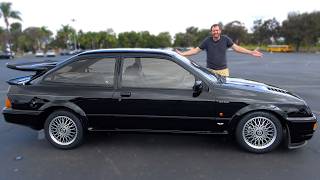

The Rarest Ford You've Never Heard Of
40sOpens with the extreme rarity and legendary status of the RS500, instantly hooking car enthusiasts and collectors.
▶ Play Clip"The title accurately describes the car as the ultimate 1980s Fast Ford, and the video delivers a thorough review."
This video reviews the 1987 Ford Sierra Cosworth RS500, an ultra-rare homologation special built for Group A racing. Only 500 units were produced, and this example is being auctioned on Cars and Bids. The host explores its quirks, features, and driving experience, highlighting its iconic double-decker wing, Tickford upgrades, and racing pedigree.
The 1987 Ford Sierra Cosworth RS500 is a road version of a successful race car, with only 500 built globally. It's being auctioned live on Cars and Bids.
The Ford Sierra was a popular mid-size family car in Europe. Ford wanted to compete in Group A racing, which required a road version. They created the Sierra Cosworth (5,000 units), then the RS500 (500 units) for even more performance.
Tickford, a British tuner formerly part of Aston Martin, upgraded the Sierra Cosworth to RS500 spec. The most famous upgrade is the double-decker rear wing, which later became iconic on other Ford Cosworth models.
Under the hood, Tickford installed beefed-up internals, a bigger turbocharger, larger intercooler, and improved oil/cooling systems. Official output was 225 hp and 200 lb-ft torque, but many believe it was underrated.
Tickford removed the fog lights from the front bumper to improve airflow to the engine and turbocharger, a noticeable difference from the standard Cosworth.
The RS500 dominated touring car racing in the late 1980s, winning dozens of races. It also competed in rallying despite being rear-wheel drive, proving its performance.
The car features Tickford's winged 'T' badge (resembling Aston Martin's logo), RS500 script in a Star Trek-like font, and a rear badge listing all model names. The wheels have a locking center cap that requires a special key.
The body kit includes wheel arch extensions and a low front lip spoiler that gives the car an aggressive, wedge-shaped profile.
The interior is very 1980s with square angles and plastic. Upgrades include Recaro seats with heavy bolsters, a three-spoke steering wheel, and an RS logo on the dashboard.
The sunroof is manually operated via a handle that folds down and twists to tilt or slide open. The sunshade has ribbed slats.
A diagram of the car shows warning lights for doors and taillights. The clock has three buttons (S, R, line) to display time, date, or a stopwatch with lap timer functionality.
The gauge cluster includes a factory turbo boost gauge. Climate control switches are located next to the gauge cluster rather than the center stack, requiring passenger reach.
A storage panel below the radio opens for concealing small items. All RS500s have a five-speed manual transmission and are right-hand drive only.
The three-door hatchback offers a roomy rear seat with three seatbelts and individual ashtrays. The cargo area is large, with a full-size spare wheel under the floor.
The car feels tossable and eager, with a linear clutch and good shifter. The engine feels stronger than the stated 230 hp, with minimal turbo lag. Handling is less focused than a pure sports car, but the overall experience is exciting and special.
The Ford Sierra Cosworth RS500 is an automotive icon, combining ultra-rare production, racing pedigree, and a unique driving experience. This well-preserved example is a true collector's piece.
How many Ford Sierra Cosworth RS500 units were built?
Only 500 units were built for the entire planet.
00:04
What racing class was the RS500 built for?
Group A, which required a road version of the race car.
03:09
Which company upgraded the Sierra Cosworth to RS500 spec?
Tickford, a British tuner formerly part of Aston Martin.
04:51
What is the most famous visual upgrade of the RS500?
The double-decker rear wing.
04:35
What was the official horsepower of the RS500?
225 horsepower, though many believe it was underrated.
07:02
What was removed from the front bumper for better airflow?
A pair of fog lights.
08:34
Was the RS500 all-wheel drive?
No, it was rear-wheel drive.
09:36
How is the sunroof operated in the RS500?
Manually, via a handle that folds down and twists to tilt or slide open.
15:23
What special feature does the clock have?
It can display time, date, or a stopwatch with lap timer functionality.
16:47
Are there any left-hand drive RS500s?
No, all RS500s were right-hand drive.
19:39
Tickford's Role
Explains how a former Aston Martin subsidiary created the RS500, adding historical context.
04:51Racing Dominance
Highlights the car's success in touring car and rally racing, underscoring its performance credentials.
09:03Manual Sunroof Quirk
Demonstrates the era's engineering solutions before power accessories became standard.
15:23Surprising Power
The host's reaction suggests the car is faster than its official specs, a common enthusiast belief.
26:25Doug Score
Provides a quantified assessment comparing the RS500 to other classic sports cars.
28:52[00:04] This is a 1987 Ford Sierra Cosworth RS500 and it's an icon for true car enthusiasts. High-performance European Fords have always been pretty cool, but this one is extra special. A road version of a tremendously successful
[00:19] race car and only 500 of these were built for the entire planet. Today, I'm going to review the very exciting Sierra Cosworth RS500 and show you all of its
[00:31] Cosworth RS500 and show you all of its quirks and features. Sierra Cosworth RS500 is currently for sale and it's being
[00:44] is currently for sale and it's being auctioned live on Cars and Bids. This is the top dog of Cosworth Fords, incredibly rare and this one is tremendously well preserved, low miles, nice shape, no crazy modifications and
[00:58] it's already here in the US and titled here and it can be yours on Cars and Bids. So, once you finish watching this video, click the link in the description below to visit the live auction for this Sierra Cosworth where you can bid on it
[01:12] Sierra Cosworth where you can bid on it and buy it only on Cars and Bids. Cars and Bids is coming live to Sonoma Raceway for Velocity Invitational. We've curated an incredible selection of top-tier auctions that will end live in
[01:25] the Velocity Invitational paddock. Truly some of the best cars we've ever physically on site for attendees to experience while our full online audience bids alongside them. And the event itself, three days of car culture
[01:40] overload. Historic race cars running wheel-to-wheel, open paddock access to the rarest machines on earth, modern hypercars, concours classics, drift cars, all set in Sonoma wine country. Come say hi to the entire Cars and Bids
[01:55] team at Sonoma Raceway, May 29th through 31st. All right, time for the quirks and features of the Ford Sierra Cosworth RS500. This is a really special car. I'm
[02:07] going to start with a little explanation, some backstory about what explanation, some backstory about what makes this car so desirable and so cool. And we begin with the Ford Sierra, which was a very popular mid-size car
[02:22] manufactured by Ford in Europe and sold throughout the 1980s and into the early 90s. This was a tremendously popular vehicle, mid-size family car, sort of the equivalent at that time in Europe to the the Honda CRV or the Toyota Camry in
[02:37] today's world. It was a really popular, you saw it everywhere kind of thing. In fact, it was so popular that they made a sedan, a three-door hatchback, a five-door hatchback, a wagon, and even a car-based van version. There were so
[02:53] many body styles cuz it had so much appeal. But, it wasn't really a performance model right off the bat. In fact, most Ford Sierras had like 80 horsepower. They were just pure boring family transport. However, Ford of
[03:09] Europe decided that it wanted to go racing in the Group A classification. Now, Group A was intended for vehicles that were street cars to be turned into race cars and then campaigned in various series, but primarily touring car racing
[03:26] and or rally racing. That was Group A. And Ford said, "We can compete, and we can compete with the Sierra." Now, the Group A racing regulation said that if
[03:38] you wanted to go racing with a car, you had to make a road version. So, Ford took the Sierra racing, and they made a high-performance Sierra Cosworth. And they made about 5,000 units of the Sierra Cosworth, and it was plenty fast
[03:51] and very exciting, and very cool, but it didn't go far enough. Ford wanted an didn't go far enough. Ford wanted an unbeatable Group A touring car with even more power and performance and craziness, and that's when they came out
[04:05] with this. They took the regular Sierra Cosworth, already the top dog, craziest high-performance model, and they made the RS500, limited to just 500 total units, and
[04:19] with some significant upgrades over the already upgraded Sierra Cosworth. This already upgraded Sierra Cosworth. This was the top top top dog, the ultimate member of the Ford Sierra lineup. And the result was a wing. Actually, there
[04:35] were a lot of results. This car has a lot of upgrades over the Sierra and even the Sierra Cosworth, and I'll go through them here, but the wing is probably the best known, the most iconically enduring symbol of this car. And it all started
[04:51] with Tickford. Tickford was a British company that had been a subsidiary of Aston Martin for decades before this car was built. But, just before it had spun off into its own company. It was a tuner, and Ford said, "Hey, Tickford,
[05:06] they're free now. They're not part of Aston. Maybe they can help us upgrade the Sierra Cosworth to even crazier heights." And Tickford said, "Yes." So, they took the regular Sierra Cosworth, they would send it off to Tickford, 500
[05:21] units, and Tickford upgraded them to become the RS500. And one of those upgrades was the wing. Now, the regular Sierra Cosworth got a big wing mounted in back with a center point and the giantness
[05:37] kind of covering the whole rear window, but the RS500 got a second lower wing, which is what's become so famous. This sort of double-decker rear wing situation that just looked like such laughable overkill on a turbocharged
[05:53] four-cylinder Ford hatchback. This wing design was later used in other Ford Cosworth models, and it really became an enduring symbol of these high-performance Ford models, and it started here. Now, the RS500's wing, in
[06:07] addition to adding the double-decker design, also got a little gurney flap on the top part of the upper wing. So, it wasn't just flat. It had like a taller stance, in theory, to provide additional downforce that you weren't already
[06:22] getting from your double-decker wing. But, while the double-decker wing is a But, while the double-decker wing is a famous upgrade to this car, Tickford's most important upgrades to create the RS500 were actually under the hood.
[06:37] RS500 were actually under the hood. Relative to a standard Sierra Cosworth, this car got some pretty significant changes, starting with beefed-up engine internals to handle extra power. From there, Tickford installed a bigger
[06:50] there, Tickford installed a bigger turbocharger to force in more air and a bigger intercooler to go along with it. This car also got improved oil and cooling systems to help manage the performance of the powertrain. It was
[07:02] really jacked up in basically every area, and the result, at least on paper area, and the result, at least on paper they said, was about 225 horsepower and a little over 200 lb ft of torque. Those numbers may not seem
[07:16] particularly strong, but a lot of people said this car was underrated from the factory, and some of the acceleration times sort of seemed to back that up. Regardless, on paper, it had 20 more horsepower than the standard Cosworth,
[07:28] which was previously the top dog in the lineup, and most importantly, it was three to four times more horsepower than the regular Ford Sierra models that were being driven around by regular members of the European car-buying public. Those
[07:43] cars again had somewhere in the neighborhood of 60 to 80 horsepower back neighborhood of 60 to 80 horsepower back in this era and this one, the top dog king of the lineup, had almost 230. It really was a significantly upgraded car.
[07:57] And I love looking at this powertrain and seeing obviously the red coloring under here, 16-valve turbo, but the Ford logo next to the Cosworth logo printed
[08:09] right there on this engine. Obviously, an enduring partnership that lasted in the '80s and then through the '90s, some really special cars came out of that partnership and it's cool to see those two logos right there on the engine.
[08:22] Now, beyond the big wing and all the engine upgrades, Tickford also restyled the front end of the RS500 and specifically, they removed a pair of fog
[08:34] lights. On the regular Cosworth, there's a fog light here and corresponding on the other side. It was removed in the RS500 for better airflow to get obviously more air to the engine, the turbocharger to help with cooling and
[08:47] that's another noticeable difference compared to the standard Cosworth model. Now, the result of all the upgrades was a very cool and very special and very exciting road car, but also a tremendously successful race car. Group
[09:03] A regulations governed a bunch of race series, but this car's primary area of focus was touring car racing, which was really popular in Europe in the '80s, '90s and into the 2000s. It was basically normal cars made into race
[09:19] cars and this car dominated, winning dozens of races and race series all throughout the mid and late 1980s. It was all the basis of this RS500 Cosworth. Amazingly, this car also went rallying, which is special because it
[09:36] wasn't a four-wheel drive. This is a rear-wheel drive car, but the performance was so stout, Ford said, "Let's take it rallying." And it was actually competitive. The really successful rally car from that era was,
[09:49] of course, the Lancia Delta Integrale, but on the right surface, the Cosworth RS500 could hang with it and even win a few rally races despite not having
[10:01] four-wheel drive. That's how fast and how successful this car was as a racer. It was a really big deal in the late '80s. So, this car was an icon, the ultimate version of the Ford Sierra. Everybody's dad in Europe in the '80s
[10:17] drove a Ford Sierra. In UK and Germany, it was so common, and this was the one that every kid dreamed his dad had instead, specifically the RS500, this car. It was an icon, and it had a lot of quirks. Let's start with the badging on
[10:34] the side here. You can see this little T badge with wings. That was the badge of Tickford, the tuning company who hot it up the RS500. You'll note the T with the wings sort of looks like the Aston Martin logo because, again, Tickford had
[10:49] a long-standing association with Aston Martin, and so the logo shows that. Now, above, you can see the RS500 script in sort of this '80s kind of high-tech, almost Star Trek font, which
[11:02] is subtly integrated into this stripe going down the side of the car. It actually looks pretty cool. Again, it is pretty subtle, but when you go around back, well, there's nothing subtle about the badging back there. You can see it
[11:14] describes every aspect of the car. It's a Sierra, it's a Cosworth, and it's the RS500. As if you had any doubt at all, considering you were looking at the ridiculous double-decker wing. Now, speaking of badging, one of the more
[11:29] interesting badging location of car is the wheels. You can see there's no visible lug nuts. Instead, there is a locking center cap that's placed on top of the lug nuts to sort of preserve this multi-spoke wheel design. If you wanted
[11:44] to access the lug nuts, there was a little silver like medallion that you moved off to the side and it exposed a keyhole. And from there, you had like a separate wheel key that you would turn in, twist, and it would loosen this cap,
[11:58] and then you could get to the lug nuts. Kind of an odd way to do this. A few cars did this in its era, but kind of a weird to see that moving medallion silver piece. However, the wheels do look good with no exposed lug nuts. The
[12:10] other thing that's cool about this car is the body kit. You can see they've done a little bit of like extensions over the wheel arches and down the a little thicker, a little bit more aggressive. But, to me, the coolest part
[12:26] of the body kit is the front lip spoiler, which starts on the leading edge of the front wheel arch and goes down low across the front end of the car. In fact, it reaches down so low that it really gives the car kind of a
[12:39] low aggressive vibe in front. And then, the whole car design kind of builds up in this heightening line going down the side of the car to the back where you have the giant wings. It actually makes for a pretty interesting profile. This
[12:54] sort of load of front, almost adding a wedge-shape kind of design to a wedge-shape kind of design to a traditional boring mid-size European car thanks to the body kit and the wing. And next, we move inside where there are,
[13:08] again, quite a few interesting quirks. Starting with the fact that it's very 1980s in here. What that means is a lot of squares, a lot of right angles, a lot of plastic, a lot of big panel gaps. This car certainly looks like the 1980s
[13:24] car that it is, at least from the inside. Now, even though this was the high-performance RS500 model, it didn't get a lot of upgrades over the standard upgrade is the seats. You can see these Recaro seats with a sort of distinctive
[13:41] pattern in the center, and they are heavily bolstered, so you're not sliding side to side. That was in both front seats. These seats are unusually heavily Before we got into kind of the modern-day sports seats, you didn't
[13:54] usually see bolsters like this, and it's kind of impressive. You also have a sort of smaller three-spoke steering wheel compared to the standard Sierra wheel, more of a performance feel. It was thicker, it looked a little cooler, and
[14:07] it made you feel like a little bit more of a racer. The other RS touch in here dashboard, you can see there's a little RS logo mounted here next to the climate vent. This is an odd logo, because it
[14:22] car. On the outside, there's no badging that has RS like this. But, you're inside the car, you see it, and you get a little subtle reminder of just how special this car is. Now, beyond the few upgrades to the
[14:37] Cosworth RS500 model, a lot of stuff in here is Ford Sierra interior, which was common with homologation cars like this. So, regular car goes racing, the interior mostly stays regular car. True also of the Delta Integrale and various
[14:54] others. Surprisingly, the Ford Sierra interior even included this heavy tilt of the center stack towards the driver. This was not commonly done in the mid-1980s. Kind of face this center stack towards the driver, as opposed to
[15:08] making it dead flat, like most other cars would have had. But, it definitely adds to a cockpit feel, even on the standard Sierra, where it also appeared. However, in terms of quirks in here, undoubtedly the quirkiest quirk is the
[15:23] sunroof operation. We begin with the sunshade, which is ribbed for some reason. So, there are little opening slats in the sunshade where light can the story. Now, you push the sunshade back, and if you want to open up the
[15:36] sunroof, well, there's no button for power sunroof. Instead, you have a handle at the front that you reach down, you pull down to get into its ready position, and then you twist. And if you twist it one direction, it tilts open to
[15:52] give you a little airflow. If you tilt it the other direction, then it slides open like your traditional opening sunroof to give you kind of a full open air experience. And that was how you open and close the sunroof in this car.
[16:05] And once the sunroof is closed back to your satisfaction, you could once again fold away the sunroof handle so it's not hanging down getting in your visibility or bothering you. Kind of an interesting solution in the pre-power sunroof days.
[16:21] Next up, another interesting item is this little diagram of the car from car, it shows all of the possible warning lights that might come on, but it's mostly there to warn you if your doors are open or maybe if a taillight
[16:34] is out, something like that. But, it's an interesting sort of electronic display showing the car from above and what might be wrong. Now, next to that, you have a clock, but it isn't just a standard clock. It's a clock with three
[16:47] standard clock. It's a clock with three buttons next to it. S, R, and line. Line will change what the clock displays. So, right now it's a clock, but if you press line, it shows the date. And if you press line again, it shows a stopwatch.
[17:01] And that's where S and R come into play because S is start-stop for the stopwatch, and then of course, R would be reset to get the stopwatch back to zero. So, you could do a lap timer here. This is an early version of the Porsche
[17:14] Sport Chrono or the Dodge SRT performance pages. Your little Ford Sierra clock with the stopwatch. Now directly above that, you have you can see a few warning lights like for your washer fluid or coolant or fuel. Check
[17:27] Interestingly, there was also a group of warning lights in the gauge cluster separate from these. So you had some warning lights in the center and some warning lights in the gauge cluster. Who knows why they chose which one went
[17:40] where, but that's how they did it. Now strangely enough, when you put on the hazard lights, no warning light illuminates in either place. Instead, the hazard light switch itself lights up and blinks to let you know the hazard
[17:54] lights are on. You're not actually reminded of that in the gauge cluster itself, which is kind of interesting. Now speaking of this area, one interesting thing in the [clears throat] gauge cluster is a turbo boost gauge.
[18:07] There weren't a lot of turbocharged cars in the mid-80s. It was just starting to take off. Seeing a boost gauge from the factory in a car back then pretty cool and this one has it. Also interesting in the vicinity of the gauge cluster is the
[18:20] way that the climate controls were done. They don't have like a specific climate control spot in the center control stack. Instead, the climate control air fan speed is this dial here in the center stack next to the radio. But if
[18:34] you want to change the positioning of the air or the temperature, it's these switches next to the gauge cluster. So the passenger would actually have to reach almost into the driver's area in order to change the temperature or the
[18:46] location of the air flow. It's especially weird that the climate controls didn't get their own position because there's this rather large blank area for audio controls, but only two audio controls are actually mounted
[18:59] here. You think they could have just stuck those in the actual head unit and then put the climate controls in the center stack, but hey, I'm not a vehicle interior designer. What do I know? Now one other interesting quirk below the
[19:12] here looks like it opens and indeed it does. It's a storage panel. You can open it up and you can store stuff in there. I guess coins you can probably put other smaller items in there if you want if you're trying to conceal them from
[19:25] people who might not spot such a panel. Now, other notable items in this interior, you can see the manual transmission. This is a five-speed manual and indeed all of the Sierra Cosworth RS500 models had a five-speed
[19:39] manual transmission. And unfortunately, they were all right-hand drive. There were no left-hand drive versions made of this car. Many left-hand drive Sierras and even Cosworths, but the RS500 specifically was all right-hand drive
[19:53] all the time. It's the only way that this car came. But anyway, next up moving on to the backseat, you fold the front seat forward, you can see the backseat is actually pretty large. It's three-wide seating back there, so seat
[20:07] belts for two sides and a center passenger. It's kind of a surprise because the Sierra was also offered as a five-door hatchback, but even if you chose the three-door, you got a pretty roomy backseat. Of course, the RS500 and
[20:20] the Cosworth were only offered as three-door hatchback models like this car. The only other notable thing about the backseat to me is the ashtrays. This is yet another one of those cars that came out of Europe in this era that has
[20:34] no rear seat climate control, no rear seat cup holders, the rear seat windows do not open, and yet there is an individual ashtray on each side because they knew back then what was really important to European car buyers. Man,
[20:49] finally, we move on to the cargo area, but first I want to talk tailgate. opening the tailgate, there was a little button back here with the keyhole and then a little latch right below that button you'd stick your finger on in
[21:02] order to ah open the tailgate. The tailgate, of course, is heavy. It's big. This isn't your typical hatchback with like a short vertical tailgate. It was a long horizontal tailgate and it includes this large rear spoiler. And it even
[21:16] includes a rear wiper back here in addition to the double-decker spoiler and the latch and the badging. It was a busy tailgate and there was a lot going on. And when you open it up, you can even see that Ford has routed a couple
[21:30] of the rear defroster coils over to the area where the rear wiper is located, which is actually a pretty smart move in order to help defrost the rear wiper, windshield, so it can be used on an icy or cold day. It's cool to see that. Now,
[21:45] when you get back here, you can see it's actually a pretty large cargo area. The result of this being a little bigger than other hot hatches from its era with sort of this long sloping rear end instead of the vertical stop is that you
[21:58] got decent rear seat space and a decent cargo area all in one. It was a pretty the back seats in order to get more space. It really was a pretty practical car in addition to being so fast. But, the most notable item back here is this
[22:15] black book prepared by the seller of the car. It's got a few beauty photos, that sort of thing. But, to me, the coolest part is the original vehicle registration document from the UK and dated August 17, 1987.
[22:30] The original document showing the owner of this car, a guy named John Churchill in Barnet, which is just north of London. Pretty impressive to see this document and a lot of other service history for this car going back almost
[22:44] history for this car going back almost 40 years and showing its loved and pampered life as the special car that it was. Now, also in the cargo area, you lift up the floor and you can see there is a full-size spare back here with a
[22:57] full-size additional wheel. Now, these are special wheels. They were unique to the high-performance models, and so getting a fifth one with the car is actually a pretty cool thing to have, that extra fifth wheel and tire for the
[23:10] car. But, with all the quirks and features in mind and out of the way, I am especially interested to get behind the wheel and drive a Sierra Cosworth, specifically the RS500. This is a very serious car. I've never spent any time
[23:25] around one, and I can't wait to see what it's like behind the wheel. So, let's find out. All right, driving the Escort Cosworth, and not just any Escort Cosworth, the famed RS500,
[23:38] one of the ultimate Escort Cosworths of all time. I have never driven an Escort Cosworth, believe it or not, or a Merkur XR4Ti, or any of the other stuff of this ilk. So, obviously I'm pretty excited.
[23:52] Oh, boy. And first up, let I put on the windshield wipers because the turn signals are flipped. That's the beauty of right-hand drive. right-hand drive cars is that's not true for all right-hand drive cars. In
[24:05] standardized placement of the turn signals and the wipers. In right-hand drive cars, sometimes it's on one side, sometimes it's on the other. This is exactly the kind of car that I like. Um like a homologation special, if you
[24:18] know, you know, type of car. Tossable, which it really already feels like it is. Quick, eager, not too much power, not too excessively sized, you know, not too small, not too big, sort of a just-right kind of car.
[24:31] And 230 horsepower in a car this size and this weight is pretty much exactly what I like. So, first uh first thought is it's it's pretty drivable, this car. thing that almost all of the homologation specials have in common is
[24:45] that because they are based on what is usually a fairly tame standard car, like the, you know, the Mitsubishi Lancer or the Toyota Yaris, GR Yaris, they always start off life like in a pretty reasonable thing without much compromise
[24:58] something I've always liked about them. Like it's a familiar shape on the outside and it's a familiar interior on the inside. And then it's tuned up to a imagined when they were first designing the car. It feels nice and solid.
[25:11] Uh surprisingly so. It It It despite being 40 years old now, um it's got some creaks and rattles like a lot of mid '80s to mid to late '90s cars. It was the era I like to say when automakers discovered plastic. And so
[25:27] there's a lot of plastic used. Now, this interior is actually in really fantastic shape. There's no excessive cracking or you know, stuff that's warped or worn or discolored. However, it's still an '80s plastic interior. And just like my Audi
[25:41] RS2 and just like every E30 M3 and E34 M5 I've been in, you get that kind of situation. In terms of the clutch and shifter, they're pretty good. The clutch little bit of like almost a little too much grab to it. Um but it's generally
[25:56] very linear and pretty easy to figure out. The shifter is great despite being sort of an older car. Uh you wouldn't really expect like a nice shift action. shift action. It is not particularly like marshmallowy or anything like that.
[26:09] It It shifts reasonably well uh and it feels nice and tight. Oh. >> [laughter] WOW. DAMN. This car is legit fast. There is
[26:25] DAMN. This car is legit fast. There is no chance this is 230 horsepower. That was really quick. You do have to wait for the engine to really get itself going for the turbo to really spool itself up. But once you do, you are
[26:38] given a massive reward. It's also not [laughter] quite as turbo laggy and as this era, which I'm surprised by cuz it's an early one. My Audi RS2 was way it's an early one. My Audi RS2 was way more like no no throttle no throttle and
[26:53] then everything. This car has more power down low and more smooth power up high, down low and more smooth power up high, uh but it still is oh
[27:07] NOW, YOU DO GET TO FEEL maybe a littlest bit out of control at those speeds. The when you're getting going like that, you do get a little nervous. Hey, I'm sitting in a 40-year-old car. This is not the best suspension technology. It
[27:20] is not the most like solidly planted on-road feel of any car. >> But damn, this thing is fast. Now, I will say handling is not quite on the same level as steering. It's nice and direct like like old cars are, and also
[27:34] it's little and it's low and there's not much car to it. And so, you generally good connection to the car, um but to be, and even though it's rear-wheel drive, I don't feel like it has quite
[27:47] the the same sort of solid sports car feel that an actual sports car would have. Probably because ultimately you're dealing with a higher center of gravity sort of age suspension technology to a degree. Overall, this is a fun car. It's
[27:59] a fun car. It's an exciting car. It's a cool car. It drives well. And of course, it's a really special if you know, you know, kind of proposition. Um I find this to be just fantastic. I love stuff like this, and I really like this car.
[28:12] expecting it to. Again, wish steering and handling was a little more focused, but surprised by powertrain. Love the ergonomics. It's nice and comfortable in here. No problems. And I just love the sort of subtlety but specialness um that
[28:25] this car kind of delivers as you drive it around. Very few people know, but it [clears throat] that's the Ford Sierra Cosworth RS500. that's the Ford Sierra Cosworth RS500. This is a truly special car. It looks
[28:40] great. It's tremendously rare. It drives well. It's just awesome. An automotive icon from its era and without crazy modifications or miles, this one really
[28:52] is a great example of how it would have come back in the day. And it can be yours on Cars and Bids. So, now it's time to give the Cosworth RS500 time to give the Cosworth RS500 a Doug score.
[29:11] 100, which puts the Sierra RS500 Cosworth here against some similar well, even against heavy hitters like the Ferrari 328 and 930 Porsche 911 significantly higher weekend scores to
[29:25] the more practical Cosworth's stronger daily scores. Overall, the RS500 boasting a cool look and strong performance, along with ultra-limited production and a neat story of racing homologation to go along with it.
⚡ Saved you 0h 29m reading this? Transcribe any YouTube video for free — no signup needed.