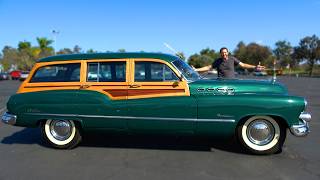

Buick was America's Lexus before Lexus existed
60sChallenges modern perceptions of Buick and highlights America's dominance in luxury cars, sparking nostalgia and debate.
▶ Play Clip"Delivers exactly what the title promises: a thorough review of an ultra-luxury 75-year-old wagon, with a few minor detours into general nostalgia."
This video is a detailed review of a 1950 Buick Roadmaster Estate wagon, a top-of-the-line luxury station wagon from an era when Buick was a prestigious American brand. The reviewer, Doug DeMuro, explores the car's unique quirks and features, including its real wood paneling, portholes, and Dynaflow automatic transmission, before taking it for a drive and giving it a Doug score.
The video reviews a 1950 Buick Roadmaster Estate wagon, a top-level ultra-luxury station wagon from 75 years ago, currently being auctioned on Cars and Bids from the Petersen Museum.
In the 1950s, Buick was a top-tier luxury brand, with the Roadmaster being its flagship model. It was positioned below Cadillac, comparable to a Lexus LS of its day.
The Roadmaster was offered in four body styles: sedan, coupe, convertible, and this estate wagon. The wagon was the least popular, with only a few hundred sold annually compared to tens of thousands of other Roadmasters.
The car features actual wood construction, not just decorative panels. This was the last mass-produced 'woody' car by an American automaker, as wood was expensive, heavy, and prone to warping, leading Buick to stop in 1953.
This was the first Buick to feature portholes, called 'VentiPorts'. The number indicated the model level: three for standard models (six-cylinder) and four for the Roadmaster (V8).
The Roadmaster is powered by the famed 5.3-liter Fireball V8, producing 150 horsepower. The engine compartment is side-hinged, and the 'Fireball' graphics are painted on the engine.
The car features a two-speed Dynaflow automatic transmission, which Buick was extremely proud of. It is advertised on the rear fender, brake light, and even the steering wheel.
The car's exterior is a showcase of 1950s American design, with extensive chrome trim, integrated reverse lights, and a Buick logo that covers the keyhole. The design was expressive and aspirational.
The interior features a massive flat bench seat with no headrests or seat belts. The door has three levers: one for the door, one for the window, and one for the front quarter window, which requires a latch release.
The dashboard is color-matched to the car. The center control stack is a chrome affair resembling a car's front grille, with controls arranged for aesthetics. The radio presets are labeled with the letters of 'BUICK'.
The speedometer is large with an art deco font. The turn signal indicator is a stylized arrow. The gear selector pattern is P N D L R, different from the later standard P R N D L.
The car features a Swiss Jaeger clock on the passenger side, with a tag suggesting where to get it serviced, separate from the Buick dealership.
The back seat is a flat bench with no seat belts or headrests, but includes an ashtray and a grab handle. The cargo area has a two-part tailgate that can be sat on for picnics, and offers a surprisingly sizable space.
The car is heavy and effortful to drive, with no power steering and poor brakes. However, it is surprisingly quiet and smooth, and handles hills without issue. It feels like a special, cool experience, though not practical for daily use.
The car receives a Doug Score of 100, which is surprisingly high due to a high weekend score, reflecting its fun factor as a cool car to take out occasionally, despite its impracticality.
The 1950 Buick Roadmaster Estate wagon is a beautiful and historically significant car, representing the pinnacle of American luxury station wagons from an era of expressive design. While it is not practical by modern standards, it offers a unique and enjoyable driving experience that makes it a wonderful nostalgia piece.
Buick's Historical Prestige
Highlights how Buick was once a top-tier luxury brand, a stark contrast to its current image.
01:17End of the Woody Era
This car marks the end of real wood construction in American cars, a significant historical milestone.
03:20Portholes as Status Symbols
The portholes were a clever marketing tool to visually differentiate luxury levels.
06:12BUICK Radio Presets
A charming example of era-specific design thinking that prioritized brand identity over convention.
14:31Driving Effort vs. Modern Refinement
The driving experience highlights how much automotive technology has advanced in terms of comfort and ease.
19:09[00:05] wagon and it's a toplevel ultra luxury station wagon from 75 years ago. You know all about the Volvo wagons and the Mercedes wagons of today. Well, this is
[00:17] what those people would have driven back in the day. And today I'm going to in the day. And today I'm going to review this Roadmaster Estate wagon and review this Roadmaster Estate wagon and show you all of its quirks and features.
[00:35] Roadmaster Estate wagon is currently for sale and it's being auctioned live on Cars and Bids. This Buick comes to us from the famous Peterson Museum in Los Angeles and it's a nice one with a Doflow automatic transmission and
[00:51] beautiful wood paneling and a nice restoration and it can be yours on Cars and Bids. So once you finish watching this video, click the link in the description below to visit the live auction for this Roadmaster Estate wagon
[01:05] where you can bid on it and buy it only on Cars and Bids. All right, time for the quirks and features of the Buick Roadmaster estate wagon. 75 years old,
[01:17] this car. Let's get into it. Starting with the basics, the Roadmaster was the top-of-the-line Buick back in an era when Buick was truly a wellrespected
[01:29] luxury brand. It's almost hard to imagine now. Buick makes good cars, but back in the day, they were really a very desirable, aspirational, top-end luxury brand. Before MercedesBenz, before BMW and Audi and Lexus and Acura all showed
[01:44] up and kind of ran the luxury table, Buick really was among the very best. In fact, America made the most desirable, aspirational, extravagant luxury cars in
[01:56] the world in this era, and Buick was among the best brands. And Roadmaster was the very best Buick. There were several different models in the Buick lineup in 1950, but the Roadmaster sat at the top, the top-of-the-line model,
[02:10] the cream of the Buick crop at the time. Now, Buick as a luxury brand was not the very, very highest end. In America, that honor still would have gone to Cadillac,
[02:22] especially under the General Motors umbrella. Cadillac was the very highest end, and a top level luxury Cadillac would have been sort of the Mercedes S-Class of its day. The Roadmaster then you could maybe think of as the Lexus LS
[02:35] of its day. sort of a nice full-size, very premium offering, but not quite at the level of the very highest end S-Class. Now, the Roadmaster in this era was offered in four different body styles. There was a sedan, a regular
[02:50] four-door sedan, there was a twodoor coupe, there was a twodoor convertible, and then there was this, the estate wagon, a fullsize luxury station wagon. Certainly an unusual idea by today's standards. Imagine a Lexus LS wagon. And
[03:06] it was actually pretty unusual then, too. This was by far the least popular body style on the Roadmaster lineup. And in fact, they only managed to sell a few hundred of these every year compared to tens of thousands of Roadmasters as a
[03:20] whole. Now, the most noticeable trait on the outside of this Roadmaster wagon is, of course, the wood paneling. In fact, it's wood construction. Not just panels placed on top of metal or sheet metal, but in fact actual wood built into the
[03:36] structure of this car. And this particular era of Roadmaster is especially interesting in the woody car world because it came at the very end. Woody cars had become popular in the 30s and the 40s, but by the early 50s, their
[03:52] popularity was really starting to wayne for a lot of reasons. Number one, it was expensive. Number two, it was heavy. Number three, as the cars got cold or wet, the wood would actually warp. Doors would become difficult to open. Panels
[04:05] sometimes would have to be replaced. It was kind of ridiculous actually using real wood in this manner in the construction of a car. And so this, the Roadmaster Estate wagon, was actually the very last kind of mass- prodduced
[04:20] woody car ever made by an American automaker when Buick pulled the plug in 1953. But after that, wood was only used as a decorative adornment on top of steel or sheet metal or automakers just use vinyl that sort of simulated wood
[04:36] but wasn't actually wood. In terms of cars using wood as an element in their structure and construction, this was the end of the line for the Woody, which is end of the line for the Woody, which is a shame because it's absolutely
[04:50] beautiful. The wood in this car is incredibly gorgeous. And when you have the dualpart tailgate open, you can really see just how cool it is, especially the dark wood on the inside of the lower tailgate kind of
[05:04] contrasting with the beautiful chrome trim and chrome handles all around. It trim and chrome handles all around. It really truly looks fantastic. And in kind of a quaint thing from the past, but back in the day, this was a normal
[05:19] aspect of some transportation. And then it was a real selling point cuz it looked so cool. My dad's car has just regular sheet metal, but his dad's car is wood. That's what the kids at school would
[05:32] say. I will say getting these panels open though does illustrate another issue with wood, which is that it's incredibly heavy. These panels are very difficult actually to open and close. This one with a giant piece of old
[05:46] school glass and wood in it is especially hard. Needless to say, we're a long way from the days of a pushb button power tailgate with these cars, but again, so beautiful. And even on the outside, you can see the sort of light
[05:59] wood with the dark wood kind of inlaid and sort of a lower elevation in the center. It is a really attractive design element. You can see why it would have been popular, especially on the top-of-the-line Buick. But beyond the
[06:12] wood paneling, this car also featured another tremendously important design element in American automotive history, and that would be the port holes on the side. These were the very first Buicks ever to have port holes. At the time,
[06:29] Buick called them venty ports, and they weren't really functional except to help delineate the level of Buick that you were looking at. So, the sort of
[06:41] traditional mainstream Buick models had three port holes or three venty ports on each side, but if you stepped up to the Roadmaster, the top of the line, you had four port holes. And back in the day in the 50s and 60s, it was well known that
[06:58] are you looking at a three-hole Buick or a four-hole Buick? And the four-hole Buicks are the ones that are really expensive, the true luxury cars that people with three-hole Buicks and other cars aspired to own. These port holes
[07:12] cars aspired to own. These port holes really help to give it that aspirational feel. Now, generally speaking, with Buicks from this era, the number of holes also corresponded to the engine size. So, the three-hole Buicks were
[07:25] sort of the mid-level cars. They also had six cylinder engines. three holes on each side made six. The larger Buicks with the V8s, well, they had four holes on each side for eight, and so it corresponded to engine size, too. And
[07:40] indeed, that is the case here. Like all Roadmaster models from this year, this Roadmaster models from this year, this one has the famed Fireball V8. That's what they called it, the Fireball. and fireball. It was a 5.3 L V8 that
[07:58] made 150 horsepower. What a muscle car. Clearly, it was a different time. Now, getting into the engine compartment, a couple cool things. For one, yes, it is sidehinged.
[08:10] So, you open it up and it's hinged on the side and that's how you access the engine, which is pretty cool. And once you open it up, you can see the fireball graphics actually printed on the side of the engine. of course, facing the
[08:23] direction where you'd be opening the engine from. So, you can see that it is indeed the Fireball V8 painted right on there and almost sort of like carnival lettering. It just looks so cool how proud they were of the big old Fireball
[08:36] V8 and their feet of engineering pulling 150 horsepower out of 5.3 L. And by the way, if you missed the four holes on each side, the fact that this is a Roadmaster, if you still weren't sure exactly which engine was in this, well,
[08:52] the front grill actually spells it out. Buick on one side and 8 on the other, of course, representing the cylinder count. Now, Buick may have been tremendously thing with this car they were proud of was clearly the transmission, which they
[09:09] was clearly the transmission, which they called the Doflow automatic. It was a twospeed automatic. Not exactly high-tech stuff by today's standards, but it must have been pretty cool back then because they really announced it
[09:21] everywhere. You can see on the rear fender, there's a badge script Doflow is written out. On the front fender, that's saved for Roadmaster, the model name. And I guess they thought the transmission name was just as important
[09:35] to announce in the back. And speaking of the back, the brake light actually has the words Dina Flow spelled out painted on top of it so that every time you stopped, it would sort of illuminate the DAFFlow wording and everybody knew
[09:50] exactly what transmission you had. In fact, this was such a big deal that they printed it at the center of the steering wheel. You can see Roadmaster in one spot and Doflow in the other sharing equal weight with the model name of the
[10:03] equal weight with the model name of the car. So proud they were of their automatic transmission. But before we climb inside, I do want to talk about how cool this car looks on the outside and how special automotive design was in
[10:18] this era. Beyond just the woody stuff, look at the rear end of this car. The look at the rear end of this car. The chrome trim everywhere, the badging, the pride in design and style in this car, the reverse lights integrated into the
[10:31] rear bumper almost like rocket boosters. pretty cool. The way that the Buick logo is printed in the center that's actually covering up the keyhole. You could twist it and access that is a pretty cool idea. And it's the same story up front.
[10:45] idea. And it's the same story up front. Just absolutely amazing expressive design language up here. Again, this was when the Americans were on top building cars that everybody else looked at in awe. These big chrome grills and this
[10:59] big hood ornament, the fenders that were expressive and showy. Again, we look at cars from this era as quaint, but at the time, it was so cool. It was it was what you wanted to strive for in your job, having a special car like this one that
[11:14] looked this way. And it was a special thing that came out of the 50s and into the 60s before cars started to get a little more bland, lose some of the special details that they had in this era as cars became more sort of general
[11:28] commuter things that people started to take for granted. Not back then. back then you had one of these, you took it for a Sunday drive with your family. It was a point of pride and all these adornments, they were part of it. But
[11:40] anyway, next we move inside the Roadmaster Estate wagon. And the first thing you notice when you get in here is this front seat. Absolutely massive flat wide front bench seat with no headrests and no seat belts. It was a different
[11:57] time. and they didn't understand the benefit of headrest for whiplash protection, seat belts for everything protection is just not how it went back then. Now, you did get three levers on the door. Three, not just one to roll
[12:12] interestingly, is for opening the door. It looks like a window crank, but it's not. You twist it, the door opens, comes open fine. Another one is the window crank. You twist it and the window rolls down. That's pretty standard. The third
[12:25] one, interestingly, is a window crank for the small front quarter window to get that open or closed. But before you could use it, you had to release it using this little latch mounted at the very bottom. You'd release it and then
[12:39] you could open up the window. Again, a lot of like high-end cool chrome detail stuff in this car. And that is a pretty cool detail. And when you opened that kind of flowing right in your face. So even on a very hot day, you were still
[12:53] getting air flow from that window as you were driving along. Now next we move on to the general interior, the dashboard, the layout of this car, and it is so cool. Even though this is an old car, it is designed in a beautiful, fantastic
[13:08] way. Starting with this giant steering wheel where you can see the outer edge is color matched to the car. In fact, everything in here is color matched to the car. You can see the door panels are also color matched. Same deal with the
[13:21] dashboard. You can see all painted to color match the car and the upholstery You probably wouldn't do this in today's world, but it looked so cool back then. This giant steering wheel and this beautifully crafted Buick Insignia right
[13:37] stuff in this interior actually, but to me, unquestionably the coolest is the center control stack, which you can see is this chrome affair that really looks
[13:49] like a front grill on a car. And there's a lot of design and style work that went into this. And I say that because there are controls mounted on either side of this center chrome grill, and they're not really corresponding controls, but
[14:03] they're put in this place cuz it looks cool. So, you have the defroster in the lighter. On the other side, you have the heater next to the headlights. Doesn't really make sense to put them all there, but when the dials are arranged as they
[14:16] are, they just look so cool together on this giant chrome piece. And at the very radio, volume, and tuning, which is cool. And you also have my very favorite detail in the entire car. The stereo
[14:31] presets are not numbered. Instead, each one has a different letter of Buick. You can see B U I C K. And so you have your five presets. And instead of boring old, let's change it to number four, you press the C in Buick. That was cool
[14:47] design. That was a cool quirk/feature from 75 years ago. And the cool stuff instrumentation. On the right side, you have the fuel gauge here and the oil
[14:59] level, which is pretty neat. Over on the left side, you have the battery amp meter and the engine temperature. Also pretty cool. Although to me, the very coolest thing in either of these gauges is the turn signal display, which is
[15:12] actually this stylized arrow. One part of the arrow is on one half of the gauge and then it goes to the point of the turn signal blinking on the other side, which is so much cooler than boring modern turn signal indicators today. But
[15:27] undoubtedly the coolest of all was the speedometer, which you can see this big with the numbers printed in this old cool art deco font. Everything just looked awesome in this car. Couple of
[15:41] interesting quirks. You can see mounted on the steering column, you have the gear selector, which is actually pretty common. Automakers still do that today. The strange part here is that the gear pattern PN DLR is very different from
[15:54] pattern PN DLR is very different from what we're used to. P R NDL is what we know that became a government standard later. But in this car, it was before the regulation came and so the gears were instead arranged in this way. Also
[16:08] in an odd place is this lever. That's actually your turn signal lever. You signals. And obviously it's on the opposite side from where we'd expect to see it today. One other interesting item in this interior dashboard is the clock
[16:23] over on the passenger side. This is a Jagger clock, a Swiss clock, because a fine high-end luxury automobile like this would of course have a Swiss clock in it. It only works. It only makes sense together. And I love the fact that
[16:37] there's actually a label, a tag from Joerger hanging off of the clock describing who created the clock and even suggesting where you can get the clock serviced, which apparently is separate from the Buick dealership. You
[16:51] would take it into a Jagger retailer and they would fix it for you in case it broke. It was that level of fine craftsmanship. And finally, we move into the back seat of the Roadmaster Estate wagon, which actually isn't quite as
[17:05] roomy as I was expecting. For a vehicle this size and positioned at the top of the lineup and called the Roadmaster, I thought I would have a little more space the 50s. Kids who sat in back just had to deal with it. There was no special
[17:19] accommodations. Proven by the fact that once again, the back seat is just one big flat bench. No seat belts, no headrests. Again, it was a different time. Although it is worth pointing out that backseat passengers got a little
[17:31] grab handle so they could at least hold on in case the car was doing something crazy like crashing. They could hold and grab as best they could and hope that they would live. Now in the center you can see there is an ashtray and of
[17:45] seat belts. We didn't do headrests but we've got a cigarette lighter and ashtray for both front and rear because of course you did. In the back, you also once again had three handles on the door. Again, one handle is a crank to
[17:59] the actual door handle, and the third opens up a rear quarter window, which again, you unlatch this little micro latch at the bottom. And then you can use the window crank in order to open or close this vent window and aim it
[18:13] directly at your face. Again, for more air flow on a hot day, as the car is moving, it would blow into you and everything would be happy. And finally, the cargo area. I showed you a little bit before, but like you saw, the
[18:25] tailgate opens in two parts. There's an upper and a lower, and the lower part can be sat on, so you can have picnics in your tailgate coming out of your Buick Roadmaster Estate wagon, which was pretty cool. You also had a surprisingly
[18:38] sizable cargo area back here where you could throw a surprisingly decent amount of well, cargo. In fact, this ended up being a pretty practical car, especially on how many people you could put in the seats. And then you had a decent amount
[18:51] of space back there. And you could even have a picnic. But you're probably wondering what this car is like to drive. I know I am. So, let's get it out on the road and find out. All right. Driving the Roadmaster Estate Wagon.
[19:09] This should be interesting. I don't usually do old cars. It's not usually my usually do old cars. It's not usually my thing. Uh, this is damn cool.
[19:21] gone through all the quirks and features with you, but they are really cool. Like like just the way everything's done. Like this was an era of really cool, not
[19:33] only automotive design, but American automotive design. Like the Americans automotive design. Like the Americans were making really cool cars that looked were making really cool cars that looked really cool back in this period. And
[19:45] this is unquestionably one of them. I am surprised every time I get on an older car, but especially getting into this era, just how effortful this this is. Um, no power steering. It's heavy. You you understand why, and we wouldn't say
[19:58] in the day, you know, people were, oh, driving a car is a man's job, right? Because it's it's it's heavy and it's smelly and it's difficult and and this car kind of exemplifies that. Like it
[20:12] kind of shows that even though this was like one of the more luxurious cars of its day. I mean this was a really high quality high-end car that would have They only sold a few hundred of them for that reason in that model year. And yet
[20:26] all 50s cars all 40s50s in the early '60s cars are not the most practical things in the world to use. But man is it beautiful in here. And I'm reminded every time I get into a 50s car, design was just really something. Like they
[20:41] were with the chrome and the styling and they just made it cool. It's actually interesting cuz I think car design really took kind of a step back uh later in in in time in the in the kind of the 70s and into the early 80s. Interiors
[20:54] occasion. Cars became boring commuter thing that you, you know, take your family out for a Sunday drive and you're you're proud of your car. It was it was an extension of yourself. Brakes are not
[21:09] of the highest quality. I would say that's always the biggest difference when I get into an older car. I'm always reminded that boy, braking is is a is a modern quality braking is a is a modern invention. You really have to take a
[21:22] deep stab of the brake pedal to do anything and put in an enormous amount of effort in order to really get it uh get it braking. It actually is surprisingly quiet in here despite a loud and and by modern standards
[21:35] certainly unrefined powertrain. You have to assume. I mean 5.3 L V8 with 150 horsepower is not exactly a an efficiency an optimized uh uh power plant. Um but nonetheless, it's actually pretty quiet and pretty smooth. I could
[21:49] totally see how this would have been in its day kind of the a top luxury car with all this wonderful chrome and these over stuffed leather seats and everything just looks and feels so nice in here. It's a big car. It's a it's a
[22:03] very expressive car on the outside. It's very nice. It's got it there. There's a luxury component to it. It's just that by the modern standards of driving, it feels like an old effortful thing. But you can tell like this would have been
[22:17] in the in the 50s in its day. This would have been quite a special machine. Um, and it's a again it's a nice car. Like it drives relatively comfortably. It's surprisingly quiet. Everything in here looks cool. It's a nice place to spend
[22:31] time. It's just cars have gotten so much more refined and so much easier to operate that by modern standards this is like work. Even though back in the day it would have felt like one of the ultimate pleasures. It's even hard to to
[22:44] just keep it straight. I'm sure it's very undert tired by modern standards given the weight and of course steering feel very uh very loose at high speeds and at low speeds with no power assist. It's very tight. It's kind of fun. All
[22:58] right, we're climbing a big hill now. See how we do. A lot of throttle effort, but uh honestly, it's doing it smoothly and without any sort of problem. Car feels great. No big deal. handled it no problem. This car came off a
[23:14] restoration where obviously real effort was spent making it really nice and really usable and it is certainly that. I mean, it's still a 50s car, so it has thinking it's about to break down or have problems as I do sometimes when I
[23:28] drive older cars. Overall, this thing is cool. Like, this is just a a cool car and a cool experience. And it's not an experience I would want to daily drive. that's what people did with these things 60, 70 years ago. But it is like by
[23:42] modern standards like a cool experience to just sort of have and have some fun. morning or something once a week or once a month or whatever and just have fun with it. But it is cool. It certainly feels cool. It feels nice and
[23:56] surprisingly usable and kind of fun. And what a what an old school trip imagining this as the the forefront of the luxury station wagon in its era. uh having driven, you know, our my family and I own the Mercedes E-Class, like today's
[24:11] version of the luxury station wagon. Uh it's a very different experience, let me it's a very different experience, let me just tell you. And so that's the 1950 Buick Roadmaster Estate wagon. This thing is cool, old school, and awesome.
[24:26] And while it may not be quite as functional or practical as a modern-day MercedesBenz E-Class wagon, it is a wonderful nostalgia piece from a fantastic era of the American automobile. And it can be yours on Cars
[24:41] and Bids thanks to the Peterson Museum who's auctioning it with us. Anyway, now it's time to give this Roadmaster Estate wagon a Doug score.
[24:57] 100, which puts the Roadmaster Estate Wagon here. Not as bad as you might expect, almost entirely due to a surprisingly high weekend score. The much you want to drive the car on the weekend. And indeed, this would be fun.
[25:10] Not in the usual way of taking your sports car to the canyons or your SUV off-road, but rather just taking out a cool car for a cool Sunday drive and experiencing the enjoyment of a work of art from another era. As a car though,
[25:22] brakes and well, it's made of wood. It's not the most practical, but it's still not the most practical, but it's still very cool to spend time with.
⚡ Saved you 0h 25m reading this? Transcribe any YouTube video for free — no signup needed.