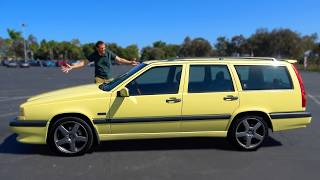

My Childhood Dream Car: 1995 Volvo 850 T5R
45sTaps into nostalgia and personal story, creating an emotional connection with viewers.
▶ Play Clip"Delivers exactly what the title promises—a detailed quirks and features review of a rare wagon."
This video is a detailed review of a 1995 Volvo 850 T5R wagon, a rare high-performance version of Volvo's first front-wheel-drive car. The reviewer, who owned a lesser 850 Turbo as his first car, shares his personal connection and explores the car's quirks, features, and driving experience. The car is currently for sale on Cars and Bids.
The 850 T5R is a rare, high-performance wagon that was the reviewer's childhood dream car. It's currently being auctioned on Cars and Bids.
The Volvo 850 was Volvo's first front-wheel-drive car, replacing the 240 and ushering in a modern era for the brand.
The T5R took the 2.3-liter turbo five-cylinder from the 850 Turbo and boosted power from 222 to 240 horsepower, with improved suspension, tires, and wheels.
The T5R featured cosmetic upgrades like flat five-spoke wheels, a front lip spoiler with integrated fog lights, and the famous cream yellow color.
Only about 7,000 T5Rs were produced worldwide, leading to the creation of the 850R and Volvo's R sub-brand.
Volvo raced the 850 wagon in the British Touring Car Championship, creating one of the most famous race cars and boosting the wagon's appeal.
The car features headlight wipers, vertical taillights that became a Volvo signature, and a subtle rear wing with special badging.
The interior is full of quirks, including three-position memory seats on both front seats, a unique info switch, and an unusual climate control fan speed slider.
The 850 was the first car to offer side airbags, which were standard on the T5R.
Alcantara is used extensively throughout the interior, including on seats, steering wheel, shift boot, and even the owner's manual pouch.
The car has been swapped to a five-speed manual transmission, which was never offered in the U.S. and significantly improves the driving experience.
The rear seat features a built-in child booster seat in the center armrest, a practical and cool feature.
The cargo area is spacious due to the boxy design, and the tailgate has an interior latch for rear-facing third-row seats.
The driving experience is smooth and strong, but the car's front-wheel-drive layout and mid-size wagon underpinnings limit its athleticism.
The reviewer gives the car a Doug Score of 50 out of 100, noting it holds its own against similar performance wagons.
The 1995 Volvo 850 T5R wagon is a rare and quirky performance wagon that delivers a unique blend of practicality, style, and driving fun, despite its front-wheel-drive limitations.
Volvo's First Front-Wheel-Drive Car
This marks a major shift in Volvo's history, moving away from the boxy 240 and into the modern era.
01:40Pioneer of Side Airbags
The 850 was the first car to offer side airbags, a safety feature that became an industry standard.
09:30Racing the Wagon
Volvo's decision to race a wagon in the BTCC created one of the most famous race cars and boosted the wagon's cool factor.
06:29Manual Swap
Swapping in a manual transmission from other markets is a popular modification that significantly improves the driving experience.
11:42Front-Wheel-Drive Limitations
Despite performance upgrades, the T5R's front-wheel-drive layout and mid-size wagon underpinnings limit its athleticism.
22:29[00:00] This is a 1995 Volvo 850 T5R wagon, and it was my childhood dream car. My first car was an 850 Turbo, the less cool, less fast, less performance-y version of this.
[00:19] And I always dreamed of this car, the rare, yellow, high-performance wagon version. This car is cool. I've never driven one, and so today I'm going to review this car,
[00:32] I'm going to live out my high school dreams, and I'm going to show you all of its quirks and features. Before I get started, big news! This 850 T5R wagon is currently for sale,
[00:49] and it's being auctioned live on Cars and Bids. This is a special one. It's got a manual swap. All of these were automatics for the U.S. market. This one swapped to a manual. It's also got extensive recent servicing and repair and
[01:05] maintenance work to make it as nice as possible. You truly don't see them like this, but you can buy this one on Cars and Bids. So, once you finish watching this video, click the link in the description below to visit the live auction for this 850 T5R, where you can bid on it and buy it
[01:23] only on Cars and Bids. All right, time for the quirks and features of the 850 T5R, starting with a little overview of what this is and why it's cool. So, the Volvo 850 came out in 1993, and it
[01:40] was a big deal for Volvo because it was Volvo's first ever front-wheel drive car. And it kind of ushered Volvo into the modern era. The 850 replaced the 240, which was Volvo's long-running,
[01:54] kind of mid-sized entry-level car for years, almost two decades that was on sale. The 850 following it up was a big deal. After all that time and going front-wheel drive with a more modern, kind of compact, high-tech at the time car, that was a major, major change in Volvo's
[02:12] world. Now, here in the States, the 850 was mainly sold in three versions. Initially, there was just the base engine, which was a 2.4 liter naturally aspirated five-cylinder with about 170 horsepower. Soon after, it was joined by the sporty 850 turbo, which was a 2.3
[02:30] liter turbo five-cylinder with 222 horsepower. But soon after that, you had this, the 850 T5R,
[02:42] the high-performance version, which took the powertrain from the turbo, the 2.3 liter turbo five-cylinder, and boosted horsepower from 222 horses to 240. Now, that was not a massive upgrade
[02:56] in power, obviously, but it was a much cooler car. And I can tell you this firsthand because as a high school student, my first car was an 850 Turbo, the lesser version of this car. And I always
[03:11] longingly dreamed of an 850 T5R, or an 850R as it was called later, with that 18 horsepower bump and also other improvements, which were pretty notable, including some 40-year suspensions,
[03:26] for a little bit better handling, and improved tires, larger wheels, and better, stickier tires, again, for better handling performance. The car was also relatively quick. Even at 240 horses, it doesn't sound like a lot.
[03:40] 0-60 was in sort of a low-to-mid six-second range, so relatively quick car, special for the time. And more importantly, for someone with another 850, looking at this, it was so exciting, because it was the T5R.
[03:54] It was like Volvo's first foray into a high-performance sub-brand like Mercedes-AMG or BMW M. It was a really, really big deal. And this car, the 850 T5R, could be had as a sedan or as a wagon just like this.
[04:12] But beyond the mechanical changes that actually made this a more desirable car than other 850 models, there were also some cosmetic improvements that were pretty cool. Probably my favorite is not the color for a couple of seconds, but actually the wheels.
[04:27] These flat five-spoke wheels are bigger than what you had in other 850s, and they just looked cool. This gray finish was a really nice look, and it really did give this car kind of a performance-y feel.
[04:39] Same deal with the front lip spoiler. You can see it's relatively low-hanging, lower than other 850 models, and it included integrated fog lights, which other 850s didn't have. you only got it in the T5R.
[04:52] And then there was indeed the color, cream yellow, they called it, and it's the color that everybody knows this car for, the cream yellow 95850 T5R,
[05:04] although it wasn't the only color offered. There was also black. You could choose between the two, and green was offered in some markets, a very dark green, and supposedly a small handful of green cars
[05:16] were even sold here in North America, although the predominant colors These are either black or yellow. Yellow, again, kind of the famous hero color for this car. Now, in the end, in 95, Volvo produced about 7,000 of these for the entire world.
[05:31] Sedans and wagons, 7,000 total, which was a bigger success than they expected. And as a result, for the following model year, 96, they decided to remove the T5 from the R and just call it the 850R.
[05:44] And this created Volvo's R sub-brand that launched some cool performance cars. including the F60R and the V70R that are beloved even today. And, to this day, the R line lives on in Volvo's products with the R-designed trim levels
[06:00] that are sort of sportier-looking versions of their cars, even though there is no current Volvo R model. Now, it was particularly cool to have this high-performance wagon in this color. It was kind of special in me, but one thing that made this car particularly enticing
[06:16] was that they took it racing And I don mean they went racing with an H50 sedan touring car racing like most European automakers did at the time They actually went racing with the wagon
[06:29] In the British Touring Car Championships, BTCC, which was a famous race series for sort of similar to street cars, you can kind of recognize them on the road as opposed to Formula One with its purpose-built race cars,
[06:42] Volvo went racing with a wagon instead of their sedan and created, in doing so, one of the most famous race cars of all time. And they also really got people to love the wagon. It was such a Volvo thing, and so to go racing with a wagon just seemed like it made sense,
[06:59] and it made the wagon especially cool. And when you see this car to this day, the T5R is cool, the extra power, etc., but people always remember the race car station wagon that was associated with it.
[07:12] But anyway, some other interesting exterior quirks worth pointing out in this car. One of them is up front, actually. You have headlight wipers, which was somewhat common in this era, the late 80s and through the 90s, on cars from northern European countries, such as this, where you get a lot of weather,
[07:28] and you might want some wipers on your headlights, not just your windshield. And it's kind of cool to see that sort of throwback relic included on this car. In back, speaking of lighting, you have these giant vertical taillights that go up the side of the car.
[07:42] Volvo is kind of famous these days for these vertical taillights, and they're still included on a lot of different Volvo models, and particularly the SUVs. And this is the car where the Volvo vertical taillights started.
[07:55] On previous models, like the 240 and the 740, you had just sort of normal-looking taillights, but here, they went vertical, and it became kind of a Volvo signature. Also back here, interesting, you have the rear wing, which is pretty cool.
[08:07] Of course, it was only on the T5R model. Gave it that kind of sporty, exciting feel that the car deserved. And you have the special badging. You can see T5R at the bottom, kind of subtle,
[08:19] but you also have this little sort of hot checkered flag with one checkered red. It was very subtle. The color, of course, was not. The car really did stand out, but the badging was subtle.
[08:31] you really had to know that you were looking at something special. They didn't just slap T5R badges all over like some automakers might do today. And then there was the interior.
[08:43] Like I said, one of these cars was my first car, or a very similar one. I still remember every inch of this interior. When I got inside, my hand instantly knew where to go for the headlights, the sunroof, all the stuff, the windows in the center.
[08:58] I remembered it all. I loved that first car, and this interior is still so fresh in my mind, so many memories, and there are a lot of interesting quirks. Like, for example, I never really understood why both front seats had three-position memory.
[09:15] You can see three-position memory on the driver's side. It makes sense. Over the passenger side, you also had a three-position memory setting. I assume they did that so they didn't have to put in different seats for left-hand drive, right-hand drive. Basically, every 850 got those two front seats, but it was always strange.
[09:30] However, I made fun of this car. In the vicinity of that seat memory, you can see the side airbag, and that's a really big deal because the very first car ever to offer side airbags was the Volvo 850.
[09:44] It was optional on most versions, but it was standard on this car. The T5R came with side airbags, and it started what has become kind of an industry standard for all cars to have side airbags, curtain airbags, all sorts of stuff.
[09:57] That basically started right here. Now, in the vicinity of those side airbags is another 850 T5R Special Touch, and that would be the silver door sill plate. You can see it says 850.
[10:09] It doesn't say T5R, but only the T5R got those in silver. More importantly, though, to the car, when you get inside, you can see the seats have these Alcantara edges, leather in the center, Alcantara on the outside,
[10:22] and that was another distinctive touch for the 850 T5R. It was actually a pretty big deal because in this era, Alcantara was not being used widely by a lot of automakers. So putting it in a car in 1995 in the sporty model to signify the performance,
[10:37] that was a pretty cool thing to do. Now, the T5R would have also had Alcantara on the steering wheel. This steering wheel has been swapped out for a wheel from a newer Volvo. I can tell instantly.
[10:50] The original wheel is included with the sale, but of course, over the years, the Alcantara has kind of degraded, and that's why the wheel's been swapped out. Hard to find a nice Volvo P5R or R steering wheel with nice Alcantara.
[11:02] Now, this car also has Alcantara in the center console lid, as you can see, and you have Alcantara on the shift boot. I'm not sure if that would have been included originally in this car, but it's pretty cool and nice to see.
[11:14] In fact, there's even an Alcantara owner's manual pouch, which is a pretty cool detail sort of stitched Alcantara with yellow accents matching the color of this car. It is such a neat thing to see, and that's pretty cool to have,
[11:28] sort of another Alcantara detail that helps distinguish the T5R from a standard Volvo 850 model. But before I get too far into this, let's move back to the shift boot. Like I said, this car has a manual transmission swap.
[11:42] One of Volvo's, let's say, mistakes in this era was that none of the turbocharged 850 models sold in America were ever offered with a manual transmission. The T5R, the R, and even the regular turbo were all automatic.
[11:58] Now, interestingly, you could get a manual turbo in Canada, but not in the States. Since the transmission was available globally, though, a lot of people swap them in these days since it really kind of wakes the car up compared to the four-speed auto that this car would have come standard with.
[12:12] And so this one has a five-speed manual transmission, looks completely right at home in this kind of console, because, like I said, some of these were sold as manuals in other markets. But anyway, let's move on to other interesting interior quirks, starting with the center control stack.
[12:29] You can see it makes liberal use of the Volvo font. Volvo had and still has a very distinctive font and they used it basically everywhere in this car all throughout the center control stack there a lot of buttons so you see a lot of Volvo font The strange thing is that on the radio head unit they only used lowercase
[12:49] There's no uppercase. Even for AM and FM and all this stuff, there's basically no uppercase anywhere on this stereo. I have no idea why they made the decision to do that. Sort of like an emo girl writing on TikTok, like, lowercase only.
[13:03] but that is indeed what they decided to do in their Volvo distinctive font. So interesting controls in here. For one, the power mirror controls. You can see they're in the center along with the window switches. There are two controls, one for each mirror.
[13:17] Rather than just a switch to move left, right, they actually gave you two individual power mirror controls. Kind of odd. Also a little bit unusual is the sunroof control is located right here, sort of to the right of the steering wheel
[13:30] and kind of an odd place with a few other switches. rather than anywhere near the actual sunroof itself. You push this, the sunroof would open, rather than a dial or button on the roof like most cars. Also in this vicinity, and kind of strange, is the info switch.
[13:44] This is a little dial, and as you twisted it, it would change what it displayed in this small screen in the gauge cluster. And the info switch could be turned to six different positions, and each different position of the switch corresponded to a different display.
[14:00] It was actually kind of a smart idea. So, when it's all the way to the bottom right, it's showing you what's on the screen in the bottom right, and then you would twist the switch and see various different other info, depending on exactly what you wanted to see.
[14:12] As sort of your precursor to your modern gauge cluster screen or infotainment screen, that little info switch linked to that tiny screen in the bottom. Also unusual, and always quirky and confusing in this car, was the climate control operation.
[14:27] Specifically, the fan speed slider. You can see it has basically two positions here, auto and then an actual fan speed. You can slide up or down, except that's not actually true.
[14:39] There's a third position here, which is in the middle. It looks like it's auto, but O is actually a zero. So if you wanted to turn it off completely, you would put it to the zero or the O in auto, and then it was off, and then auto was to the left, and the fan speed slider was to the right,
[14:55] and that confused so many people while I owned my car. How do you turn it off? It doesn't make any sense. It's on auto. People always said that, and it never really made sense. Now, not all of the controls were peculiar and weird in this car.
[15:08] I always loved the door handles, which you can see, you don't really pull them towards the interior of the car like in most vehicles. Instead, they go down sort of towards the rear of the car, which is odd, but actually very easy to use.
[15:21] At one point, I heard that they did this because it's the easiest way to open the door. So if you're hurt in an accident trying to get out, that's the least resistance. I don't know if that's actually true, but it is certainly a quirky door handle, and I always kind of liked it.
[15:35] I also always loved this little plastic strap at the base of the windshield, which was only there for displaying stuff. So if you parked somewhere and got a little ticket with your time on it, instead of just putting it on your dashboard,
[15:49] you could literally, like, strap it to the window with this little plastic thing, and then it would display pushed up against the window, easy to read for anybody who needs to come by and see your parking ticket or a parking pass that you might have to display.
[16:03] That's a pretty cool idea. A lot of Volvo's have had it over the years, and it was always neat to see. And then we move on to the back seat, where there's a couple of other interesting quirks, including more Alcantara.
[16:15] And actually, it's quite a bit more Alcantara back here. You don't just have it around sort of the leather seat centers, but the entire center seat is primarily Alcantara. The entire seat bottom and a lot of the backrest part,
[16:28] except for the middle armrest that folds down, is all Alcantara, which kind of added to the luxury car appeal. Same deal on the back of the front headrest. Interestingly, they were Alcantara, so rear passengers could see them and see the quality,
[16:42] but in the front of the headrest, it was leather. I don't know why that decision was made, probably because of Alcantara wearing so quickly, but you do have it on the back, which was another nice touch.
[16:54] As were the floor mats. You can see this car has dedicated 850 floor mats, and 850 is yellow to match the cream yellow exterior of this car. That's actually true up front also, but those are still covered in protective film.
[17:07] The rear ones are easier to see, and it's a nice, cool touch. And another nice, cool touch in this car is dropping this center armrest. It's not just an armrest. You can open it up, and it becomes a child's booster seat, which is a great thing to have integrated in a car, a built-in booster seat.
[17:25] Of course, it won't work for every age or size child, but if you have the corresponding size child, it's nice to have that in here built in, so you don't have to lug a booster seat around with you everywhere like in most other situations.
[17:38] Kind of a cool idea. And then there was the cargo area. Open up the tailgate with a handle back here. and you can see the cargo area, which is not particularly exciting or interesting or unusual in any way,
[17:51] except that due to this car's rather boxy design, the cargo area was pretty impressive in terms of storage capacity, because it was wide and it was tall, and the car doesn't taper off or have any sort of teardrop look.
[18:05] It was all just one big boxy open space, which made it a pretty practical vehicle. And speaking of practicality, on the inside of the tailgate, you can see there's a latch to get out, which doesn't make a lot of sense for a cargo area, but some of these 850 wagons were sold with rear-facing third-row seats mounted in the cargo area.
[18:26] And so, if you wanted to climb out from the third row, that latch was like an inside door latch for any other door. You would open it up, and that's how you got out of the back if you were sitting in the cargo area, which is pretty cool.
[18:38] So, those are your quirks and features of this car. Definitely a trip down memory lane for Doug, but I'm especially excited to get behind the wheel and finally drive an R from the 850 line.
[18:52] Let's see what it's like. All right, driving the 850 T5R. I cannot tell you as a kid how obsessed I was with the Volvo 850 I know all the stuff The VIN YB1L S5 355 5758 This is YB1L
[19:10] W5X, and it's a wagon with a top powertrain. I loved these cars. It was my first car. It was everything to me. And I've always wondered two things. What is it like as an R or a T5R?
[19:24] And what is it like with a manual? I always assumed the R would be pretty similar to my car. There's only 18 horsepower. I think the suspension's a little better. The tires, bigger wheels. But, like, I always assumed it would be about the same.
[19:36] I'll cover that in a sec. The manual, you know, this car was never offered as a manual in the United States, nor was the regular turbo. The only way you could get a manual 850 in the States was the base model, which was a 2.4-liter naturally aspirated 5-cylinder with 168 horsepower.
[19:51] That's all up here. It'll never leave. So I'm curious, you know, how it is. It's not so bad. These cars were offered with manuals in other markets, so this isn't some hack job. I assume it was done based on a manual V5 auto.
[20:05] It's probably the actual transmission from one. Feels good. No vibration through the transmission. Nice to shift into gear. Feels nice. The shifter could use a little bit more weight, and the clutch is a little bit heavier than I would expect for a car
[20:18] that isn't like a real, you know, all-out performance car. But it's fine. And it's just nice to row your own gears in this car. That was always the biggest drawback of the A50 Turbo and R to me,
[20:30] is that they were all automatics, and it was a four-speed torque converter auto. It was not a good transition. It was stout, but it was not a good transition. So this is actually kind of nice. It adds a fun element to the whole situation.
[20:43] In terms of the driving experience, I always loved the power. I always loved the way these engines were, the way they built power. They had good mid-range, but it's still clearly true. I'll get on some faster roads in a sec. But it's also a nice, smooth engine.
[20:56] A good inline-5 or inline-6, always a nice, smooth engine. This feels like that. Despite the fact that it was a 90s turbo car, it never felt that laggy to me back then and even now. It never felt like it had some weird, you know, dead spot to overcome.
[21:11] Obviously, there's a little bit of that. It's sort of what it is. But it was reasonably powerful even sort of at a lower range of, you know. And actually, the powertrain was always a great thing about it. Here we go, here we go. Yeah.
[21:24] That's the juice I remember. This car is still faster than that. I think this car's got maybe more than 18 horsepower over my old one. This car is just such a nice example.
[21:36] But that power train is so good, and I remember the torque steer. That was an issue even with mine, which is kind of a reality of putting this much horsepower through front drive wheels in this era. They didn't have a great way to mitigate torque steer,
[21:48] like a lot of automakers do now, with all sorts of differential tricks and traction control plays and things like that. But before it, I don't know. Before you get good tire, this car is fun.
[22:03] Feels good. Feels smooth. Feels strong. Feels stout in a warning light. Like, this car feels 170,000 miles, but the amount of work that's gone into this car recently, this car is worked over. It is nice.
[22:15] It is in good shape. This is a good example. Like, a good example. The odometer wouldn't scare me that much just based on the sheer amount of work that's been done. Now, the drawback to this car, and any honest owner of this car will tell you,
[22:29] the drawback to this car is and always was, it's a front-wheel drive, mid-size sedan at its core, or mid-size wagon in this car's case. Like, under it all was a front-wheel drive, mid-size wagon.
[22:42] And the 850 was a tremendously popular car for Volvo, both globally and here in North America. Tremendously popular, and so as a result of that, it was not intended initially to be a performance car. In making this car, they did a good job. They added some sport.
[22:56] Like, it feels nicer, it feels faster, they did what they could, but like, ultimately, this is a mid-sized kind of near-luxury sedan, sort of like an Acura TL or something like that.
[23:08] Volvo did what they could with the chassis, but ultimately, the steering is over-assisted, You get understeer if you try to plod fast through a corner. That's just a reality of this car. So it's fast and it looks awesome and the interior is cool.
[23:22] The Alcantara, like there's a lot of great things about it. But as a all-out performance car, it held back. Like there were always going to be limitations and this car, I wouldn't say it suffers from them.
[23:35] You know, you know that going in and it's reflected in the market price. But that is kind of the situation. I think this is so special, and this is the most special one with the manual flop, with all this service work. Like, this car is nice, and it's a thrill to go back to this world
[23:50] as someone who spent a lot of time in a similar car. And so that's the 1995 Volvo 850 T5R Wagon.
[24:02] This was front-wheel drive and based on a fairly tame midsize car, So, it was never the athlete that, say, a BMW N5 was. But, it's still cool. Ultra-rare turbocharged power, some awesome cosmetic upgrades and other benefits,
[24:19] and little Doug wanted nothing more. And I'm thrilled I had the chance to review this car and spend the day with it. And you can buy it on Cars and Bids. Anyway, now it's time to give this 850 T5R wagon a Doug score.
[24:37] And the Doug score is here, 50 out of 100, which puts the 850 T5R here against some similar cars. It holds its own in this reasonably strong group, which makes sense.
[24:50] It's relatively quick and very practical and pretty cool. It's not quite as much of an athlete as some cars on this list, like the Audi RS2 or the Mitsubishi Evo 6, but the 850 T5R is a lot cheaper than those.
[25:03] And if you're into fast wagons, the cool factor is pretty close.
⚡ Saved you 0h 25m reading this? Transcribe any YouTube video for free — no signup needed.