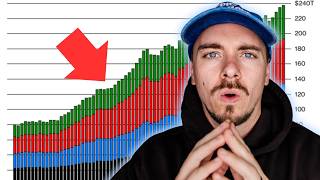

The Dollar Lost 87% of Its Value Since 1971
40sShocking examples of dollar devaluation make people question the safety of holding cash.
▶ Play Clip"Delivers on the macro thesis but oversells the '99%' claim—solid argument wrapped in FOMO-bait and self-promotion."
The video argues that the US dollar's purchasing power is being systematically debased through financial repression, forcing the government to run the economy hot to win the AI race against China. The speaker explains why this monetary environment, combined with accelerating institutional crypto adoption, makes him extremely bullish on crypto and why he holds the vast majority of his net worth in it.
The speaker defines financial repression as a policy with one goal: transferring wealth from savers to the government's balance sheet through currency debasement.
Using a chart of US dollar purchasing power, he shows the dollar has declined 87% since 1971, meaning it would have fallen 80% if treated as a stock or altcoin.
In 1913, a dollar bought 30 Hershey bars; today it costs $26.14. In 1944, a dollar bought 20 Cokes; today it costs $14.71.
The US, China, and every major country are racing for AI and robotics dominance. The winner takes everything, and the speaker claims this is the 'race to end all races.'
A new research paper called SEAL shows AI can continuously learn after deployment. Once AI can improve itself, progress becomes exponential, moving from AGI to superintelligence.
Google and Yale used AI to discover a new cancer mechanism. Gemini 3.0 created a full front-end website from scratch in one attempt, a job that cost $50,000–$100,000 a few years ago.
China produces 80% of the world's highest-density robots. Ford CEO Jim Farley warned that Western executives visiting China are 'coming back terrified.'
China added 295,000 industrial robots last year; the US added 34,000; the UK added 2,500. China also surpassed the US in electricity generation around 2009.
To win the AI race, the US must keep credit cheap and liquidity abundant, even at the cost of higher inflation. The speaker sees no other option.
Trump has called for 300 basis points of cuts, and market odds of a December cut jumped from 98% to 88%. Two cuts are priced for next year.
Bessent hinted at a national housing emergency, deregulating private markets, and even $1,000–$2,000 stimulus checks funded by tariffs.
Larry Fink admitted Bitcoin's role will be similar to gold; State Street says 60% of institutions plan crypto exposure; 401k plans can now access Bitcoin via executive order.
What is financial repression?
A government policy that transfers wealth from savers to the government's balance sheet through currency debasement.
00:02
How much purchasing power has the US dollar lost since 1971?
87%.
00:55
In 1913, $1 could buy 30 Hershey bars. What would that cost today?
$26.14.
01:22
What percentage of the world's high-density robots does China produce?
80%.
07:20
How many industrial robots did China add last year versus the US?
China added 295,000; the US added 34,000.
07:48
Who is the Ford CEO who said Western executives are 'terrified' after visiting China?
Jim Farley.
07:33
What did Trump call for in July regarding interest rates?
A 300 basis point cut (i.e., 3%).
11:36
What role does Larry Fink say Bitcoin will have in the future?
A role similar to gold.
15:34
The dollar's 87% decline since 1971
Quantifies the erosion of purchasing power and sets up the entire thesis.
00:55AI race is existential
Frames the AI competition as the primary driver of future monetary expansion.
02:43China's robot deployment dwarfs the US
Concrete numbers highlight the urgency of the arms race.
07:48Institutional adoption accelerates
Shows a structural shift in how mainstream finance views crypto.
15:47[00:02] crypto, and most people would call that insane. But what's truly insane is get out of debt. It's called financial repression, and it has one single goal: to transfer wealth from your savings to the government's balance sheet. In this
[00:16] video, I'll share exactly what the great debasement is, why it almost certainly means that all assets, including crypto, will be going much higher from here going into 2026, and exactly how I'm positioning myself to hopefully make a
[00:30] to throw a lot of stuff at you. I know I'm going to be going really in-depth, overwhelming to kind of go through all of this information. But if I'm right, then we could possibly be heading into the single greatest bull market of our
[00:43] lifetime. And if you're caught not holding assets during that bull run, then you're just going to watch your wealth get massively debased while those who do hold assets are set to make an absolute fortune. This is the US dollar
[00:55] purchasing power over time, and you can see that it's basically gone down only. This is the US dollar purchasing power since 1971, and you can see just since 1971, the dollar's lost 87% of its purchasing power. That means if it was a
[01:08] stock or an altcoin, it's gone down 80% in value since 1971. It is an absolutely horrible asset to hold. And this is a little bit of a different way to look at it. In 1913, a dollar would buy you 30 Hershey's chocolate bars. Today, that
[01:22] Hershey's chocolate bars. Today, that would cost you 2614. In 1944, a dollar would buy you 20 bottles of Coca-Cola. Today, that cost you 1471. And honestly, because it would actually cost you quite a bit more. Since January 2020, the US
[01:35] dollar has lost approximately 25% of its purchasing power due to cumulative picture. The dollar's value is consistently and constantly going down over time, and it's not slowing down at all. In fact, it's only accelerating the
[01:51] more time goes on. And the reason the dollar's value constantly goes down is because the government likes to spend a lot of money. And every time that they want to spend more money that they don't have, they debase the value of the
[02:04] dollar to essentially transfer wealth from those who are holding and saving US dollars to the balance sheet of the US government. It's kind of like a hidden time they press the button to print more money. And there's literally nothing you
[02:16] can do to stop them from doing that. And even worse, like most people just aren't going up, and they're like, "Oh, those greedy corporations raising prices." When when in reality, the government is constantly debasing the US dollar. It's
[02:29] value. It's that your dollar's just worth a lot less. Now, like I said, this isn't going to end anytime soon. In fact, I think this process is about to get kicked into overdrive because of where Trump and Bessen want to take us.
[02:43] Basically, the US, China, and every other country on the planet is in an arms race for the most powerful technology on the face of the planet that's ever existed and probably will ever exist, and that's AI and robotics.
[02:57] The person who wins this race wins everything. And if you don't understand this and you think I'm overexaggerating, I promise you I'm not overexaggerating. accelerating on an exponential curve. So, although right now we're maybe
[03:09] sitting on this line between AGI and and artificial narrow intelligence, because of how technology compounds over time, and because of the fact that as AI gets smarter, you're actually able to use AI to improve AI, which we're literally
[03:22] continues to progress, you get to a point where AGI is as good or better than the best AI developers on the planet. Meaning at that point, AI can continue to develop itself. Right now, there's maybe, let's say, 5,000 top-tier
[03:37] AI developers really pushing forward the space. But at the point that AI is spinning up more instances of that AI. So, you could have 1,000, 10,000, 1 million, 2 million, 10 million different models continually working to improve
[03:52] AI. Then every time you have an improved model, that model is now used to further improve it, and then further improve it, etc., etc. So, once you cross a certain threshold, things exponentially start growing at just a rate that's kind of
[04:04] hard to imagine. Which means we quickly go from AGI to artificial basically a model that's far superior and far smarter than any human on the planet, and then quickly from there to something that is frankly really hard
[04:17] for us to imagine in terms of intelligence. And we actually might not be far off from that scenario today. This is a post where it talks about a new research paper called SEAL, self-adapting language models, describes
[04:29] how AI can continuously learn after deployment, evolving its own internal just because I know most people are not caught up to date on where AI is today, somebody prompted it to create a new front end for itself. That's just a
[04:43] template like Squarespace or anything like that. It's coded from scratch. And they prompted it to create its own front end to kind of advertise 3.0. And in one shot, one try, it spit out this website, which is crazy because if you look at
[04:56] this website, this website maybe 5 years ago would have cost somewhere around 50,000 to 100,000 dollars to make. And today, Gemini 3.0 does it in one shot by itself. Here's another post. Google
[05:09] and Yale use a new Google model to discover a new cancer mechanism. AI made a new biological hypothesis, and it was right. And to show you how fast things are evolving, this is a video that AI made back in 2023 versus a video that AI
[05:22] made today. And this isn't even the best model, but you can see how much of a massive difference just 2 years of progress has made. My point is that whoever wins this race, whoever achieves artificial superintelligence first, wins
[05:36] everything because they're going to have a machine that is smarter than every other human on the planet. Like the the capabilities of that country will be unrivaled. And so, this really is the race to end all
[05:48] races. As scary as that sounds, like that's not me exaggerating. That that is exactly where we're headed. And it's not just AI, it's also robots. And these kind of go two hand hand in hand. Uh but AI enables robotics to to actually work
[06:00] on the scale that people have kind of imagined from all these movies and things. And we have, like this is a the the figure three that just got released. We have robots today that that are coming out that
[06:12] are are pretty insane. Like they can do dishes and put away things and fold laundry and all kinds of crazy stuff. And imagine, again, I showed you that curve, the compounding curve. As as AI gets more intelligent, as robotics
[06:25] there's more money being made, they start improving at an exponential rate. This opens the floodgates in terms of like what a country could do. Again, your country gets first to superintelligence, but you have millions
[06:39] of robots that are working in your factories, pushing down the cost of all houses, making building houses super cheap, building your roads. Like it just counterweight to inflation. So, it just like pushes down the cost of everything.
[06:54] through the roof. Like it just nothing like it before ever seen in history. So, you become like the ultimate economic force as a country. You are raking in all the money. And obviously, your warfare capabilities would be absolutely
[07:07] unrivaled in terms of things. And the thing is that right now, China is absolutely crushing the US in this race. This post says China makes 80% of the highest density of them in the world. And it has an article where it says
[07:20] Western executives who visit China are coming back terrified. Robotics have catapulted Beijing into a dominant position in many industries. I know it novel, but this is real, and this is here today. And a lot of people are
[07:33] article, but it's a quote from the CEO, Jim Farley of Ford, where he says, "If Ford." And this is part of like these executives are going over there and just realizing how far behind the US is
[07:48] then it goes on to say China added 295,000 industrial robots last year. The US added 34,000. The UK added 2,500. On top of this, right now we're in a compute and power race because compute demand is growing at an exponential rate
[08:03] demand is growing at an exponential rate right now. compute, and people are like racing to build out bigger and bigger data centers
[08:18] the other bottleneck behind this, that's probably even the bigger bottleneck, is electricity to run these data centers. And in terms of power, China is also just dominating the US right now. They crossed the mark around 2009 where China
[08:32] just went exponential with their power generation, and the US has basically stayed flat. So, on another scale, not only does China have all the robots, not capabilities, but they also have all the power to power these data centers,
[08:46] robots, etc. Which brings me kind of to my point around this in the markets. Right now, the US is in a race they cannot lose. This is existential to the US's survival, and really the survival of the West versus like China becoming
[08:59] the dominant force on the planet. And if the US wants to win this race, they have no choice but to run the economy hot. They have no choice but to build out massive amounts of data centers, a lot of new ways frankly to generate power in
[09:12] strong economic environment for these companies to take on a lot of debt can win this race without that. That's how any startup on the planet works, take on a ridiculous amount of investments in in tune of millions or
[09:26] hundreds of millions of dollars with the hope that these investments pay off and or, you know, Google or, you know, Facebook, whatever. Only in this instance, I don't think it's just going to be the private markets funding the
[09:39] internet. The internet wasn't existential to the US's survival where AI and robotics is. So, I don't see how the government doesn't have a choice but to run things hot, make credit extremely cheap, and get the liquidity just
[09:53] can keep building these data centers, keep expanding AI, ramp up robotics a ton of inflation and like somebody's going to pay that bill eventually and that's true. That's absolutely true. But my point is that the US has literally no
[10:08] my point is that the US has literally no choice but to do this. We are in an arms race and if we do not win this race like we're toast. Like there's just no other to win this race and this is why I believe we've seen Trump and Bassant
[10:21] pivot from austerity to wanting to run it hot. I think in part they realize there's just no way for us to get out of debt through austerity. So we have to people are starting to catch on that we're in this existential race with
[10:33] by running the economy hot. And the way that the government does that is they use the US dollar as a tool. So we talked about how the US dollar's value time. Uh well, they're going to accelerate
[10:45] that process because they're going to use and expend that capital to run the That means letting inflation run a little bit hot. That means pushing down rates so so more rate cuts so credit's cheap and that means abundant liquidity
[10:58] sloshing through the system which is insanely insanely bullish when it comes to risk assets, crypto, etc. And this is Paul Tudor Jones saying on CNBC right that we could be heading for a blow-off top. So basically he's saying we're
[11:12] is a chart comparing altcoins to the business cycle and it's saying that actually at the bottom. And this guy is saying we're at Q3 2019 or Q2 2016.
[11:24] really early in the cycle and that fits more with my thesis that you know we're extremely early in this cycle because typically every cycle ends tightening. But we're doing the opposite right now. We're coming out of
[11:36] tightening into easing. And this is Trump back in July calling for 300 basis points of cuts which would be basically dropping rates by 3% which is absolutely existential race with China and that we have to run the economy hot. And this is
[11:50] in October. Right now it's sitting at 98%. This is the odds Fed decision in December and it's now currently sitting at 88%. So the odds of that has have jumped up. So we have two more cuts priced in this year. Right now currently
[12:03] for next year. We have Trump aggressively stacking the Fed board to get even more cuts than that because again he wants 300 basis points of cuts. anchoring and he really wants less than that or or what. Uh but I I think the
[12:17] end goal is that he wants rates to be lower so there's cheap credit so the economy could be running at full steam and he doesn't mind if inflation runs a little bit hot. Because for one 2026 is midterms so like obviously he wants the
[12:29] economy to look good so he can win midterms but for two I I do think that the administration does get uh that on some level we are in this competitive race with China and that if we don't win it's game over for the US. And those who
[12:41] are are are doing a really good job calling signaling if Trump replaces Powell with them clearer and if I haven't made it clear enough at this point you have Trump
[12:56] debt. That is the playbook that they plan to run. And Trump and Bassant are trying all kinds of things to get this kind of train going. One of the things Bassant warns the US government could declare a national housing emergency
[13:09] this fall. I think in part this is a policy decision of like saying hey yeah they're going to midterms. I think at the second part is they realize there's trapped in housing that if they can unlock it via loans like taking out a
[13:23] really easy and cheap etc. and in various forms of deregulation that's more liquidity and money sloshing through the economy. And they he spelled has uh that one of their plans to get
[13:35] the economy going is deregulation of the private markets and deregulation of the they're doing some of the SLR changes that I've talked about where they're loosening restrictions allowing banks to hold less reserves which means again
[13:47] there's more ability to lend which that's a form of money creation. And as even considering thousand dollar two thousand stimulus checks for all taxpayers using tariff revenue. And the crazy thing is it's not just the US
[13:59] doing this. Right now China's going through some like incredible stimulus keep that steady so they're not ramping it up but they're already doing it at a pretty heavy pace right now so they don't really need to ramp it up. You
[14:11] ushering in a new era of spending. Basically a lot of investment going into military buildout in Europe. Japan as well recently elected a new party leader of of Trump pushing to run the economy hot. You have the Bank of England
[14:26] running it hot. You have India running it hot and the overall point is you have a global coordinated effort where everyone is right now running it hot and it hot right now will flip to doing so in the near future
[14:39] because again this we're entering a new kind of phase of just everything. Like everything is changing at a rapid pace and you have no choice but to run it hot or find yourself kind of reshuffled in the global power scale in terms of
[14:53] Jerome Powell hint at the fact that they're likely to be ending QT within the next couple months which is fantastic especially for the everything of the biggest things is the the plumbing of the market and so we need
[15:07] ending and that should really clear out things especially in terms of crypto which we already have this these fantastic amazing flows from ETFs and in plumbing clears it's just off to the races for crypto. Now obviously I put my
[15:21] and that's in part because I just know crypto really well. But that's also due to the fact that crypto is absolutely primed to skyrocket given its current setup in the flows and adoption that have been coming crypto's way over the
[15:34] where it talks about how Larry Fink just went on 60 minutes to tell the world he was wrong about Bitcoin for years and in the future it will have the role similar to gold. And institutional adoption of crypto is really just getting started.
[15:47] dollar asset manager State Street says 60% of institutional investors plan to crypto. Trump signed an executive order 8.7 trillion in 401k plans can now access Bitcoin. Larry Fink says crypto's going to 15 trillion this cycle. Brian
[16:03] crypto regulation clear rules are on the way. That's he's talking about the crypto futures and options trading in 2026. Just in S&P has launched the digital markets 50 index provide
[16:16] crypto. This is super bullish altcoins. This means there's now an index where you can access the top 50 crypto tokens uh probably excluding obviously stablecoins which is insane considering a lot of these altcoins are extremely
[16:30] small in terms of market cap compared to um you know a lot of the stratify money. Just in world's largest custodian bank BNY Mellon is exploring allowing tokenized deposits and blockchain payments. Just in SEC plans to formalize
[16:42] companies by the end of the year. Crypto is just primed to go higher. Whether and new crypto products and on-ramps for for people to access crypto or you're marketing standpoint where a couple years ago you had like you know
[16:56] by the way crypto don't touch that it's really bad. It's for terrorists and and you know drug dealers and etc. And now you have uh the same government figures institutional figures coming out and saying it's the future and you need to
[17:09] own more and you should have exposure. And you know maybe for millennials or they don't care. But you do you remember the vast majority of wealth currently is held by boomers. They have trillions and trillions upon trillions and trillions
[17:22] listen to this stuff and they do listen when these uh you know authority figures grew up in are telling them they need to allocate more into crypto into Bitcoin and and altcoins and and tokenization's the future etc. And so that is a huge
[17:36] that's just not going to slow down anytime soon. And so given the current heading into an easing cycle given the fact that crypto the narrative and the more bullish in it entire history of crypto it has never been this bullish.
[17:52] It is absurd the doors that are being opened to crypto right now. Given that holding the vast majority of my net worth in crypto because we know how worth in crypto because we know how crypto responds to easing
[18:06] cycles. We know how crypto responds to liquidity. If you don't know you should four year cycle where I go into a lot of detail about 2013, 2017, and 2021 cycles and why they were primarily driven by macro easing cycles and not by the
[18:20] Bitcoin halving. I think 2026 is going to be insane. I think it's possible even goes beyond 2026 depending on the setup and I guess we'll find every time I buy and sell various tokens as well as different weekly video market updates.
[18:32] to new members but you can sign up for the waitlist in the description of this investment advice. None of this was me telling you to do anything with your advisor. If you want to see more videos like this make sure to hit that like
[18:44] make sure to hit that subscribe button and the little bell next to it to be video. Thanks for watching and I'll see you next week.




⚡ Saved you 0h 18m reading this? Transcribe any YouTube video for free — no signup needed.