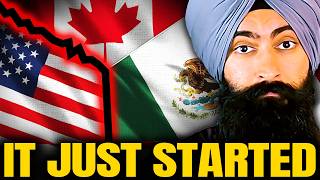

Trump Rips Up Trade Deal – Your Prices Going Up!
45sDirectly impacts everyday costs like groceries, gas, and cars, making it highly relatable and urgent for viewers.
▶ Play Clip"Delivers on trade deal explanation, but padded with self-promotion and historical context, lowering density."
President Trump has terminated the USMCA trade agreement, which could raise prices on groceries, gas, and cars due to new tariffs on imports from Canada and Mexico. This move introduces uncertainty into the economy, potentially impacting inflation and stock market volatility. The video explains the history, consequences, and investment strategies for navigating this change.
President Trump ripped up the USMCA trade deal, potentially imposing taxes on imports from Canada and Mexico, raising prices on goods like avocados, vegetables, fruits, and lumber.
The Federal Reserve is already fighting inflation, and new tariffs could exacerbate price increases.
NAFTA was signed in 1994 to eliminate taxes on trade between the US, Canada, and Mexico, but led to offshoring of manufacturing to Mexico.
Trump replaced NAFTA with USMCA, requiring 75% of car parts to be made in North America to avoid tariffs.
The USMCA had a renegotiation clause for July 1, 2026; Trump exercised it, tearing up the deal due to a trade deficit.
Existing tariffs include 50% on Canadian steel, aluminum, and copper, and 25% on foreign car parts. New tariffs may expand.
Tariffs make imports more expensive, leading companies to pass costs to consumers, raising prices on housing, cars, and groceries.
Inflation is over 4%, the highest in about three years, partly due to oil price spikes from US attacks on Iran.
Inflation erodes savings and purchasing power, making the average person poorer even with raises.
Uncertainty from trade deal leads businesses to delay investment, causing stock market volatility.
In the first half of 2025, three stock market crashes occurred due to tariff announcements and subsequent pauses, each creating buying opportunities.
The speaker advocates 'always be buying' (ABB) during downturns, as uncertainty creates opportunities for long-term investors.
Tariffs benefit steel companies, onshoring firms, and inflation hedges. Money movement creates opportunities.
The termination of the USMCA introduces economic uncertainty, but also investment opportunities for those who remain disciplined and buy during dips. Understanding the interplay of tariffs, inflation, and market volatility is key to protecting wealth.
What year was NAFTA signed?
1994
01:26
What percentage of a car's parts must be built in North America under USMCA?
75%
02:37
What is the renegotiation date for USMCA?
July 1, 2026
02:52
What is the tariff rate on Canadian steel?
50%
03:57
What is the current US inflation rate mentioned?
Over 4%
05:37
How many stock market crashes occurred in the first half of 2025?
Three
08:47
What investment strategy does the speaker recommend?
Always be buying (ABB)
11:09
What triggered higher oil prices?
US attack on Iran
05:50
What happens to supply chains when tariffs are imposed?
Companies switch to domestic suppliers, changing money movement.
04:42
What is the impact of inflation on purchasing power?
Inflation erodes savings and makes people poorer if raises don't match inflation.
06:46
USMCA Renegotiation Clause
Explains the structural trigger for trade deal termination, a key geopolitical insight.
02:52Three Market Crashes in 2025
Concrete example of how tariff uncertainty repeatedly crashed markets, demonstrating volatility patterns.
08:33Always Be Buying
Core investment principle emphasizing discipline during uncertainty, actionable for investors.
11:09Inflation at 4%
Key economic data point linking trade policy to broader inflationary pressures.
05:37Price Pass-Through
Explains mechanism by which tariffs lead to consumer price hikes, a critical economic insight.
04:28[00:02] President Trump ripped up one of the biggest trade deals that America has, and this can now impact the prices of your groceries, your gas, and your car. Which trade agreement? I'm talking about the United States, Mexico, and Canada
[00:17] trade agreement. Because now the stuff that we were buying, the avocados, the vegetables, the fruits from Mexico, the lumber, and the other imports from Canada, which we didn't have to pay taxes on, now might be subject to taxes,
[00:32] which means the prices of a lot of goods that we're buying from Canada and Mexico could be going up, and that's something you want to pay attention to, especially during a time where inflation is already going up, and now the Federal Reserve
[00:45] to fight inflation. So, let me break this all down, but first, I want to make a quick announcement, which is that on July 8th, in about a week, I'm going to be in Manhattan doing a free meet and
[00:59] greet. And live meet and greet. So, uh if you're in the area, you want to come hang out, you want to come say hi on July 8th at 5:00 p.m. Eastern Time, I have a small little Google Form that I put in the description where you can
[01:12] will send you an email of where we're going to be meeting at 5:00 p.m. on July 8th. So, uh if you want to come say hello, I would love to meet you. I would love to say hi. The link is down in the description below. That way we can come
[01:26] All right, so what's going on? Let's back up to 1994. United States, Canada, and Mexico were trading with each other, buying stuff these taxes. So, if you bought something from Mexico or Canada, there would be
[01:39] taxes imposed, and so a deal called NAFTA was signed. And what NAFTA said was that the three countries would stop taxing each other. something happened. American car companies said, "Oh, we're producing
[01:53] companies said, "Oh, we're producing cars in Detroit and Ohio, but if we just take this now car manufacturing plant and take it south to Mexico, a fraction of the price because we can pay somebody in pesos in Mexico instead
[02:08] of dollars in America, and then we can just ship that car back to the United So, we started to see a lot of offshoring that a lot of manufacturing and that was where President Trump in his first term said NAFTA is a horrible
[02:24] agreement, and he ripped it up. Instead, he built a new agreement called USMCA, this United States-Mexico-Canada USMCA, this United States-Mexico-Canada uh agreement, which said that now 75% of
[02:37] a car has to be built in North America in order for it to not be subject to these taxes. But this USMCA agreement also had a which said that it would be subject to
[02:52] renegotiation on July 1st, 2026. And yesterday, July 1st, 2026, President Trump said, "I don't like the deal anymore." And he ripped it up. The reason why he doesn't like the deal has
[03:06] to do with something called a trade deficit, that the United States is buying more stuff from Mexico, the United States is buying more stuff to from Canada. We are putting more money into their economies than they are
[03:18] putting into our economies, and that's why President Trump says that we would be better off without this deal. Now, there are consequences to this Now, there are consequences to this because, remember, this deal means that
[03:30] we are not going to be taxing their stuff. So, for all the people that are buying lumber from Canada, all the businesses that are buying groceries from Mexico, they were able to purchase this stuff
[03:43] without additional layers of tax thanks to the deal. Now that this deal no longer exists, that means you might be seeing a tax coming soon on goods that you buy from Mexico or Canada which were
[03:57] But we have to see what will happen because we know that there are certain tariffs. For example, if you want to buy steel, aluminum, or copper from Canada, there's a 50% tariff on that. There's a 25% foreign part tariffs on cars.
[04:13] So, this could be an expansion on tariffs or a way for renegotiation for Canada and Mexico to buy more stuff that you have to pay attention to in the meantime is that the prices of certain
[04:28] things could be going up here in the United States. Why does that matter? Because when there is a 50% tariff on Canadian steel, do you know what companies do? They stop buying Canadian steel because
[04:42] now all of a sudden it's a lot more affordable to buy American steel. So now you start shopping around at American steel companies. Why does that matter? Because that can change the supply chain. It changes where money moves
[04:54] because now people will be looking for other places to buy certain things if it is available. And we don't know how long this agreement is going to go through in negotiation, but it could change how
[05:07] companies spend or it could change how much companies have to pay. If companies have to pay more money to produce their stuff, they might have to charge you to buy that stuff. If it costs more money to get wood,
[05:21] producing a house gets more expensive. If it costs more money to get steel, expensive. If it costs more money to get avocados, your guac can get more to pay attention, and this is coming at a time where inflation is already at
[05:37] over 4%. We have the highest inflation that we have seen in approximately 3 pandemic. Now, part of the reason why we have such high inflation right now is due to the United States attacking
[05:50] That attack on Iran led to higher oil prices. The higher oil prices then led to higher gas costs. The higher gas per costs also meant we have higher diesel costs. That means shipping becomes more expensive.
[06:03] That means transporting groceries from the farm to the warehouse to the store becomes more expensive. And it also means fertilizer for farmers gets more expensive. So, the higher oil prices mean that a lot of things get
[06:16] more expensive, things that you need, which has been contributing to the there's been a lot of talks about the war with Iran being over. Again, that kind of flip-flops very regularly, but we've seen oil prices
[06:30] fall. However, despite oil prices falling, they were before. And that lower oil price still hasn't been seen in a lower inflation rate yet. Now,
[06:46] this is where people are getting concerned about is inflation getting high, it makes it harder for people to afford life. It makes it harder for people to afford groceries because incomes are not
[07:00] inflation, which means the average person is getting poorer. Because your savings have less buying power. It's not because you're making less
[07:13] money. You might actually get a raise. But if that raise isn't matching or exceeding inflation, you're still poorer after the raise than you were before the inflation hit.
[07:26] important because when you have inflation, it is the investor that gets So, the thing that you want to understand of how this is going to impact the stock market now is that the one thing that the stock market does not
[07:39] like is uncertainty. And what this trade agreement does is now it's going to unleash some more uncertainty into the economy. The reason is is businesses, like car businesses, now don't know what is going to happen in
[07:55] terms of importing goods from foreign countries. And when there is more uncertainty, there's less business investment. Because a car company might say, "We're thinking about opening a car
[08:08] but we don't know what's going to happen with taxes. We don't know what the true cost is going to be of opening it up in Ohio or Mexico. So, let's wait and see."
[08:20] investment. It can slow down stock market investment as people now want to wait and see what is going to happen because the reality is we know that there's been a lot of volatility when it comes to tariffs. How
[08:33] rhyme. If we go back to the beginning of 2025, this was a very interesting time, and I like talking about this because it really is one of the most educational times
[08:47] ever. Because we had three stock market crashes in the first half of 2025. In February of 2025, President Trump has announced harsh tariffs on Canada and Mexico.
[09:05] That announcement triggered a fast and big stock market sell-off in the United which created a great buying opportunity. Because now stocks were falling, and you could buy good stocks at a discounted price.
[09:18] market crash happened, people were freaking out. There was a lot of uncertainty about this trade agreement. President Trump said, "We're going to pause these tariffs." So, then the stock market started
[09:31] week later. Fast forward to March, 1 month later. President Trump says, "The tariffs are back on Canada and Mexico. And not only are they back, but they're back stronger and harsher than before."
[09:47] Now, the uncertainty started again. The stock market started sell off again. was in February. Again, it created a great buying opportunity. And then some days later, as people were
[09:59] is going to do to the economy, what's it going to do to the stock market, what's it going to do for business investment, President Trump paused those same Now, about a week or so later, the stock market was breaking brand new record
[10:12] off. Now, stock market is booming again. Then came April. And in April, 1 month later, the third month in a row, not only did President Trump announce new tariffs on Canada and Mexico,
[10:26] he announced Liberation Day. Liberation Day was tariffs on many, many, many countries all around the world. It was sweeping tariffs. sell off in the United States, but a global stock market sell off, the
[10:41] fastest one that we had seen since the pandemic. were panicking, but again it created a great buying opportunity. And then some days later, President Trump then paused that same Liberation Day tariff.
[10:57] about a week or so later, the stock market went from crashing to breaking brand new record highs. This is why, again, uncertainty is what Wall Street doesn't like. But as an
[11:09] investor, uncertainty creates opportunity. This is why I always talk about ABB, always be buying. The way that you win is not by always buying the market. And markets are up, down, and sideways. In fact,
[11:22] want to buy even more aggressively because it allows smart investors to discounted price. By the way, I have a full master class on this. If you I put together a full investing master class where I walk you through how you
[11:36] class where I walk you through how you can find opportunities today in our changing economy and how you can turn those opportunities into investments. up for it, you're also going to get access to market briefs. So, if you want
[11:48] market briefs all for free, I have that link for you down in the description below. But, this is where again, your job is to be an investor, not trying to trade because trading is gambling. You want to be an investor for the long term
[12:02] to be able to find where the opportunities are. So, who are the When there are tariffs, the winners tariffs. When the steel tariffs happened,
[12:15] companies. The onshoring companies because we have seen more made in America, more onshoring happening. So, the companies that now become effectively cheaper are those American produced products
[12:29] because buying from the foreign countries becomes more expensive. And if you have concerns about inflation, then inflation has just become winners. That's the thing that you want to pay attention to because anytime money
[12:43] moves, opportunity happens. the best thank you is a referral. If you could, please share this video with a fellow investor. That way we can continue to spread this type of
[12:56] Manhattan on July 8th, again, I have that form for you down in the there. President Trump's new Fed chair recently finished his first meeting and his announcements caused money to change overnight. Gold prices crashed to under
[13:10] $4,000 for the first time in months. Silver prices crashed even harder than that and Bitcoin prices fell off of a cliff. This is where everybody is pointing their fingers at Kevin Warsh's new economic plan as


⚡ Saved you 0h 13m reading this? Transcribe any YouTube video for free — no signup needed.