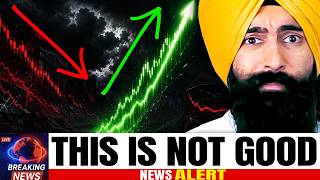

Why the Stock Market Keeps Hitting Record Highs Despite Bad News
44sHighlights the puzzling disconnect between negative economic news and rising markets, sparking curiosity and discussion.
▶ Play Clip"Delivers a solid breakdown of contradictory economic signals, though padded with a sponsor segment and self-promotion for an ebook."
This video explains why the stock market continues to hit record highs despite negative economic news such as war, rising oil prices, tariffs, and a slowing job market. The host breaks down the impact of oil prices, tariffs, and inflation, and discusses the Federal Reserve's dilemma between fighting inflation and stimulating the economy. He advocates for a consistent investment strategy ('Always Be Buying') rather than reacting to headlines.
The stock market is breaking record highs despite negative news because it can stay irrational longer than people can stay solvent.
Oil prices jumped 20% in recent weeks, pushing gas above $4. Higher oil prices increase shipping and production costs, affecting everything from groceries to diesel.
Even though the US is more energy independent, higher global oil prices still impact domestic prices due to the interconnected market.
President Trump announced 50% tariffs on Canadian goods (wine, cheese, cars, etc.). Canada is the US's largest trading partner, so these tariffs could significantly raise prices.
The expiration of the USMCA trade agreement may lead to broader tariff wars, with Canada likely retaliating.
Current inflation is 3.5%, above the Fed's 2% target. Higher oil prices and tariffs could push inflation even higher.
The Federal Reserve faces a choice: raise rates to fight inflation or cut rates to stimulate the slowing job market. The next announcement is on July 29th.
Inflation makes the average person poorer but benefits asset owners and investors, which is why the Fed targets 2% inflation rather than 0%.
The host advocates 'Always Be Buying' – consistently investing through up, down, and sideways markets, rather than trying to time the market.
The economy may seem contradictory, but understanding the underlying factors (oil, tariffs, inflation, Fed policy) allows investors to find opportunities. The key is to stick to a disciplined strategy of continuous buying through the noise.
What is the current inflation rate mentioned in the video?
3.5%
07:14
What inflation rate does the Federal Reserve target?
2%
07:14
How many jobs were added in the most recent job market report?
57,000 jobs
08:13
What percentage tariff was announced on Canadian goods?
50%
03:35
What is the trade agreement between the US, Mexico, and Canada called?
USMCA
04:58
Why does the Federal Reserve want 2% inflation instead of 0%?
Because slow inflation benefits asset owners and investors, while being less noticeable to the average person.
09:33
What is the name of the investment strategy promoted in the video?
ABB (Always Be Buying)
06:07
What is the expected number of jobs that were forecasted but not met?
115,000 jobs
08:25
What did the new Fed chairman say about forward guidance?
The Fed will stop giving predictions and forward guidance about the future.
12:03
According to the video, who benefits from inflation?
Investors and asset owners
10:16
Market Irrationality
Key quote explaining why markets defy negative news.
00:17Inflation vs Target
Specific data point showing inflation above Fed target, setting up the tension.
07:14Inflation Benefits Investors
Explains the structural advantage of investors in an inflationary system.
10:02ABB Strategy
Core actionable principle for investors amid uncertainty.
15:10Fed Dilemma
Highlights the central bank's conflicting goals and upcoming decision.
08:51[00:01] Street says that the stock market should be crashing. We have a full-blown war going on. Oil prices are skyrocketing. The job market is down, and tariffs are coming back strong. But despite all of these things, the stock market keeps
[00:17] breaking brand new record highs. In fact, yesterday was one of the best days for the stock market in weeks. And the reason why is because the stock market can stay irrational longer than many people can stay solvent. Meaning
[00:31] the stock market doesn't have to make sense, but you have to know how to make sense of the stock market. And in this video, I'm going to help you break down you can make better decisions with your money. So, let me start by going on with
[00:45] what's going on with the war and oil prices and its impacts on the economy. on with tariffs. And then I'm going to end this video by talking about inflation and the Federal Reserve Bank and tie this all together when it comes
[00:58] to investment. So, let's break this all down starting with oil prices because the conflict in the Middle East has started back up. And this has costs. Obviously, it has costs with human lives, which is
[01:12] immeasurable. But what I want to focus on today is the financial side of things. Because we have seen oil prices jump up by around another 20% or so in just the last few weeks. And as a result, gas
[01:26] last few weeks. And as a result, gas prices are now at above $4 again. The reason why this matters is because oil prices impact everything. Gas prices go up, diesel prices go up, shipping costs go up, grocery costs go
[01:41] Which means when you go to the store and you want to buy groceries, which I know of groceries because they're scared of getting sick. But when you go to buy groceries are more expensive. Why?
[01:55] pay more money in fertilizer to produce the groceries. Number two, the store had to pay more money to get those groceries to the store from the warehouse because diesel prices are more. And the farmer had to pay more money to get those
[02:10] groceries from the farm to the warehouse as well. So, the cost to produce stuff goes up, which means your cost to buy those things go up. how the higher oil prices are going to impact inflation during a time where
[02:26] jobs are hurting, during a time where inflation has already been high. This is important. Now, you might be thinking, "Well, Jaspreet, I thought the United States has become a lot more independent when it comes to energy and oil. Why do
[02:39] these higher oil prices impact us in the United States if we can produce our own oil?" The reason why is because oil prices are around the world start to become more expensive,
[02:54] they impact us here in the United States as well. Yes, we are more independent with oil now than we were before, but if oil prices are going up, it impacts oil prices everywhere, including the oil prices here in the United States,
[03:08] which is why higher oil prices mean higher gas prices, higher diesel costs, Now, the other thing that you want to pay attention to beyond now oil prices and gas prices is what's going on with
[03:21] tariffs. Because very recently, President Trump just announced brand new tariffs on Canada. The reason why this matters is because the largest trading partner with the United States is Canada. And these new tariffs are a 50%
[03:35] Canada. And these new tariffs are a 50% tariff, 5-0, on a lot of Canadian goods. Things like wine, cheese, cars, hockey sticks, cement. And that means that the prices of those things could be going up
[03:49] if a company is importing them from Canada. Again, Canada is the biggest trading partner with the United States. A tariff is a tax, it is a fine, it is a fee, which means if you are going to purchase a product from a different
[04:03] country, you have to pay an additional, in this case, 50% in order to import it. Which means the price all of a sudden has gone up to produce that product. So now you as a business have to either pay that additional 50% and then either
[04:18] pass that cost down to the customer, meaning raise your prices, or shrink meaning raise your prices, or shrink your margins and make less profits. an alternative way to produce the products,
[04:30] different country or you make it in the United States, which still will probably cost you more money than it did before. This is where again people believe that we're going to see more inflation because if the prices of things go up,
[04:44] well, that contributes to higher costs for people. Now, the reason why this Canadian tariff is so important is because this could be the start of something bigger. I made a video about this a couple of weeks ago
[04:58] because a couple of weeks ago President Trump refused to renew the USMCA, which is the trade agreement between the United States, Mexico, and Canada. And what the trade agreement did was essentially it would allow
[05:12] the United States, Mexico, and Canada to sell goods to each other without having to worry about tariffs on certain items. And President Trump said that we, the United States, were losing in this trade agreement, so we did not
[05:27] Trump has come back and has increased tariffs on and we don't know where this is going to lead with negotiations, but what we know as of today is that Canada has said that they will
[05:41] is that Canada has said that they will likely retaliate. What does that mean? Well, maybe they will sell less American stuff. Maybe they will put more tariffs on American goods. We don't know exactly just yet, but we know that Canada has
[05:53] said that they want to retaliate in response to these new tariffs on Canadian goods. So, we could be seeing more tariff wars starting again while we have these concerns going on with oil and inflation.
[06:07] This brings me now to inflation, the job market, and the Federal Reserve Bank, which ties it all together, which shows where the opportunities are. By the way, this is one of the reasons I just put together a brand new ebook called ABB,
[06:20] watching my videos, you know how I teach the way that you invest your money and build wealth is through what I call ABB, always be buying. Don't try to time the market because nobody knows when is the top, nobody knows when is the bottom,
[06:34] buying, that's how you build wealth when markets are up, down, sideways, and everything in between. And in this ebook, I break down the strategy of how you can build wealth through all the chaos and non-chaos in the economy. So,
[06:48] if you want to read this ebook, you can download it for free. I have the link to how you can download ABB, how you can build wealth through any economy. The below. Now, when we take a look at where
[07:00] inflation is, what we know is that inflation is much higher than what the Federal Reserve Bank wants. As of right now, the most recent inflation report said that inflation is at around 3.5%.
[07:14] but it's worse than what the Federal Reserve Bank wants. The Federal Reserve Bank wants 2% inflation, not 0% inflation, but 2% a minute. But they have this 3 and 1/2% inflation
[07:31] against the 2% inflation that the Federal Reserve Bank wants. And this 3 and 1/2% inflation is before the most recent oil spike. And it's before the new tariffs that are put on to Canada. And that's why now people are getting
[07:46] more concerned about inflation again because if oil prices stay higher again it's going to push inflation higher. it's going to push inflation higher. If these tariffs cause companies to have
[08:00] goods, that can cause the prices of things to go up as well. right now is not just because we're seeing the prices of things potentially rising even more
[08:13] but also because the job market is hurting. The most recent job market report says that the job market in the United States only added 57,000 jobs.
[08:25] We were expecting 115,000 jobs. Which means that the job market is slowing down. While the costs are going up.
[08:37] And this is where all eyes are now going on to the Federal Reserve Bank because next week, on July 29th the Federal Reserve Bank is going to make their next announcement on what they are going to do in response to the
[08:51] job market and in response to inflation. Now, I said just a minute ago that the Federal Reserve Bank wants 2% inflation, not 0% inflation. And this is a very important concept that I want you to understand that most people
[09:04] completely ignore. The Federal Reserve Bank is the central Their job is to help manage inflation and manage Well you would think that if your job is to
[09:19] manage inflation, you would want 0% inflation because inflation means that Inflation means that your savings have less buying power. Inflation means that less buying power. Inflation means that your salary can buy less stuff.
[09:33] But the Federal Reserve Bank wants 2% inflation, not 0% inflation, which means they want an inflation to happen, which is not that severe that the average person notices it.
[09:47] This is why year after year, decade after decade, the average person has become poorer because we have this slow compounding inflation that happens year after year after year, and the goal is that the
[10:02] average person doesn't notice it. Now, what does inflation actually do? Well, what inflation ends up doing is it makes the average person poorer while somebody It is the investor that gets richer through inflation, and so the Federal
[10:16] Reserve Bank has these inflation policies, which end up ultimately benefiting the investors. It benefits asset prices. It benefits the asset But the average person doesn't see it happening. And the reason why the
[10:29] is because when you have just 2% inflation, it's not significant enough for the average person to notice it day-to-day. But when it's at 4% 5% or 9%
[10:41] significant enough that the average person notices it day-to-day, and that's rather it be at 2% because day-to-day the average person doesn't notice it, but it doesn't go away. It still happens. It just happens at a slower
[10:56] that most people don't notice it day-to-day. we are a week or so away from the Federal Reserve Bank giving their next announcement as to what they want to do to help the economy because remember,
[11:09] the Federal Reserve Bank wants to help fight inflation while they want to boost the job market. But they can't fight inflation and boost the job market at the same time. The reason why is because the Federal
[11:22] fights inflation by raising interest rates. market by cutting interest rates. When you raise interest rates to fight inflation,
[11:37] what you're doing is you are tightening money. interest rates to stimulate the job market, they're loosening money. Well, you can't tighten and loosen money
[11:51] at the same time. They have to pick one. And this is where we're getting conflicting stories as to what the Federal Reserve Bank is going to do. Even worse, the new chairman at the Federal Reserve Bank also added a new
[12:03] And he said that the Federal Reserve Bank is going to stop giving predictions and forward guidance as to what might be coming in the future, which essentially blind. Before,
[12:15] the Federal Reserve Bank would give some sort of guidance as to what they think would be coming in the future. Now, that's not happening. life is that oftentimes the things you don't pay attention to end up mattering
[12:28] the most. And that's why I want to talk to you about life insurance with our sponsor Policygenius, because if you don't have the assets to live off of yet, and something tragically happened to you,
[12:40] spouse and your family trying to struggle to survive financially, and come into play. Now, I'm talking about term life insurance here, not whole life insurance. The whole idea with term life insurance is it's life insurance for a
[12:54] period of time, 10 years, 20 years, 30 years, that way you can work to build your assets. It is a lot cheaper than whole life insurance because the whole idea is you're not here trying to get rich off your life insurance, it's just
[13:07] there as a bridge until you can build your assets. This is one of those things it is. Because if you're a healthy 30-year-old guy, you could potentially get a half a million-dollar term life insurance policy for less than a dollar
[13:20] you want to learn more about term life insurance, or you want to see how much a actually cost you. I'll put a link to Policygenius' form down in the minutes to complete and it'll give you an actual quote on how much term life
[13:35] have that link for you down in the description. More and more people now are trying to predict what is going to happen because on one hand we have these concerns about inflation. We have higher oil prices. We already have the 3 and
[13:48] 1/2% inflation rate. We have these new tariffs. All of these things contribute to higher inflation which hurts the average person which is why some people going to have to raise interest rates in 2026. That raising of interest rates
[14:03] means your mortgage rate goes up, your car loan rate goes up, borrowing money becomes more expensive, it puts more downward pressure on the stock market. we're seeing more and more pain in the economy.
[14:15] The job market is getting hurt. Many companies are actually struggling to grow their profits. Yes, some companies have been booming, especially the AI companies, but everybody else is kind of struggling.
[14:29] different camp of people saying the Federal Reserve Bank has to cut interest rates to stimulate the economy, to get the economy moving again. rates at the same time and we don't know what the Federal
[14:44] where everybody is guessing and that's why next week, July 29th, is so important because we're going to get the next round of announcements from the Federal Reserve Bank as to what they're going to
[14:57] Reserve Bank as to what they're going to do to help save, stimulate, or protect the United States economy and the United States dollar. And again, we don't know that each one of their actions has
[15:10] different results on the economy. Your job as an investor is not to panic, is not to freak out, is not to chase headlines, but rather to understand the opportunity. Again, I call it ABB,
[15:23] you win. That's what my ebook is all about. The idea being, how do you understand how to find the opportunity where money to want to get even more involved and want to find where the opportunity is
[15:40] want to find where the opportunity is based off of how money is moving. involved as an investor to try to boost your returns, but the idea is stop chasing the headlines, stop chasing the news,
[15:53] and understand your strategy as an investor because anytime policies change, anytime new rules are implemented, and it creates investment opportunities. And while most people are panicking,
[16:09] say, "Oh my god, we're going to see a recession. Oh my god, the market's going going to happen." What you want to do is and buy through the noise. Because you've been seeing all this bad news,
[16:22] brand new record highs. And the people that have been talking about how, "Well, markets go up because all these bad things are going to happen." They've the opportunity. Then, we also have the chance that we
[16:36] could see a market crash. We could see an AI bubble bursting. We could see a lot of bad things happen. Well, that also creates opportunity. And right, what you want to do is know your
[16:49] strategy as an investor and buy through all the noise because you want to buy when markets are up, buy when markets are down, buy when markets are sideways because that's where the real wealth is built. Again, I have the free ebook free
[17:01] value out of this video, the best thank you is a referral. So, if you could, family member, colleague, or fellow investor. That way we can continue to spread this type of financial education. Thank you. In our economic system, you
[17:14] can't become wealthy by working a job. Doesn't matter if you are a teacher, a truck driver, a doctor, or an executive. The way you become wealthy is about owning the right assets. That way now you can get paid even if you stop
[17:26] working. Because if you stop working at your job, the money stops coming in, but your job, the money stops coming in, but you still got bills to pay.


⚡ Saved you 0h 17m reading this? Transcribe any YouTube video for free — no signup needed.