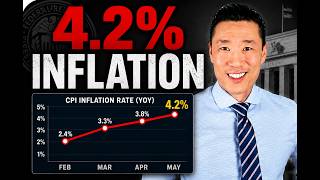

Inflation just hit 4.2% — hottest in 3 years
56sThe alarming acceleration of inflation from 2.4% to 4.2% in just four months is a stark wake-up call that grabs viewers immediately.
▶ Play Clip"Title matches the core data — inflation is indeed surging, and the video delivers the numbers without fluff."
The video breaks down the May U.S. inflation report, which came in at a hot 4.2% — the fastest pace in three years. The host discusses the accelerating trend, the impact of the Iran war and Strait of Hormuz disruptions on oil prices, and what this means for Federal Reserve interest rate policy. He also reviews market expectations via the CME FedWatch Tool and explains the market's inverse reaction to jobs reports.
The May CPI report shows inflation at 4.2%, the hottest rate in three years.
The Iran war triggered a supply shock, pushing energy prices up and accelerating inflation.
Inflation rose from 2.4% in February to 3.3% in March, 3.8% in April, and 4.2% in May.
Trump spun the data as a victory, saying 'I love the inflation. The numbers were great.'
Whether inflation peaks hinges on the peace deal and normalization of energy flows.
Even without escalation, unresolved disruption in the Strait of Hormuz keeps energy prices and inflation climbing.
Oil supply is insufficient to meet demand at roughly $93 a barrel.
The Fed expects June inflation to soften to 4.1%, but the host is skeptical of number fudging.
CME FedWatch shows a 96.2% probability that the Fed holds interest rates steady next week.
For July 29, there is an 84.3% chance of no change, 12.3% chance of a hike, and 3.3% chance of a cut.
Markets price a 68% chance that rates end the year higher, 30.8% unchanged, and only 1.2% lower.
Strong jobs reports tend to sink markets because they reduce the odds of Fed rate cuts.
With inflation running hot and the Fed unlikely to cut, the host stays long-term bullish but warns of an 'everything bubble' and advises against margin debt. He encourages joining his investing community for ongoing guidance.
What was the U.S. inflation rate for May?
4.2%
00:13
What were the inflation rates from February to May?
2.4%, 3.3%, 3.8%, and 4.2%
00:42
What did President Trump say about the inflation numbers?
"I love the inflation. The numbers were great."
01:11
What is the probability that the Fed changes interest rates at the June meeting, according to the CME FedWatch Tool?
There is a 96.2% chance of no change.
04:56
What are the probabilities for the Fed's July 29 meeting?
84.3% no change, 12.3% hike, and 3.3% cut.
05:25
What is the market's year-end interest rate expectation?
68% chance higher, 30.8% unchanged, and 1.2% lower.
05:50
Why do stocks often drop on strong jobs reports?
A strong labor market reduces the likelihood of Federal Reserve rate cuts.
06:45
What is the Federal Reserve's dual mandate?
Stable prices and maximum employment.
07:13
Hottest Inflation in 3 Years
The 4.2% CPI print sets a three-year high, establishing the core context for the entire video.
00:13Clear Acceleration Path
The month-over-month jump from 2.4% to 4.2% shows a steepening trend, not just a one-off spike.
00:42Market's June Expectation
A 96.2% probability of no rate change shows Wall Street has fully priced in a Fed pause.
04:56Jobs-Inflation Market Paradox
Explains why markets rally on bad news and fall on good news, a counterintuitive dynamic driven by rate-cut expectations.
06:45[00:01] today and I'm not going to lie, the results came in pretty ugly. Well, you could be the judge. So, for the month of May, the report shows that the rate of inflation came in at a 4.2%. So, that is the hottest rate of
[00:13] inflation for the past 3 years. Now, I want to show you why this is so concerning. It's because of how quickly the rate of inflation is accelerating. here, which I've circled in red, the rate of inflation was at 2.4%, okay?
[00:29] And then, of course, the war broke out and we're experiencing a supply shock to So, energy prices are going up and that's causing the rate of inflation to go up, which we're clearly seeing. So, February, the rate of inflation is
[00:42] So, February, the rate of inflation is at 2.4%, March went up to 3.3%, April 3.8%, and then May, the most recent one that was released today at 4.2%. So, I want you to think about it that
[00:56] Okay, so we're 10 days into June. June's going to be released in July. If we're at 4.2%, what is it going to go up to for June? 4.5%? 4.6? 4.7%? Like, that is so far, if you think about it, from the goal of 2.0%.
[01:11] Now, when President Trump was asked about whether he was worried about the accelerating rate of inflation, President Trump, he tried to spin this into a victory. President Trump responded with, "I love the inflation.
[01:23] The numbers were great." So, Trump said that the rate of inflation would drop like a rock once the Iran war is over, possibly in 2 or 3 days. But, of course, the big question is, will the rate of inflation start to
[01:36] come down? Like, has this been Have we reached the peak, basically? depends on whether Trump's peace deal is still in motion. Although, you know, as of this morning, we've been sending off friendship missiles, and it
[01:51] around the corner. So, maybe there will be a peace deal in what keep Trump President Trump keeps saying and maybe energy flows will saying and maybe energy flows will normalize and prices will come down.
[02:04] But listen, I just want you to know that the war doesn't even have to escalate in order for energy prices and inflation to continue going up. as long as this whole situation, especially in the Strait of Hormuz, as
[02:17] long as it's just in a state of limbo, and nobody's doing anything, which is apparently the case, if nobody's going to do anything and oil is not flowing properly, then energy prices are going to keep going up and
[02:30] inflation's going to keep going up. Because right now, there's not enough Because right now, there's not enough oil supply to satisfy demands at this price point for oil, which is around $93 a barrel.
[02:42] But if there's escalation, and they're blowing up each other's energy infrastructure, then of course energy prices are going to go up even faster, to go up even faster. Because there's still a few million barrels escaping
[02:56] through alternative routes and pipelines bypassing the Strait of Okay, now I want to bring this to your attention. Like, I thought this was you think. So, the Federal Reserve is saying that
[03:09] in June, they expect the rate of inflation to come down from the current 4.2% in May, and they're expecting it to come down to for June. So, I'm sure Okay, if they We're talking
[03:24] about the CPI prints. Like, if they play with the numbers enough, yeah, I'm sure they can get it down to 4.1% on paper, but I would be skeptical, you know, with inflation. That's That's just my opinion.
[03:37] opinion. But again, we have 20 days left in June, so let's see what happens. Now, let's take a look at what the market believes will happen. So, this is according to the CME FedWatch Tool.
[03:49] So, the situation is that inflation is running hot at 4.2% and it's rising. The labor market, according to the government, is doing great. So, the Federal Reserve has no reason to cut interest rates at their next meeting
[04:02] think about it. Why would they cut interest rates? Like they have no reason to. They don't have an excuse to. So, they're supposed to cut interest rates when the labor market is suffering or if inflation is low. Like if if
[04:15] inflation's low, then they can afford to cut interest rates is inflationary, but if it's low, then they can do it. But neither of those are happening right now. So, they don't have an excuse to cut interest
[04:28] You know, in reality, if you think about it, the only real reason to cut interest Trump. But I'll tell you this, when I look at the situation, it looks like President Trump's going to play the play it cool card and he's not going to
[04:42] belittle Warsh or criminally investigate him for not listening to his demands for lower interest rates, at least not yet. So, it looks like for June, there's not Warsh is going to be given a pass. Like he's President Trump's going to let it
[04:56] slide for this month. There's a 96.2% chance that Warsh does not change interest rates next week. If you want to see the probabilities for an interest rate cut in July, then you know, take a look. It's still mixed
[05:09] expectations. So, the next meeting after June is on July 29th. An 84.3% chance that the Federal Reserve does not change interest rates at that meeting. A 3.3% chance that they cut interest rates and a 12.3% chance that they raise
[05:25] interest rates. So, listen, it's most likely that nothing changes in June. The interest rate's going to be the same and then there's going to be a risk of would be devastating to the markets and of course the economy, but we're talking
[05:38] of course the economy, but we're talking about that risk starts elevating in July So, but we're just talking about a possibility of a quarter point rate increase, but more importantly, it's the expectation of higher interest
[05:50] rates for longer that's really going to upset the markets and of course the a look at this. This is a look into how interest rates will be by the end of the year. There's a 68% chance that interest rates
[06:03] will be higher by the end of the year. There's a 30.8% chance that interest year. And there's only a 1.2% chance that interest rates are lower by the end of the year. So listen, I want you to
[06:17] works. When inflation is coming in hot, the markets are not going to like that. Most likely the markets are going to be down. That's because if inflation is hot, then the Federal Reserve is less
[06:30] likely to cut interest rates. And that means less cheap and easy money to fuel the stock markets. And then when the labor market data is published, like an example, I'll just say it's funny because if we
[06:45] get a strong and good jobs report, then the market generally goes down. And if we get a bad jobs reports, then the market goes up. Okay, why is that? That's because a good or a strong jobs reports means that the labor market is
[07:00] fine and dandy. Like the labor market is strong and it's less likely that the Federal Reserve will cut interest rates. And if the jobs report comes in terrible, then the market goes up because it gives the Federal Reserve a
[07:13] reason to cut interest rates. Because the Federal Reserve has a dual mandate, stable prices and maximum employment. So it's pretty wacky how that works, right? But that's just the way it is because what's fueling this
[07:27] artificial rise in the stock markets? It's financial asset inflation. It's just cheap and easy money like ever since 2008. But listen, I just want to say that my stance, my position remains the same. I'm long-term bullish, but
[07:39] being bearish, but it's the energy crisis of course that's got me concerned. But as you know, I have a properly hedged. But the way I see it, we're in an everything bubble. Long-term, it's all
[07:52] just going to go up. So just don't mess around with margin debts. Buy the dip, ahead. Like we don't have to make this thing We don't have to make this whole thing complicated. And I encourage you to join our investing community along
[08:06] going to leave a link for you down below. Thank you for the support, and I below. Thank you for the support, and I wish you a very nice day. Take care.



⚡ Saved you 0h 08m reading this? Transcribe any YouTube video for free — no signup needed.