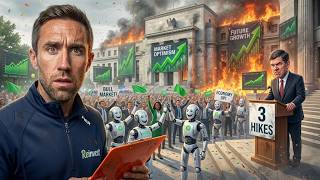

CPI Hot & Rate Hikes Ahead
45sImmediate market-moving news with a clear, actionable takeaway for investors.
▶ Play Clip"Delivers a substantive market analysis with specific data and scenarios, though the title's promise of a 'market bottom' is speculative."
CPI came in hot, raising questions about stock market implications and whether it's a buy-the-dip opportunity. Risks include rate hikes and geopolitical tensions.
Rate hikes are likely between now and April, posing potential problems for AI CapEx build-out but not an immediate recession driver.
Markets are pricing in three full rate hikes by April 2027, with an 86-88% chance of the first hike on September 16th. Peak pricing suggests three hikes and done.
T.S. Lombard notes new Fed chairs often hike early to establish credibility, aligning with a rate hike within the first six months of Warsh's term.
If the worst case (three hikes) is fully priced, any delay (e.g., to December) would be upside for markets. A double hike in September is unlikely (<1% chance).
Year-over-year inflation is broad: airfare +23%, energy +16-27%, hospital services +5%, car repair +5%, electricity +3.8%, clothing +3.6%, restaurants +3.4%, rent +3%. None consistent with 2% target.
Core services ex-housing rose 0.51% in August, the highest since January, up 3% on the year. Energy costs are spreading to other sectors, including education and trash collection.
US confirmed strikes on components of Saudi Arabia's East-West Pipeline, used to move oil from the Persian Gulf to the Red Sea. This, combined with Houthi control of the Red Sea, limits Saudi oil export options.
Leaked White House comments suggest the war could last through Trump's term, likely a negotiation tactic. The creator sees this as posturing, with a possible deal before the election.
Peak oil prices, peak rate fears, and peak Iran fears could lead to a pre-election deal, driving oil prices down and boosting markets. The creator estimates an 80% chance of positive Iran news before the election.
Iran faces severe inflation and gas shortages, with people waiting weeks for fuel, crippling work and increasing public anger—pressuring a deal.
The NASDAQ consolidation is seen as a resumption of war, but with AI boom intact and Atlanta Fed GDP at 4.4%, a breakout above the 100-day moving average is possible.
Apple, Meta, and software stocks are recovery plays, while hardware (NVIDIA, Broadcom, AMD, CoreWeave, Oracle) is undervalued for this cycle phase.
Edge cases like Iran using a nuclear weapon or a missile hitting an aircraft carrier could cause a recession, but these are unlikely (<1% chance). Without leverage, investors can ride out volatility.
With three rate hikes priced in, the only direction is bullishness if a deal reduces rate expectations. This could be peak bearishness, making it a good time to buy.
The creator believes current conditions—peak rate fears, peak oil, and peak Iran tensions—may signal a market bottom, with a likely pre-election deal driving a bullish reversal. He advises buying quality stocks, as the downside is limited and the upside potential is significant.
Three rate hikes priced in
Quantifies market expectations, providing a concrete baseline for analysis.
01:40Inflation is broadening
Shows inflation is not just energy-driven but spreading across many sectors, challenging the Fed's 2% target.
04:19East-West Pipeline strikes confirmed
Geopolitical event with direct impact on oil supply and prices, a key market driver.
06:57Peak risk elements align
Suggests a contrarian bullish setup where worst-case scenarios are priced in, offering upside potential.
13:01Hardware stocks undervalued
Identifies specific investment opportunities based on cycle analysis.
17:27[00:00] Obviously, CPI came in hot this morning. So what does this mean for the stock market? And is this actually a buy-the-dick opportunity? What are the risks? And what the heck is going on out there? Because now there's reporting that the yesterday rumor mill that the East-West Pipeline got struck ended up being true.
[00:20] This isn't good. Now, we've got to put that together with what's going on with bonds and oil and inflation. And there's a lot. So let's try to understand it all. First of all, at this point, we're probably going to see rate hikes.
[00:34] We're going to see them between now and April. That does cause potential problems for the AI CapEx build-out. It is just another straw on the back of the AI CapEx build-out.
[00:46] We know if AI rolls over, the world goes into a recession. But we just don't know when it's going to roll over. So far, it doesn't look like there are indicators that it's going to roll over soon. I think the biggest canaries in the coal mine, and this is the old news,
[01:00] but we think the biggest canaries in the coal mine are not just the anthropic initial S1 earnings that come out, but the longer-term earnings. How do the longer-term earnings transition over time?
[01:12] Those will be sort of our little warning shots for when the AI bubble is getting ready to turn. So far, we just don't have the indications that we're ready to turn to the dark side. We know there's a lot of spending going on. We know there's a lot of financing going on.
[01:25] And rates are going to make them more challenging, but they're not going to drive us into a recession tomorrow. So from an investor point of view, I look at this as an expectations play and where we sit with market drama now.
[01:40] So when I put together my thoughts, these are some of the things I'm thinking of. First of all, we are currently pricing in three full rate hikes between now and April 28th of 27.
[01:52] These are the approximate odds for when we see those hikes. So you can see that about 86% to 88% chance of our first rate hike September 16th. And then you can see these various different pricings, where we sort of peak out at around 3.5 rate cuts by next summer.
[02:10] We actually forecast indicate we start coming down again from there, which suggests probably we're more like a three hikes and done year for Warsh. T.S. Lombard actually had a nice breakdown on this
[02:23] where they indicate that often when a new Fed chairperson comes in they have to put the pants on they have to let everybody know I'm the boss now, I'm the captain now and they end up hiking
[02:35] maybe sooner than a legacy chair would at the early part of their term to establish that credibility that's not ideal because it does mean
[02:47] it sets us up for an initial rate hike within the first six months of Warsh's term, which would align with a rate hike really no later than December. We know there's still a chance that we don't get a rate hike here next week, September
[03:03] 16th. It seems likely. In my opinion, that means the worst case scenario is really priced in right now. I don't think we can get to permanent runaway inflation expectations, oh, we need to raise
[03:15] rates, you know, 2%, three rate hikes is the equivalent of 75 basis points. So, my thinking is if the markets have fully priced in the worst case scenario, then if
[03:27] we end up getting the worst case scenario, and we get delayed hikes to, let's say, December, then that would only be upside for markets. Like, it can't really get worse. If we're already expecting
[03:39] a rate hike September 16th, do we really think there would be a chance of two rate hikes September 16th? No. That would be a rug pull and a shock and destabilizing. That would really be bad.
[03:51] And I don't think that's what Warsh is trying to do. I suppose it could establish substantial, you know, theoretically credibility rapidly, but then it could also send the signal that they've lost the plot, they're willing to destabilize markets, and that they're rash.
[04:07] Not ideal. So that's very unlikely. I put that at less than a 1% chance. I'd say the 90% chance of a hike at this point is more realistic. especially given this broadening of inflation. And that is a problem.
[04:19] So, for example, if we look right here, I think Heather Long has a very good point when she looks at just the year-over-year numbers. I was looking at this morning the month-over-month numbers, but I think her points on the year-over-year fare as well.
[04:31] Air fare is up 23% year-over-year. Obviously, energy and gas up 16% to 27%. Hospital services up 5%. Car repair up 5%. Electricity up 3.8%. Clothing up 3.6%. Restaurants up 3.4%.
[04:43] Services up three, excluding energy. Rent up 3%. These are your year-over-year moves, and none of them are consistent with 2% inflation. And this is why you've even got now Nick T.
[04:59] pointing out that we are seeing even core inflation moving up super core inflation specifically moving up to around I want to say it was 5 we pull it up in just a moment
[05:15] But super core has moved up as well, which isn't great, because usually Jerome Powell, he would previously look at super core and say, hey, super core is what we're going to watch, because it's going to strip out, yeah, here it is, core services, it's going to strip out the food and energy components,
[05:30] and it's going to strip out housing, which has this weird lag that could be about an 18 to 24-month lag. And Nick T here says that core services ex-housing rose 0.51 in August,
[05:42] the highest reading since January, and up 3% on the year. This is indicative that that energy pricing is now traveling throughout other sectors, and it's showing up in this annual data from Heather Long here.
[05:56] It's showing up in SuperCore, and it's showing up, like we saw this morning, in trash collection services and education. Maybe because tuitions have to go up because teachers need to get paid more because they've got to pay more money to get to school every day.
[06:12] Increases in education prices, worth noting, mostly came from increases in tuitions to elementary and high schools. For many people, those are free, given public schools, obviously.
[06:25] So that did contribute here. Some of that private school tuition did contribute to this. And the category was up 1.4% of the month. That is the highest reading since 2004. In addition to that, cost for daycare and preschools went up 1%,
[06:42] which is the highest increase we've seen in two years. So whether it's the war or whether it's not, we are seeing a trickling down of inflation all the way down to the end result of now kid schooling even.
[06:57] This is happening at the same time that obviously the oil situation has gotten substantially ugly. This reporting, and I'm always trying to see an end here because they got apparently the confirmation
[07:11] from the United States that everybody's been waiting for. So last night around 9 p.m. California time, I was looking at initial reporting that the East-West Pipeline or components of the East-West Pipeline may have gotten stuck. That kind of already got priced in later in the day in oil markets before oil markets closed.
[07:30] Because the satellite imagery had come out even earlier in the day yesterday. It just became a lot more popular to talk about it late yesterday. And we didn't have U.S. confirmation on it, so it was really just a rumor. But now apparently they got the scoop that the U.S. has confirmed that components of the East-West Pipeline have been struck.
[07:47] This is very important because it's what Saudi Arabia uses to move oil from the Persian Gulf and the Strait of Hormuz, essentially in the Arabian Gulf, from that region to the Red Sea.
[07:59] Now, of course, their ability to get out of the Red Sea has gotten a lot harder now that the Houthis have taken over the Red Sea coastline and the Mocha port from, you know, to basically block Saudi shipping.
[08:12] That's problematic. But we already knew that yesterday. Markets mostly knew about these East-West Pipeline strikes, which, again, is their way to try to get to the Red Sea, which is also now blocked. So Saudi's kind of, like, stuck between a rock and a hard place right now
[08:26] with cleaning opportunities for getting oil out of this area, which I think is what contributed to Brent oil prices going up to about $170 yesterday. But anyway, now we're getting that official confirmation. You can actually see some of these pumping stations right here.
[08:41] And on the left, you have a February 15, 2026 picture. On the right, you have a 9-11 picture. So today, this is what the pumping facility looked like. And if you look closely, the black here, the char, that's burned.
[08:53] And when you look, it's all gone. at this pumping station. Now, some say it's strategic that they hit the pumping station rather than the pipeline itself,
[09:05] because the pumping stations, they can be rebuilt faster, and so as part of negotiations, it's not, like, suggested that you're going all out, and you're going literally scorched earth on the pipeline,
[09:19] because they're a lot harder to rebuild, even though you went scorched earth, literally, on the pumping facility. So this happened potentially as many as eight or nine different strikes. It's suggested that the Houthis were involved, though that is not confirmed yet.
[09:35] But my point is, this is just yet another sort of peak situation now. So think about it. We have these peak rate expectations that we're going to get three between now and April.
[09:47] We have attacks on the East-West Pipeline, which was a tool to get oil prices down and avoid Hormuz. and we have the Houthis in control of the Red Sea blocking the Saudis at the bottom.
[10:00] So, race, peak Iran fears. This is what I think the setup is with Iran. Look at this. Trump setup is the following The war could go on for the rest of this term That was quote leaked by the White House yesterday I also just like side note I do not believe when people are like
[10:20] oh, according to reporting, like, I don't actually believe that it was not supposed to come out. I think when it's like, according to sources, we're hearing that the White House is secretly preparing that this war could go on for the rest of the term.
[10:36] I think often they know that that is about to come out, and they want it to come out as part of their negotiation. So now, in other words, you get to signal to the Iranian negotiators, wherever those negotiations are going on,
[10:55] ah, crap, they're going to keep this war going on forever. Okay. It's sort of like this morning, CNBC had a piece about Leo. For some reason, I can't seem to find the situational piece right now.
[11:09] I'm going to look for it. But there's this idea that Leo is going and buying options in Andy, Bloom Energy, CoreWeave, and he's buying calls.
[11:21] He's back. He's not leveraging up with the banks. He's back. And this is according to people familiar with the matter. I personally think that is an intentional leak to try to quickly pump those stocks up a little bit
[11:33] so they can pump up their balance sheet a little bit so my reason for bringing up Leo is not because I think like I actually think it's bearish if he's going bullish because I think he's a knucklehead but I'm not putting that much weight on that
[11:45] I put more weight on Donald Trump is probably purposefully leaking out this idea that oh yep you know this war may go on for the rest of my term you know what, this war, it actually, it won't end by the election.
[11:58] You know, we're good. The Iranian economy is just actually going to collapse before then and we might strike Pickaxe Mountain. I think this is Donald Trump's M.O., his modus operandi. His idea is, you know what, we're going to go on forever.
[12:13] We're good. We don't really care about the war. We're good. We're just going to keep fighting and, hey, we're good with higher oil prices, right, because we want to stop the nuclear weapons. Okay. I think this is his posturing, and I am willing to bet that in the next 53 days, that right now we are at a relative peak with Iran.
[12:34] Iran's attacking our ships, or trying to, three times. Us sinking seven tankers. The East-West Pipeline strikes. The Houthis taking the Red Sea, which was a concern.
[12:46] All of that has led to peak oil prices. the inflation report coming in a little hotter than expected leading to peak interest rates, and Trump leading to full-on, this is going to go on forever, that kind of commentary, all of these three things together, to me,
[13:01] actually make me think this is a very bullish setup to where Donald Trump, before the election, says, we have a deal. He comes out with a new memorandum of understanding,
[13:13] we have a new April 2nd, basically, where gas prices plummet. Oil prices plummet. His insider traders make a ton of money right before the announcement, obviously. But, you know, I'm not here to talk about that.
[13:27] Here to focus on us and our opportunities. But I think that would be so strategic because then he walks into voting day with people going, all right, we went through some pain. We went through some higher oil prices and gas prices.
[13:40] But, you know, it's coming down now. It's okay now. You know, Donald Trump was just negotiating, whatever. and then all the, you know, knee benders are like, well, okay, he pulled it off after all, whatever.
[13:53] Point is, all of that together, to me, it makes me think we are creating a floor, a sort of bottom in the stock market, and a peak on yields and a peak on oil right now.
[14:06] So, the Iranian economy, obviously, we've also, the problems are mounting over there. There's no questioning that. We know inflation is severe,
[14:18] but beyond inflation, like inflation being severe is one thing, you can still go to your job and try to survive. But what's also happening now is you're getting to the point where people are actually running out on their gas quotas,
[14:30] at least per the Wall Street Journal, and they're literally having to wait weeks to get gas. And so they can't fill up their cars anymore, and they can't work. And even though their purchasing power has declined in half, if they can't work, they have zero. And then people get really pissed.
[14:43] So I do think we're at this unique intersection of peak risk elements. And we do have a meeting between Iran and other Middle Eastern nations that is purportedly occurring on Monday.
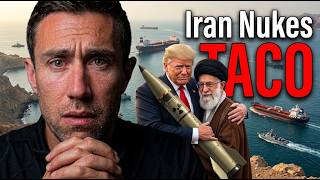
[14:59] That just ironically could align perfectly with a Taco Tuesday right before Kevin Warshay. so like there is a maybe 20% chance
[15:12] something gets announced between now and the day before the Kevin Warsh day and then oil prices tank and then Kevin Warsh goes oh these prices are down again I don even put the pants on I can wait to see how much these prices tank
[15:26] That's a chance. I think there is a more like cumulative 80% chance that we get some kind of positive outlook on Iran between now and the election.
[15:42] That drives oil prices down. That drives the inflationary impact down. That drives the three rate hikes that we've now fully priced in down. And then that ends up being very bullish for the broader market.
[15:54] I mean, look at the NASDAQ Technologies Index, for example. My belief is that this consolidation that we've had right here is really the resumption of war. And so we've been unable to get to new highs because of the resumption of war.
[16:12] and there's been a lot of uncertainty. I mean, we have the whole Leo fold in here and higher rates and all that. But I think there's enough evidence
[16:24] to suggest that this AI boom and the economy can keep booming, especially with the Atlanta Fed GDP. I think it's up by 4.7. Now we'll look at it. I think there's enough to say this has been 4.4 right now. Here it is.
[16:36] It's been held back by other factors that are not saying, oh, we're going to fall into a recession yet. Those indicators come when we see a rollover of earnings of the big spenders,
[16:49] the anthropics and open AI, and with the Astra release, the stable release, we're not there yet. Can it come? Yes. If it rolls over, will it be a horrible, nasty recession? Yes.
[17:01] But between now and then, could it be possible that we're creating more of a bottom in the tech market? And as we create more of a bottom in the tech market and data center market, and we align that with peak rate fear, peak Iran fear,
[17:15] and then, you know, basically what's Trump going to do here, we could be at a good setup for a breakout off this 100-day moving average on the Qs.
[17:27] That's my view. I think big beneficiaries will continue to be stocks like Apple and Meta as a recovery play, as something software does well. But I also think that hardware has gotten too cheap for this phase of the cycle.
[17:45] That would benefit the NVIDIAs, the Broadcoms, the AMDs, the Coreweaves, Oracle, even though it's flat after earnings here, SpaceX. These guys all win in this next memorandum of understanding.
[18:01] And so I know it's my speculation. I could be wrong about it, but I have a hard time seeing how it gets even worse. There are some ways it does get worse, but they seem less likely.
[18:13] Like, Iran pulls a nuclear weapon out of its butt. Okay, obviously, that would be bad. And while that's unlikely, it could happen. Might be, like, less than a 1% chance, but it could happen. That would be bad.
[18:28] Another one would be a ballistic missile actually hit an aircraft carrier and 500 Americans die instantaneously, and then Donald Trump wants to use strategic nukes in Iran and send them to the Stone Age.
[18:42] Obviously, we will probably rapidly fall into a recession in those edge case scenarios. But for removing the edge cases, knowing that we're positioned in a way where,
[18:56] you know, we're not like margined up, we're not leveraged up, we're super exposed to real estate anyway, doesn't matter. I think those extreme downsides are really unlikely to happen,
[19:12] but also if you don't have debt, you're not really worried about those downsides anyway because you're going to ride out whatever it is. Whereas on the flip side, I think the odds that Donald Trump before the election is really motivated to get a deal done,
[19:26] and that means if we fully price their rates, three rate hikes at this point, there's a potential that we actually have to unprice those rate hikes. That would be bullish, right? We get the three, base case, no problem.
[19:39] I don't think we're going to go for four or five or six or whatever. So it really means the only direction we could go is bullishness by going down on potential rates situation because of the deal. Then we might be at peak bearishness this week.
[19:53] And that makes me enthusiastic for buying good and bad. So, that was a long explanation. And it ends with, there's no coupon code.
[20:05] So, good luck. All right, cool. That's that. Why not advertise these things that you told us here? I see that nobody else knows about this. We'll try a little advertising and see how it goes. Congratulations, man. You have done so much. People love you.
[20:17] People look up to you. Kevin Passer, FSI. Nice to meet you. And you too, but me, Kevin. Always great to get your take. you
⚡ Saved you 0h 20m reading this? Transcribe any YouTube video for free — no signup needed.