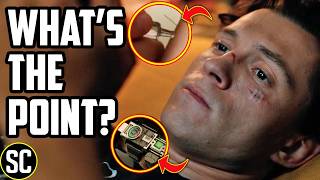

The Hidden Grief in Spider-Man: Brand New Day
45sThis segment introduces a compelling, emotional angle on a popular movie, sparking curiosity and engagement.
▶ Play Clip"Delivers on the promise of a deeper analysis, but pads it with a long sponsor segment and some self-indulgent tangents."
This video analyzes the deeper themes and hidden meanings in the film 'Spider-Man: Brand New Day,' arguing that it is a story about grief, isolation, and self-acceptance. The analysis connects Peter Parker's emotional journey to broader societal issues, including the post-COVID experience and queer-coded narratives, and explores how the film's characters each cope with loss in different ways.
The video posits that 'Brand New Day' is a superhero film about mental health, echoing themes from 'Thunderbolts' (depression and isolation). The central emotional throughline is grief, which Peter Parker experiences not only through death but through the loss of his entire life and relationships.
A scene where Peter swings in the rain and the film cuts to him in his apartment is interpreted as a brief moment of self-life-taking ideation. Unlike previous films where he had support, Peter is entirely alone, unable to mourn because he has lost everyone who remembers his past relationships.
The opening logo sequence is replaced with images of Peter fading from the memories of his friends and family, visually representing his loss. The logo ends with only Peter's face visible, highlighting his isolation, with the Spider-Man mask in the background symbolizing his attempt to escape loneliness.
The film is about the natural grief of growing up and life changing. Peter's relationship with MJ is a metaphor for the end of childhood and high school romances. The film argues that a 'brand new day' requires a previous day to be over, and that growth requires accepting that some things can never be the same.
The film is described as a post-COVID superhero movie with heavy themes of isolation and loneliness. Peter's self-isolation at the start mirrors the global experience of lockdown, and his emerging from it is represented by forming a real friendship with the character 'the wolf' by the end.
Peter's interaction with the world through Ned's social media is shown to be more painful than not seeing his friends at all, as it reminds him of what he is missing. The film demonstrates that digital socialization cannot replace human contact, and Peter's awkwardness at the party reflects the struggles many faced after COVID lockdown.
Every major character deals with grief: Bruce uses self-delusion (the inhibitor), Frank uses physical violence, and Jean lashes out emotionally. The film shows the dangers of repression, as seen when the real Hulk breaks out, and Frank's violence harms an innocent person.
The film draws parallels between Jean's story and the queer experience, with her rejection from her family being a metaphor for the rejection of queer children. Peter's journey of self-acceptance is also paralleled to queer people, and his ability to accept Jean is tied to his own self-acceptance.
The film marks Peter's graduation from a high school kid to a fully-fledged adult superhero. He becomes the mentor to a teenager (Jean), instead of being the mentee. His role in the climax is giving support, not receiving it, and he teaches 'with great power comes great responsibility'.
The film is a battle between Peter's private and public lives. He wants to be only Spider-Man, ignoring his personal needs, but this is destructive. The spider abilities begin to take him over because his life is out of balance, and he must face and grow from the pain of his personal life.
Tom's Peter makes the opposite decision from Tobey's in Spider-Man 2. While Tobey gave up being Spider-Man to focus on his personal life, Tom gives up his personal life to only be Spider-Man. The film shows that being seen as Spider-Man is not the same as being known as Peter Parker.
Jean wears a hundred faces when possessing people, but struggles to inhabit her own body, escaping into others due to self-hatred. By the end, she accepts her powers and herself, channeling destructive energy into something productive, just like Peter.
Subtle Depiction of Ideation
The analysis of the rain scene as a moment of self-life-taking ideation is a profound and sensitive reading that adds depth to Peter's character.
01:53Grief of Growing Up
The film's theme of natural grief in life changes is a universal and relatable concept, making the movie's message accessible to a wide audience.
03:03Post-COVID Loneliness
Connecting the film's themes to the global experience of lockdown and isolation provides a contemporary and relevant context for understanding the movie.
05:23Queer Coding and Acceptance
The interpretation of Jean's story as a queer analogy and the importance of parental acceptance is a meaningful and progressive reading of the film.
11:04Contrast with Tobey's Spider-Man
The comparison between Tom's and Tobey's decisions highlights a key character development and thematic difference in the franchise.
16:57[00:00] Spider-Man Brand New Day is making a ton of money and the movie is a lot of fun, but we also think there's a hidden meaning that explains exactly why this movie is resonating with audiences on such an emotional level. So in this video, we are going to break down the
[00:13] deeper meaning, themes, and messages that a lot of us may have missed the first time we saw this film. See, much like the Thunderbolts, this is a superhero film that tells a compelling story about mental health. The Thunderbolts told a story about depression and isolation through
[00:27] the characters Yelena and Bob. And now these scenes are being echoed in Brand New Day. It's no coincidence that Yelena appears in this movie since it helps tie these two together. And one of the biggest emotional through points throughout this film is grief. Now of course Peter Parker
[00:42] has been facing grief in every live-action Spider-Man movie. In the original Tobey Maguire trilogy the death of Uncle Ben haunts the narrative. And in the Amazing movies it's the death of Captain Stacy and his daughter Gwen. And in the MCU Peter has dealt with grief over losing
[00:56] Tony and in No Way Home he lost Aunt May. But in Brandon Day we see him confronting the loss of his entire life. He didn't just lose a loved one to death he lost every single person in his life but
[01:09] he still sees them every day. MJ and Ned may not be dead but his relationship with them is gone and that is still grief and loss. However there's a key difference for Peter that makes this loss even more difficult than all of the ones he suffered before. See instead of suffering through
[01:25] grief with a community to support him, Peter is entirely alone. He has no one who can empathize with him or listen to his troubles. And far from home, he shares the grief of Tony's death with Happy. And in No Way Home, his alternate selves help dig him out of depression after May's death.
[01:41] About half an hour into the movie, Peter is swinging around New York City in the rain after MJ and Ned's party. Now, there's a moment when he turns to face the ground, and we don't see him swing. Instead, it just cuts to him back in his apartment.
[01:53] Now, there are two purposes to this scene. One is that it ties into the rooftop scene from No Way Home, where it was also raining, but there he had other people to come and comfort him. Also, that moment of him facing the ground seems to point to a brief moment of self-life-taking ideation.
[02:09] Here, he can't properly mourn because he has lost anyone who even remembers that those relationships existed. It's an extension of the scene with Happy and Peter in May's grave in No Way Home. How'd you know her?
[02:21] Through Spider-Man. Yeah. Peter can't lean on the people around him because he is mourning those very same relationships that he lost. This is why all of the images in the opening logo have been replaced by Peter fading out of the memories of his friends and family.
[02:37] The opening reflects the fact that this movie is much more concerned with the human cost of Peter's wish than being a traditional superhero movie. We're not getting comics or cool action shots. We're just getting the visual representation of Peter's loss.
[02:50] The logo ends with only Peter's face visible, reflecting his isolation. In the background, we see the Spider-Man mask. And this shows how his identity as Spider-Man is his attempt to escape from that loneliness and loss.
[03:03] Now, these scenes of grief don't just apply to human loss either. There is a natural grief in growing up and your life changing. And ultimately, that is what Brand New Day is about. A brand new day requires a previous day to be over.
[03:16] And this film is about Peter accepting that certain things can never be the same. The end of Peter's relationship with MJ is a metaphor for the end of his childhood and the expected end of most high school romances.
[03:29] It's sad, but it's a part of life. That's the reason that Peter and MJ don't get back together. If everything ended up exactly the same as it was, then he wouldn't get the chance to grow and change. This is a movie that is about life transformation,
[03:42] and that is something that we can all relate to. Like, I think back on when I turned 18, and I went to college, and I picked a major, I actually made the wrong choice, and my life almost went down a very different path. Like, for instance, at our live shows, people always ask me, how did I
[03:55] get this job? I mean, this is a dream job for me, but I'm only here because of a key decision I made years ago. Like, originally, I thought I was going to be a social studies teacher. That's why I went to school, but then I improvised. I got bit by the comedy bug and decided to learn how to film and
[04:10] edit videos instead. Now, I was lucky that I was able to recognize that I was going down the wrong path and then I could still make a change while I was in school. But it's not always this easy. A lot of you might be stuck at the wrong job or you're dreading going to work every day and you
[04:25] wish that you could get a degree that actually works for you. Well, you can start going down the right path with Southern New Hampshire University. They're the sponsor of this video. SNHU is one of my favorite sponsors that we work with. They are one of the largest
[04:37] accredited universities in the USA with some of the most affordable tuition rates in the country. To get started you go to snhu slash screencrush and find the field that right for you And this is one of the best things about SNHU You gain real experience with their extremely flexible programs There are no set class times you work when and where you want
[04:57] This is why SNHU has been changing lives for years. You can also transfer up to 90 academic, military, or experiential credits. And that is why SNHU was voted one of the country's most innovative universities by U.S. News & World Report.
[05:09] So guys, it is never too late to pursue something that you love. Get started today by going to fna2.edu slash screencrush at the link below. Now, back to what I was saying. Now, it's also important to note that Brand New Day is a post-COVID superhero movie
[05:23] with heavy themes of isolation and loneliness. Now, we actually made a video you should absolutely check out about how these same themes are present in modern horror movies. Now, the gist of the video is this. Being stuck in our homes without human contact had a huge effect on global mental health.
[05:39] Current society has a much greater understanding of what it is to be cut off from other people and how important that contact is in our lives. At the start of Brand New Day, Peter has none of that contact. The girl on his floor tries to interact with him, but instead, he chooses to self-isolate.
[05:55] His only friend is the wolf, but he doesn't even know the names of her kids. This is a co-worker relationship more than it is a true, fulfilling friendship. This movie is Peter emerging from his own self-imposed lockdown.
[06:07] And, by the end of the movie, that is represented in part by him now having a real friendship with the wolf. There is a certain kind of loneliness that comes from living in a big city like New York, where you are surrounded by people who are connecting with none of them.
[06:22] There's a lot of shots at the beginning of the movie that purposefully place Peter alone and small within the frame. In film language, this is telling us that he is feeling like the world is a big place and he's barely a part of it.
[06:34] Even Peter's AI-Easy is a lot less human-like than his previous models. If I were her, I wouldn't be disappointed at all. Thanks, Mary. She really might have somebody to talk to. Now, this makes sense practically because he doesn't have access to the same resources that he used to,
[06:49] but it also gives him just one less human connection. Also, when it comes to COVID and technology, the one outlet a lot of people had during the pandemic was our electronics. Peter isn't even having tiny human interactions with others like talking to his food delivery people.
[07:05] The digital world makes it possible for him to withdraw completely. Similarly, Peter is only interacting with the world through Ned's social media. But this movie shows us that social media socialization cannot replace human contact.
[07:18] In fact, watching these videos is more painful for Peter than not seeing his friends at all because this just reminds him of how much he is missing. When Peter goes to MJ and Ned's party, he doesn't really know how to act.
[07:30] He has lost the casual ability to interact with other people that comes from, you know, regular human connection. Many people struggle with this same thing after emerging from COVID lockdown. This is also why Peter regaining his friendship with Ned is so important.
[07:45] After a period of isolation, our relationships with the people around us change. Peter and MJ may never return to where they were before the end of No Way Home, but that's okay. That is a natural part of growth and change.
[07:57] But still, Peter needs some human connection. That's why it is so heartwarming to see him and Ned rekindle their platonic love. Without MJ, Ned, May, and the rest, Peter was struggling to be Peter Parker.
[08:09] His identity as a person, outside of being Spider-Man, is shaped by his relationship with others, as is the case for so many of us. We always talk about endings being bittersweet because they are also chances for new beginnings.
[08:22] But the same holds true in reverse. Every New Day was created by an ending. This movie is about the pain of moving into the future. In the beginning of the movie, Peter is still stuck in the past. He watches Ned and MJ share opportunities that he can't be a part of, and it leaves him miserable.
[08:37] Instead of feeling his emotions, he throws himself into work, trying to convince himself that he can be Spider-Man full-time, and therefore, he can avoid the emotional pain of being Peter Parker. Peter is not only grieving Aunt May, but also his friendships, romance, college, childhood, and the future he expected to have.
[08:54] It's not just the grave of Aunt May that he keeps visiting. It's also Peter Parker's grave. He is mourning his own life, but also not making any steps toward reclaiming happiness. And Peter is not the only character in the movie who is dealing with loss.
[09:08] Every major character in the movie has dealt with grief and pain. Bruce lost Natasha, Frank lost his family, and Jeannie lost her sister. Each character reflects a different way of dealing with that loss. Bruce responds
[09:21] with self-delusion, which is represented by the inhibitor. As this movie shows us, Smart Hulk was basically a long period of denial. The rage still exists inside of Bruce The inhibitor just hides it But as Peter finds out it is not healthy to inhibit yourself for the purpose of suppressing inconvenient emotions That is why the real Hulk breaks out again Frank responds with physical violence It no secret that his vigilantism is the way he copes with the death of his wife and kids and it is not good for him
[09:49] This movie confronts him with the way his anger and violence can be destructive to the people around him. Peter even wants him in their first scene together. Frank shooting Peter at the end
[10:02] is two things. It is a concrete example of how his vigilante lifestyle and violent solutions are actually harmful to innocent people, but it's also a metaphor to represent how his anger hurts the people he cares about. He was trying to kill Jean to protect innocent lives, but instead ended up
[10:18] endangering an innocent life himself. Jean's actions are also motivated by grief and loss. While she may not know for certain that her sister is dead until she's in prison, she definitely still feels that loss. Her actions throughout the movie are actually metaphors for emotionally
[10:33] lashing out out of grief. She is being cruel to others and letting her own identity become buried in pain. But this is actually a reflection of all the misery she's experiencing. It is not only about the grief of losing her sister, but, similarly to Peter, of losing her whole life.
[10:50] Because of her mutation, she was rejected by her mother and lost the entire life that she used to half, so she is also grieving the loss of her life. And it's worth noting the obvious parallels between Jean's story and the queer experience. Jean and her sister's rejection from their family
[11:04] feel like a queer analogy to the rejection of queer children by some of their parents. Now, the X-Men have been used as a metaphor for multiple societal issues, including race, gender, and sexuality. But in most recent iterations, there is a lot of queer coding in the text.
[11:18] Has he tried not being a human? This is why it's important to not only have Peter accept Jean, but also to have his version of May accept her. Acceptance from a parental figure, unconditional love is very healing to a traumatized, queer-coded teenager.
[11:34] Peter's own journey of self-acceptance also has parallels to queer people. He has to learn to accept all of himself, even the parts that he might find inconvenient or that scare others. And it's through this self-acceptance that he can truly offer that acceptance to Jean.
[11:48] And the same motifs also exist in the Hulk. The inhibitor, much like the cure for mutations seen in various X-Men stories, is a representation of suppressing her true self. Bruce is hesitant about Peter inventing a universal inhibitor because he sees the potential ramifications.
[12:04] But he doesn't analyze his own use of the inhibitor. In She-Hulk, we saw Jen harness and accept her anger and be able to exercise control over her other self. No, I'm doing this. Okay, this is completely new territory.
[12:18] But Bruce never tried to learn that lesson. He found a way to chemically control his alter ego, and so he never had to go through a journey of self-acceptance. And this movie shows the danger of repression. When your true self inevitably comes through, it isn't going to be pretty.
[12:33] The first three films in Tom Holland's Spider-Man trilogy were about a high school-aged Spider-Man with the accompanying problems of youth. He had girl troubles. He wanted to be able to enjoy a class trip and had trouble getting into college. But now, in Brand New Day, those problems are, as Elena would say, small potatoes.
[12:49] He's in the big leagues now. And in order to show his new growth, there was no better way than to make an antagonist of the film a teenager. Spider-Man is now the grown-up mentor in the movie instead of the mentee that he has been for the last three films.
[13:03] His role in the climax is giving support instead of receiving it. And it was only through his own struggles that he was able to be there for Jean. This is metaphorically represented by the way that only Peter can see Jean when she's jumping between bodies.
[13:16] He can relate to her experience and see her, but when he represses himself, he also loses the ability to understand Jean. It's through self-acceptance that he can also accept her. Now, this marks a really important transition for Peter.
[13:29] In the first three films, he had various mentor figures. Most importantly, of course, Tony. But, we're finally seeing Peter graduate from being a kid into a fully-fledged adult. Superhero. It's perfect thematically that this comes with a graduation from high school and from a time jump.
[13:44] Now, he can be the adult who is there to guide a troubled teenager who is struggling with her power. Instead of hearing it, now Peter is teaching that with great power comes great responsibility, and he's now responsible for Jean being the hero that she's going to be in the MCU.
[13:58] Now, you might be thinking that it's May who gives Jean the most important support, and you're right. But that vision of May is from Peter's own mind. It's only because he received that support himself that he is able to pass it along to someone who needs it more than he does.
[14:12] As it says on her headstone, when you help someone, you help everyone. This also does a great job of honoring May's legacy in these movies, and also affirming how important she was to Peter's character development. As Destin Daniel Cretton said to producer Amy Pascal if we can do a movie that is about how reaching out and making a connection to someone is the most important thing you can do then I understand how to do this movie
[14:35] Not many movies in the MCU have dealt with the classic secret identity aspect of superheroes. Spider-Man is one of the few heroes with the remaining secret identity, which was restored to him after No Way Home. But this is a part of the conflict that he's facing in this movie.
[14:49] This movie is a battle between Peter's private and public lives. He wants to completely let his personal life become subsumed into his public life, ignoring his wants and needs. But instead, the spider begins to take him over because his life is out of balance.
[15:03] He can't exist only as his superhero persona as much as he might want to. He has to face and grow from the pain of his personal life. The moment when the spider abilities first affect him is right after that moment of ideation that we talked about earlier.
[15:17] He is so overcome by his repressed negative emotions that they forcibly create a physical outlet. That energy can't just be suppressed forever. Even Metzger mentions early in the movie that Damage Control's goal is to redirect destructive energy into something useful.
[15:33] And that reinforces this theme. Instead of being repressed, Peter's destructive spider abilities need to be redirected to help him. Peter sacrificed everything in No Way Home. and his initial goal was to regain his private identity as Peter Parker, separate from Spider-Man.
[15:48] But, in a classic be-careful-what-you-wish-for move, in doing so, he lost everything that made the Peter Parker identity valuable. His history, his relationships, and family were all gone in one fell swoop.
[16:00] Now, when he tries to ignore Peter's needs altogether in favor of being Spider-Man, we see the ways in which this decision was destructive. Peter's struggles in the previous trilogy of movies were all focused around figuring out ways to balance being Spider-Man with his personal life.
[16:15] He wanted to be able to be a regular kid, to go on vacation, and to go to college without being burdened by his superhero identity. This time around, he's trying to figure out how to manage his superhero identity without having to be a fully realized human being at the same time.
[16:30] Peter doesn't want to live his life because if he has to face life as Peter Parker, he has to acknowledge how isolating and depressing it is to be himself. This movie's conflict about Peter's powers misbehaving is also reminiscent of Tobey's similar issues in Spider-Man 2,
[16:44] where he temporarily lost control over his abilities. They even both have a scene where Peter falls out of a building. My back! My back! But Tom's Peter makes the opposite decision from Tobey,
[16:57] Whereas Tobey decided to give up being Spider-Man altogether to focus on his personal life and happiness, Tom gives up his personal life to only be Spider-Man. In this movie, we see the superhero identity reach even greater heights,
[17:09] but being seen as Spider-Man is not the same as being known as Peter Parker. He's famous, with Ned even tracking his movements with an app, but Ned is only interested in Spider-Man, not in Peter, who is a stranger to him.
[17:22] There's a slot early on in the movie when Peter is holding a key to the city that he received as Spider-Man, while bruised and miserable doing his laundry. This one shot shows exactly the problem that he is facing. He is lauded as a superhero,
[17:34] but it's not doing anything to improve his day-to-day life. Peter also uses fake names when he's out and about in his personal life. This has practical motivations, of course, but it also represents his loss of personal identity.
[17:46] Instead of being Peter Parker, alias Spider-Man, he is only Spider-Man. When he meets with Yelena, she forces him to be vulnerable by removing his costume and asking him personal questions. but he keeps the mask on, both literally and figuratively.
[18:00] I think it's also meaningful that Peter is more cavalier about showing his real face while in the suit than he has ever been. He's frequently out on rooftops with his face visible. He's not nearly as concerned as he used to be about his secret identity being revealed,
[18:13] because that Peter identity doesn't mean anything to him anymore. And this is yet another thing that ties Peter to Jean. She wears a hundred faces when she's possessing people, but she is struggling how to figure out how to inhabit her own body.
[18:25] To deal with the self-hatred that comes from being rejected by others, she is escaping, literally, into other people. But the end of the movie shows that she is finally accepting her powers and herself, and she is channeling that destructive energy into something more productive, just like Peter.
[18:41] Huge shout-out to Harriet Lingle-Enright, who wrote this video. You can find her links below. And another huge shout-out to philosopher and friend of the channel, Nicholas Michaud, whose insights we used to write this video. So, guys, let us know what you thought the deeper meaning of Brand New Day was,
[18:53] and what you think of the movie down in the comments, or on our free-to-join Discord server. And if it's your first time here, welcome to the channel. Please subscribe, smash that bell for alerts. For Screen Crush, I'm Ryan Airy.
⚡ Saved you 0h 19m reading this? Transcribe any YouTube video for free — no signup needed.