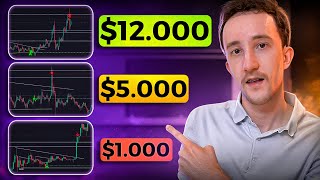

My $20K Trading Strategy Revealed
45sThe promise of a personal, profitable strategy with specific dollar amounts creates immediate intrigue and FOMO.
▶ Play Clip"The title promises a 'money-making strategy' and delivers a detailed walkthrough, but the heavy promotion of a paid team and the single trade example dilute the value."
The video presents a personal trading strategy that focuses on entering at decisive points where other traders make decisions, using liquidity zones and market psychology. The trader demonstrates the strategy with a real trade, showing both successes and mistakes, and emphasizes the importance of discipline and a systematic approach.
The strategy is based on personal experience from 5 years of trading, aiming for $10,000-$20,000 per trade.
Use a screener to find active coins; look for coins with high price change (e.g., 172%) and over 1 million trades in 24 hours.
Identify key levels like slopes, densities, and accumulation zones where stops are hidden; these are liquidity zones.
Enter at the moment of breakout or retest, using the power of other traders' decisions.
The trader made a mistake by exiting early due to emotions, turning a $1,000 loss into $3,000.
After re-entering, the trader earned $19,000 (42% move) by following the strategy and holding through the movement.
The strategy consists of 7 steps: coin selection, formation, entry point, stop, take profit, behavior in trade, and rule compliance.
What is the first step in the strategy for selecting coins?
Use a screener to find active coins with high trading volume and clear trends.
00:46
What is the minimum number of trades in 24 hours for a coin to be considered?
Over 1 million trades in 24 hours.
01:56
What price change percentage indicates a heavily pumped coin?
A price change of over 100%.
01:26
What are the key elements of a formation that a trader should look for?
Levels, slopes, densities, highs, lows, and accumulation zones.
02:58
Why is it important to identify liquidity zones?
To find decisive places where people make decisions, such as stops and entries.
03:13
What type of stop is recommended when entering after a pin on a slope?
A short stop, because the trader saw strength after the pin.
07:27
What mistake did the trader make in the first trade?
He exited early due to emotions, before his stop was hit.
13:11
What was the consequence of the mistake in the first trade?
It increased his loss threefold, from $1,000 to $3,000.
17:34
Why does the trader keep take profits manual instead of limit orders?
Because after crossing final levels, there could be a big long movement or trend.
23:34
What was the final profit from the trade?
He earned $19,000, a 42% move.
26:13
Coin Selection via Screener
Provides a concrete, actionable method for filtering coins based on activity and volume.
00:46Trading at Decisive Places
Explains the core philosophy of profiting from where other traders make decisions.
02:43Emotional Exit Mistake
A real-world example of how emotions can lead to costly errors, reinforcing the need for discipline.
13:11Mistake Triples Loss
Quantifies the impact of a single mistake, showing how it can amplify losses.
17:34Manual Take Profits
Highlights a strategy for maximizing gains by not setting limit orders, allowing for flexibility.
23:34[00:02] Many traders are looking for a bunch of different strategies, trying to get big percentages and make money here and now as quickly as possible. But, as a rule, this ends with them losing their money very quickly, because these
[00:18] strategies have no system, and it is unclear what they are based on. But today I will show you personally my strategy, with which I earn 10, 15, 20,000. dollars
[00:30] from each transaction. This strategy is based on my experience, on a huge number of transactions that I have made, and I have been trading for 5 years now. Let's jump right into the trades and strategy and go over each aspect. Take a
[00:46] notepad and a pen and write down everything I say step by step. The first thing we have is the selection of coins. For this we use screenergage. We enable the
[00:58] search for active coins in the workspace settings. And the screener will show us the most active coins that we have on the market. And from these coins we will take those coins that we will trade. I'll leave a link to
[01:11] Digash's screener in the description below the video. And now the screener has just found an active coin for me. This is a yk coin. And let's look at its technical data. What should you pay attention to in general? The first criterion
[01:26] is the change in price. In this case, the coin grew by as much as 172%. It was heavily pumped, and this tells us that money and volumes are being pumped into the coin tells us that money and volumes are being pumped into the coin . And the coin has a clear,
[01:41] understandable long trend. The next thing we need to look at in technical data is the number of trades in 24 hours. Here we had 2 million Here we had 2 million transactions. We select coins over 1 million.
[01:56] This means that this particular coin's value was twice the average for our trading criteria—that is, the average value is 1 million, while this one is 2 million. Looking at the technical data, we can see that the coin is
[02:11] truly active, that it has a clear trend, that it has grown by many percent, and that a large number of trades are being made on it . And it's clear that a large number of people trade this coin , and people set their
[02:26] stops, enter trades, exit trades, and lock in their positions. They take a lot of actions when trading. And knowing what actions people take, we make money from this. This is what my trading system is all about.
[02:43] Make money in decisive places, in those places where people make their decisions. Let's now look at the second point. This is the formation itself, what it should look like. First of all, of course , we must have clear, understandable goals.
[02:58] Our targets may be levels, slopes, densities, highs, lows, slopes, densities, highs, lows, trades, and some accumulation zones. And behind all this we have a large number of stops. And stops are
[03:13] liquidity, and our market goes for liquidity. And, therefore, in this transaction, we will be hunting according to our strategy at the intersection of these long levels. And I also want to draw attention to the fact that we trade strictly according to the
[03:27] trend. Here at four o'clock we see a big pump. And it was precisely on the higher timeframe that these levels were formed. Next, we move on to a more local timeframe, that is, 5 minutes. And let's see what we have here. Here we
[03:42] hit these levels, started to roll back, and we got this accumulation zone. Next we move to an even more local timeframe. This is 1 for a minute. And here we see that we have such a triangle. And so,
[03:56] in our country, trades are traded in such a format that the trade accumulates strength in a given area, in a given zone, and it, like a spring, shoots out in some place. And our task here is to enter the moment when
[04:11] the spring is triggered by the power of those people who will ultimately win in this accumulation. Here we have a coin that has a good long trend. Plus, we have a large liquidity zone here in the form of long levels, so it
[04:27] will be more preferable to work in the long position. And before I processed the deal, I first posted it to the Puzachi team. Here we see how I have marked these scenarios. First, we have clear levels on the four-hour timeframe. And then we move on to the local timeframe
[04:43] for a minute. Here I noted that we have high. And according to the first scenario, our entry point is at the moment of breaking, just when this spring is released and people start winning, and we enter with force. And the second
[04:58] scenario, which I also noted here, occurs at the moment of trading the final levels. during the period of time when we begin to cross the final triggered. That is, this strategy is suitable for most traders,
[05:13] because some like to delay trades, some like quick scalping trades, hop-hop, in-out in a short period of time. Some people actually like medium-term deals there. That is, everyone has their own way of dealing with things, everyone has their own psychotype,
[05:27] temperament and psychology. That's why I highlight scenarios for all types of traders. Personally, I find goals and then push towards that goal. I'm pulling the deal towards this goal in advance. As a result, I have marked the trading scenarios here and posted them to the
[05:42] pot-bellied team. I also described in detail what I expect from these coins and how I plan to trade. We have a large amount of training material on our team of pot-bellied people , and there are a large number of topics. You can go to them and find answers to
[05:57] all your questions. The team also posts the formations we are monitoring, including all the marked trading scenarios. And with this, making money from trading becomes much easier. Join the
[06:11] pot-bellied team. Let's pull the green stuff together. Now let's move on to the actual processing. Here I see that our coin has begun to accumulate strength and is approaching the short slope that we have formed. And here the
[06:25] plan is that you can work on a rebound from this slope or on a spike in this slope, that is, our slope shows that we have a long trend, and the trade can be considered either on a rebound from the slope or on a spike in this
[06:41] slope. But we will also have long-term goals. And now I see that we are trampling around the slope, they pricked it a little and hop, they suddenly bought it off. That is, the longists showed strength. And so here I saw that, aha, the
[06:56] payoffs come from the tilt. They removed a little liquidity and started buying back the coin. And therefore, here you can try to enter the stake of this slope with the aim of exiting the trade at the moment of straw and holding out until the final long targets.
[07:13] Therefore, as soon as we started buying back the coin, I already noticed that the longs began to show their strength. And here, of course, it is more important to work with a short stop, because here we have already seen the strength, just
[07:27] after we pinned this slope, pulled the nearest stops and began to buy back the coin. And after that, after we called, I already saw that, aha, we had strength, so I decided to enter into this deal
[07:42] and went long. My stop here is as short as possible for the reaction short as possible for the reaction we had from the stab on the scrap. And then we see that we have added long purchases and the movement
[07:56] begins to go higher and higher in the long direction. And I also want to say about this entry point, that here we begin these buyouts that are happening now. And therefore, if we already had a second touch in the tilt as a decisive place,
[08:11] now we already have this third touch in the tilt as a decisive place. And the stop is already located just beyond the third touch . And now we have reached the round number of 0.1 dollars and are hovering around it. $0.1 is a big, nice
[08:27] round number. There are still densities here, and therefore, after this round number is broken down, it is more likely that we will have an impulse and a breakout of this trade, after which a long exit will follow. And in
[08:40] trading, it is important to be able to find the decisive places where people make their decisions. Trades are entered, trades are exited , positions are fixed. Someone is starting to gain ground. It is important for us to be able to find such places. And now
[08:55] accumulation is already taking place around the round number 01. And pay attention to what happens next. We initially touched on this round number, rolled back from it, and now we are starting to break through it. After that, we approach
[09:08] the slope itself, we begin to gradually cross it, and our coin activity increases very strongly. And, by the way, activity increases precisely in crucial places, when people connect and make even
[09:21] more transactions. This is where we start to cross, and we are already experiencing neat breakouts. Also, pay attention to the spot that we have a slab of yellow density, which ultimately pushed up
[09:36] density, which ultimately pushed up the price. That is, we clearly have a participant on the coin who substitutes densities both on futures and on spot. And there are also a lot of other people who put their stops,
[09:49] enter trades, exit trades, lock in positions. in decisive places. And that's why trading becomes much easier when we trade with other people, when we understand what and why these movements are happening. At
[10:05] the moment, it's already +4,000 dollars, and the coin is moving at very high percentages here, so I entered with small volumes, but at the same time, due to the fact that the coin is moving at high percentages, the profit is the
[10:19] profit that I should get on average from transactions. And here the coin has already crossed this threshold and gone long . That is, we already clearly have good strength. And with this strength we have already left. Stops worked locally. And our
[10:34] next targets here are the final long levels, behind which are the main stops. If we initially decided on a coin, a formation, an entry point, a stop loss, and a stake, then the next step, when we
[10:50] are already in the trade itself, is when this behavior in the position comes into play, what we this behavior in the position comes into play, what we will do within the trade, will do within the trade, because we do not always exit according to the
[11:03] scenarios that we initially prepared. That is, we do not always close a deal at that stop, at those take profits, and because we have decisive places, they can change within the position itself, and even more so when our
[11:18] position is stretching, and within this position, at this distance, our decisions can change and new ones can appear. And in this case we see that the coin left this trade and then returned. And now it is in the
[11:33] retest zone. We are slowly undergoing a retest. And here the decisive points are the appearance of a new High and the retest of this trade itself. At the moment, we see that we have retested and we are starting to see a buyback. That is, the longs
[11:49] defended this place and bought back the price, due to which we had a long movement, a rebound, a retest from this trade. But it is also important not to forget
[12:01] about the short sellers, that they exist at all and that they can also do something of their own . And by the way, another very important detail that I noticed after a large number of transactions is that if we have a superactive coin, then it
[12:16] will move quite manipulatively. That is, there are easy entry points there, they will be knocked out or the liquidity will be somehow removed behind these entry points. which is what is
[12:29] happening now. That is, we had a super clear point from the slope where I entered. Plus, it was still possible to enter the breakdown itself and it was still possible to enter from the retest. But now we see that the short sellers have joined in.
[12:44] And notice that the coin starts to roll in. I see this big roll-in. And exit the deal, that is, I stop and walk with a minimum stop.
[12:56] But, by the way, I want to say that I made a mistake here, because I exited incorrectly here, because the coin fell sharply and on sharp falls of the coin, they then buy back in the knife format. But I, well, emotions kicked in,
[13:11] something was somehow unclear to me here , and that’s why I just went out when I needed to just sit. And what’s more, we haven’t even reached my stop. I got out here before my stop. As a result, I close my first
[13:27] entry point at the minus of $730. A short stop, you could even say a breakeven, but a big mistake was made here , so this is an extra minus that shouldn't have existed at all , because here it is due to a
[13:42] mistake. And now, notice that my stop was located behind the very pin of this long inclination from which I entered. But I left early and I left in an unscheduled manner. And so here I caught an extra stop that I shouldn’t have
[13:59] caught, and at the same time I made a mistake that I exited ahead of time, not according to the strategy , not where I should have exited. And I also didn’t take into account the fact that when we have a sharp movement, it then pays off in a knife-like manner, which is what
[14:13] started to happen here. The coin started to buy back, and it turned out that I was knocked out and after that the coin went long. And if you've had exactly the same thing, when you close a deal, stop out, and then the coin goes where it should,
[14:29] ultimately achieving all our goals, then write in the comments the word was. This way we will know how many of us there are. But the most important thing is to understand where the mistake was. And that's why I re-entered this trade here because I exited incorrectly. I
[14:44] understood this immediately and that's why I switched. the fact that I was simply removed by this withdrawal of liquidity, and I still needed to be here in a position and pull it out. But, by the way, I re-entered not at the most favorable prices either, and therefore, you could
[15:00] say, I took that stop, simply took a minus out of nowhere and also ruined my entry point. It is always important to follow a strategy and trade systematically according to the rules. Only then will there be good results and earnings from trading. That's the
[15:16] whole point. Discipline. Only discipline and system decide. As a result, the coin began to accumulate its strength here again. And we can notice that we have such a local short trend. And here the decisive point
[15:31] will be the intersection of the first candles on the path of our short trend. That is, after we cross them, a long trend will begin. We will move into the long phase again. In the end, that's what happened. We crossed these candles.
[15:47] We had a long move, but then bam again and the shorts came in and pushed the price down. After which I saw that we had a new slope, and everything would happen against its background. And slopes have this feature:
[16:03] , then when the slope is crossed, this liquidity is all triggered at once and a large movement occurs. But it also happens that there is little liquidity behind the tilt and it will be bought out. And after crossing
[16:19] the slope, a jam may occur, or even a rebound. And here it is important to understand whether this liquidity exists or not. And in this case, pay attention to what will happen now after crossing the slope. We approach it, and our
[16:34] activity increases, and as a result, the nearest candles cross. And we have a big short candle happening. And the activity is short, the candle is short.
[16:46] As a result, I get stopped out again here . As a result, I closed the second entry point to the mine. 300 dollars. And here, because I made a mistake in the first deal , firstly, I exited incorrectly. Plus, this incorrect
[17:02] exit led to me re-entering the deal at unfavorable prices. And if in the first deal I closed minus 700 dollars, then in this deal I closed minus 2,300 dollars. As a result, I already had a minus of 3,000 dollars. But at the same time
[17:18] already had a minus of 3,000 dollars. But at the same time , if I had not made a mistake in the first trade, I would have made only one trade and would have closed at minus $1,000, and not as it turned out in the end at - $3,000. That is, having made a
[17:34] $3,000. That is, having made a mistake, I increased my stop, increasing mistake, I increased my stop, increasing my minus threefold. That's a lot. And now you can clearly see why it's important to stick to a trading
[17:48] strategy, why discipline and system are key in trading. And if we deviate from our system and discipline, then we will increase our stops, increase our minuses, some kind of mess will appear, incomprehensible
[18:05] transactions, incomprehensible actions. This will not lead to anything good. Therefore, only discipline, only system, only structure, all of this is important to observe. All the rules that we have written down. And if you want to see live
[18:21] trading, what I do in life, what trades I make, posts with trade analysis, posts on psychology, then visit my Telegram channel. I'll leave the link in the description below the video. And now let's look at what
[18:36] our situation is at the moment. We see that the coin initially accumulated strength, exited the trading range, and then fell to retest. They started to hold something back during the retest, but then they couldn’t. The coin rolled in. Then the tilt appeared again.
[18:51] The slope was crushed by short sellers. And now we have a short loi formed. We hit this short loy, we stabbed him a little. And here it is very important what
[19:03] appeared. We stabbed this loy a little bit, and accumulation began to occur here . That is, we did not fall below this barking, but on the contrary, we began to maintain it. And now, since we have no stops left for the long-termists,
[19:17] we knocked out these stops for the retest, for the short tilt, for the nearest barks, then for this bark there are no more of these stops left. And now we are on this bark, we sharpen it a little, and we begin to make den purchases. I see this and
[19:33] enter into a deal because we cannot rewrite the loy. We are being bought out, there is a long movement, and therefore this is a very good point to enter into a deal. And right now we will see how this deal, how
[19:49] now we will see how this deal, how this point works out. But it is also important here not to rush, so that at least a little bit of a long candle appears. No, at the very least, we should have this supported by both a graphical picture, a graphical
[20:02] pattern, and a glass formation. what is happening to us in total what is happening to us in total across all the criteria that we have in the market. All of this is important to take into account, and then we will truly understand
[20:17] that Aha, we have an accumulation of candles on the chart, , so we rely on both the chart and the glass. And that's why
[20:32] I entered into this deal. So, what are the key points on our chart now? The first deciding place is where my stop is. I have it where my stop is. I have it behind the fence of this local
[20:47] behind the fence of this local level. And when my stop is crossed, the stops of other longs will start to be triggered and a short trend will occur. And and a short trend will occur. And the second decisive place for us is at the
[21:01] moment of breaking, at the moment of torque at the 0.95 mark. It is precisely when this level, this accumulation, is crossed that we will enter into long positions and a long trend of continuation of our entire
[21:17] long trend of continuation of our entire movement will occur. And here it is important to understand what decisive places we have, what people are doing on the chart, what people are doing in the glass. It is important to take all of this into account. And only then, only then will we have a
[21:33] truly good result. And now we see that I entered into a deal and immediately a green light is drawn for me. It’s not like we’re just hacking it together, rolling it in, or doing something incomprehensible . No, I immediately get
[21:48] green paint. Why? Because I entered at a decisive point. Because I entered through the power of other people. And that’s why, together with this force, all movement goes on for me
[22:00] like a locomotive. It's like going with the flow. You jumped into the current and it carries you away. And it's exactly the same here. I went with the current, and it carried me in the
[22:12] direction I needed. At the moment, it is plus 4,500 dollars. And in general, in this transaction, in this formation, I included a stop of $3,000. In principle, that's how it turned out. And my take profits were around 20,000 dollars,
[22:28] because the coin moves at high interest rates, and therefore I took into account that I set such-and-such a stop and such-and-such a take profit. Therefore, my ratio in this Therefore, my ratio in this transaction was around 1 to 5, or
[22:40] 1 to 6. This is taking into account that I have already worked it out in several transactions. But in several transactions this is, of course, due to an error in the one that I re-entered. The first table should have worked out, but it only ended up being minus $1,000,
[22:53] and because of an error it grew to $3,000 . But in the end it’s still in the region of what I had included in the risk. So, from a financial perspective, it's all strategic. And now I’ve already entered, the coin is starting to steer towards long. Here we have another
[23:07] accumulation of this kind. And the deal the deal turns out to be quite long-term. I see this and ultimately decide that I have already entered a position, that’s it, it’s stretching, my stop is in
[23:22] the glass, and my take profits are always manual. I don't set take profits as limit orders, because after crossing the final levels, where my take profits will be, there could be a
[23:34] big long movement, and plus some big trend could appear . And in order not to miss this impulse, a big movement, some kind of trend, I always have take profits, they are manual and based on the facts that we
[23:49] ultimately have after the intersection. Somewhere I might even close before the levels, somewhere behind them, somewhere I’ll take the impulse, somewhere I’ll wait for a big movement to develop. As a result, here I already had to go, leave the house for
[24:03] business, and I decided that I would close this deal over the phone. So then I worked on it and closed it from my phone. So I'm driving in the car and decide to see
[24:15] what's going on. As a result, I take it out, look, and the coin is at the top . I go into my personal account and I see green stuff there. I'm like bam-bam-bam. I go in and see that she has flown away from the chart.
[24:30] And it was precisely on this flight that I secured my position. But, as we see, the coin went even further, even higher. They pumped her up even more, but that was the next move we had in the future. This is not my strategy.
[24:46] My strategy is to find a liquidity zone where a large liquidity zone where a large number of stops are hidden, and to gain in advance, reaching this zone, and to take more movement after crossing this zone due to
[24:58] the stops that have accumulated there. As a result, it happened here that I found the decisive place after pinning the short local. At the moment when longs started buying up the price, I clicked at the decisive point. Then our coin started
[25:14] moving and gained strength again. created such a slope. We crossed this slope , and here we already had a large movement in the form of a stick. And when sticks appear on our chart, they, as a rule, in most cases
[25:30] begin to roll in. And these rolls are very sharp. That's why you can never predict here that we'll have either a roll-in or a continuation of some trend or movement. Here we only work at the moment when we have the criteria
[25:45] that suit us for trading. Here, at that very moment, a moment, a stick happened and the stops were triggered, removing all liquidity. And then we didn’t have any places with liquidity. And therefore,
[25:58] further movement is not processed according to the schedule, it is processed only according to the glass. And since I wasn’t at home, of course, I couldn’t physically work it off with a glass . So I closed the trade using
[26:13] my strategy and took a plus 42% move from that trade and earned plus plus 42% move from that trade and earned plus $19,000. And if you want to start earning money from ratings, then join our team of Puzachi. Here you'll find a
[26:26] wealth of educational material, current formations with pre-defined trading scenarios, a friendly team, and 24/7 support. I post this deal on BC and
[26:38] generally all the formations that I trade in the Puzachey channel. And the pot-bellied ones also took away our green stuff here. Some people say 14%, some say 14%,
[26:50] green stuff here. Some people say 14%, some say 14%, some say 35%, some say 9%. Everyone takes their profits and makes money from trading. The most important thing is to stick to the strategy. Our team's strategy is very clearly defined, so it's very easy for the pot-bellied
[27:04] to collect the green stuff. Everything is built on the structure of decisive places. Profits are immediately shown. Join the pot-bellied team. I'll leave the link in the description below the video. Let's pull the green stuff together. And so we see that when
[27:18] we fully adhere to our strategy, when we do everything strictly according to the rules, then the result is appropriate. And if we start to deviate from the rules, as in the first deal, then
[27:31] our results worsen. And that is why it is important to control ourselves and all the actions we take. Only then will there be a good and stable income from trading.
[27:43] And it is also important to consider the risks. the downside that you can bear and accept from the deal. This is important so that it doesn’t happen that you go in, get a minus, then go in again, get another minus, then another, then another , then another. As a result, I am already in a tilted
[27:57] state. They caught a bunch of minuses, it ’s not clear what they did. This won't ’s not clear what they did. This won't work. This will lead to the draining of the deposit and complete withdrawal. Therefore, it is important to take into account all the risks, rules, and
[28:11] allow for a certain amount of acceptable loss and a certain number of transactions per transaction. Because the number of transactions made is also important, since if we have a large number of transactions, then a person can
[28:26] fall into a daze, and he will not be able to control himself. Therefore, it is important to let yourself know that, aha, we got three minuses, we got two minuses, we got one minus, we got five minuses. Each person has their own threshold, after
[28:40] which they begin to feel courageous, and it is unclear what to do. And we choose this threshold for ourselves, that my threshold is so much, so much in the form of money, in the form of the number of transactions. All. And we adhere to this threshold so that
[28:54] All. And we adhere to this threshold so that all our transactions are rationally and not just because we wanted to or because we felt some emotions. It won't work like this. Only discipline,
[29:09] system and adherence to rules work. So what do we get as a result? What do we need to make money from trading? Take the green stuff and pull the big, huge inflatable belly. First, we are selecting coins. The second is the formation,
[29:26] how it should look. Third is the entry point. Fourth - stop. Fifth - take. entry point. Fourth - stop. Fifth - take. Sixth - behavior in the transaction. Seventh, compliance with all these rules. Compliance with the system. Take a disciplined approach to
[29:43] trading. We covered all of this in this video. Go through all of these factors thoroughly. Write it down in your notebook, in your workbook, and before each transaction, read it to yourself and double-check that you are doing everything correctly. Only then will there be good
[29:59] earnings from trading. You have everything for this . All that remains is to begin. All links to Telegram channels, the screener, and the " Puzachi" team will be in the description below the video. Subscribe, let's get the green stuff together. Thank you all very much
[30:15] for watching. Let's shake hands, enjoy ourselves, and have fun. We inflate the big belly, be sure to pull out some green stuff, large pouring glasses. Thank you all very much, goodbye . Bye. [ __ ]




⚡ Saved you 0h 30m reading this? Transcribe any YouTube video for free — no signup needed.