[00:01]
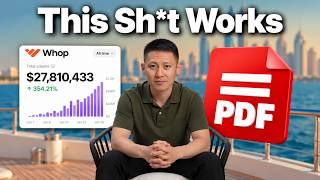
digital product business that does $500,000 a month and exactly what I do if I had to start over and get back here so you can run the same playbook. And the thing that made it work wasn't a better product. It was that I stopped
[00:16]
listen to me on this, to be honest. If you don't know me, my name is Richard Yu. I sold my first digital product in university, a $500 productivity course. It did about $500,000 in 8 months. And since then, my digital products have
[00:31]
done over 32 million in sales. And to prove it's not just one person who got lucky, here are three of my clients. Lila, a university student, did over faceless. [music] Priscilla, a stay-at-home mom with two
[00:45]
kids, made over 20 grand in her second month. And Shawn, working 80 hours a week as a full-time nurse, made over 105,000 in sales [music] in a little over 4 months. Now, to be clear, those are sales, not profit, and they're also
[00:58]
not typical. Your results are going to vary depending on your effort, your >> I'm showing you these so you can see the real steps in a real working business, here's exactly what I'm going to walk you through. First, how to find a
[01:14]
product that people already want to buy and prove it before you build anything. Second, how to package it so people pick yours over everyone else's. And third, how to deliver so well that your buyers come back for more. Fourth, how to turn
[01:30]
attention into buyers without your content feeling like an advertisement. And fifth, how to use your numbers to keep hitting winner after winner. I'll give you the mistakes that I've seen thousands of students make [music]
[01:43]
and exactly what I do in order if I had to start from zero tomorrow. And I'll digital product if you want to sell your own, and selling someone else's product
[01:55]
>> [music] >> Most people think that the hard part of It isn't. The hard part is that almost [music] everyone is guessing. Every step in this video replaces a guess
[02:09]
with evidence. If you're here for a quick hack, this is not that video. If you want to know what to build and around. So, step one is to find a product that people already want to buy.
[02:23]
If you've ever built something, launched it, and heard nothing back, this is >> [music] >> They pick something that they know. They it, and then they post about it and hope the right people show up. That sounds
[02:39]
logical. It's also how you spend 3 months on a product that nobody buys. You see, knowing a topic doesn't prove anyone will pay for it. You need [music] evidence before you can build. And here's how I found mine without even
[02:52]
>> [music] >> In college, people kept coming up to me with the same questions. Richard, how did you raise your grades from last How are you waking up so early at 4:00 or 5:00 a.m. in the morning? How are you
[03:04]
so disciplined? You take cold showers. You stick to your routine. How are you my first business coach, my first business mentor, and he said, "Okay, why don't you make a digital product on it?" And I never really seen it that way. The
[03:17]
they asked [music] me, those questions weren't small talk. They were actual real demand. People were asking me over and over. They were telling me that they wanted to learn from me before I had ever built my own digital product. So, I
[03:32]
took the knowledge I had and I packaged it into a simple productivity course, priced it at $500, and in 8 months, it did half a million in sales. Now, listen, I did not guess the topic. The market told [music] me first. So, here's
[03:45]
the first question you need to ask before you build anything. What evidence want this? If you answer that, then go find out. Three places that I look. One, the questions people already ask you.
[03:58]
Friends, co-workers, your DMs. This is what happened to me. And if people something, write it down. That's the same signal that changed it for me. go online and look for content that's already winning. Search your topic on
[04:11]
Instagram or YouTube and look for outliers. An outlier is a post or a video that did way better than what that accounts videos normally do. If an account normally gets 2,000 views and then you see one post has 200,000 views,
[04:24]
that's clearly an outlier. It tells you that that topic landed, not just the And then scroll down and read the comments underneath that video. People will literally type out the problem that they would pay to fix.
[04:36]
most likes on those comments. And open that account and look for other winners. do it again. A few hours of doing that and you'll have a list of what your market already watches and what it's already looking
[04:50]
for. I call that a demand map. Now, you don't know what to search for? Just go and try ChatGPT or Cloud. Give me 30 things that people search for in this niche. That's your starting list. Number three, products that are already
[05:02]
for something like it, that's the strongest evidence there is. That's exactly why selling someone else's product is such a good place to start. It's called product arbitrage. Uber, you see, does not own millions of cars.
[05:17]
with drivers. With product arbitrage, you don't make the products. You just connect a product that already sells with the people who want it. And you keep a cut of every sale. The testing's already done. And
[05:30]
the cut can be quite big. You see, most traditional commission programs pay 3 to 10%. Digital products pay 50 to up to 85% commissions. On a $1,000 product, that's the difference between $50 and $500 on the the sale.
[05:46]
Now, there's a trap here. Sometimes people need what you teach, but they don't want it yet because people buy outcomes, not methods. Look at my own course. They asked how I got better grades and
[05:59]
got locked in. The 4:00 a.m. wake-ups and the cold showers were just how I got there. The grades were what they wanted. Or take He was a college student who played a video game called Rocket League.
[06:12]
like the last thing anyone would want to pay for money, right? Well, but the players, they don't want lessons. They want to win more games. So, that's exactly what he sold. In his first 40 days of launching, he did over 31,000
[06:26]
individual product sales. Obviously, that's not typical. He worked super hard for those results. But the rule is so simple. If people already want your topic, build around it. If they don't, change your topic or connect it to an
[06:39]
outcome that they already want. But here's what surprised me when I started. Even when people want exactly what you're selling, most of them will still buy it from someone else. Step two, package it so people pick yours.
[06:52]
Think about how you scroll. Dozens of posts go by. You stop on maybe one. Everyone else is lost. Demand gives you the opportunity. Packaging decides how much of it you actually get.
[07:05]
Packaging is the promise you make and how you frame it. It's on your content. line. That's your cover. And on your product, it's the name, the promise, and
[07:17]
of people go wrong. They see a post that went viral. They copy the words. They swap in their topic, and it flops. Don't copy the words. Figure out why people example. There's a framing that works over and over. How to get this result so
[07:33]
fast it feels like cheating. I'm sure you've seen this all over YouTube. And why does this work? It's a result people already want faster than they thought possible, and it feels like an unfair advantage. If your audience wants a
[07:46]
result badly and wants it fast, that framing fits. But, if your buyer is making a careful, serious decision, a flashy framing can push away the exact person you want. Same words, different audience, opposite results.
[08:00]
This is also why I don't post the same thing everywhere. I'm on Instagram, I'm on YouTube, and each one gets a different format. On Instagram, a lot of what works is short reels, 7 to 14 seconds. The only job is to stop the
[08:14]
scroll. On YouTube, it's long videos, just like this one. The job there is to teach enough that you trust me. And inside each platform, not every post has the same job.
[08:26]
Some content is built for reach, broad topic, big promise, made to get in front of as many new people as possible. Other content is built to convert, specific problem, real proof, a clear next step. It gets fewer views, but it's where
[08:40]
productivity. A reach post is something like, "How I wake up at 4:00 a.m. without an alarm." A convert post is, "The exact morning routine I'd give a student step-by-step and where to [music] get the full
[08:54]
system." Most beginners, they only make one kind. All reach and they get views with very little sales. All conversion and nobody ever sees it. You need both. And before you post anything, test it.
[09:08]
Put your hook or your cover next to the top posts in your niche and be honest. Would you stop on yours? Show it to a friend. And if the answer is no, fix it before it goes live. So, here's the question.
[09:23]
Does this give the right [music] person a clear reason to pick mine over everything else in one glance? Now, let's say it works. They click, they buy. This next part decides whether that's the last time they ever buy from
[09:36]
you. Step three, deliver so well that your buyers come back for more. The moment someone clicks, the question in their head, it changes. Before it was, "Well, which one should I pick?" After it's, "Did I pick right? Should I
[09:50]
keep going?" Your opening has to answer that. [music] And there's a simple framework for it. Promise, proof, plan. Promise, repeat what they came for right away in the very first 5 seconds so they
[10:04]
know they're in the right place. Proof, give them your best reason to trust you on this. This is the one that most people completely skip. Find your single reason and use it every time. And by the way, it doesn't have to be some huge
[10:17]
grades. I helped my first 10 friends do this. Whatever's true for you. And plan, show them where this is going. Clearly enough that they commit to the rest. And if that sounds familiar, it's because that's exactly how this video
[10:32]
opened up. What I built, why you should listen, the five steps, that wasn't an accident. Here's what actually decides whether any of this works. The goal isn't views. It is not how long
[10:45]
someone watches. The goal is satisfaction. Did they get what you promised or better? Every promise sets an expectation. If your post promises a raw, behind-the-scenes look, well, then give
[10:57]
If your product promises a step-by-step system, well, give them steps, not a pile of motivation. I've seen this pattern across thousands of students. When someone has a refund problem, it usually isn't a product
[11:11]
problem. It's a promise problem. The product was fine. It just wasn't what the post said it would be. And if you're selling someone else's product, this matters twice. A refund usually takes your commission
[11:24]
back with it. Satisfied buyers come back. friend. That's the flywheel. Editing, nice design, a fancy sales page, those help, but they cannot save a
[11:37]
page, those help, but they cannot save a weak idea or an empty product. So, write your promise in one sentence, and then check that everything you deliver keeps I'm not here to entertain you. I'm here to show you how this actually
[11:51]
works. If that's what you want more of, subscribe. That's the only time I'll ask. So far, you've got a product that people want, package so they pick it, deliver it so they come back. None of that matters if nobody buys, and this
[12:04]
next step is where most people's content falls apart. Step four, turn attention into buyers. Views are nice, but views do not pay you. Here's how most people ask for the sale. Value, value, value, and then out
[12:19]
It feels a little bit like a bait and switch, and people scroll right past it. The next step should feel like the most useful thing you could offer. Not a Then right, people actually thank you
[12:32]
Here's the test that I use. Would an honest expert with nothing to sell still mention this because it makes the content more useful? If yes, mention it. If no, don't force it. This is where product arbitrage has a
[12:47]
real advantage. If your post is about a problem, and the product you're selling solves that exact problem, mentioning it is not a pitch. It's just the answer. [music] And if your offer cannot naturally be
[13:01]
the answer, extend the lesson. Give them the next piece they're going Instagram. On some posts, I'll say, "Comment a word below, and I'll send you the breakdown." They comment, they get a DM with
[13:14]
something useful, and now we're in a DM conversation. That's called a comment keyword. There are four ways to move someone from a post to a purchase, from simplest to most personal. The first is link in bio.
[13:26]
They tap it, and they go straight to the checkout page, they buy. A comments, you reply to that comment and you point them directly to your product. A keyword, automatically gets sent to them in the DMs. And a DM conversation, you actually
[13:41]
get to know them and build a relationship. Start with the link in your bio. Add others as you grow. And here's the principle. Your content does not have to make the whole sale, it just has to make the next step obvious. Now,
[13:57]
once the first sales come in, the question changes. It's not what should I make, it's what should I make more of. Step five, use your numbers to keep hitting winner after winner. Once something's live, it's evidence.
[14:12]
Good or bad, it tells you what to do next. Most people here double down and they think, do the same thing again. That's not it. Doubling down means keeping the reason something worked and finding a new or better way to use it.
[14:24]
Remember my productivity course? After it did over half a million dollars in sales, people started asking me a new question. Not how are you so disciplined, now it was Richard, how the heck did you make half a million with
[14:36]
one single digital product? Same signal as before, people asking, so I didn't make productivity course number two, I followed that question. I started teaching people how to build digital products. That's the business that does
[14:49]
$500,000 a month today. That's what doubling down actually looks like. You see it in practice, you've got these three moves. One, more content on the angle that worked. Same reason it worked, new framing, new format.
[15:04]
Two, a second product for the same buyer. They trusted you once, what do they need next? Number three, a price ladder. A ladder just means offers
[15:16]
at different prices for different levels of the commitment. Say, a a of the commitment. Say, a a entry product, then a mid-price program for people who want more. Then, high-ticket hands-on help for the people
[15:29]
who want the most. Same buyer, more ways to say yes. To know which move to make, track four numbers: views, clicks or comments, conversations, and Every week, look at where people drop off. That's your bottleneck. Picture a
[15:44]
bottle. It doesn't matter how wide the bottom is, everything pours out at the speed of the narrowest point. Here's what that can look like. You have total of 1,000 views that you've created through those posts. If 1% click onto
[15:58]
the link in your bio, that's 300 clicks. And if 5% of those people buy, that's 15 a guarantee. Your numbers may be different. The point is finding where they break. If the views are low, well, your topic or your packaging is not good
[16:12]
enough. If you have views, but no clicks, it's your next step. If people click, but don't buy, it's your offer or your page. Fix the bottleneck that's holding you back first. Now, seven things I've learned the hard way fast.
[16:26]
One, your most viewed posts can be your least valuable. If something goes viral on an off-topic idea, you'll track thousands, maybe even millions of people Your account is one campaign, not a pile of separate posts. Two, one viral post
[16:40]
is a clue, not proof. Before you build around it, look for the same thing working again and again, especially on other people's accounts. Number three, a result can have more than one cause. A post might have worked because of the
[16:53]
hook or because of how it was structured and delivered. Copy only the hook, and you might miss the part that actually did the work. Four, study what failed, not just what worked. If you only look at winners, you can prove any bad idea.
[17:09]
Five, being specific costs you reach. Go as broad as you can, but never so broad that the right buyer [music] can't tell it's for them. Six, if a visual and edits or design choice doesn't make something clear, it's decoration. Cut
[17:24]
it. And seven, everything you decide before you post is still a guess. The market gets the final vote. So, if I lost everything tomorrow and had to start from zero, here's exactly what I do in order. First, I write down every
[17:38]
question people have ever asked me. That's my first list of demand. Then, I'd spend a few hours building a demand map, outliers, the accounts behind them, and the comments underneath them. If nothing I know has proof behind it yet,
[17:51]
I'd start with product arbitrage. Find a product that's already selling in that space and connect it with buyers. Then, I make two kinds of content. Reach to get seen. Convert to get sales on the platform where my buyers already are. I
[18:07]
put one link in my bio, then add a comment keyword. And every week, I'd write down four numbers. Views, clicks, conversations, and sales. And fix the narrowest one. No guessing at any step. All of this comes down to one idea.
[18:23]
Better decisions come from better information and knowing how to read it. That's the biggest advantage I have. I've worked with over 3,000 students. What that number really means is this. I've watched thousands of people make
[18:35]
these exact decisions. Which product, which promise, which post, which price. And then, I got to see what happened next. So, when I look at a new product or new niche, I'm not starting blind. I've usually seen that decision play out
[18:49]
before. But, a good decision still has to get done every week. That's what turns this from a video you watched into a business you run. This isn't a magic button. You still post. You still help people. You just stop guessing. And if
[19:02]
you want to see how all five of these steps connect into one system, I've recorded a free masterclass. Because once your product, your buyers, and your traffic are all connected? Each one feeds the next. It's the first link in
[19:15]
the video right here as well. So, go ahead and tap on this right here and I look forward to seeing you on the other side.