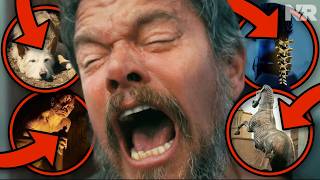

Nolan's Odyssey: Zeus Law & Hidden Magic
40sOpens with a mystery about 'apparent magic' and Zeus's law, immediately hooking viewers with a fresh, philosophical take on a classic epic.
▶ Play Clip"The title promises a breakdown of details and ending explanation, and the video delivers exactly that with thorough analysis."
This video provides an in-depth breakdown and analysis of Christopher Nolan's 2026 film adaptation of Homer's epic poem, The Odyssey. It explores the film's adaptation choices, hidden details, and deeper meanings, examining how Nolan reinterprets the ancient story through a modern lens.
Eric Boss of New Rockstars introduces the video as a scene-by-scene review of Christopher Nolan's The Odyssey, focusing on adaptation choices, attention to detail, and things viewers might have missed.
The Universal logo focuses on the Mediterranean Sea, the route of Odysseus. Lightning flashes represent Zeus. The text 'A time of apparent magic' suggests subjective, not historical, magic.
The film opens with a bard (Travis Scott) performing in dactylic hexameter, referencing Homer's Odyssey. The bard's staff slams mimic the rhythm, and the opening lines are from Emily Wilson's translation: 'Tell me about a complicated man.'
The Odyssey is an epic poem composed around the late 8th century BCE, after the Greek Dark Ages. The film redefines the 'Sea People' as responsible for the Bronze Age collapse.
The film reframes the Trojan horse story, focusing on the suffering it caused. Sinon (Elliot Page) is a young farm boy tricked by Odysseus, not a treacherous agent. The Trojans see the horse as a peace offering.
The Odyssey is the first movie shot 100% on IMAX film. Nolan used a modified IMAX camera ('the blimp') with a sound-dampening shell to record dialogue on set. Mirrors were used to maintain eyelines.
The Troy set was built in Morocco at Ait Benhaddou, covering 2.5 acres, accommodating 2,000 extras. The horse is rolled on logs, not wheels, showing Trojan care.
Penelope (Anne Hathaway) stops the bard's song about Odysseus. The film is told non-linearly, with different characters recounting parts of the story. Penelope weaves a shroud, undoing it each night to delay remarriage.
Telemachus (Tom Holland) confronts the suitors, led by Antinous (Robert Pattinson). The suitors abuse Zeus's law of hospitality. Telemachus uses an American accent, suggesting the story is told from an American perspective.
Telemachus repeatedly calls the beggar 'bright-eyed Athena's eyes,' a phrase from Emily Wilson's translation that reflects oral tradition. This repetition is a memory marker for oral storytelling.
Telemachus trains with Eumaeus (John Leguizamo), a blind swineherd. Argus, Odysseus's old dog, is played by a Podenco, an ancient breed with only about 75 left. The dog's recognition of Odysseus is a poignant moment.
The score features a lyre, an ancient Greek instrument, and a three-note motif (da da dang) from the bowstring. The sound of the bowstring pluck is how Penelope recognizes Odysseus.
Matt Damon plays Odysseus. The bowstring pluck is a key sound. The scar on Odysseus's leg from a boar hunt is how Eurycleia recognizes him later. The film frames Odysseus as more honorable than in Homer's poem.
Eumaeus explains that Odysseus drafted men by lottery. Antinous lied about volunteering; actually, Sinon begged to go in Antinous's place. This backstory ties Sinon to the Trojan horse and the theme of breaking Zeus's law.
Ithaca's castle was shot at Castello di Santa Caterina on Favignana island. The crew had to hike and airlift equipment up a 1,000 ft hill. The production built a practical Troy set in Morocco.
Odysseus reveals that Agamemnon would take his son if he refused to go to war. Agamemnon sacrificed his daughter Iphigenia to appease Artemis, which is the original sin of the House of Atreus.
Penelope gives Odysseus her pin of Athena, which serves as a totem to remind him of her. Athena (Zendaya) appears to Odysseus in human form, but only he sees her; the camera shifts reveal her presence.
Calypso (Charlize Theron) forces Odysseus to consume the lotus flower, causing amnesia. This replaces the Lotus Eaters episode. The lotus flower is a metaphor for the dream-like state in Inception.
Many of Nolan's films (Inception, Interstellar, The Dark Knight Rises) are essentially stories of Odysseus trying to get home. The film explores the toll of Odysseus's cleverness and the pain it caused.
Agamemnon (Benny Safdie) wears polished black chrome armor resembling Batman's. He never fights, and his armor foreshadows him as a skeleton for what he did to his daughter.
The crew includes Eurylochus, Perimedes, and others. Elpenor translates during the Cicones raid and later dies against the Cyclops. The film uses a Viking longship for Odysseus's fleet.
Nolan drew a map of Odysseus's journey, based on real locations in the Mediterranean. The Aeolian Islands are the inspiration for Aeolia. The crew filmed in various locations including Sicily and Greece.
The Cyclops is a giant with a twisted eye and nose. The effect was achieved using force perspective and a 60-foot animatronic puppet. The Cyclops eats crew members, mirroring the painting of Saturn devouring his son.
Nolan left out the 'Nobody' pun from Homer's poem, as it was considered too campy. Instead, the Cyclops just screams for his father Poseidon. The escape involves covering armor with straw and wool.
Odysseus fires an extra arrow at Polyphemus, violating Zeus's law. This angers Poseidon, who punishes Odysseus. Odysseus gives his ring to Eurylochus to remember the fallen soldiers.
Telemachus visits Menelaus (Jon Bernthal) and Helen (Lupita Nyong'o). Menelaus has scarred Helen's face for her role in the war. Helen is described as 'the face that launched a thousand ships.'
The casting of Lupita Nyong'o as Helen sparked discourse, but Nolan focuses on the story. Menelaus scarring Helen shows the barbarity of the Greeks as 'sea peoples.'
Menelaus gives an eyewitness account of the horse: men stayed for days, some drowned, they sat in excrement. The horse is not a victory trophy but a desecration of Athena's temple. The Greeks look like villainous assassins.
Troy was lit with 'pyrahedrons' mimicking fire. The sound of bronze sheets struck during the siege evolves into Odysseus's three-note musical motif. Olive trees were craned in for the garden scene.
Helen begins to tell the story of Agamemnon's return, but Menelaus stops her. The parallel between Agamemnon and Clytemnestra is important. The sea is depicted as 'wine-dark,' referencing Homer's description.
The crew lands in a forested area (possibly Italy) and encounters the Laestrygonians, man-eating giants. They trap Greeks in tree cages. Odysseus's boat escapes, but two others are destroyed.
Circe (Samantha Morton) turns men into pigs by feeding them stew. She sings an incantation and molds their faces. Odysseus grabs her crow to force her to change them back. Circe calls the men 'disgusting invading beasts.'
The underworld was filmed in Iceland during midnight sun. Odysseus digs a hole with sacrificial blood, and spirits rise, including Sinon and Tiresias. Sinon gives back the lot, shaming Odysseus for lying to him.
The theme of the noble lie appears, as in Nolan's other films. Agamemnon's ghost warns Odysseus to come home in disguise. Tiresias prophesies the sirens, Charybdis, Scylla, and the sun cattle.
Odysseus is tied to the mast while the crew plugs their ears with beeswax. The sirens' song is played on an aulos, an ancient Greek double-reed instrument. The song tells Odysseus what he wants most is what he can't have.
The sirens' song is interpreted as Nolan working through his own creative drive, which takes him away from his family. It suggests part of him doesn't want to go home and grow old.
The crew passes Charybdis, a monstrous whirlpool, and Scylla, a six-headed serpent that grabs half the crew. The crew later eats the sun cattle, causing a storm that destroys the ship, killing all but Odysseus.
Calypso found Odysseus with the lotus flower and they were happy for seven years. She releases him, and he sails home, letting Zeus take the wheel. He washes up on Ithaca.
Helen sends word to Penelope apologizing for Troy. Odysseus reunites with Eumaeus, learning of Antinous's plan to ambush Telemachus. He promises vengeance and to restore Zeus's law.
Telemachus suggests Mentor is Athena in disguise, but Odysseus denies it, saying he would be disappointed. Odysseus sees Athena as the ghost of a young Trojan woman he killed, representing his guilt.
Penelope wants to burn the suitors. She tells Telemachus she has been sitting on an empty throne for 20 years. She wants Odysseus back. The dog Argus dies upon seeing Odysseus.
Odysseus, disguised as a beggar, sees the suitors' cruelty. He gives Antinous the lot stick from Sinon. The firelight makes the screen glow, echoing the tesseract in Interstellar.
Odysseus reveals the Greeks were violent savages, killing women and children. This moment is in conversation with Oppenheimer, showing the horrors of war. The Trojan horse is like the atomic device.
Athena is actually the ghost of a young Trojan woman killed on the steps of her temple. She has stalked Odysseus ever since. The gods' silence is explained by pain: 'Who doesn't understand pain?'
Penelope says the sea people are the Greeks themselves. This echoes Interstellar's 'we are the ghosts' and Oppenheimer's 'I believe we did.' Penelope sets up the bow challenge.
Penelope unveils Odysseus's bow. No suitor can string it. The beggar (Odysseus) strings it and shoots through 12 axes. The sound of the bowstring is recognized by Penelope and Antinous.
Odysseus kills Antinous and other suitors. Telemachus duels Melanthius. The suitors who kneel are spared. Odysseus stuffs the lot in Antinous's mouth, saying 'Give him back his shame.'
Odysseus lies in Penelope's arms. She tests him about their bed, which is carved from a tree. He passes, confirming his identity. They plan to sail west together, recalling the Grey Havens.
The film ends with Odysseus and Penelope sailing west, leaving Telemachus behind. The songs remembering the tale will be all that remains. The final shot echoes the burning Trojan horse.
Christopher Nolan's The Odyssey is a profound reimagining of Homer's epic, exploring themes of guilt, the cost of war, and the nature of storytelling. The film uses innovative filmmaking techniques and deep character work to deliver a powerful and visually stunning adaptation.
Christopher Nolan
person
Matt Damon
person
Anne Hathaway
person
Tom Holland
person
Zendaya
person
Robert Pattinson
person
Lupita Nyong'o
person
Charlize Theron
person
Samantha Morton
person
Elliot Page
person
Travis Scott
person
John Leguizamo
person
Benny Safdie
person
Jon Bernthal
person
Kate Fleetwood
person
Cory Hawkins
person
James Remar
person
Bill Irwin
person
Josh Stewart
person
David Keely
person
Ludwig Göransson
person
James Blake
person
Rosa Fragorupti
person
Callum Armstrong
person
Emily Wilson
person
Samuel Butler
person
The Odyssey by Homer
book
The Iliad by Homer
book
The Aeneid by Virgil
book
IMAX camera
tool
Pyrahedrons
tool
ZocDoc
service
New Rockstars merch store
link
NR Underground
link
What is the significance of the phrase 'a time of apparent magic' in the film?
It suggests the magic in the story is subjective, not historically recorded, reflecting unreliable accounts.
01:07
Who plays the bard in the film, and what is the significance?
Travis Scott plays the bard, continuing Nolan's tradition of casting music stars, and his performance uses dactylic hexameter.
01:48
What translation of The Odyssey does the film use for its opening lines?
Emily Wilson's 2017 translation, beginning with 'Tell me about a complicated man.'
02:47
How does the film depict the Trojan horse differently from traditional accounts?
It is not a victory trophy but a desecration of Athena's temple, and the Greeks are shown as villainous assassins.
26:49
What is the 'noble lie' theme in Nolan's films, and how does it appear in The Odyssey?
The noble lie is a deception for a greater good; here, Odysseus lies to Sinon about the horse, causing destruction.
33:14
How does the film explain Athena's human form?
Athena is actually the ghost of a young Trojan woman killed on the steps of her temple, haunting Odysseus.
42:16
What is the significance of the bowstring sound in the film?
The three-note motif (da da dang) from the bowstring is how Penelope recognizes Odysseus.
12:06
How does the film handle the 'Nobody' trick from Homer's poem?
Nolan omitted it because it was considered too campy; instead, the Cyclops just screams for Poseidon.
21:32
What real-world location was used for the underworld scenes?
Iceland, filmed during the midnight sun to create a cold, desolate landscape.
32:34
What does Penelope reveal about the 'sea people'?
She says the Greeks themselves are the sea people, responsible for the Bronze Age collapse.
43:19
Subjective Magic
Sets up the film's approach to mythology as subjective, not literal.
01:07Emily Wilson Translation
Highlights the film's use of a modern, acclaimed translation.
02:47First 100% IMAX Film
Technical achievement in filmmaking.
06:27Trojan Horse as Desecration
Reframes a classic story to emphasize the horror of war.
26:49The Noble Lie
Connects to recurring theme in Nolan's work.
33:14Athena's True Identity
Reveals the goddess as a victim, adding depth to the story.
42:16Greeks as Sea People
Ties the myth to historical Bronze Age collapse.
43:19[00:02] his past films from Oppenheimer to Interstellar. So, let's unpack all of these subtle connections. I'm Eric Boss of the New Rockstars channel, and this is an in-depth breakdown and analysis of Christopher Nolan's The Odyssey, the
[00:15] 2026 film adaptation of the 30,000-year-old epic poem attributed to Homer. I loved this film. It was my favorite film of the year so far. And in this video, I'm going to review it scene by scene to examine the deeper meaning,
[00:27] adaptation choices, the incredible attention to detail, and some things that you just might have missed. Both on this channel and our other deep dive Christopher Nolan's films. So, you know, I couldn't wait to get into this one.
[00:40] understood Tenant, I am wearing this I this, plus our even better Odyssey themed design are available at our merch store, nerdriot.shop. The Universal Studio logo of the globe, specifically
[00:53] Mediterranean Sea around the islands of Greece and Italy. Yes, the exact route Odysius and his crew take in this movie. And as we pull out from Earth, we see flashes of lightning in that part of the world. The one actual form we see Zeus
[01:07] take in this film, as it is Zeus's law of hospitality that these characters are upholding. And then over black, we see this dark blue text, a time of apparent magic. Apparent is the key word here. Christopher Nolan doesn't set this film
[01:21] in a time of actual historically recorded magic, but rather of subjective magic. Magic according to unreliable accounts seen by unreliable eyes. In world was like during this time, as this end of the Bronze Age was followed by a
[01:34] historical dark period that both makes the exact authorship of the Odyssey reflected internally in this film by the rise of the mythologized fearsome people from the sea, a historical mystery that this film gives an explicit answer to.
[01:48] The film opens with the bard, played by rapper Travis Scott, making this the casting a music star after David Bowie in the Prestige and Harry Styles in Dunkerk. In this hall of Ithaca, the bard slams his staff with, if you'll
[02:01] This could be a reference to the sacred cattle of the sun god that Odysius's crew are forbidden from eating. The bard chance, boom, boom, boom. A face. Boom boom boom boom. A fleet. Boom boom boom boom. A war. Boom boom boom. A man. Boom
[02:16] boom boom boom. A thought, a trick, a trick to break the walls of Troy and opening words of Homer's The Odyssey, translated by Samuel Butler in the year 1900 are, "Tell me, Omuse, of that ingenious hero who traveled far and wide
[02:31] after he had sacked the famous town of Troy." Now, in that translation, Butler used no poetic meter. But in Greek, Homer's Odyssey is in dactilic Homer's Odyssey is in dactilic hexameter, which is d.
[02:47] managed to both modernize the language and put it in amic pentameter. Nolan has cited this exact adaptation and its version of the opening line. Tell me about a complicated man. Muse, tell me how he wandered and was lost when he had
[02:59] wrecked the holy town of Troy and where he went and who he met, the pain he he worked to save his life and bring his men back home. He failed to keep them safe. Poor fools. They ate the sun god's cattle and the god kept them from home.
[03:12] Now godless child of Zeus tell the story of our modern times. Find the beginning and let us go back to the beginning. The Odyssey is the epic poem that's literature. Composed by an apocryphal figure known as Homer sometime in the
[03:25] late 8th century to early 7th century B.CE. Sometime after the Greeks adopted Phoenicians. The Greeks first met the Phoenicians either in the late Bronze Age which would have been 1500 to 1200 B.CE CE or right in the middle of the
[03:39] Greek dark ages which ran from around 1100 to 800 B.CE. I mean it was really the earliest dates historians are able to trace the Odyssey document back to Many historians attribute the fall of the Bronze Age of Greek civilization to
[03:52] the rise of the people from the sea. Sea people referenced in Egyptian literature which historians have seen as some maritimebased raiders like the Luca or the Peliset as well as others such as the Wes. Nolan uses this whole film to
[04:05] redefine exactly who these people of the sea were, who were responsible for the due to this historical dark period, the poem's true origin is a mystery. But it was believed the poem was drafted from a couple dozen homeriic poems that were
[04:18] oral traditions performed out loud at contests and festivals and then drafted alongside some literate collaborator who must have him or herself been familiar enough with that oral tradition to put it into written dactilic hexameter. So
[04:30] really by opening with this bard telling the story played by a rapper that we trying to translate what that oral fact that the bard immediately redefineses the Trojan horse as a trick
[04:43] ground. Nolan is clearly using this whole film to examine the toll of Odysius's clever maneuver and the actual pain and suffering it inflicted on Troy. We see the Trojan horse here in the sand of a beach. It's found by soldiers from
[04:56] Troy. And these Trojans are wearing the classic white hat colors while the forces of the Aayans aka the Greeks are depicted in black hat colors as we see in classic western film as this movie is really judging them as the true villains
[05:08] of this war led by King Agamenon of Mys to retrieve Helen of Sparta but really also to control shipping routes. Left all alone to accompany this horse is Sinon played by Elliot Paige. Sinan does not appear in Homer's the Odyssey or in
[05:21] Homer's the Iliad, but does appear in Virgil's the Aniid as the treacherous agent of the Greeks here, the one who convinces the Trojans to bring the horse Christopher Nolan reframes the story of Sinnon as just a young farm boy who
[05:34] ended up taking Anton's draft lot for the war effort whom Odysius exploited as a sacrificial pawn, never telling Cinnon that they were inside the horse the believable in his explanation to the Trojans. Nolan really wanted to fix the
[05:48] story of the Odyssey as to why the Trojans would fall for rolling in a horse on wheels. Like in many art depictions, the wheels were built onto the horse. Who would be that dumb? Well, here the Trojans wound, who calls the
[06:01] horse a gift for Athena. The Trojans respond, "Common gods respect their offer. Save it from the waves. Take it to Athena's temple. The war is over." Yes, these Trojans see it as a peace offering from the Aayans to their shared
[06:13] journey home. and they choose to take this token of goodwill from the waves, saving it from destruction. So, by tricking the Trojans this way, Odysius is totally violating Zeus's law of hospitality and directly insulting
[06:27] opening shots that it just looks incredible. The Odyssey was the first movie ever shot 100% on IMAX film. Ever since 2008's The Dark Knight, with shooting more and more of his movies on this format, but always
[06:40] vertical film moving through the shutter, making it normally impossible So, for this film, Christopher Nolan and his producer and wife, Emma Thomas, version of the IMAX camera with a new heavy shell cover that muted the sound
[06:55] so that they could record the actors there on set. Christopher Nolan named collaborator David Keelley who sadly passed away right after they wrapped on dedication in the movie's closing credits. In other promos, the actors
[07:08] seem to refer to this massive camera as the blimp because it required multiple could not see their scene partners across it. So to get around that, the crew rigged up a system of mirrors to maintain their eyelines. The Trojans
[07:21] haul the horse out of the surf. And we see that the Trojans roll it not on wheels built into it, but rather on logs that they shaved to avoid scraping the horse and even wrapped up its tail to avoid any damage. That's how much they
[07:33] left it. Now, in the distance of this shot, we can see the practical Troy set that Christopher Nolan's crew built. They built the set in Morocco at Ayat Benhadu near the Atlas Mountains and covered more than 2.5 acres or over
[07:46] 110,000 square feet large enough to accommodate 2,000 extras and more than movie, we believe we're going to get a full prologue showing the end of the Trojan War. But suddenly, we cut away from these images as Penelopey,
[07:59] Odicius's wife, Anne Hathaway, shouts, "Stop! Not this song." Penelopey doesn't story of the husband who never came home. Like Homer's poem of the Odyssey, Christopher Nolan's film adaptation is not told in sequence, and the full story
[08:12] throughout the film. The first part of it by the bard here, and then later by Menaaus as a story of conquest, and then later by Odysius to Penelopey as a story of horror and regret. Odysius and Penelopey's son, Tmicus, Tom Holland,
[08:26] complains about the 108 suitors who have taken up residence on Ithaca, hoping to Ithaca. In Odysius's absence, Penelopey tells her son to try casting them out by bringing up Zeus's law. By Zeus's law, she means the custom of hospitality. The
[08:39] idea of seeing every stranger visitor as a potential god in disguise, as Zeus, take a disguised mortal form to test the hospitality of homeowners. These suitors are abusing that law. Penelopey is behind this thatched semi-transucent
[08:54] screen, obscuring her from even our view as she continuously weaves her father's burial shroud, which she insists upon finishing before even considering a by Penelopey. She pretends to be in this devout state of mourning, but every
[09:06] undoes the day's progress of her tapestry. The fact that she's often vanity curtain to keep the suitors from staring at her too lustily. For us, it's also kind of a way to keep Odysius from even clearly seeing his platonic ideal
[09:21] wife. Tyicus confronts the leader of the suitors, Antennuis, Robert Patson, and his fellow suitor, Polibus, Cory Hawkins, who say they remember Odysius's bad mind for how he strung his cattle. [laughter] This might be a reference to
[09:33] how Odysius in the poem feigned lunacy by tying an ox and a donkey to plow and sew fields with salt, all as a way to try to get out of going to Agamemnon's war. Antonus tells Cymicus, >> "You're pining for a daddy you didn't
[09:46] even know, like some sniveling bastard." characters in this movie using terms like dad and daddy. But also, the term father never existed in ancient Greek. I will admit, it is an interesting choice
[09:59] Tom Holland use American accents instead of just their natural normal English accents. But since this is all a story being told by the bard, it is arguably a story being told from an American point of view. Tyicus allows in a beggar,
[10:12] might strike them down. And we hear a thunderclap that scares them off. This sets up why the suitors will reluctantly allow in Odysius when he pretends to be a beggar in the third act. Ticus tells the beggar that he has wise eyes,
[10:24] Athena's eyes, a phrase that he will repeat often in this film, especially to Homer's poem is actually a disguised form of the goddess Athena, despite the fact that Odysius in this movie denies that theory. This repetition though with
[10:37] intentional because when Emily Wilson composed her 2017 translation of the poem, she noted that past translations maintain the over repetition in Homer's poem of phrases like wine dark sea and brighteyed Athena as markings of this
[10:51] being an oral tradition because such repeated phrases are really helpful memory markers for an oral storyteller and a listener. So in her translation, she did repeat these phrases just slightly less. But Nolan has Tom Holland
[11:03] repeat Bright Eyes Athena's Eyes several times throughout the movie as this is translation of the Odyssey and again coming from the perspective of a bard who is a rapper. Tyicus trains with mentor and Umeus played by John
[11:16] Leguisamo a blind swine herd who looks after Argus Odysius's very very old dog. The dog playing Argus in the film is a podango, an ancient breed of dog, of which there are approximately only 75 left in the world. And we flash back to
[11:30] first spared this adorable puppy. But you know, Chris Nolan, I didn't need thrown off before Argus. Now, throughout this, we hear a combination of scene, The Liar, played by musician Rosa Fragorupti.
[11:54] Christopher Nolan to create a sound fully unique to this world. And Juren in would have been popular in music in ancient Greece. And the strings really come together well in this flashback as a younger Odysius strings his bow
[12:06] completing it, we hear the three notes of the liar. Da da dang. Yes, the bow string is what provides the the movie. I love it. On this sound effect, we finally see Matt Demon's face
[12:21] in this movie as the epic titular hero. That bow string pluck will be how Penelopey recognizes him later. And I'm just going to say, isn't it interesting the way he moves his finger in this motion, but he plucks it here to draw
[12:35] the hog out to make it a fair fight to fight with honor. Even though the hog leg, this guy's never going to have great luck with pigs. But the wound left on his leg as Yuri Clea, played by Kate Fuglay, stitches it will be exactly how
[12:47] this nurse maid later recognizes him when she washes this beggar's feet. I in this particular detail because it is a big deal in Homer's poem that the master's bodies even better than their spouses do. It's also interesting how
[13:01] Nolan's take on the Odyssey frames Odysius as far more honorable than the trickster, liar, and code switcher the hero is described as in Homer's poem. Nolan's films that he likes to prop up his heroes on pedestals, making them
[13:14] than them just being, you know, deceitful little shits like men sometimes are in the world. Um explains how when Agamimnon's fleet appears, Odysius drafted men by lottery. Now, the first version of events that we hear is
[13:27] that young Antinuis volunteered trying to buy the lot of young Cinnan, but Odysius sympathizing Antinuis's father made the kid stay behind while taking the original drafty young Sinnin. But the truth we learn later is that this
[13:39] was a lie by Antinuis. It was actually the opposite. Antinuis was the one who drew the lot and Sinnin begged to go instead so that Antinuis could financially support Sinn's father which Antinuis never did cuz he sucks. This
[13:51] Sinnin is an invention in Nolan's adaptation. It's not part of Homer's text. It's all to tie these characters directly to the Trojan horse and the general theme of breaking Zeus's law. The castle of Ithaca was shot at the
[14:04] 15th century Castello de Santa Catarina on the island of Favnana near Sicily. to shoot at that castle for all the exterior shots, but they refused to allow the crew to build a road up to the over 1,000 ft tall hill. So, they had to
[14:18] hike and airlift stuff up there every day to shoot. Odysius reveals to Penelopey that if he were to refuse to go to war, Agimenan will take their son daughter. Agimenon's daughter is Ephagenia. Agimemon had previously
[14:31] offended the huntress goddess Artemis by killing a sacred stag. And Artemis retaliated by preventing his forces from reaching Troy due to strong winds. So to calm the winds, he sacrificed itia which ended up being the original sin of the
[14:43] house of Atraus. During this scene, young Tmicus sleeps on the floor facing trope. Like in Inception, the memory of the child that the hero is longing to represent the daddy away at work starting to forget what his kids look
[14:57] take the fastest ship and sail west. Hold hands on the deck, chase the escaping son. She gives him her pin of Athena, which really in this movie serves the function of Odysius's inception totem, kind of like Dom's
[15:09] him back to the memory of his wife. But really, in the present, Odysius is struggles to regain his memory. Walking with him on the beach is Athena, played strategic warfare, and crafts. In Homer's Odyssey, Athena is an active
[15:24] backer of Odysius's schemes. en raging Poseidon, the god of the sea, who rages against the boat engineering that Athena inspires. Here in this movie, she is the one god we see in human form. But the reason why Odysius sees her this way
[15:36] this movie, every time Nolan reveals Athena talking to Odysius, it's in the form of a Texas switch of cinematographer Van Homa just shifting one shot Odysius appears alone. But then as the camera turns, suddenly Zenaia is
[15:50] there. Odicius asks why gods can't speak in ways mortals understand. And Athena says, "Who doesn't understand thunder, the fire, a child's smile, a good harvest?" Yes, with this line, Nolan outlines the real natural elemental
[16:02] this movie. On this island with him is Calypso, played by Chariss Theon, a nymph, said to be the daughter of the Titan Atlas. Most of Odysius's journey recalled in flashbacks while he's here talking with Calypso, who's really
[16:15] trying to repair his broken mind after forcing him to consume the lotus flower. of this lotus flower is how Christopher Nolan keeps in a chapter from Homer's poem that he otherwise omits the lotus eaters. The people on the island Jerba
[16:28] sweetest honey flower that causes their minds to fill with amnesiac peaceful apathy and forget their homes. There are and Inception and the dream version of
[16:40] Maul who lures Dom into staying with her in limbo forever while Dom struggles to family waiting for him. In truth, whether it was Inception or Interstellar or even The Dark Knight Rises, many of Nolan's films have been essentially the
[16:53] story of Odysius trying to get home. And then back after Troy fell, we see the grave of Cinnan with his armor stacked and Troy smoldering in the background. Odysius faces Agamimnon, Benny Safty, whose armory is truly goddy, a kind of
[17:05] polished black chrome that looks like Batman's body armor in Nolan's Dark leads this war effort, but we never actually see him fighting anyone. The these golden vertebrae. And I think it's all to foreshadow this guy as kind of a
[17:19] skeleton for what he did to his daughter. Odysius tells his men that southerntherly route, hoping to take advantage of those winds to get home faster than Agimenon and Menaaus. Among his crew we meet here are Urilicus,
[17:32] command and husband to Odysius's sister, and Pites, played by Andrew Howard. Others on Odysius's crew include Anki, played by Will Yun Lee. We actually his ears and swimming to the sirens. Rest in power king. There's Sephiius
[17:47] played by Jimmy Gonzalez. Menitus played by Jesse Garcia. Is played by Ryan Dayal. And Elpenor played by Jovana Depo. He's the one who translates the they raid who later gets thwacked against the cave wall by the Cyclops.
[18:01] Rest in power to you too, King Odysius will return to the underworld to honor played by Josh Stewart, a past Christopher Nolan collaborator. He played Barad in The Dark Knight Rises and he actually voiced Case the robot in
[18:14] fleet, they used the world's largest modern Viking long ship, the Draken modern Viking long ship, the Draken Harold Harager. It's 35 m or 115 ft long, and they actually sailed this boat throughout the Aolon Islands in the
[18:27] Mediterranean Sea. Christopher Nolan drew an actual map of the fictional and journey. The places Odysius visits in Homer's poem are believed to be based on And on this map in the behind-the-scenes shot, you can see the Aolon Islands,
[18:41] Leipari, which is where he set the Siren Rock on its western shore, Volcano, and then Basilazo, which is where Nolan set the Sila rock. And to the western shore, another rock forming the Sila Pass that Odysius later chooses to take to avoid
[18:54] the Caribis whirlpool. Actually, the Aolon Islands are believed to be the inspiration of the mythological Aolia, the island kingdom of Aololis, ruler of by a wall of bronze that Odysius visits
[19:06] first stop at this island where a goat herder says they abandoned their village fearing these Greeks were the people from the sea. H it's kind of like this answer to the question is and they actually build this part on the Sicilian
[19:19] island of Fagnana, the goat island, which is believed to be the place where Homer envisioned Odysius landing at this point in the story to barbecue some of this crew won't like what's ahead, but now feeling confident, they land on
[19:31] another island and follow a single sheep up a trail into a cave. They actually shot this in Netor's Cave in the Pelpineese region of Greece in a space measuring 65x 52 feet with a vated ceiling only 95 ft high. It's actually
[19:45] period. They turned this cave into a practical sound stage. So cool that they finds bags of cheese on the walls. This comes from Homer's description of the Cyclops making cheese from sheep or goat milk and dry storing it in wicker racks.
[19:59] Historically, this is considered to be the origin of feta cheese. And now the giant cyclops enters the cave. This cyclops is named Polyphimas and is worked with Christopher Nolan to puppet the movement of Tarsus in Interstellar
[20:12] and voice the robot. Polyphimmas' design in this movie is gnarly. One human eye twisted sideways so that it opens and closes vertically along with a human nose that's also just kind of stretched and twisted to the side. This visual
[20:24] effect of his size scaling was accomplished practically using some old Harryhausen. They shot Bill Irwin on one plate with a scaled down cave entrance model for the background. And then they shot Odysius's crew on a separate plate
[20:37] then they used force perspective to visually trick our brains in merging the two. They also built a practical 60-foot anthropomorphic animatronic puppet so that when the Cyclops sleeps, that is a real puppet that the actors are sneaking
[20:50] Winston's team in Jurassic Park were able to build a super lifelike sick touch. This amounts to a horrifying sequence. A huge hand burst out of the that soldier still kicking and Bill Irwin's hand, which must mean that Bill
[21:05] Irwin was holding a smaller motorized puppet. And then he bites off the head out of his mouth onto the headless stump. Actually, the way the Cyclops eats this guy, biting off the head and the arm, mirrors the way in this famous
[21:19] painting where the Titan Kronos, also known as Saturn, eats his child. But can talk. It's just in a very loud voice. But you can make out that he's screaming to his father, Postitan. In Homer's poem, though, Odysius full-on
[21:32] converses with Polyphimas and ends up escaping by fooling the Cyclops into thinking that Odysius's name is Nobody. So that after Odysius blinds him with the hot poker, Polyphimas screams, "Nobody's blinded me." And all the other
[21:44] talking about?" And don't come to his aid. It amounts to a wordplay punbased trick that Christopher Nolan left out because yes, it is a little campy and it on this island. And also, it still doesn't really explain how Odysius gets
[21:58] Polythemis himself or is it his, you know, neighborhood of buddies? Here's Stewart asked him about this change. >> Apparently, there is a joke that Odysius makes with Cyclops. >> Yes. Yes.
[22:14] >> He was very upset that that was not in the movie. I I understand >> Puns in translation are tough. >> Do you do a lot of puns in your monologues every night that you know >> we do sometimes but only because we
[22:28] write the show at a fifth grade level. >> It's a slightly different. possible to work it in. around Polyphimas just being a shepherd and the fact that they do blind him. As
[22:41] periodically open and close the cave to let the sheep out. And Odysius decides to cover their armor with straw and wool so that when Polyphimas's fingers brush them, a blind Polyphimus wouldn't be able to tell. They run back to the shore
[22:53] as Polyphimis chases them even into the water and goes down under and then pops soldiers. Odysius has fired off one extra unnecessary arrow to further injure Polyphimis, which along with his general trick and freeloading Atheta
[23:06] ultimately amounts to a violation of Zeus's law. Kind of like the suitors back at his home in Ithaca. This is a critical mistake as Polyphimis is the son of the sea god Poseidon. Odysius gives his ring to Urilicus to remember
[23:18] the soldiers that they were unable to properly bury. Meanwhile, Tmicus arrives by John Bernthal. Mentor tries to sit beside Menaaus, but he snaps not you. Showing how this brother to Agimenan
[23:30] in Mentor's eyes. Seated on the other side of Menaaus is Helen of Troy played by Lupita Yongo. We are at the wedding feast of Menaaus and Helen's daughter, Hermione, who in Homer's Odyssey marries the son of Achilles, Neopus, a promise
[23:43] Menaaus had made to Achilles during the Trojan War. Menaaus refers to Helen as her well-known moniker, the face that launched a thousand ships, but maybe now just 500, he says, as he turns her face to show that he scarred it. Yes, it's
[23:55] his wife for absconding with Paris. Helen of Troy is described in Homer's the world, but really nothing further specifically about her physical description besides a line in the Iliad where Homer called her white armed. But
[24:09] reference to her race, but rather just how people with high social status were didn't work out in the sun tilling the fields, you would just have white arms. It wasn't until a century after Homer's Odyssey that poets started to describe
[24:22] golden hair or blonde. And then two years after that in Uripides play Helen, it details the origins of Helen's birth as the offspring of Zeus who was taking the form of a swan and mated with Lita, the wife of a Spartan king, and that
[24:36] Lita produced an egg that Helen hatched out of. So all of this discourse around the casting of Lupita Niongo as Helen, someone who hatched out of an egg, I this movie into a culture war narrative that I really don't think Christopher
[24:48] Nolan is that interested in. Either way, Nolan does choose to have Mena scar thematic example of these wararmongers being the barbaric sea peoples that civilization. Thanks to ZuckDoc for sponsoring today's video. The last thing
[25:01] anybody wants to do when it's nice outside is spend all day navigating a phone tree to find a doctor or worse still, sit in urgent care for a few of time. I had a stomach issue after a cookout a few weeks ago and I just did
[25:14] not have the spare energy to deal with any kind of hassle. Luckily, ZuckDoc made it easy to find a doctor near me who is taking new patients instantly. search and compare high-quality in-et network doctors and choose the right one
[25:27] you to see a doctor quickly without having to spend hours looking for one. Zukdoc has more than 150,000 providers across all 50 states with more than 200 you can see the doctor's actual appointment openings and instantly book
[25:42] phone. No waiting, no back and forth, no extra effort when you already don't have appointments fast, typically within just 24 to 72 hours of booking, and you can even score same day appointments. They also have the option for inerson or
[25:56] stomach bug, it was perfect. I just hopped into a video visit within a few hours of calling, got a prescription, and was back on my feet in 24 hours. easier thanks to ZDOC. Head to zoddock.com/newrostars
[26:10] Thanks to ZuckDoc for sponsoring today's video and helping make it easier for all video and helping make it easier for all of us to look after our health. eyewitness account of the story of the horse from the inside. He reveals that
[26:24] they had stayed in that horse for days, that several of their men drowned in the tide, and that they were sitting in their own excrement. As Cinnan waited As the people of Troy bring the horse into the city, Trojan soldiers poke
[26:36] see if this was a trick. I love the slicing a soldier. Menaaus covers the dude's mouth to muffle the scream and Odysius smartly wipes the sword as it goes back up to remove the blood. The
[26:49] Athena. In Nolan's telling, the Trojan horse is not a victory trophy. It's the enough to relocate the offering they who would bless both sides ships and civilizations. OC's men climb out of the
[27:03] a rope to prevent the sound of it hitting the ground. The way they slip a healthy organism. They don't really look like heroic invaders. They look like villainous assassins. Troy at night was lit without actual fire, but rather
[27:17] thousands of devices they called the pyrahedrrons, triangular circuit boards light mimicking the color and movement of fire. Nolan suggested that the Trojan represented by these large bronze sheets that the people of Troy would have
[27:31] struck during the siege and that the growing cacophony of that sound would evolve into Odysius's defining three note musical motif throughout the film. Da [singing] da da. The production had to crane in 15 fully grown olive trees
[27:44] for the garden within the Troy walls where Odysius's men had to kind of with the Troy soldiers to give their men time to crank open the gates. And it clunk we're seeing civilization trying to grasp on to existence and then
[27:59] feels like a defeat because when the gates open it's really just Agamenon really is just a personal grievance for him but then the Greek soldiers flood in screaming at victory and that's where this story just seems to end as Menaaus
[28:15] that's really all Menaaus remembers from the war. He doesn't think about the aftermath. Helen scoffs at this being righteous and begins to tell the tale of what awaited Agamemnon when he returned to her sister Clydeinestra also played
[28:27] by Nongo. But Menaaus similar to Penelopey in the opening scene shouts it down. But all of this really sets up the parallel between Agimenan and Clydestra important thing in Homer's poem. Odysius tells Calypso how Poseidon punished
[28:40] threw them off course. At this point, Christopher Nolan and Hoya make the sea look a purplish shade of gray that I would say might be their way of making it look like the wine dark sea, as Homer often describes it. Actually, that
[28:52] some historical linguists to believe that the ancient Greeks might not have seen the color blue the way we see it, that maybe they just saw the sky as a its own word like the color of their dyes did. And specifically, they had not
[29:05] could use in their dyes. The crew lands on a new forested land where snow this detail because it implies that this area might be part of mainland Italy. grown man in armor, but it's actually a child played by Barnaby Nolan, who I'm
[29:20] or his brother Jonathan. Somehow, this child screams and alerts the adult Lystragonians. So, in Homer's Odyssey, man-eating giants who eat many of Odysius's men and end up destroying 11
[29:33] out of his 12 ships by hurling rocks at them. Here they are steelarmored giants which Nolan does to help with the shooting of the stunt action because he of actors and shot all these scenes twice using force perspective in shots
[29:46] figure in the foreground that's really just actually much further away from the hurl these Greeks into trees and interestingly trap them in seemingly magical tree cages that close in around them. While Odysius's boat gets away,
[30:00] the two other boats are smashed and capsized by the Lregonians. Odysius returning the favor that we find out Urillicus did to him as Troy was falling that Odysius regrets in the short term with the soft mutiny that happens at
[30:13] their next stop. As Odysius watches his ships destroyed, we actually hear Ludvigor's main theme sung with humming from singer James Blake.
[30:28] Cersei's cabin passing a lion, a panther, a leopard, a tiger, animals at all. But Homer describes Cersei's Island as proud by strangely docel lions men whom Cersei has shapeshifted. Cersei is a witch, or perhaps a nymph. She's a
[30:44] amazingly in this movie by Samantha Morton. As the men eat her stew, they find themselves unable to stop eating, tethered to the soup via these long their throats. Cersei sings this sweet little incantation as she grabs their
[30:58] ears and faces and ends up molding their faces like clay, stretching out their ears into pig ears and their full faces into snouts. It's so awesome. I love this sequence. Odysius finds Cersei casually washing these pigs. Pigs who
[31:10] clearly trying to warn him, meaning that they still have the minds of the men. Urillicus, Odysius wises up to what's happening and grabs Cersei's crow whom Actually, in Greek mythology, Cersei's sister is Pacé, wife to Minos, who ended
[31:26] know if it's the same sister here, but Odysius asks, "Why leave her like this?" this way." In Homer's Odyssey, it goes down a bit differently. The messenger Odysius and warns him about this witch. And he advises him that if he ends up
[31:41] Cersei's going to be like, "Hey, come to bed." And during that sex, Odysius makes But there's no sex here. It's just grabbing the crow. Cersei snaps that she primal. They're disgusting. Invading beasts who just consume. I mean,
[31:55] Samantha Morton again just amazingly rageful as this witch. But giving in to Odysius holding her sister crow, she ends up singing again and whispering back into your disguises. I love this line. The idea of identity concealment
[32:08] and disguise is such a huge motif in Homer's Odyssey. Odysius is really a disguise. It's really a virtue of Zeus who also just loves surprising mortals by taking various forms. So here Cersei says back into your disguises to remind
[32:21] us that these armored soldiers of honor are actually disguises worn by savage beasts. That is a common feminist critique of Zeus, someone who takes the wait for consent. After getting away, the crew sails to the underworld, aka
[32:34] Hades. The underworld sequences were all filmed in Iceland in the month of June midnight sun in desolate terrain under Iceland to represent Hades because its cold remote landscape felt as far as
[32:47] possible from Odysius's Mediterranean home. They dig a hole and fill it with sacrificial livestock blood and from the black soil rises Sinn as well as the prophet Theresius, James Remar, and all of the veterans of Odysius's campaigns.
[33:00] take Antonus' rightful place when Antinis was drafted, but Antinuis offered payment to his family. And now Sinn gives the lot back to Odysius to quote, "Give Antonis back his shame." Sin shames Odysius asking, "Did you have
[33:14] to lie to me?" Again, we see the theme of the noble lie, which is really a prestige, where Bordon lives a double life lying to his wife for a noble Knight Rises, where Batman and Commissioner Gordon lie about Harvey
[33:27] Dent, and Interstellar, where there was the lie of the plan A to save Earth, the Matt Demon scene. But Sinnin is right to explain that there was nothing noble about a lie that amounted to a trick that destroyed civilization. Agamemnon's
[33:40] ghost finally speaks, saying that when he came home, Clydeestra played the part of washing him, but then murders him in his bed. In Homer's poem, Agamemnon is murdered by Agistus, the lover of Clydeinestra. Agamemnon asks if his son
[33:52] Arrestes avenged him and Adysius is like but actually in the text arrestes does return to Athens and kills both Aegis and his mother Clydeestra bringing about at the house of Atraus that would become the plot of the Orista the trilogy of
[34:05] plays by Escilis. Agimenon advises Odysius to not make his same mistake and in the front door expecting garlands and praise but rather to come in disguise and take his time. Tyreseius prophesizes Odysius's next step of the sirens,
[34:19] Cribdis and Silla, and the island of the Sun Cattle, but also in Homer's poem prophesizes Odicius's eventual return journey to honor Sinn's request. In this appearance by Achilles, who at this point in Homer's poem laments to
[34:31] Odysius, I would rather be tied to the soil as a surf than be a king of all these dead and destroyed. These amassed souls of Odysius's soldiers chase men who will be waiting for Odysius's return to honor them. Now Odysius
[34:44] the sirens. He instructs his crew to tie him to the mast while filling all of sound of a Mishbatel putting the beeswax in is kind of like how it sounds like approaches the siren rock. The music we hear is the Alos, which is a double read
[35:00] one musician. Something that comes from ancient Greece played here by Callum Armstrong. >> We don't have uh any surviving reads. So I worked with uh two other people and we spent a while trying to work out and
[35:14] [music] the top. We had to read lots of ancient source material and try and work ancient source material and try and work out how they did it.
[35:27] as kind of the rock instrument of its time. Specifically, this specific theme night with Penelopey. And we hear it later when they reunite. Urillicus sees Odysius screaming in agony and later he explains what he heard and this
[35:40] monologue is haunting. He says it was all the things you wanted it to be. Then the delicious itch you go to scratch that lies under the skin you can't unbearable. It told you what you want most is what you can't have. And what
[35:54] you most can't have is what you already had and lost. It was the song of all the promises I failed to keep. And it told me I don't really want to go home. Ooh. interpreted as the filmmaker trying to work through himself, pouring himself
[36:08] into these passion projects overseas that take him away from his family, or is there with him as he toils through earn his way back home. It kind of sounds like for Christopher Nolan, his
[36:20] creative artist keeps doing this to himself because part of him doesn't want to go home and grow old. Now, the crew pilots past Caribbdus, the monstrous whirlpool from this part of Homer's poem. By the looks of it, it's a
[36:33] somehow generated. But Odysius orders them to sail closer to the rocks where Tyreseius told them another monster resides. Sila Sila is described in the with a serpentine body and six dog
[36:46] heads from long snake- like necks, grabbing half of the crew and pulling guess the rest of her body is unseen. Modern scholars believe that Curbdtus straight of Mesina off the coast of Sicily and opposite a rock on the
[37:00] mainland identified with Sila. And a whirlpool does actually exist there dangerous only to a small craft in extreme conditions. The crew proves Theresius right by eating the sacred sun cattle and they end up facing a violent
[37:13] storm where the harsh hand of Zeus kind of chops the ship in half and Adysius Urilicus and the rest drown in the other half. We actually hear someone screaming, "Cryptis," suggesting that this storm has swept them all back out
[37:25] to the whirlpool. In Homer's poem, Odysius, after being separated from his Cryptus' ma, but he ends up surviving by clinging to a big tree. And all of this brings Odysius to Calypso's island. She reminds him that she found him with the
[37:38] with the lotus flower that shifted his physical pain to a pain in his mind, fell in love with him and that they were happy together for 7 years. But she happy because she found him clutching an object, Penelopey's pin of Athena, and
[37:54] >> In Homer's poem, Calypso ends up supplying Odysius with a small vessel to sail home with good winds to carry him. Here, it's kind of presented as Odysius him to be taken out by Poseidon and Zeus's tides, cleansed by the gods,
[38:08] basically letting Zeus take the wheel. And then, miraculously, he washes up on Athena. Menaaus and Helen send off forward to whisper, "Tell her I'm sorry. I'm sorry for Troy and for all the
[38:21] things done in my name." It's such a heartbreaking offering from woman to woman to be the sin eater for all of this madness because as we see in this fallen, but all of civilization. Helen considers it her fault that the bronze
[38:34] age of civilization collapsed. Odysius reunites with Umus, pretending to be a veteran who served Odysius at Troy. He learns of Antennuis' plan to ambush Tmicus on the road back from Pyos in the temple of Zeus. And he promises the
[38:46] homecoming of Odysius. >> Bringing [music] vengeance. Bringing it >> By bringing it all, Odicius is saying that he plans to bring in all of the lessons he has learned on his journey. Not just to restore Zeus's law in his
[38:58] house, but really to confess his own breaking of it. Mentor and Tmicus visit presents himself as a beggar sent by Umeus, taking on the name Cinnan as a soldier who fought alongside Odysius at Troy. Mentor gets poisoned and Odysius
[39:11] a suitor disguised as these priests. Here's where Tmicus suggests that he always suspected Mentor was Athena in disguise, but Odysius shoots it down and men. You'll just be disappointed. Yeah, a little clue that Odysius really
[39:24] in this movie because every time he sees Athena, he just feels the disappointment he felt in the aftermath of Troy. Ticus tells Penelopey his plan to have her leave. And then Menaaus, I guess, will back Tmicus' claim to the throne. And
[39:38] mama's response is trying to win an Oscar here as Anne Hathaway says she wants to lock the door, set a fire, and burn the bastards, saying, "You think if I remarry that world is gone?" And Tyus says that he can't kill a suitor without
[39:50] being exiled and that the throne will stay empty. And Penelopey says, "Because only a man can sit on it. Empty throne. I've been sitting on an empty throne for experience, that's nothing compared to the bristles on your chin." And asks,
[40:04] she cuts him off, SAYING, "I WANT ADYSIUS." Odysius does find his way back, finding an elderly Argus outside. This dog whines upon seeing his old master and his little tail wags weakly as Odysius pets him and the pup finally
[40:18] dies. Yes, the dog doesn't live in Homer's poem either. From this, Tmicus realizes who this man is. And Odysius says, "I am a beggar. And you are the worthy, beautiful son of Odysius, of whom when you finally meet, he will be
[40:31] so proud." From the dog dying to this father-son moment. Woo! I lost it in the his home, he truly does have to take his Agamemnon. He presents himself to Palibus and Antennis begging for food.
[40:45] And from below, he sees how cruel they truly are. Something Penelopey could only see from a distance from above. And he gives Antonyus the lot stick from Cinnan that originally was Antinois'. And he even uses the name Cinnan to make
[40:57] this guy [ __ ] his pants. The feast is cleared and Odysius, still in disguise, sits across the screen from Penelope. The fire light in the scene causes the vertical and horizontal lines of the screen to glow making this whole
[41:09] translucent wall visually echo the tesseract construct bookcase an interstellar a translucent bookcase as that traveler finally made it home in a sense but still was not able to fully embrace his family as that was the
[41:22] moment of insight and catharsis and interstellar and that space odyssey that's the moment of insight of the odyssey the alos pipe music returns and now we see the aftermath of Troy from Odysius's haunted perspective. The
[41:35] liberators the Greeks were hailed in the songs as the songs that Penelopey shut down. They were actually violent savages killing women and children. I think scream that was included in Oppenheimer's vision of the atomic blast
[41:48] >> But I'll bet the Japanese didn't like it. >> Yes, this moment is fully in conversation with Oppenheimer, a movie
[42:01] that some like Spike Lee criticized for not showing the actual horrors of the Nagasaki and really left it all in Oenheimer's mind. This time, Nolan does show the audience an eyewitness's view of the death of civilization wrought by
[42:16] think it's interesting how throughout this movie, the Trojan horse is even propped up in a specific way, lugged around kind of like the device was in New Mexico throughout Oppenheimer, handled with great care, uh, wrecked
[42:29] the movie, consuming the world in flame. And we finally learn that the reason Athena is the one god we see take human form in this movie, seen only by Odysius throughout his travels, Zenaia actually just played a young innocent woman of
[42:42] Troy, slaughtered on the steps of Athena's temple. Ever since that moment, that ghost has stalked Odysius in the form of the goddess of wisdom. That's why the gods don't speak more plainly to them, Athena responded, "Who doesn't
[42:55] understand pain?" The pain that she's talking about is the pain that Odicius has upon seeing the slaughter of the original girl who took this form. interviews Zenaia gives in the behind the scenes promo, the outfit she's
[43:07] wearing is that big reveal hidden in plain sight. Odysius says that with the trick of the Trojan horse, they broke Zeus's law forever. He says, quote, "We lived in a world of palaces, trade, and language, blind to its beauty until we
[43:19] broke it." Penelopey answers the question posed by this movie of who are threatening to bring about the coming dark age. She tearfully says, "You are reveals in the tesseract of Interstellar, the mysterious
[43:34] fifthdimensional beings who put all this in motion are us. And it also matches Oppenheimer when J. Robert Oppenheimer tells Einstein that when they once stood at this pond and speculated if they had started a chain reaction that would
[43:47] bring about the end of the world and says, "I believe we did." Now, Penelopey puts her own plan in motion, a challenge to all the suitors in this locked hall. storage room, Penelopey unveils Odysius's hunting bow for any suitor to
[44:00] through these 12 axes. No suitor is able to do it. Even Antinuis is like, "I don't need to." But then this stranger, this veteran, steps up and puts them all with them by pretending like he can't do it at [music] first, just so that
[44:14] Penelopey will turn her back and he can win her over with just the sound of him stringing the bow and thonging the bow string that both Penelopey and Antennuis immediately recognize. Odysius perfectly flings the arrow. Hey, this is actually
[44:26] the origin of that TSG Entertainment studio bumper. When you saw The Secret Life of Walter Mitti, it was spoiling the ending of this movie. Polibus' right to the neck. Actually, this is Antinuous's fate in the poem. All hell
[44:39] Marshall Green, who's actually Melanthos's twin brother and also just to the weapon storage where you may knowing that this [ __ ] was eavesdropping, locks him inside. Meanthus does break the floor to drop in
[44:52] Bane blowing a hole in the Wayne Enterprises armory in the Dark Knight Rises and then starts dropping weapons through. But Tmicus duels him using the him before and he ends up defeating him and dropping the best weapon, a sword,
[45:07] down to Odysius to overwhelm and defeat the suitors. Eventually, more and more suitors respectfully kneel, recognizing that their king has returned. Odysius slays Antinuis, stuffing the lot in his mouth, saying, "When you get to Hades,
[45:20] them. And when he sees Sinn tell him, "I gave you back your shame." And then he kills him. Odicius lies in Penelopey's arms, embracing the centuries of bronze age. He says that his time at Ithaca will not be short due to death,
[45:34] Dark Knight Rises echo there. >> Death or exile? from Penelopey where she arranges to Odysius corrects that that would be impossible because their bed frame is
[45:48] carved out of a tree that he planted beneath their room. So upon hearing that her husband. Now there is no mention of Odicius's life after his homecoming in the poem. However, Tyresius's prophecy in Homer's poem does foretell that
[46:01] Odysius must someday go on this return journey before he can die of old age. So actually showing us the beginnings of that journey as they leave Tmicus behind their promises to each other to take their fastest ship, clutch hands on the
[46:15] kind of recalls the Grey Havens sailing out west at the end of Frodo in Bilbo's indicates that the songs remembering this tale will be all the future has to communication. And as they hope that
[46:30] with Odysius's vision from the night Troy burned. The Trojan horse itself being consumed in flame. Comment down below with your thoughts on this film. And a special thanks to one of our NR Underground subscribers. Well, let's go
[46:43] classic literature here and say Dante for supporting us at the executive exclusive bonus content by clicking the link in the description below or going to nr.supcast.com. Big thanks to Studio Tech Brian Kim, New
[46:55] Abby Freel and all of the supporting editors for their work on this video. subscribe button. Thanks for watching and I'll see you next time. Bye.
⚡ Saved you 0h 47m reading this? Transcribe any YouTube video for free — no signup needed.