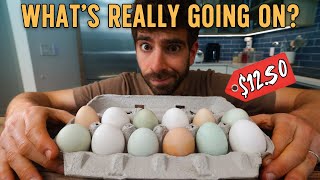

Egg Prices Are NOT the Real Problem
45sChallenges common perception with a bold claim, sparking curiosity and debate.
▶ Play Clip"The title promises a deeper issue, and the video delivers a thorough, well-researched exploration of the egg industry's vulnerabilities."
The video explores the recent spike in egg prices, arguing that the real issue is the fragility of the industrial food system. It traces the history of egg production from wild chickens to modern factory farms, highlighting the hidden costs of cheap eggs, including animal welfare and disease vulnerability. The creator suggests changing our relationship with food by seeking higher-quality, locally sourced eggs and considering backyard chickens for self-sufficiency, not savings.
Eggs are nutrient-dense, with 6g protein each, and are versatile in cooking, from baking to sauces.
Red jungle fowl laid only 10-15 eggs per year; selective breeding in India and China increased this to 30-60 eggs.
Electricity enabled artificial lighting and heating, allowing chickens to lay year-round, boosting supply.
The American Egg Board, a marketing group overseen by the USDA, promotes egg consumption, but this relationship leads to lax regulations.
High-density farming causes stress and disease spread, leading to mass culls and supply disruptions, as seen with avian flu.
Michael suggests cooking from scratch, shopping locally, and seeking higher-quality eggs to change your relationship with food.
Pasture-raised eggs cost more ($7-9/dozen) but offer better flavor and nutrition; local farms kept prices stable during spikes.
Raising backyard chickens is not cost-effective for the creator, but offers self-sufficiency and better egg quality.
How many eggs did the red jungle fowl, the wild ancestor of chickens, lay per year?
Around 10-15 eggs per year.
02:00
What technological advancement enabled chickens to lay eggs year-round?
The invention of electricity allowed farmers to use artificial lighting and heating to push chickens to lay eggs year-round.
03:46
What is the American Egg Board and what is its main mission?
The American Egg Board is a marketing group made up of egg suppliers, overseen by the USDA, with the mission to get people to eat more eggs.
06:02
How do high-density farming conditions contribute to disease outbreaks like avian flu?
High-density conditions cause stress, which weakens immune systems, making birds more susceptible to diseases like avian flu, leading to mass culls and supply disruptions.
08:13
Does raising backyard chickens save money for the creator?
No, the creator spends about $780 a year on eggs, and just organic feed costs close to that amount, plus infrastructure and upkeep costs.
13:29
Wild chickens laid few eggs
Shows the dramatic transformation of egg production through selective breeding.
02:00USDA oversight conflict
Highlights a potential conflict of interest in industry regulation.
06:41Changing relationship with food
Offers a practical approach to improving food quality and supporting sustainable practices.
09:07You are what you eat eats
Emphasizes the importance of animal welfare for food quality.
10:38Backyard chickens not cost-effective
Provides a realistic financial assessment of a popular trend.
13:29[00:01] been hitting record highs and people are losing their minds. Stores are getting political hot topic and it's even sparked a lot of people to start raising their own backyard chickens. And I know that because of this sudden increase in
[00:15] views on my raising chicks video right in the month of March when egg prices were at their highest. But as everyone is freaking out about egg prices, I think there is a much bigger problem going on that's been brewing for
[00:27] decades. And it starts by investigating why egg prices were so cheap in the first place. But before we get into history, let's first talk about why humans consume so many eggs. Outside of them being delicious, of course, they
[00:40] are calorie for calorie one of the most nutrient-dense foods available with around 6 g of protein per each egg along with a ton of healthy fats and a whole lineup of vitamins. And if I had to choose the most important ingredient in
[00:53] my kitchen, eggs are definitely taking first place. Breakfast, lunch, dinner, desserts, snacks. Eggs pretty much sneak themselves into every single meal of the day. And of course, they have a very strong reputation of being the star at
[01:07] workhorse in the kitchen behind the scenes. I use them in nearly every single baked good I make since they're such a good binder. They make a wonderful addition to breads by adding an extra level of luxuriousness and
[01:20] fluffiness like in a beautiful bri. They're the key element to making a nice rich custard like for an ice cream base or a fla or creme brulee. They add richness and help emulsify sauces. And pasta would just really be noodles
[01:34] without the addition of egg yolks. So, it's not hard to paint a very clear picture of why eggs are such a cornerstone in our modern diets. But eggs were not always such a staple food and ingredient that most people imagine
[01:47] them as today. And one of the main reasons is that chickens were just not the same type of powerhouse egg layers that we have today. So the original wild ancestor to the chicken was the red jungle foul, which was domesticated
[02:00] around 7 to 8,000 years ago in Southeast Asia and only laid around 10 to 15 eggs per year, which of course was happening during breeding season. Most birds, of single day year like we're used to with modern chickens. And it wasn't until a
[02:14] few thousand years later in parts of India and China where we really see the start of human intervention. Chicken started to be bred specifically for their size, their amount of meat, and their eggs, which is when egg production
[02:27] finally started to increase a bit, but the increase was still small. We're talking 30 to 60 eggs per year at this point. So over the course of history, we see this smaller increase in egg production, but they were still
[02:39] considered more of a delicacy for thousands of years because eggs are seasonal. A lot of people don't know this because of just the unlimited supply of eggs we basically can get from the supermarket. But in the winter when
[02:52] it gets cold and the light decreases, chickens stop laying eggs or slow down their egg production by a lot. Now, the first real sign of an actual egg industry happened in the 1870s in the form of dried eggs. Basically, drying
[03:08] eggs was the first solution to preserving and shipping them over long distances without spoilage, breakage of the shell. And of course, this was just a much more mindful way to ship them when you think about the limited space
[03:20] available during travel. And this breakthrough in preservation and shipping really opened up a larger egg industry. And as eggs became more popular, farmers started heavy selective breeding of chickens that laid more
[03:33] technology and more science was much more advanced than the selective breeding that was happening thousands of years before. Plus, with the invention of electricity, farmers now had the ability to add artificial lighting and
[03:46] heating to coups, pushing chickens to lay eggs year round. And from these advancements over the course of around 150 years, farmers took their hens from laying 30 to 60 eggs per year to today where we see chickens laying up to 300
[03:59] eggs a year in modern chicken farms. Now, this increased the egg supply just in time for World War II, which took egg consumption to a whole new level. having eggs in their rations. And once the war ended, there was much more
[04:14] to eating all of these eggs. Since the infrastructure was built up to supply these eggs, this really kicked off the first time in history that eggs became a staple food of daily consumption, which is the beginning of what I'm calling the
[04:28] egg industrial complex. But before we get into that, I wanted to take a quick sponsor, which is bombas. Pretty much the only socks myself and my family wear at this point. And what always annoyed me about buying socks is that my
[04:41] lifestyle requires different styles of socks. And I never found one company that was good at making all of the styles until Bombas came along. So, I can get all of my winter cozy marino wool socks, which are the best, but I
[04:55] can also get more everyday casual socks. And I am so happy they are now crushing it with their athletic line. I live a very active lifestyle, and they make both amazing running socks and training socks. And not only do they use super
[05:07] premium materials like marino wool and extra-l long staple cotton, but the style and designs are great as well. Not to mention, they make great kids socks as well. At this point, with the comfort levels and fun designs, it's the only
[05:19] sock both of my girls will wear. And they are rather picky when it comes to of socks purchased, Bombas will actually donate a pair with 150 million items you're making is also doing something good. So, if you're interested in some
[05:34] description and use code word Mike G for 20% off your first purchase. So, now we're post war and the infrastructure is all set up to produce a lot of eggs. But It needed to figure out how to get this rapidly growing baby boomer generation
[05:50] to eat more eggs, which is when the American Egg Board or the AE was first introduced, which was formed in the mid70s. And they're famous for these really wacky TV commercials from the 70s and 80s called The Incredible Edible
[06:02] and 80s called The Incredible Edible Egg. Incredible edible egg. And the name makes them sound like an official government agency, but in reality, they're actually a marketing group made up of different egg suppliers with one
[06:14] main mission, get people to eat more eggs. But here's where things get a little bit interesting. So the American Egg Board is actually overseen by the United States Department of Agriculture, the USDA. But the USDA actually picks
[06:27] who sits on the American Egg Board, which is kind of like a team picking their own referees for the game. So this relationship has ultimately led to much more lax regulations in the egg industry in order to increase profits without
[06:41] much concern for the animals, in this case the chickens well-being. And we've all seen the footage. We've seen the documentaries. Some of these factory terrible. Things like battery cages,
[06:54] overcrowded barns, inhumane treatment of chickens. It's pretty much chicken prison. All with one main upside which are the cheap eggs that we are used to today. And for decades the price of eggs has barely budged. Even through heavy
[07:08] periods of inflation where feed costs, labor and shipping were increasing. Eggs stayed fairly cheap and people got very used to cheap eggs. But the poor conditions for these chickens have some serious downsides. One is just bad
[07:21] quality of eggs, which we'll get into later. But two is the outbreak and spread of potential diseases, which is what we're seeing today, where bird flu will hit a farm and a single outbreak can wipe out millions of eggs and
[07:33] wanted to talk to someone who was connected a little deeper in the egg Michael who's the founder of Farm to People running out of New York City who has been deeply embedded in the food distribution industry for over the last
[07:47] decade. I think what the recent aven flu outbreak, you know, has once again really exposed is the vulnerabilities of the industrial food system. Um, and especially when it comes to how animals are raised. Most commercial egg
[08:00] operations are super super high density kayos, confined animal feeding operations, um, where tens of thousands, in some cases hundreds of thousands and even millions of birds can be kept in super close quarters. you know, these
[08:13] the animals, but they also make it really really easy for diseases to spread like the aven flu. Um, and when you think of like human stress, like related to animal stress, like when does your immune system become more likely to
[08:27] contract an illness, it's usually when you're when you're stressed. So these these birds are are living in that highly highly stressful environment. And then in the repercussions of once a bird gets sick, it means in in a kayo that it
[08:40] it leads to mass coals. So entire flocks, hundreds of thousands of birds are then getting killed. Um, and that then leads to supply chain disruptions and then those supply chain disruptions and lack of supply lead to these price
[08:53] spikes that we're seeing. So the next question is what do you do about all of this? And I think the most important thing, the first thing you can do is start to change your relationship with eggs. For me, growing up, I thought eggs
[09:07] were just this commodity product. You buy your eggs, you buy your milk. They're both very cheap and you don't think very much about the quality of the when I first started educating myself and seeing the downside of the modern
[09:21] industrial food systems, my relationship to food in general started to change. And the first thing I did right away was just continue to cook more food from scratch, which will automatically eliminate so much of the processed food
[09:33] that is being thrown in our faces and marketed to us every single day. That was step one. The next step was starting to seek out higher quality ingredients. And I was doing that by shopping more locally and shopping seasonally. And
[09:47] since eggs were such a key player on my grocery list, I started trying to seek out higher quality eggs, which can be done, of course, by looking for higher quality eggs at the grocery store, or you can go to your local farmers market
[09:59] higher quality eggs. And every single egg producer is going to be operating a suggest talking to the farmers if you can, seeing how they raise their chickens. Generally, these smaller scale egg operations are feeding chickens
[10:13] better, giving them more space in the coops and letting them free range on open pastures. To contrast the the sort of um industrial egg system, you know, the farms that we source from raise their hens on pasture. The the
[10:26] conditions are healthier. As a result, the eggs I think you can see it. I think better. And that really comes from a better way of farming that really prioritizes the health of of the
[10:38] really like is like you are what you eat eats. And so when you think about like a chicken or a grass-fed cow or anything, you want to just like not only think enjoying, but what was the the the life before that that that piece of protein
[10:52] before that that that piece of protein or egg or or or whatever it is had prior to you enjoying it. And I think you can taste the difference. Now, of course, when you're investing in higher quality food, it comes at a cost. And eggs are
[11:04] no different. I went from getting a dozen eggs for $2 or $3 to spending 7 8 $9 for a dozen of eggs. But as I changed my relationship to food, this was just an area of my life that I was willing to invest more of my money into in order to
[11:17] get a much higher quality and better tasting product, plus an egg with a much higher nutritional value. Now, what I find very interesting about the recent increase in egg prices is that the industry is starting to level out a
[11:30] little bit where you have these bigger industrial egg producers, their egg prices have been going up a lot in the recent months, whereas these local farms or smaller egg producers have been able to keep their prices closer to the
[11:42] original price they've been selling these eggs for years. when pricing of eggs spiked drastically and ours stayed the same as it was 12 months ago. I difference between what our egg is which is a not a commodity product and the
[11:57] commodity market which is a whole other thing. The commodity market was having supply issues because you know there were supply chain breakdowns, there were mass cullings like all of these issues that led to the the supply becoming
[12:10] diminished and therefore the value of what remained going up. We were outside contracting directly with farms that you know very luckily were spared from these outbreaks but they that meant that
[12:22] nothing about their day-to-day changed but the price of their eggs 6 months ago eggs and then randomly due to these supply chain issues in the commodity market their pricing became very attractive. My hope is that what people
[12:35] discovered when they went to these now cheaper eggs, momentarily cheaper eggs, was that they discovered that the the flavor and the quality of these eggs was that much better and that they will in turn stick around and stick with them.
[12:49] Now, I couldn't finish a video on eggs without talking about backyard chickens. And it's awesome to see the spike in interest that people have in raising backyard chickens as this chicken gets into the food source, get out of there.
[13:03] And I don't want to talk about how to actually raise chickens. I have other videos on that which I'll link below, but I want to answer one question that a financials of backyard chickens and does it make sense with the increase in egg
[13:17] price breakdown to answer that question. So, I have a family of four, soon to be five. And on the conservative side, we go through about two dozen eggs a week. And if we're using Farm to People's prices at say 750 for a dozen of
[13:29] pasture-raised eggs, that's $780 a year on eggs. Now, I don't have my exact numbers, but I can tell you just on organic feed alone, it's probably close to that number. And then you add on initial infrastructure costs,
[13:42] the upkeep, the time it takes. For me, I am not saving money on eggs by raising chickens. There are ways to do it on a budget where you can save money, but that's not happening in my personal operation, and I'm all right with that.
[13:55] Raising chickens for me is not about saving money. It goes back to the same farmers market eggs by giving these chickens the best diet possible, the best life possible. I know I'm going to get the best possible eggs. Just like
[14:08] I will say the feeling of self-sufficiency of being able to raise chicks all the way up to egg producers. So, you're completely off the grid from these type of food industry crises and outbreaks and recalls. That is a good
[14:22] feeling and another reason chickens is worth the investment. Whoa, what are you little bit confused when I'm just ranting to a camera in their chicken ranting to a camera in their chicken run.


⚡ Saved you 0h 14m reading this? Transcribe any YouTube video for free — no signup needed.