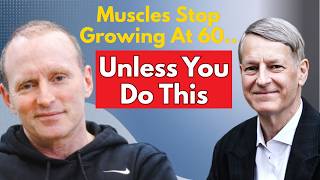

Why Protein Needs Increase After 60
60sExplains anabolic resistance and why older adults need more protein, a common concern for aging fitness enthusiasts.
▶ Play Clip"Delivers on the promise with expert insights on protein thresholds, though some parts are conversational and could be more concise."
In this video, Dr. Brad Schoenfeld discusses the challenges of building muscle after age 60, focusing on anabolic resistance and the increased protein requirements for older adults. He explains the importance of leucine threshold, the role of supplements like creatine, and practical strategies for optimizing muscle protein synthesis.
Older individuals have diminished ability to respond to mechanical stimuli and use protein at the tissue level, a condition called anabolic resistance. This means they need higher protein doses to achieve similar muscle protein synthesis increases.
Muscle is sensitized to protein intake for 24+ hours post-exercise, so protein needs can be spread over the day. Most studies focus on post-exercise period, but the concept applies to daily intake.
Leucine, a branched-chain amino acid, kick-starts muscle building. Younger individuals need 2-3 grams, but older individuals may need up to 4 grams to hit the threshold. Animal-based proteins like whey are rich in leucine.
To reach the leucine threshold, older individuals may need 30-45 grams of high-quality protein (e.g., whey) per sitting. Foods with lower leucine content require more protein to achieve the same effect.
Dr. Schoenfeld emphasizes food-first, but protein supplements can help older adults who have reduced taste sensitivity or difficulty eating whole foods. Supplements are an option if daily protein needs aren't met.
Creatine monohydrate is the only muscle-building supplement with good efficacy. It enhances strength and hypertrophy modestly, not steroid-like. It helps regenerate ATP and may have brain health benefits, but more research is needed.
Creatine stores are like a glass; once full, extra intake doesn't increase stores. Vegans tend to have lower stores and respond better. About 30% of population have full stores and may not benefit.
Creatine improves both strength and hypertrophy. It acts as an osmolite, attracting water into cells, which may increase protein synthesis. Training harder leads to more muscle gain.
Older adults need higher protein intake, particularly leucine-rich sources, to overcome anabolic resistance. While supplements like creatine can support muscle building, a food-first approach is recommended, and individual responses vary.
What is anabolic resistance?
A diminished ability of tissues to respond to mechanical stimuli and use protein, requiring higher protein doses for muscle synthesis.
00:20
How many grams of leucine do older individuals need to kick-start muscle building?
Up to 4 grams, compared to 2-3 grams for younger individuals.
02:03
What is the recommended protein dose per sitting for older adults to hit the leucine threshold?
30-45 grams of high-quality protein like whey.
03:12
What is the only muscle-building supplement with good efficacy according to Dr. Schoenfeld?
Creatine monohydrate.
05:50
Why might vegans respond better to creatine supplementation?
They tend to have lower creatine stores due to lack of animal-based products.
07:01
How does creatine enhance muscle building?
It acts as an osmolite, attracting water into cells, which may increase protein synthesis, and it improves strength and hypertrophy.
09:09
Anabolic Resistance Explained
Key concept that explains why older adults need more protein.
00:20Leucine Threshold for Older Adults
Specific number (4g) that guides protein intake recommendations.
02:03Creatine as Effective Supplement
Evidence-based recommendation for a supplement that actually works.
05:50Creatine Response in Vegans
Practical insight for plant-based eaters.
07:01[00:04] nutrition to support the muscle growth. And as you kind of alluded to before, uh we get less good at absorbing protein. And And I I guess also using the protein in the muscle I mean do we get less good at both parts of
[00:20] those? Like the Not really the absorption. Uh it's the ability to use it at the tissue level. Right. There's an anabolic resistance of the tissues to purposes. It's called anabolic resistance. And And again, both It's
[00:36] training the uh mechanical stimuli are uh are are diminished uh in terms of your ability to respond to it older individuals. And uh and the ability particularly to
[00:51] use protein and there's several explanations given which I don't know deep down that rabbit hole you want to go, but bottom line is is that generally speaking the dose of protein needs to be higher.
[01:03] Uh so in a given sitting usually you get a older individuals have been shown to need higher dosage of protein to achieve uh similar muscle of protein to achieve uh similar muscle protein synthesis uh increases.
[01:18] Okay. Could you talk about that in a little bit more detail? So higher dose little bit more detail? So higher dose like grams per kilogram or And is it in each sitting or can you have it one or two meals a day?
[01:32] Well, usually it's I mean it's been most studied in the post exercise period, but muscle is sensitized to uh protein intake for 24 plus hours after a workout. So conceivably it would be over the course of the day. But um
[01:48] having So So I I guess that we can go down this road if you want. Um let me just touch on it that um there's a uh which is one of the branched chain amino acids and it has been
[02:03] consid- the evidence suggests that it kind of kick-starts the muscle building pro- uh process post exercise. And there's a threshold of leucine that's needed. So in grams. So in younger individuals two to three grams
[02:18] it's been shown it may be up to four grams. So it it's increased the leucine is uh particularly replete in animal-based proteins uh such as milk
[02:32] going to need if you're a vegan a plant-based uh eater uh you're going to need more even more because you usually plant-based a fortified. You can get proteins that are fortified in leucine.
[02:46] So again that this is a discussion for another day, but just the important point is is that in the research that we have probably somewhere in the four grams may be needed
[03:00] for older individuals to hit that leucine threshold to kick-start the leucine threshold to kick-start the muscle building process. And that as mentioned before there's going to be individual responses there. So that can
[03:12] be anywhere by the way between 30 to 45 grams of a uh quality when I say quality a animal-based protein. You usually in research they use whey protein which is a one of the fractions of milk proteins.
[03:27] So when we talk about animals it's not necessarily a meat, but uh milk proteins are extremely high quality particularly leucine and casein are the two fractions. Um so you just need a decent amount of
[03:41] protein which is higher. Get it you're going to need more to achieve that Right. And so that was how many grams of kind of whey to to get to that leucine level? 30 to 45 grams of whey of whey protein.
[04:00] Now again that that leucine is going to be uh have different is going to be in different quantities in different foods. So if it's if a food has less leucine
[04:13] content. Uh so if you you're going to eat a protein that is less high you know has less leucine in it you're going to have more protein. Right.
[04:28] So So you talked about anabolic resistance. Now is there any supplements or or any other way that we can kind of overcome this? I mean there are some supplements that
[04:42] you can that that are meant to help with muscle Uh do you think that any there are any that are really effective? Well, so I'll say this. Um you do not
[04:57] need to take a protein supplement. So you I'm a big food first person. Now one of the issues that uh older individuals tend to have is that number one there's
[05:09] uh the taste buds tend to decrease or the sensitivity of the taste decrease or the sensitivity of the taste buds. So food is less pleasurable when people get older to some extent. Um and it can be harder to for older
[05:22] individuals to consume the the in in whole food. So supplements can protein supplement can just make it easier to get protein in. But you certainly there's no the fact is that you certainly don't
[05:37] need to take like whey protein or casein or any other supplement to meet your protein needs. If you're not able to get sufficient daily protein in or per meal protein, then it's an option that to me should be
[05:50] considered. The only real muscle building supplement that has in my opinion good efficacy in the is creatine uh creatine monohydrate. Um
[06:06] the short course is is that uh it can enhance strength and and uh hypertrophy to some extent. It is not uh it's not a steroid first of all. It does not have steroid-like effects. The
[06:20] effects are relatively modest. Uh roughly 30% of the population are So they don't You can take creatine Who it depends upon So you creatine helps to regenerate ATP adenosine triphosphate
[06:35] which is the energy-producing molecule in the body. Um And if you have sufficient crea- creatine stores, it's kind of like a glass. Once they're full, you can take
[06:47] more creatine in, but you're you're not going to store more creatine. They only have a certain capacity. Uh what I would say is if um lot of animal-based products, they will tend to
[07:01] have higher creatine stores. Those who are vegans plant plant-based eaters tend to have lower creatine stores and tend to respond better to creatine. Um but like I said 30% of the population just have full stores. But it's
[07:17] something that can be worth trying. It's a relatively inexpensive supplement. Uh the vast uh literature on the topic does not show any real side effects from it other than some
[07:30] there's ways you can potentially put it in stirred in hot water. Anyway, there's some warm water. There's some ways to get around that, but there's really no
[07:42] from my reading of the literature uh and this goes across studies up to over and this goes across studies up to over a year in length uh any negative something that someone could try. If it works, can keep using it. And And there
[07:58] somewhat outside of my area of expertise. I've looked into it to some extent, but there is emerging literature that it may and I want to use that term to express the uncertainty quite cautiously. There may
[08:12] uncertainty quite cautiously. There may be brain health uh effects of creatine. Something that I still think needs a lot more exploration in the literature. So something that people can try. Uh other than that supplements are um
[08:27] from a muscle building standpoint they're just not something I I think are the population. If you're an athlete, there's other things that can be considered. But for the vast majority of population I just don't think it's
[08:41] going to make much difference. Right. So creatine helps you work out harder. And so your muscle gets And so your muscle gets harder and so you know I guess that the
[08:54] the message to build is stronger. It does it also help the muscle actually build? Yeah, creatine does improve both strength and hypertrophy or it can. So train better, you generally you're going to gain more muscle.
[09:09] creatine acts as what's called an osmolite. So it attracts water into the cell. And there's some evidence that hydrocellular hydration may increase protein synthesis. So And there's theories around it. But
[09:24] does have muscle building effects as well as strength enhancement.



⚡ Saved you 0h 09m reading this? Transcribe any YouTube video for free — no signup needed.