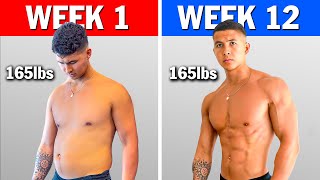

You CAN Build Muscle & Lose Fat At The Same Time
45sChallenges a common fitness myth with scientific evidence and examples of pro athletes.
▶ Play Clip"The title accurately reflects the content: the video provides a step-by-step guide on how to lose fat and gain muscle simultaneously, backed by research."
Body recomposition—building muscle while losing fat—is possible for most people, not just beginners. Research shows it occurs even in advanced athletes when using a small calorie deficit, high protein intake, and proper training. The key is balancing opposing goals by signaling the body to use fat stores for muscle growth.
A 2021 meta-analysis of 59 studies found that muscle growth halts when the calorie deficit exceeds ~300 calories, and decreases beyond 500. A slight deficit of 200-300 calories is optimal for maximizing recomposition odds.
During a deficit, muscle protein synthesis drops. High protein intake (0.8-1g per pound of body weight) counteracts this and supports muscle growth while losing fat.
A 2023 study showed both heavy/low-rep and light/high-rep training can work for recomp, provided sets are taken close to failure (within 3 reps). Effort is the key factor.
A 2020 study found that a sleep education program (aiming for 7+ hours) significantly improved fat loss during a workout program, while the workout-only group gained fat.
Beginners, people returning after a break (muscle memory), and those who previously trained suboptimally are most likely to recomp. However, even for them, recomp becomes harder below ~15% body fat (men) or ~22% (women).
Recomp results are slow and harder to track than bulking/cutting. Traditional cycles may be superior for experienced lifters. The video recommends considering your primary goal before choosing recomp.
What is the recommended calorie deficit for body recomposition?
A small calorie deficit of around 200-300 calories per day.
[1:35]
What protein intake is recommended during a calorie deficit for body recomposition?
0.8 to 1 gram per pound of body weight.
[3:16]
How much sleep is recommended to support body recomposition?
At least 7 hours per night.
[6:09]
Which three groups of people are best suited for body recomposition?
Beginners, people returning after a break (muscle memory), and those who haven't trained optimally before.
[6:21]
Why is body recomposition considered challenging?
Because muscle building is energy-demanding and a calorie deficit typically prevents it. However, the body can use fat stores for energy.
[0:43]
What study is referenced to determine the optimal calorie deficit for muscle growth?
A 2021 meta-analysis of 59 fat loss studies.
[1:35]
What does the 2023 study say about training with heavy vs. light weights during a calorie deficit?
Both heavy weights for low reps and lighter weights for high reps can work, provided effort is high (close to failure).
[3:49]
How close to failure should each set be taken to maximize muscle growth?
Within 3 reps of failure, possibly even closer.
[4:24]
What does research suggest about gender differences in body recomposition?
Females may be more likely to experience body recomposition even when relatively lean.
[7:55]
What are the approximate minimum body fat percentages for body recomposition to be possible?
Around 15% body fat for males and at least 22% for females.
[8:11]
Pro athletes can recomp
Shows body recomposition is possible even in highly trained individuals, not just beginners.
[0:25]Optimal calorie deficit
Provides a specific, research-backed range (200-300 calorie deficit) for maximizing muscle gain while losing fat.
[1:35]High protein intake crucial
Emphasizes the importance of protein (0.8-1g per pound) to counteract reduced muscle protein synthesis during a deficit.
[3:16]Train close to failure
Highlights that effort level (within 3 reps of failure) is more important than rep ranges for muscle growth during a deficit.
[4:24]Who benefits most
Identifies three groups (beginners, returnees, suboptimal trainers) most likely to succeed with recomp, helping viewers self-assess.
[6:21][00:00] build muscle lose fat pick what well
[00:04] what if I want to do both at the same
[00:06] time known as body recomposition many
[00:09] people believe this is impossible or
[00:11] only reserved for a small percentage of
[00:13] people but that's not entirely true most
[00:16] people definitely can build muscle and
[00:19] lose fat at the same time in fact it
[00:21] happens all the time in research and not
[00:23] just in beginners this study found
[00:25] positive body recomposition in pro
[00:28] football players already squatting over
[00:30] 382 pounds and benching over 289 pounds
[00:34] and even some women at extreme levels of
[00:37] leanness preparing for a bodybuilding
[00:39] show have been found to gain a bit of
[00:41] muscle during this process so what's the
[00:43] secret well the major problem with
[00:45] trying to build muscle and lose fat at
[00:47] the same time is their two opposing
[00:49] goals to typically you need to be in a
[00:52] calorie deficit to lose fat but because
[00:54] muscle building is such an energy
[00:56] demanding process this usually prevents
[00:58] you from building muscle however the
[01:01] energy your muscles need to grow doesn't
[01:03] just have to come from your diet with
[01:05] the right nutrition and training plan
[01:06] you can actually signal your body to use
[01:09] its existing fat stores as energy
[01:11] towards building muscle and as a result
[01:13] build muscle and lose fat simultaneously
[01:16] so how do we do it well there's three
[01:19] steps to this starting with nutrition
[01:20] now the most important part of your
[01:23] nutrition is your calorie intake and
[01:25] although you want to be in a calorie
[01:27] deficit to stimulate fat loss it
[01:29] shouldn't be as aggressive as it is
[01:31] during a typical diet and phase as for
[01:33] what that sweet spot is let's take a
[01:35] look at this 2021 meta-analysis
[01:38] researchers pull together 59 fat loss
[01:41] studies to try to find at what point a
[01:43] calorie deficit becomes too low for
[01:45] building muscle to be possible here is
[01:47] the graph of the results notice how many
[01:50] people were able able to build muscle
[01:51] when the deficit was small but as soon
[01:53] as it surpassed a deficit of around 300
[01:55] calories muscle growth came to a halt
[01:58] and even began to decrease as soon as
[02:00] the deficit grew larger than 500
[02:02] calories now keep in mind this data is
[02:05] from subjects following standard fitness
[02:07] programs employed in research studies
[02:09] which usually aren't the most ideal
[02:11] programs for building muscle so with the
[02:13] optimized training plan I'll show you
[02:14] later on in this video it's very
[02:16] possible you'll still be able to build
[02:17] muscle even in a 500 calorie deficit and
[02:20] Beyond however based on this data if you
[02:23] want to maximize your odds of being able
[02:25] to recop it's likely that a slight
[02:27] deficit of around 200 to 300 calories is
[02:29] best and if you do want some help
[02:31] calculating this you can head over to
[02:33] billtoscience.com calculator okay so we
[02:36] have calories figured out but what seems
[02:38] to be just as important is your protein
[02:40] intake you see a calorie deficit reduces
[02:43] your rates of muscle protein synthesis
[02:45] so less of the protein you eat will be
[02:47] used as a building block for building
[02:49] muscle E2 little protein and your body
[02:52] will start to look for it elsewhere such
[02:53] as your existing muscle mass as for how
[02:56] much to eat to counteract this let's
[02:58] take a look at three studies each of
[03:00] them had subjects eat in a calorie
[03:01] deficit but assigned them to either a
[03:03] low or high daily protein intake of
[03:06] different amounts every single study
[03:08] found Superior muscle growth in the high
[03:10] protein group and since subjects were
[03:12] still in a calorie deficit they managed
[03:14] to lose fat at the same time now
[03:16] unfortunately we don't yet have a study
[03:18] that compares protein intakes that are
[03:20] both relatively High during a calorie
[03:22] deficit such as 0.8 versus 1.2 grams per
[03:25] pound of body weight however I think
[03:27] it's pretty safe to say that you'll be
[03:29] pretty much close to maximizing your
[03:30] growth at about 0.8 grams per pound and
[03:33] if you really want to be on the safe
[03:34] side bump it up to one gram per pound so
[03:37] the next step is to pair your nutrition
[03:39] plan with a training plan designed to
[03:41] force your muscles to grow and there's a
[03:43] few relevant studies that can help us
[03:45] determine what the best approach might
[03:46] be one of them is a study published just
[03:49] last year where research just took 130
[03:51] subjects with at least six months
[03:53] trading experience and compared the
[03:55] effects of having them trained with
[03:56] heavy weights versus lighter weights
[03:58] while in a calorie deficit a common
[04:00] belief is that lighter waste for High
[04:02] Reps is better for fat loss whereas
[04:04] heavier weights for Less reps is best
[04:06] for building muscle but in this case
[04:09] both approaches resulted in a similar
[04:11] amount of fat loss as well as a little
[04:14] bit of muscle gain but this does heavily
[04:16] depend on one factor effort and this is
[04:20] honestly where I believe most of you
[04:21] guys are falling short you see in order
[04:24] to maximize growth you need to take each
[04:26] of your sets at least within three reps
[04:29] short of failure and in fact based on
[04:31] the new pre-print study it might be
[04:33] advantageous to take each set even
[04:35] closer to failure than this thing is
[04:37] most people don't train anywhere close
[04:39] to hard enough to reach this no you got
[04:41] more come on come on come on you have at
[04:44] least three more go and this brings me
[04:46] to an important point I want to make
[04:47] there really isn't a special body
[04:49] composition position training plan it's
[04:51] about doing the basics but doing the
[04:53] well polish hard enough during your sets
[04:55] train with enough volume work each
[04:57] muscle at least twice per week and most
[05:00] importantly stay consistent even if
[05:02] you're an experienced lifter fixing any
[05:04] one of these variables can very well be
[05:06] the stimulus your body needs to continue
[05:08] building muscle despite being in a
[05:10] deficit but before I cover who exactly
[05:12] body recomposition is best suited for
[05:15] there is one more variable you need to
[05:17] make sure you don't overlook sleep okay
[05:20] so the most relevant study we have
[05:21] regarding sleep and body recomposition
[05:23] was published back in 2020 researchers
[05:27] took untrained men and randomly assigned
[05:29] them to either a worker program
[05:30] consisting of two full body workouts per
[05:32] week or that same workout program plus a
[05:35] sleep education program designed to
[05:37] improve both the quantity and the
[05:40] quality of their sleep after 10 weeks
[05:42] both groups had similar increases of
[05:44] muscle with a trend favorite in the
[05:46] Sleep group when it came to Fat Loss
[05:48] however the Sleep group actually he
[05:50] ended up losing a significant amount of
[05:52] fat while the workout only group ended
[05:55] up gaining a little bit of fat other
[05:57] Studies have shown similar effects as
[05:58] well where sleep deprivation negatively
[06:00] affects both muscle gains and fat loss
[06:03] so to make sure you don't sabotage all
[06:05] the work you put into your nutrition and
[06:06] training try to get at least seven hours
[06:09] of sleep per night alright so now that
[06:10] we've covered how to recap let's discuss
[06:13] the most important part who body
[06:15] recomposition is best suited for and
[06:17] whether or not it's actually worth your
[06:18] time pursuing so first off the higher
[06:21] your potential for growth the more
[06:22] likely you'll be able to recall and
[06:24] there's three main groups of people who
[06:26] satisfy this criteria the first group
[06:28] are beginners who can basically touch a
[06:30] weight and end up growing the second
[06:32] group has to do with the fact that
[06:33] muscle regrows far easier than it took
[06:36] to initially grow it Lawrence one of our
[06:38] bill of science members is a good
[06:39] example of this he took some time off
[06:41] training and in his first two months
[06:43] back although his body weight didn't
[06:45] change very much he was able to build
[06:46] some muscle while losing a good amount
[06:48] of fat but the third group is where I
[06:51] think most people fall under and Nick
[06:53] another one of our build science members
[06:55] is a perfect example of this although he
[06:57] had been training for several years he
[06:59] was pretty much just going through the
[07:00] motions he never properly applied
[07:02] Progressive overload and had plenty of
[07:04] other areas where his training could
[07:05] improve I also just didn't know how to
[07:07] approach his nutrition after we helped
[07:09] optimize his plan he quickly saw results
[07:11] and experienced incredible body
[07:13] recomposition over the course of several
[07:16] months although his actual body weight
[07:18] didn't change too much he clearly built
[07:20] a good amount of muscle while losing a
[07:22] ton of fat in the process that said even
[07:25] if they do fall into one of these three
[07:27] groups there's still one more condition
[07:28] you should satisfy and the importance of
[07:31] this is highlighted in a recent 2023
[07:33] case study researchers analyzed a group
[07:36] of professional bodybuilders during the
[07:38] contest prep and found that as they got
[07:40] leaner building muscle became far less
[07:42] likely and eventually muscle loss became
[07:45] inevitable once they surpassed a certain
[07:47] level of leanness it is interesting
[07:49] however that a few of the female
[07:51] subjects were still able to build a
[07:53] little bit of muscle and another study
[07:55] has actually shown similar results it
[07:57] suggests that body recomposition may be
[07:59] more likely to occur in females even
[08:01] when relatively but we definitely need
[08:03] more research but overall although the
[08:06] exact minimum level of body fat required
[08:08] to recomb isn't entirely clear yet I'd
[08:11] say around 15 body fat for males and at
[08:14] least 22 percent for females is a good
[08:16] minimum but now it's time for the
[08:18] million dollar question is body
[08:20] recomposition even worth your time well
[08:23] first off if you're someone who's pretty
[08:24] lean or has been trained both hard and
[08:26] consistently for at least six months
[08:28] then you're probably gonna have a hard
[08:30] time trying to recall secondly even if
[08:33] you are likely to recall you should also
[08:35] consider what your main goal is right
[08:37] now I know you want to do both but
[08:39] what's truly more important to you right
[08:40] now building muscle or losing fat for
[08:43] example while you might end up building
[08:45] a little bit of muscle during a recomp
[08:47] most research suggests that a surplus or
[08:49] lean ball book is likely Superior
[08:51] whereas if your main goal is to lose fat
[08:53] then a slightly more aggressive deficit
[08:55] would definitely lead to more fat loss
[08:58] with the possibility that you'll still
[09:00] be able to gain a little bit of muscle
[09:01] it's also likely no coincidence that no
[09:04] bodybuilder on the planet at least that
[09:06] I'm aware of natural or enhanced tries
[09:08] to recomp their way to muscle growth
[09:10] they use Balkan and cutting cycles and
[09:12] end up looking better year after year
[09:14] and perhaps just as important we as
[09:17] humans like to see things go in the
[09:18] right direction during a recomp results
[09:21] can be slow and your body weight doesn't
[09:22] really help indicate whether things are
[09:24] going in the right direction so you have
[09:26] to rely on other metrics like small
[09:28] differences in progress photos
[09:29] strengthen the gym have your clothes are
[09:32] fitting and tracking your waist
[09:33] circumference over time without proper
[09:35] guidance this can be a lot more
[09:37] difficult to navigate than a traditional
[09:39] bulker cut where the scale and quicker
[09:41] body changes can lead the way that said
[09:44] I do think for some people it is worth a
[09:46] shot and at the very least it's helpful
[09:48] to be mindful of when dieting in the
[09:50] event that your weight is stuck and you
[09:52] think you're not making progress but
[09:54] you're really just building muscle and
[09:55] losing fat simultaneously and as a recap
[09:58] here's who is best suited for here's how
[10:00] to execute it and here's what to expect
[10:02] and how long it typically lasts and if
[10:05] you need some help optimizing your plan
[10:06] then head to buildtoothscience.com and
[10:09] take our 30 second quiz to find the best
[10:11] step-by-step training and nutrition plan
[10:13] for you and your body I highly recommend
[10:16] that you give this video watch next for
[10:17] some new science-based training
[10:19] techniques you can start applying today
[10:21] to speed up growth thanks for watching
[10:23] I'll see you next time


⚡ Saved you 0h 10m reading this? Transcribe any YouTube video for free — no signup needed.