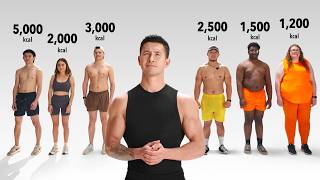

4 Body Types Revealed with Science
45sThe hook introduces a relatable topic with a promise of scientific insight, making viewers curious about their own body type.
▶ Play Clip
[00:00] You probably fall into one of these four
[00:02] body types. But have you ever wondered
[00:04] why and how to actually change it? To
[00:06] find out, I brought in men and women of
[00:08] completely different body types,
[00:10] measured their exact muscle and fat
[00:11] levels, and even used the world's most
[00:14] accurate metabolism test to find out how
[00:16] many calories they actually burn and
[00:19] eat. You actually eat calories per day.
[00:23] >> Oh my goodness.
[00:25] >> Calories per day.
[00:27] By the end of this video, you'll know
[00:29] which body type you fall under, why your
[00:31] body works the way it does.
[00:32] >> I would think that I have a slow
[00:34] metabolism,
[00:34] >> and the simple training and diet
[00:36] approach it needs to actually see
[00:38] progress.
[00:39] >> I'm so jealous.
[00:41] >> This is Aaron. He is very lean at just
[00:43] 13% body fat, but his total muscle mass
[00:46] is below average.
[00:47] >> Would you say you're somebody who like
[00:49] has a hard time sitting still?
[00:51] >> Yep. 100%.
[00:52] >> Aaron falls into our first body type,
[00:53] the skinny physique. This is a naturally
[00:56] lean, slender look characterized by a
[00:58] smaller frame, low muscle mass, and less
[01:00] fullness in your shoulders, arms, and
[01:02] legs. Personally, this is the body type
[01:04] I started with. I played sports as a
[01:06] kid, and I felt like I could eat
[01:07] whatever I wanted without gaining
[01:08] weight. But when I started lifting to
[01:10] build muscle, my body was slow to
[01:12] change. And this is Maria, weighing in
[01:14] at just 97 lbs. Her goal is to build
[01:17] strength.
[01:17] >> Mainly in my upper body, like my arms, I
[01:20] feel, are really weak. I want just to
[01:22] feel stronger in general. No, I can't.
[01:25] >> But because of their low muscle mass,
[01:26] they both struggled when we tested their
[01:28] strength. And for Maria, these results
[01:30] were especially concerning.
[01:32] >> So your number came in at 5.09. If this
[01:35] number is below 5.45, the person is at
[01:38] risk for what's called sarcopenia, which
[01:41] is as you age, you lose muscle. Maria's
[01:44] DEXA also revealed a second concern. Her
[01:47] bone density is lower than 72% of others
[01:50] her age, which puts her at a greater
[01:52] risk of fractures, especially as she
[01:54] gets older. I bring this up because
[01:56] while you can be healthy and active
[01:57] across multiple body types, there were
[01:59] different health risks we found that
[02:01] seem to affect certain body types more
[02:03] than others.
[02:04] >> I'm borderline diabetics, says my
[02:06] doctors.
[02:07] >> Even those who on the outside look fit
[02:09] and healthy. I'll show you how to
[02:10] prevent each of these risks at the end
[02:12] when I explain the diet and training
[02:14] plan I'd recommend for each body type.
[02:15] But first, let's get to our next body
[02:17] type, skinny fat. Now, in clothes, this
[02:20] actually looks quite similar to the
[02:22] skinny body type, but underneath it,
[02:23] there's a softer physique, carrying
[02:25] excess fat, especially around the belly
[02:27] and love handles.
[02:28] >> When I moved to California, it was like
[02:30] a flip. Like, I just started gaining
[02:32] weight.
[02:33] >> And David's experience isn't unique.
[02:35] Research shows that while your body
[02:36] weight fluctuates up and down all the
[02:38] time, the average person quietly gains
[02:40] about 1 to two lbs every year. If you're
[02:43] not lifting weights or not lifting
[02:45] properly, most of that extra weight is
[02:47] stored as fat, which explains why the
[02:49] skinny fat body type is so common,
[02:51] especially when you're younger. But it
[02:52] doesn't just look one way. You can be on
[02:54] the leaner end of skinny fat like Dennis
[02:56] and Grace, or be carrying slightly more
[02:58] body fat. But what everyone in this
[03:00] group has in common is below average
[03:02] muscle mass. And we're calculating this
[03:04] using everyone's fat-free mass index,
[03:07] which is a score that basically reveals
[03:09] how jacked you are. You take your body's
[03:10] total lean mass, which is just your body
[03:12] weight minus how much fat you're
[03:13] carrying, and then you divide that by
[03:15] your height squared. Now, average
[03:17] fat-free mass for men is right around
[03:19] 18, while the average score for women is
[03:21] just below 16. And you may have noticed
[03:23] that two of our subjects in this group
[03:25] happen to be identical twins, Paula and
[03:28] Paola. And I'm curious, since you guys
[03:30] are twins, genetically identical, do you
[03:32] have any theory as to why there's a
[03:34] slight discrepancy in your body fat
[03:36] right now?
[03:36] >> Yeah, I mean, it's not not really a
[03:38] theory. I was depressed and I gained a
[03:41] lot of weight. I was eating a lot of
[03:43] food and a lot of like takeout, boneless
[03:46] wings, fried sushi, fried fried sushi.
[03:49] Yeah, I was having fried sushi.
[03:50] >> And while Paola can point to a single
[03:52] event that caused her weight gain,
[03:54] everyone I spoke with seemed to have
[03:55] their own theories as to why they have
[03:57] their current body type.
[03:58] >> I would think that I have a slow
[04:00] metabolism.
[04:00] >> You know, Uber Eats, going to
[04:02] restaurants takeout.
[04:03] >> I work in retail. That comes like three
[04:05] to four times a week. I'm on my feet
[04:07] pretty much the whole time. But how many
[04:09] of them are actually correct? To find
[04:11] out, one month before filming, I had
[04:12] nine of our subjects complete a test
[04:14] that not only reveals their actual
[04:16] metabolism, but also lets us predict
[04:18] exactly how many calories they've
[04:20] actually been eating. But here's the
[04:21] catch. None of our subjects know what
[04:24] this test was for. So, they have no idea
[04:26] that I know their exact calories in and
[04:28] calories out for the past 2 weeks. And
[04:30] I'm curious to find out how well each of
[04:32] our subjects know their own habits.
[04:34] >> Are you serious?
[04:35] >> What? You're
[04:36] >> Oh my god. I will say there were a few
[04:39] surprises in the results we got back.
[04:41] >> Damn, that's really eye opening.
[04:42] >> But we still have two more body types to
[04:44] cover with the next one being the most
[04:46] common body type for gym bros. Bulky.
[04:52] >> How How many was that?
[04:52] >> I counted 14.
[04:54] >> This is Sahil and he falls under our
[04:56] third body type, bulky. Unlike the
[04:58] skinny fat group, this body type carries
[05:00] an above average amount of muscle, which
[05:02] explains how Sahil easily jumped to the
[05:04] top of the leaderboard in our not so
[05:07] scientific strength test, only to
[05:08] immediately have his record beat by
[05:10] Eric, whose fat-free mass index was just
[05:12] two points shy of what most people
[05:15] consider the natural ceiling.
[05:16] >> That's like pro bodybuilder high. But
[05:19] while Sahil and Eric have above average
[05:21] levels of muscle mass, they also have
[05:23] slightly above average levels of body
[05:25] fat, both in the high 20s, which hides a
[05:27] lot of their muscle definition. And
[05:29] while bulky builds are more common in
[05:31] men due to higher levels of
[05:32] testosterone, that doesn't mean women
[05:34] can't fall into a similar category as
[05:36] well. These are too easy. Look at these
[05:38] guns. We need a side angle of this. And
[05:41] you don't do curls.
[05:42] >> No. This is Melody and her goal is to
[05:45] start slimming down now that she's made
[05:46] great progress after 5 years of weight
[05:49] training. Your body fat percentage is
[05:51] 33.7%.
[05:53] >> Oh,
[05:53] >> why'd you say it like that? Is that
[05:55] higher or lower?
[05:55] >> I thought it would be higher.
[05:56] >> And your muscle score, fat free mass
[05:59] index is 18.5. That is above average.
[06:03] That actually puts you there's like a
[06:05] ranking and it puts you at like advanced
[06:07] gym user.
[06:08] >> So cool.
[06:09] >> Yes. But the fat loss plan I'd build for
[06:11] Melody is a lot different from what I
[06:13] propose for our final body type, which
[06:15] is categorized by a significantly high
[06:18] level of body fat. Over 30% for men and
[06:20] over 40% for women. Your body weight is
[06:23] currently 323 lb and your body fat is
[06:27] 51%.
[06:28] >> Wow.
[06:29] >> Is it is that higher than what you
[06:30] expected?
[06:31] >> That's I didn't know what it was going
[06:32] to be, but that's that's up there.
[06:34] >> I really appreciate you even just being
[06:35] part of this video. the fact that you
[06:37] took your shirt off in front of
[06:39] everybody here, like that's that takes a
[06:41] lot of courage and I appreciate that,
[06:42] man.
[06:42] >> Thank you.
[06:43] >> But the good news is despite not working
[06:45] out, both AJ and Michelle actually have
[06:48] more muscle than most of our other
[06:49] subjects.
[06:51] >> Easy, too, dude. I think you should try
[06:54] 40s. So, you actually have more muscle
[06:57] than every girl who's here today and
[07:00] most of the guys,
[07:02] >> which is crazy considering you do not
[07:04] work out.
[07:04] >> I got to carry this. She's a body
[07:06] around.
[07:06] >> The downside is all the extra weight
[07:08] they are carrying can make staying
[07:10] active much harder.
[07:11] >> I had plantto fasciitis for a long time.
[07:14] >> Um I was working in the culinary
[07:16] industry. So I was always on my feet and
[07:18] I would have such bad planter fasciitis
[07:20] that I couldn't stand or walk like after
[07:22] a shift.
[07:22] >> Fortunately, each body type that we
[07:24] covered is going to come with its unique
[07:26] advantages and challenges when it comes
[07:28] to building nutrans. And based on the
[07:30] visuals, you might already be able to
[07:31] tell which body type you are. But if you
[07:34] want to figure it out through a
[07:35] calculation, you can use this table here
[07:37] to figure it out. You just look at your
[07:38] body fat percentage and your BMI, which
[07:41] is your weight divided by your height
[07:43] squared. But regardless of where you
[07:44] fall, most people's goal is to build
[07:46] more muscle while losing their excess
[07:48] fat. And if you do this properly, you'll
[07:50] land in what I call the athletic
[07:52] physique, which is defined by an above
[07:54] average amount of muscle paired with low
[07:56] body fat. Usually below 18% body fat for
[07:59] guys and below 28% for women. But as you
[08:02] can tell, there's a pretty wide range of
[08:03] what athletic can look like depending on
[08:05] how much muscle you have. Max and Bailey
[08:07] are both aspiring bodybuilders, whereas
[08:09] Ethan and Nicole are both incredibly
[08:11] lean, but aren't actually carrying that
[08:13] much more muscle than some of our
[08:15] skinnier body types. And while I will be
[08:17] diving into each body type step-by-step
[08:19] solution to build muscle and lose fat, I
[08:21] should mention that many of our subjects
[08:23] were already perfectly happy with where
[08:25] they're at.
[08:26] >> To be honest, I'm pretty happy where I
[08:27] am right now. Mhm.
[08:28] >> Ideally, like another 5 lb more more
[08:31] muscle would be nice. Pretty satisfied.
[08:33] >> When you're doing like heavy labor,
[08:34] being lean really isn't very good.
[08:36] >> It's like it's hard on the joints. You
[08:38] know, mass moves mass, right? You're
[08:40] carrying a paddle, it's 80 lbs. Well, do
[08:41] you want to be a 150 lb person? You want
[08:43] to be a 200 lb person, right?
[08:45] >> So, as long as you're eating a balanced
[08:46] diet and staying active, you don't have
[08:48] to look a certain way. But in our case,
[08:50] nearly everyone we spoke to wanted to
[08:52] improve their bodies in some way. In the
[08:54] end, I'll be selecting one subject to
[08:57] personally work with on a year-long
[08:59] experiment to completely transform their
[09:01] body. But first, I want to find out how
[09:03] much each person's body type is
[09:05] determined by their activity level,
[09:07] their diet, or their natural genetics.
[09:10] What nobody knows who's watching this is
[09:12] that you two are actually sisters.
[09:14] >> Yeah.
[09:15] >> Tell me a little bit about what it's
[09:17] been like growing up. Was there like a
[09:19] big lifestyle difference, activity
[09:20] difference? Our mom enrolled us in like
[09:22] every sport was the same. We played on
[09:24] the same team sometimes.
[09:26] >> Same meals. It's not like I made my own
[09:27] meals or anything. We actually did
[09:29] everything like quite the same. My guess
[09:31] is like there's like this side of the
[09:33] family like
[09:33] >> our mom's side of the family.
[09:34] >> It's like very like there's a lot of
[09:36] Yeah. like farmer. Yeah. And then
[09:38] there's the other side that my mom also
[09:41] has that like there's a little bit of
[09:42] thin and my dad's side has a little bit
[09:44] of a thinner build.
[09:45] >> And while bringing in siblings and even
[09:47] twins to learn from is interesting, I
[09:49] want to take this a step further. So, I
[09:51] had nine of our subjects complete what's
[09:53] called the doubly labeled water test.
[09:55] This test has been used to study the
[09:57] metabolisms of astronauts up in space
[09:59] all the way to remote tribesmen living
[10:02] in Tanzania. And it works by first
[10:04] having subjects drink the most expensive
[10:06] water in the world because it contains
[10:08] an isotope. And once that isotope makes
[10:10] it through your system and back out in
[10:12] the form of a urine sample, depending on
[10:14] how much that isotope has changed or
[10:16] broken down, researchers can predict how
[10:18] many calories your body burns at rest,
[10:20] how many calories you burn through
[10:21] activity, and even how many calories you
[10:24] actually eat. All right, guys. So, I
[10:26] have your lab results right here. I want
[10:28] you to organize yourselves based on who
[10:31] you think was eating the most calories
[10:34] versus the least calories. And if you
[10:35] guys get this correct, you're each going
[10:37] to get $100 cash. Okay. So, take some
[10:41] time, chat amongst yourselves, and put
[10:43] yourself in the order. I
[10:44] >> feel like you eat high because of like
[10:46] your sports that you cuz you're a
[10:48] fighter right?
[10:48] >> I I train. Yeah.
[10:49] >> Yeah. I think that we have to kind of
[10:51] think about mass here, too.
[10:53] >> Yeah.
[10:53] >> Cuz like, you know, generally speaking,
[10:55] whoever uh eats the most calories would
[10:57] maybe have the most mass on them.
[10:59] >> Yeah. Do we want to go most over there?
[11:01] >> Sure. Yeah.
[11:02] >> Yeah. Well, you're you're a lot taller,
[11:04] too. career,
[11:05] >> right?
[11:05] >> I feel like I have to be here, right?
[11:08] >> This is This is your final answer.
[11:10] >> I I'm happy with this.
[11:11] >> Okay, I think we stick with this. Yeah.
[11:12] >> Yeah. Yeah.
[11:13] >> You guys work kind of close. Okay,
[11:15] David, if you switch with Sahil,
[11:19] >> so you guys switch spots and you guys
[11:21] put Aaron last.
[11:23] >> Aaron, I want you to come over here.
[11:24] >> Are you serious?
[11:25] >> You're right. You were right. What the
[11:27] heck? Are you serious?
[11:30] >> Aaron eats over 4,000 calories a day.
[11:33] What? I do
[11:34] >> 4,230 calories a day.
[11:37] >> Aaron, our skinny body type, is
[11:39] literally eating 1,000 calories more
[11:41] than AJ every day despite weighing half
[11:44] as much. And when I compared Aaron's
[11:45] diet to my own, he was eating more
[11:47] calories than I would consume even on
[11:49] the most aggressive bulk.
[11:50] >> Do you think like you and your family
[11:52] are gifted with like a super metabolism?
[11:55] >> Yeah. Um, I don't know. It's hard to
[11:56] say, but to be honest, I think
[11:58] especially on my mom's side of the
[11:59] family, I'd say so. But when I started
[12:00] asking Aaron about his daily activity,
[12:03] things started to make sense.
[12:04] >> I work in retail. That comes like three
[12:06] to four times a week. I'm on my feet
[12:08] pretty much the whole time moving
[12:10] around, lifting stuff around. I want to
[12:12] say like my phone's tracking like a good
[12:14] 10 to 12,000 steps on average when I am
[12:17] working. But pretty much every day if
[12:18] I'm not working or if I'm not training,
[12:20] I try to do something pretty active. If
[12:22] I'm not doing anything, have time off
[12:24] work. Go play some pickle ball outside.
[12:26] Go longboarding if the weather's nice.
[12:28] Now, what's interesting is based on his
[12:29] test, Aaron's resting metabolism was
[12:31] actually quite low. He only burns about
[12:33] 1,500 calories just from living every
[12:35] day. But this is actually normal
[12:37] considering his size. In fact, when we
[12:39] tallied the results, everyone's resting
[12:41] metabolism scaled almost perfectly with
[12:44] their body weight. The more you weigh,
[12:45] the more you tend to burn just by
[12:47] existing, which might explain why out of
[12:49] all the nine subjects we tested, not one
[12:51] person had an abnormally fast or slow
[12:54] metabolism. So, in Aaron's case, he was
[12:56] staying lean because he was burning
[12:58] almost 3,000 calories a day from
[13:00] exercise, bumping his total daily
[13:03] calorie burn up to over 4,000 calories a
[13:06] day. Maria, on the other hand, who is
[13:08] far less active than Aaron, she had a
[13:10] different cause keeping her skinny. Your
[13:12] actual intake was 2,80 calories.
[13:16] >> That's pretty close.
[13:17] >> Yeah.
[13:17] >> Compared to everyone else that that I
[13:19] went through, that was actually one of
[13:20] the closer ones. which just tells me
[13:22] that you are very mindful of what you're
[13:24] eating.
[13:24] >> Maria actually had strong awareness of
[13:27] how many calories she was consuming each
[13:29] day.
[13:29] >> But I tried to eat like really balanced
[13:31] meals. I try to cook at home during the
[13:34] week. During the weekend, we usually go
[13:35] out. I don't snack a lot though, and I
[13:39] don't like sweets at all. In fact, both
[13:41] Aaron and Maria were eating and burning
[13:43] almost the exact same amount of calories
[13:46] across the entire week, which shows how
[13:48] consistent their habits are around
[13:50] exercise and diet, preventing either one
[13:52] of them from gaining weight. However,
[13:53] when we compare our skinny group to our
[13:56] skinny fat body type, the results at
[13:58] first seemed confusing. Paola, yours was
[14:02] 2,72 calories. Oh,
[14:05] >> Paula, your actual intake was 1,400
[14:10] calories. 1438.
[14:13] >> What?
[14:14] >> Remember, this is during the testing
[14:15] period, right? And so, you actually eat
[14:18] quite a bit lower than the amount of
[14:20] calories that you burned per day.
[14:22] >> Meanwhile, David's results were just as
[14:24] shocking for other reasons.
[14:25] >> So, you predicted that you were eating
[14:27] 2,000 calories per day. That's what you
[14:30] predicted.
[14:31] >> Yeah, that sounds perfect.
[14:32] >> Sounds perfect.
[14:33] >> Yeah.
[14:34] So, you were actually eating 3,300
[14:38] calories per day.
[14:42] >> What was happening?
[14:42] >> David was eating enough to gain an extra
[14:44] pound of fat every week. And he was our
[14:47] second guy in a row who was eating far
[14:49] more than he predicted. So, in order to
[14:51] find out what was causing such a
[14:52] disparity, I put together a snack table
[14:54] in our waiting room with two hidden
[14:56] cameras to find out which foods our
[14:58] subjects choose to eat.
[15:06] You do.
[15:07] >> Based on our little spy cam here, it
[15:09] looks like you have a sweet tooth and
[15:10] you love your snacks and chips.
[15:11] >> I do love my snacks.
[15:12] >> The twins, they both pretty much avoided
[15:14] the snack table altogether. And their
[15:16] daily calories were actually lower than
[15:18] Maria's. So, what was going on? Well,
[15:20] after digging deeper, I did find out
[15:22] they've both recently been watching what
[15:24] they eat and consistently losing weight.
[15:26] Well, now I actually care about what I
[15:28] put into my body, you know, and I'm now
[15:31] I'm really like I'm very much active.
[15:34] >> However, because they're not strength
[15:35] training very much, I fear the weight
[15:37] they do lose will be mostly muscle
[15:39] rather than fat, keeping them skinny fat
[15:41] instead of the toned look that they're
[15:43] after. And one thing I did notice is
[15:44] that neglecting hard strength training
[15:47] was actually a common trend amongst
[15:49] everyone in this group.
[15:50] >> I've tried going to the gym and I just
[15:52] don't see results. So, I usually just
[15:54] stop because I don't I don't have the
[15:55] consistency right?
[15:56] >> Mhm.
[15:57] >> So, it's mostly running.
[15:58] >> And since unlike the twins, David was
[16:00] actually gaining weight, the lack of
[16:02] strength training means nearly all of
[16:04] that weight gain is getting stored as
[16:05] fat. Which helps explain why David says
[16:07] each year his body just keeps getting
[16:09] softer and softer. And for the skinny
[16:11] subjects who are strength training,
[16:13] >> I get to a point and I just I'll just
[16:15] and I'll stop.
[16:16] >> Yeah, Dennis is somebody who he loves to
[16:18] be comfortable. So, as soon as you take
[16:20] that comfort away from him, he will uh
[16:21] run away and cry. But Dennis, that's the
[16:24] key man.
[16:24] >> It's just grabbing those heavier weights
[16:26] that make me feel like I look like puffy
[16:28] and bulky after.
[16:29] >> Really,
[16:29] >> which I need to.
[16:30] >> But have you ever looked puffy and bulky
[16:32] after?
[16:33] >> Probably not. Probably not.
[16:35] >> This is a big contrast from our bulky
[16:37] body type where all their extra muscle
[16:39] actually came with some serious
[16:40] advantages.
[16:41] >> Here I have it as 2600 calories. That's
[16:44] what your ring predicted your metabolism
[16:46] was at. your actual metabolism or how
[16:50] many calories you your body burns per
[16:51] day. 3,33 calories.
[16:54] >> Oh, interesting. Okay, I'm trusting my
[16:56] my ring now. I don't know if I should
[16:58] trust my ring as much.
[17:00] >> So, one thing I noticed is our bulky
[17:01] subjects burn way more calories compared
[17:04] to our skinny fat group. You actually
[17:06] burn 3,274
[17:09] calories per day.
[17:10] >> What?
[17:11] >> Yes. You have like a very very high
[17:14] daily calorie burn. And as we dug into
[17:16] the data, we found a couple reasons why
[17:18] this was happening. First, all of our
[17:20] bulky subjects were already living a
[17:22] relatively active life with strength
[17:24] training and usually some form of cardio
[17:26] or step counting.
[17:27] >> I love weight training, not
[17:28] powerlifting, just like classic standard
[17:30] weight training. I like martial arts,
[17:32] boxing, and kickboxing.
[17:34] >> I try to get at least like 10,000 steps
[17:36] a day.
[17:37] >> Secondly, as you know by now, the more
[17:38] you weigh, the more calories you tend to
[17:40] burn just from living. But this is
[17:42] especially true if that extra weight is
[17:45] muscle. And that's because muscle is
[17:46] metabolically active and requires three
[17:49] times as much energy to maintain
[17:51] compared to fat. With every pound of
[17:52] muscle burning about 10 extra calories
[17:54] per day just sitting there may not sound
[17:56] like much, but when you're comparing
[17:58] someone with 20 or even 30 lbs more
[18:00] muscle, it starts adding up. And you put
[18:02] these factors together and explains why
[18:04] someone like Melody can lose fat on a
[18:06] diet of 2500 calories a day while Paola
[18:09] would have to stick to just 1,500
[18:11] calories to lose the same amount. But if
[18:13] that's the case, then what's stopping
[18:15] our bulky group from burning through fat
[18:17] like they're on easy mode?
[18:19] >> We love food. Me and my husband love
[18:20] food. So it's like it's so hard. Working
[18:22] out is so simple, but food is so
[18:24] challenging. So if we treat Aaron as an
[18:26] outlier and remove him, we can actually
[18:28] see a clear trend in how much each group
[18:30] was underestimating how many calories
[18:32] they were eating based on their body
[18:34] fat. So you predicted that you eat
[18:37] between 1,800 to 2200 calories per day.
[18:40] You actually eat 3,000 calories per day.
[18:46] >> Oh my goodness.
[18:47] >> I'm curious why the discrepancy.
[18:50] >> I don't know. I live like downtown, so
[18:52] it's easy to walk out and go to a new
[18:55] restaurant or just Uber eat something
[18:56] two to three times a week.
[18:58] >> Your actual calorie intake 2,837
[19:01] calories.
[19:02] >> Okay,
[19:04] that's a lot higher than I thought.
[19:06] >> So, 500 calories more.
[19:08] >> But for some of our participants, what
[19:10] exactly they were overeating with led to
[19:12] some alarming health concerns.
[19:14] >> The visceral fat. So, this is the fat
[19:16] that's like deep within your abdomen and
[19:18] your organs. you had a little bit over
[19:20] 1,000 g, which is like moderate to high
[19:23] risk.
[19:24] >> Mhm.
[19:24] >> This real belly fat is often called the
[19:26] hidden fat of your body as it builds up
[19:28] around your organs mainly from what you
[19:30] eat.
[19:31] >> What does a day of eating look like for
[19:32] you right now?
[19:33] >> Wake up, milk, chocolate milk. Maybe
[19:36] lunch will be I mean whatever you know,
[19:38] tuna sandwich, pizza, go to the bar,
[19:42] grab a burger, and then dinner will be
[19:44] like, I don't know, another pizza maybe
[19:45] or even like steak and eggs. You're
[19:48] living the dream, man.
[19:49] >> So, basically, you just eat and just
[19:52] train hard,
[19:52] >> 100%.
[19:53] >> Eating lots of fatty foods and sugar can
[19:55] build up your visceral fat over time.
[19:57] And unlike normal fat, visceral fat is
[20:00] alive. It spits out harmful chemicals
[20:02] that can lead to disease and even early
[20:04] death. It also makes your gut look and
[20:07] feel bigger. But the good news is with a
[20:09] proper diet and training plan, it is
[20:10] actually the fastest form of fat to burn
[20:13] off. And I'll show you exactly what that
[20:15] looks like once we get to the solutions
[20:17] for each body type. But before we get
[20:19] there, we do have one more body type to
[20:21] cover. And this one had some of the most
[20:23] unexpected data of the entire
[20:25] experiment.
[20:26] >> You were actually eating 3,900
[20:30] calories per day.
[20:32] >> I love a double cheeseburger. I don't
[20:34] know what to say. Like I do.
[20:37] >> Damn, that's really eye opening.
[20:39] Meanwhile, AJ was eating almost 800
[20:41] calories above what he had guessed.
[20:43] >> Do mainly cook at home, but I also eat
[20:45] out quite a bit. A lot of snacks. I do
[20:47] eat a lot of snacks. Just that one. Like
[20:49] a lot of chocolates and like caramel
[20:52] stuff.
[20:52] >> I've never been conscious about what I'm
[20:54] eating or anything nutrition value or
[20:57] >> And while having a slow metabolism
[20:58] wasn't actually contributing to their
[21:00] weight gain, there are two genetic
[21:02] factors that still could be giving them
[21:04] a disadvantage. For one, when we look
[21:06] back at the footage from a hidden
[21:07] camera, neither Michelle or AJ grabbed
[21:09] food from the snack table. But then when
[21:11] I watched Michelle sitting and waiting,
[21:13] I noticed that her body was completely
[21:15] still. And when you compare Michelle to
[21:17] someone like Bailey, look at the
[21:18] difference. Bailey is constantly moving
[21:21] and fidgeting even when her body is
[21:22] trying to sit still. Now, these small
[21:24] subconscious movements are largely
[21:26] genetic, but they can actually add up to
[21:28] hundreds of extra calories burned each
[21:30] day. And the second genetic component is
[21:33] something neither our calorie test nor
[21:34] our cameras can actually measure. It
[21:36] turns out some brains produce an
[21:38] incredibly strong dopamine response to
[21:41] food that encourages you to keep eating
[21:43] and leaves you less full after a meal.
[21:45] In fact, by measuring this response,
[21:47] researchers can actually predict which
[21:49] children are most likely to become
[21:51] overweight later in life. So, while each
[21:53] of our body types can for the most part
[21:55] be explained by calories in versus
[21:57] calories out, the reasons why some
[21:59] people overeat can be incredibly
[22:01] complex.
[22:02] >> We uh we used to previously struggle
[22:03] with addiction, so hard drugs. So,
[22:07] >> um that's something that we've always
[22:09] struggled with. And when we stopped
[22:10] doing that, we kind of leaned into food
[22:12] a lot more, replacing one with the
[22:14] other. So, I think that's probably our
[22:17] unhealthiest habit that we have right
[22:19] now. But luckily, there are powerful
[22:21] sciencebacked strategies that can be
[22:23] used for each body type. If you're
[22:25] starting out skinny, the only way your
[22:27] body is going to add muscle is if you
[22:29] allow it to gain weight. And the good
[22:30] news is, when you're lean, even just 5
[22:33] lbs of muscle makes a huge visual
[22:35] difference. Take a look at my friend
[22:36] Brandon, for example, who put on 5 lbs
[22:39] of lean mass after I trained him for 100
[22:41] days. And that's not all, because if you
[22:43] keep going, adding another 10 to 15 lbs
[22:46] can completely transform your physique,
[22:48] like it did for me. And the training to
[22:50] get there doesn't need to take over your
[22:51] life. Even just three short full body
[22:54] workouts per week focused around these
[22:56] six key movements is more than enough to
[22:59] make solid gains. If you're training
[23:01] hard and eating a fist size of protein
[23:03] at every meal, most of that weight gain
[23:05] should be muscle. But even if it does
[23:07] come with a little bit of fat gain,
[23:08] don't worry. Your body naturally leans
[23:10] down easier if you choose to do so later
[23:12] on. But for our skinny fat group, eating
[23:15] more calories to fuel muscle growth
[23:16] isn't actually going to be necessary.
[23:18] >> What I would like to do with you is call
[23:20] a body recomposition.
[23:21] >> Mhm.
[23:22] >> This is where you lose fat and build
[23:24] muscle at the same time. Not everyone
[23:26] can do it, but those in the skinny fat
[23:27] group usually are the best candidates
[23:29] for it, but it does require three
[23:32] conditions to be met. Number one is hard
[23:34] resistance training. Most people get
[23:36] skinny fat or stay skinny fat either
[23:38] because they focus more on cardio rather
[23:40] than weights or when they do lift
[23:42] weights, they just don't push hard
[23:44] enough to give their muscles a reason to
[23:45] grow.
[23:46] >> Sometimes I get really tired, so I don't
[23:48] really push myself.
[23:49] >> When I look at the cameras and he's
[23:50] working out by himself, he's kind of
[23:52] just like,
[23:53] >> it's so painful.
[23:54] >> For you, I would recommend like three
[23:56] just hard training sessions per week.
[23:58] Can be full body and still do Pilates,
[24:00] all other fun stuff. You need that
[24:01] signal telling your body like, "Hey, I
[24:03] got to keep on to this muscle. I got to
[24:04] grow more.
[24:05] >> And second is you need to pair this with
[24:07] a small calorie deficit, feeding your
[24:09] body just a bit less calories than it
[24:12] burns every day.
[24:12] >> And now what your body's going to do is
[24:14] it's going to start using your fat for
[24:15] energy towards building muscle,
[24:17] >> right? So you get two for one deal.
[24:19] >> When done properly, you should lose
[24:21] about half a pound to max one lb per
[24:24] week. But what's perhaps more important
[24:26] for this body type than others is eating
[24:28] a higher protein intake. There's some
[24:30] evidence it'll increase the odds that
[24:32] you build muscle while losing fat. And
[24:34] if you multiply your body weight in
[24:35] pounds by 0.8, that is a good minimum
[24:38] target to aim for every day. And here is
[24:40] an example of what following those three
[24:42] steps did for my brother-in-law Dayton
[24:44] and my friend Nicole. In a matter of
[24:46] months, they each dropped over 20 lbs of
[24:49] fat while building several pounds of
[24:51] muscle. But what if you're more
[24:53] experienced like our bulky body types?
[24:55] Can you still lose fat while building
[24:56] muscle? Well, unfortunately, it's much
[24:58] harder to do, mainly because you have so
[25:00] much training experience and existing
[25:02] muscle. But that's also good news
[25:04] because all you have to focus on is
[25:06] chiseling away the fat that's covering
[25:08] it up.
[25:09] >> But I do think if you dial things in and
[25:11] we just work on correcting your diet
[25:13] that we can easily get you to 15%, you
[25:16] know, as quick as 3 to 4 months.
[25:17] >> Really?
[25:18] >> Yeah,
[25:18] >> that'd be good.
[25:19] >> Yeah, but it's all diet, dude. Again,
[25:21] training is not the problem. You're good
[25:23] with that. Your activity is good. You
[25:24] burn a good amount of calories. It's all
[25:26] just going to be about uh dialing in the
[25:28] diet. In fact, the one habit that
[25:30] separated our bulky subjects from our
[25:32] athletic subjects wasn't some special
[25:34] workout or training plan.
[25:35] >> Properly tracking your food.
[25:37] >> Yeah.
[25:38] >> Yes. It's got to be on point. Weighing
[25:40] it is like the key.
[25:42] >> Compared to Melody, Bailey was almost
[25:45] bang on with her prediction of how many
[25:47] calories she was actually eating. Now,
[25:49] you don't have to track forever, but for
[25:50] the best results, you need to be
[25:52] confident that you're actually eating
[25:54] about 400 to 700 calories less than your
[25:57] body needs per day. which for most
[25:58] people leads to about 1 to two lbs of
[26:01] weight loss per week.
[26:02] >> Uh we're going to hook you up with our
[26:03] app and there we do have an AI meal
[26:05] scanner. It works really well and we
[26:07] updated it for like international foods.
[26:10] >> Yes, Vietnamese food. So try it out.
[26:12] Scan it. Let me know how that works cuz
[26:15] it's going to make it way easier.
[26:16] >> Meanwhile, for our high body fat group,
[26:18] while it may seem like they have the
[26:20] toughest road ahead of them, they
[26:21] actually do have some unique advantages.
[26:23] You burn 3,379
[26:27] calories per day.
[26:29] >> I'm so jealous.
[26:30] >> Damn.
[26:31] >> What?
[26:32] >> You burn more calories than like
[26:35] professional athletes do. Both Michelle
[26:37] and AJ have very high metabolisms,
[26:39] meaning they can lose fat while eating
[26:41] more than most of our other
[26:43] participants. And because they're
[26:44] starting with a high level of body fat,
[26:46] they can actually use a more aggressive
[26:48] deficit and lose weight faster, as much
[26:50] as two to four pounds per week without
[26:52] losing muscle. And while that may seem
[26:54] like an aggressive target, we can easily
[26:57] cut those calories with just a few easy
[26:59] swaps in their diet.
[27:00] >> You know, maybe cutting down a little
[27:01] bit on the Kit Kat, we could find
[27:02] something else. You know, there's really
[27:04] good protein bars nowadays. Even just
[27:06] like
[27:06] >> oil,
[27:07] >> that was like a huge one. Using spray
[27:09] versus oil, that was like a massive
[27:12] change. But there is one factor that
[27:14] applies to this body type more than any
[27:16] other group that we've covered, and
[27:17] that's having a clear why that's bigger
[27:20] than just how you look.
[27:21] >> Yeah, I do want to have kids in the
[27:22] future, but I want to prep my body and
[27:24] be ready for that and be the healthiest
[27:26] version I can of myself. Me and my
[27:28] sister really want to time each other to
[27:30] have kids at the same time so we can
[27:32] have our kids grow up together cuz that
[27:33] would be really special. Yeah.
[27:34] >> I had an inflamed heart. They don't know
[27:36] what caused it. They don't know where it
[27:37] came from. So, I went to the hospital
[27:39] and they they thought I was going to
[27:40] have a heart attack, but I wasn't. It
[27:41] kind of woke me up. Now, while it takes
[27:43] some time to decide the one person I
[27:45] will be personally working with for the
[27:46] next year, I do want to give a big thank
[27:48] you to our subjects for putting
[27:49] themselves out there. I know it's not
[27:51] easy and also give a huge thank you to
[27:53] Regen Recovery for supporting our DEXA
[27:54] scans. And I also made this table to
[27:57] summarize the exact training and diet I
[27:59] would recommend depending on which body
[28:01] type you're starting off with. And
[28:02] that's exactly why we created the Built
[28:04] with Science Plus app. It's going to
[28:05] guide you every single week with the
[28:07] exact training and diet approach that
[28:09] your body needs to actually see
[28:11] progress. And you can try two weeks free
[28:13] over at builtwithscience.com or by
[28:15] scanning this QR code right here. And
[28:17] after speaking with all 18 of our
[28:19] incredible participants about their
[28:20] goals and struggles, the one person I am
[28:22] going to be working with for the next
[28:24] 365
[28:26] days is I would love to personally work
[28:29] with you oneon-one throughout this. I
[28:32] would love to. I would love to. If
[28:34] you're down, if you're downt
[28:38] this is my uh this is my rose. If you
[28:40] look at my rose,
[28:41] >> I will absolutely. Thank you. Let's go.


⚡ Saved you 0h 28m reading this? Transcribe any YouTube video for free — no signup needed.