
Gain Muscle & Lose Fat? Truth Revealed!
45sStarts with a provocative question that challenges common fitness myths.
▶ Play Clip"The title promises the 'real truth' and delivers exactly that, debunking myths and explaining the science."
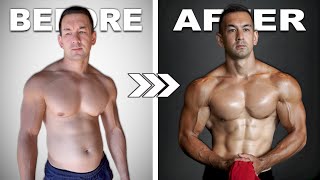
Body recomposition—gaining muscle while losing fat—is real but highly individual. It succeeds best for beginners with higher body fat, relying on a calorie deficit, adequate protein, and consistent training. The video clarifies that no special 'recomp program' exists; it's simply a well-executed fat loss phase where muscle gain may occur automatically.
Yes, it's possible: break down stored fat via a calorie deficit, and with proper training, the body can use some of those calories for muscle growth.
Leaner individuals (<10% body fat) struggle more because the body fights to preserve fat stores. Higher body fat (e.g., 30%) provides ample reserves for recomposition.
Beginners respond better to training stimulus, building muscle even in a deficit. Advanced lifters (5+ years) face greater difficulty.
No special 'recomp' diet or program exists. A recomp is a standard cutting phase: ~500 calorie deficit, 0.8–1g protein per pound, progressive overload training. Muscle gain, if any, is an automatic byproduct.
What is the non-negotiable rule for losing fat during a recomp?
A calorie deficit (about 500 calories below maintenance) and sufficient protein intake (0.8–1g per pound of body weight).
04:12
Do you need a special 'recomp diet' or training routine?
No, it happens naturally as a byproduct of a proper fat loss phase with training stimulus.
03:45
Which group has the highest chance of successful body recomposition?
Beginners with high body fat (e.g., overweight or skinny fat).
03:04
Why is recomping harder for lean individuals (e.g., 10% body fat)?
Your body is less willing to break down remaining fat stores for energy when it's already low.
01:31
What does a calorie deficit do in the context of recomping?
Store fat and fuel additional muscle growth.
00:38
What is the minimum protein intake recommended during a recomp?
At least 0.8 grams per pound of body weight daily.
04:42
Recomposition Mechanism Explained
Clearly explains how fat breakdown and muscle growth happen simultaneously via a calorie deficit and training stimulus.
00:38Who Benefits Most from Recomping
Provides a specific profile (beginners with high body fat) for optimal results, clarifying who should attempt recomping.
03:04Recomping is Not a Separate Program
Debunks the myth of a special 'recomp diet/routine'—it's simply a regular cutting phase with potential muscle gain as a byproduct.
03:45[00:00] Alright, so the million dollar question, how do you gain muscle and lose fat at the same time? Is it really possible and if so, what is the most effective way to go about it? Well, the truth is that there's a lot of myths floating around out there on the subject of body
[00:13] recomposition, and if you don't have a proper understanding of how the process actually works, you could easily end up wasting a ton of unnecessary time and effort, spinning your wheels and potentially not getting anywhere. So let's quickly break this down. By the end of this video,
[00:25] I promise it will all make sense. You'll see just how straightforward the subject actually is, and you'll know exactly how to proceed with your own program as far as bulking, cutting, or recompositioning our concern. So first off, is body recomposition possible to begin with,
[00:38] or is it just a bunch of over-hyped BS? Well, the answer is that yes, it is possible, and the overall process is pretty simple. Breakdown stored fat through a calorie deficit, and then with a proper trading stimulus in place, your body can use some of the calories from that fat,
[00:51] along with your protein intake to fuel additional muscle growth. So it is doable. However, and this is a big, however, the degree to which this will actually occur, the amount of muscle you can actually put on while also losing fat, that's going to be highly dependent on you as an
[01:05] individual. Anybody who just gives one sweeping answer across the board, that yes, you can gain muscle and lose fat at the same time end of story. So that's what your goal should be because everybody can do it. They're not giving you the best information because it will vary quite a bit from person to person
[01:18] and depend on two main factors. The first factor is body fat percentage. That is ultimately a stored form of energy that your body requires for survival, and so the leaner you are, the less willing your body will be to divert that fat toward building new muscle tissue, because at that point it's
[01:31] already fighting to hold onto the remaining stores, plus muscle also requires additional calories to be maintained after it's already built. So for example, at 10% body fat and below, you're likely not going to be gaining any real muscle while trying to get increasingly leaner,
[01:44] and in fact, you might even start losing muscle at that point as you cut further. Whereas if you've spent the last eight months on a steady diet of fried mayonnaise balls and you've dirty both yourself up to 30% body fat, then you'll have plenty of reserves in the tank. Your body isn't in any kind of
[01:57] immediate survival mode at that point, and so building significant muscle while dropping fat is going to be much more realistic. And then everything in between those points from very lean to very not lean, the muscle growth potential will operate along a spectrum. And then the second main factor is going
[02:11] to be training experience. So the longer you've been properly lifting for and the more muscle you're already carrying, the harder it's going to be to put on additional muscle, even if you're in a calorie surplus, little lone while also trying to lose fat. Whereas for a beginner, weight training is going
[02:24] to be a novel stimulus. It'll be treated by the body as a more serious threat, and it will react more strongly to that and be more incentivized to build new muscle as an adaptive response. And once again, this is all going to work a long spectrum. Someone who's never touched a weight before in their life,
[02:38] aka 95% of the comment section in TikTok fitness, those people will have the highest chances for successfully recomping. Whereas for someone with five plus years of consistent, hard training under their belt, it's going to be a lot more difficult. And then everything in between, that's going to
[02:51] involve varying degrees. Now, I know this all might seem a little bit gray area right now, but stick with me because you're going to see in a minute how it all ties together and how to actually apply it. But to sum that up, the people who will be able to recomposition with the highest degree of success
[03:04] by gaining the most muscle while also losing fat are going to be beginning with the high body fat percentage. So either overweight or skinny fat. And then on the opposite end are going to be more advanced lifters at leaner body fat percentages. And then everything in between will produce varying results
[03:18] that can't specifically be quantified. Not to mention that genetics are also going to play a role in this as well. And keep in mind that we're talking about natural lifters here since pharmaceutical assistance will of course influence things too. Now, if you don't fall onto one of those two sides of the spectrum,
[03:31] so you're not a beginner with high body fat or an advanced lifter with low body fat, you're just kind of somewhere in the middle, you're probably wondering how to go about this because you don't know exactly what degree of recompositioning is really possible for you. However, and this is what most people
[03:45] get wrong on this. It doesn't actually matter in practical terms or affect how you should go about things. And the reason for that is that there's no such thing as a body recomposition program in the first place. There's no special recomp training routine or recomp diet you need to follow because
[03:59] recomping is not something you can specifically force. And instead, it's just something that happens naturally on its own. Recomping means what? It means that you lose fat and you gain muscle at the same time. And what is non-negotiable rule number one when it comes to losing fat is that you have to be
[04:13] in a calorie deficit. And there's no way around that because your body has no need to break down store fat without one. So, this idea that you commonly hear about recomping at maintenance or God forbid recomping at a surplus, that doesn't actually make sense because a calorie deficit has to
[04:27] be in place for fat to be lost. When it all comes down to it, a recomp is essentially no different from a regular fat loss phase. You get into a calorie deficit around 500 give or take below maintenance is pretty standard in most cases. You consume sufficient protein so no less than 0.8 grams per pound
[04:42] of body weight daily as a minimum. If you want to fully maximize the chances of putting on muscle while in that deficit, then you can bump it up a bit higher to around one gram or more. So, that's going to be the basics for your diet. You pair that up with a proper weight training program where
[04:55] you're training hard with the focus on progressive overload. None of this lightweight high-ref low-rest period nonsense. And just keep training in the same basic way as you always do. Throw in some optional cardio as an extra calorie burning tool without going overboard, getting your high-quality sleeve,
[05:09] add in a few basic supplements if they suit your needs, real science athletics, of course. It's just a regular cutting phase you'd normally do and then from there, depending on your individual condition in terms of existing fat stores, muscle mass and genetics, any potential muscle that
[05:22] can be gained during that period will simply happen as an automatic byproduct, okay? That's really all there is to it. A recomp is a cutting phase where additional muscle growth occurs on its own if the conditions are in place for it. So, if getting leaner is your main priority right now, whether you're
[05:36] overweight or skinny fat or you're a more experienced lifter who's coming off of a bulk, go ahead and shift into that fat loss phase. Maybe you'll put on some additional muscle during that time and maybe you won't. That's not within your control aside from just implementing a properly structured cut in
[05:49] general. And then once you've reached your desired level of leanness, you can reassess from there in terms of what your next goal is, whether it's to just maintain for a while or to shift into a focus bulking phase, but body recomposition in and of itself, that's not something you can specifically
[06:02] train or eat for. It's just something that happens automatically for some people as they lose body fat in a calorie deficit. If you want some help getting your actual program onto the right track, whether your main goal is to put on muscle or lose fat and potentially recomposition, make sure to visit
[06:16] SeanNal.com slash custom. Just fill out the short form on that page and I'll send you back a free step-by-step training program based on your current condition and goals, along with an easy to follow nutrition plan as well. The link for that is in the description box. Here are two more videos I'd
[06:28] recommend watching now. Don't forget to subscribe to the channel to stay up to date. Thanks for watching guys and I'll talk to you again soon.
⚡ Saved you 0h 06m reading this? Transcribe any YouTube video for free — no signup needed.