
Protein Burns More Calories Than Carbs!
45sSurprising science on thermic effect of food that viewers can immediately apply.
▶ Play Clip"The title accurately sets expectations for a science-based discussion on eating for health, fat loss, and muscle gain, aligning closely with the transcript's content."
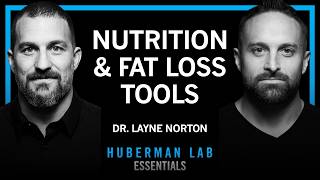
In this episode of Huberman Lab Essentials, Dr. Andrew Huberman is joined by Dr. Layne Norton to discuss the science of nutrition, energy balance, and body composition. They break down complex topics like calorie metabolism, the thermic effect of food, and the impact of macronutrients on weight loss and muscle building.
A calorie is a unit of heat energy. The body converts chemical energy from macronutrients into ATP, the energy currency, through digestion, assimilation, and metabolism.
Food labels can have up to a 20% error, and metabolizable energy varies based on factors like insoluble fiber content, which reduces extractable energy.
Energy expenditure is composed of resting metabolic rate (50-70% of TDEE), thermic effect of food (5-10%), and physical activity, including NEAT (non-exercise activity thermogenesis).
Fat has a TEF of 0-3%, carbohydrates 5-10%, and protein 20-30%. This means protein nets fewer calories and is more satiating.
Daily weight can fluctuate 5-6 pounds due to fluid. Weighing daily and averaging weekly provides a more accurate trend, preventing discouragement.
Protein is highly satiating, has a high TEF, and helps preserve lean mass. Benefits plateau around 1.6 g/kg, but higher intakes up to 4 g/kg show no adverse effects.
Leucine is a key driver of muscle protein synthesis. Adding free leucine to plant proteins can match the anabolic response of animal proteins like whey.
Ultra-processed foods lead to spontaneous overeating—about 500 extra calories per day—according to Kevin Hall's study. Minimally processed foods are generally better for satiety.
Replacing sugar-sweetened beverages with artificially sweetened ones is a net positive for weight loss. Potential microbiome effects are negligible compared to the benefits of reduced calorie intake.
Randomized controlled trials show no independent negative effects of seed oils when substituted for saturated fats. Issues arise from caloric overconsumption, not the oils themselves.
Creatine is a safe, effective supplement for improving exercise performance, increasing lean mass, and potentially providing cognitive benefits. A loading phase is optional; 5 g/day is sufficient.
The key to effective nutrition and body composition is focusing on overall dietary patterns, prioritizing protein, and being consistent with tracking. Small, sustainable changes—like replacing sugary drinks with diet versions—can have a massive impact, and individualization is crucial.
What is the thermic effect of food (TEF) for protein?
20-30%
05:40
What percentage of daily energy expenditure does resting metabolic rate typically account for?
50 to 70%
04:24
Which amino acid is a key driver of muscle protein synthesis?
Leucine
15:41
What is NEAT and how many calories can it burn?
Non-exercise activity thermogenesis; it can burn hundreds to nearly 1,000 calories per day.
07:08
According to Dr. Norton, how much does daily weight fluctuate due to fluid changes?
Five to six pounds
07:56
What is the recommended daily dose of creatine monohydrate?
Five grams per day
29:23
What is the TEF of fat?
Zero to three percent
05:40
What is the maximum possible error in food labels?
Up to 20%
02:42
What is a PDCAAS (Protein Digestibility Corrected Amino Acid Score) of 1 for soy?
It indicates soy is a complete protein source providing all essential amino acids.
14:56
What did Kevin Hall's study find about ultra-processed foods?
People spontaneously increased their calorie intake by 500 calories per day.
18:20
What is the benefit of replacing sugar-sweetened beverages with artificially sweetened ones?
It is a net positive for weight loss and improves health markers like HBA1C.
20:35
Does creatine cause hair loss according to Dr. Norton?
There is only one unconfirmed study that showed an increase in DHT; Dr. Norton is not convinced.
28:33
Calories as Energy Units
Provides a fundamental understanding of what a calorie really means in biological terms.
00:56Thermic Effect of Macronutrients
Highlights the distinct metabolic cost of processing different macronutrients, especially protein.
05:40Protein as a Key Lever for Body Composition
Offers actionable advice on protein intake for muscle preservation and satiety.
10:03Leucine's Role in Muscle Protein Synthesis
Explains how leucine can be used to optimize plant-based protein for muscle building.
15:41Artificial Sweeteners as a Weight Loss Tool
Challenges common fears about artificial sweeteners by emphasizing their net positive effect on weight loss.
20:35Seed Oils Are Not Inherently Harmful
Cuts through the noise by referencing human randomized controlled trials that show no independent harm from seed oils.
22:44[00:00] Welcome to Huberman Lab Essentials, where we revisit past episodes for the most potent and actionable science-based tools for mental health, physical health, and performance.
[00:12] I'm Andrew Huberman and I'm a professor of neurobiology and ophthalmology at Stanford School of Medicine. And now for my discussion with Dr. Lane Norton. Dr. Norton, thank you so much for being here. This is a long time coming and I have to say as a fellow PhD scientist, I feel a great
[00:27] kinship with you. I know you have tremendous experience in fitness and nutrition in a number of areas. I'd like to start with something that's rather basic and yet can be pretty complex and that's this issue of energy balance and energy utilization. What happens when we eat food
[00:44] of any kind? And how is that actually converted into energy as a way of framing up the discussion around weight loss, weight maintenance, weight gain, and body composition? So a great question.
[00:56] And like you said, this is one of those things where people use the term calories and calories out and they say, well, that's way too simplistic. And I'm like, if you look at what actually makes up calories and calories out, it's actually very complicated. So a calorie just refers to a unit of energy
[01:13] of heat specifically. Really what you're talking about is the potential chemical energy that is in the bonds of the macronutrients of food, right? And by digesting, assimilating, and metabolizing
[01:27] those nutrients, we are able to create energy. The in-product of that mostly is ATP, adenosine triphosphate, which is your body's energy currency. So a lot of metabolism is simply creating ATP.
[01:43] Proteins a little bit different because protein gets converted to amino acids which can be used for muscle protein synthesis or protein synthesis in other tissues. But it also can be converted through glycineogenesis to glucose. And there also are some ketogenic amino acids as well. Then you have fatty
[02:01] acids which are able to create energy through what's called beta-oxidation or essentially you're taking these fatty acids and you're lopping them off two carbons at a time to produce acetyl CoA, which again
[02:13] can go into the Krebs cycle, produce those hydrodions that can then power the production of ATP. So that's kind of like at the cellular level of how this stuff works. But stepping back and taking it back out,
[02:26] like what does that have to do with weight loss or weight gain, right? When you think about the balance of energy and versus energy out, sounds very simple. But let's look at what actually makes up energy and versus energy out. First of all, you've got to realize that the energy inside of the equation
[02:42] is more difficult to track than people think. So one, food labels, which we like to think is being, you know, like from upon high, can have up to a 20% error in them, really. Oh yeah. The second aspect is
[02:56] those what's called your energy, but then there's also metabolizable energy, right? So if you have food stuff with say a lot of insoluble fiber, typically insoluble fiber is not really digestible. And so you could have, you know, quite a bit of carbohydrate. But if you can't extract the energy from it,
[03:13] and typically this is because insoluble fiber from like plant material, the carbohydrate or and even some of the protein is bound up in the plant structure, which makes it inaccessible to
[03:25] digestive enzymes. And so this is what like adds bulk to your school stool or whatnot. But again, reduces the metabolizable energy in there. And there's some evidence that based on people's individual gut microbiome, that some people may actually be better at extracting energy out of fiber
[03:44] compared to other people. So just starting off right there, okay, there's, there's quite a bit of play in the energy inside of things. Now, one of the things people will say is, well, see, that's why you shouldn't worry about tracking calories because, you know, if the food labels can be 20%
[03:58] off. And what I'll say is, okay, I understand where you're coming from. But typically if it's off, it's going to be consistently off. And if you're consistent with how you track it, eventually you'll be able to know kind of what you're taking in. So now let's look at the energy
[04:12] outside of the equation, which is actually way more complicated. Right. And so your energy out is a few different buckets. The first one and the biggest one is your resting metabolic rate. So
[04:24] your RMR. That for most people is anywhere from 50 to 70% of your total daily energy expenditure. Sedentary people will be on the higher end of that. So it'll be a bigger proportion. Whereas people who are more active, it'll be a little bit lower. Not because their metabolic rate is lower,
[04:38] but because they're expanding a greater percentage of the calories from physical activity. Then you have something called the thermic effective food, which is a relatively small percentage of your total daily energy expenditure. It's about five to 10%. Very difficult to measure. And
[04:51] usually what researchers do when they're kind of looking at this stuff as they just kind of make an assumption about it. They use a constant. And that refers to the amount of energy it takes to extract the energy out of food. You can't just eat food and then, you know, it just appears in
[05:06] yourselves and you start doing stuff. It has to be systematically broken down and put into forms that can actually produce energy. A lot of times people will say something like, well, not all calories are created equal. That's not true because calories just a unit of measurement, right. That would be like
[05:23] saying not all seconds on a clock are created equal. Yes, they are. All sources of calories may have differential effects on energy expenditure and appetite. So if we look at something like fat, for example, the TEF of fat is about zero to three percent, meaning if you get 100 calories from fat,
[05:40] your net will be about 97 to 100. So the process of breaking down that fat essentially subtracts some of the calories away because you used it in creating energy by breaking those chemical bonds and creating ATP. Correct. Okay. That is actually the easiest
[05:55] thing to convert into energy. Then you have carbohydrate, which has a TEF of like five to ten percent. So you eat 100 calories from carbohydrate. And obviously, like the fiber content makes a big difference on this. But if you eat 100 calories, you'll net 90 to 95. Protein is about a 20 to 30 percent
[06:12] TEF. So if you eat 100 calories from protein, you're only netting 70 to 80. Now you're still net, you know, people say, well, you can't eat too much protein. Well, you know, people will ask, well, can protein be stored as fat? The carbons from protein, it's unlikely it's going to wind up
[06:26] an adipose tissue. But if you're eating a lot of protein overalls part of a lot of calories, it has to be oxidized and it can provide a calorie cushion for other things to be stored in fat. But protein itself does provide, you know, a net positive for calories, but less so than carbohydrate
[06:40] or fat. And tends to be more satiating. So again, when people talk about, you know, our all calories created equal, yes, but all sources of calories may have differential effects on energy expenditure and appetite. So that's the TEF bucket and the BMR bucket. Then we go to physical activity
[06:56] and physical activity is essentially two parts. There's exercise, which is kind of your purposeful movements, like you go out for a walk, you do a training session, whatever, any purposeful activity.
[07:08] And then you have what's called meat, which is non-exercise activity thermogenesis. So for example, if I'm talking if I'm waving around my hands, if I'm tapping my feet, if I'm whatever, that's meat. The calorie burn from meat is actually pretty significant. We're not talking about
[07:24] 100 calories or 200 calories per day. We're talking about in some cases, hundreds of thousands, excuse me, hundreds to maybe even close to 1,000 calories per day. And what's very interesting about meat is that seems to be the most modifiable of, you know, BMR, TEF and meat. Meat seems
[07:41] to be far more modifiable. The next thing is a lot of people weigh very sporadically and I'll tell people like if you're going to make an intentional weight loss a goal. And again, this can be different for different people, but typically I tell people weigh in first thing in the morning, or I have to go
[07:56] to the bathroom, do it every day and take the average of that for the week. And then compare that to the next week's average as somebody who weighs themselves pretty, pretty regularly. I mean, my weight will fluctuate, you know, five, six pounds and not seemingly changing much, you know, and that's
[08:11] just, you know, those short-term changes are fluid. So if you're somebody who just randomly is weighing in and you're eating in a calorie deficit and you just weigh in one day where you've just whatever
[08:24] reason holding some more fluid, then you'll see this isn't working. When the reality, your average might be dropping. Weight fluctuations are actually identified as a major reason why people get discouraged from weight loss. It kind of stops the buy-in, you know, when they have a fluctuation up. So that's one
[08:38] of the reasons, one of the reasons early on that low-carb diets tend to work really well is because people lose a lot of water weight really quickly and they get that buy-in. It's like, oh, this is working. People think about, I am going to do a diet and I'm going to lose this weight and they do not give any thought
[08:52] to what happens afterwards. Think about if you have some kind of chronic disease or a diabetic, right? You can't just take insulin once and that's it, right? You've got to take it continuously, otherwise you're going to have problems. You can't create a new version of yourself while dragging your
[09:07] old habits and behaviors behind you. So what I'll tell people is, because people say, well, I'm doing a carnivore diet or I'm doing this diet or that diet and I'll say, that's fine. Do you see yourself doing that for the rest of your life? And if the answer is no, you probably need to rethink what your
[09:23] approach is going to be. Could you briefly talk about how macronutrients, including protein, impact satiety, from the standpoint of somebody who, for instance, would like to, quote, unquote, lose a few pounds, right? Probably would be happy to gain a little bit of lean body mass, provided it
[09:38] was in a particular location on their body. That seems to be a thing now directed hypertrophy, if you will. And how much they should focus on protein as a core component of creating this diet.
[09:50] And our animal sources of protein, indeed, more bioavailable. That's a tricky word for sake of muscle building, but also for sake of somebody who just would like to lose body fat, they don't want to lose muscle and they'd like to bring their weight down a few pounds.
[10:03] Of the macronutrients protein is definitely the biggest lever that you can pull because even if, you know, it doesn't take a ton of protein to get a lot of the muscle building benefits. I mean, I think the benefits really start to plateau out around 1.6 grams per kilogram of body weight.
[10:17] There's some evidence that maybe even up to like 2.4 or 2.8 grams per kilo may give like a little bit more benefit. I think it probably looks something like an asymptote in terms of a curve where
[10:29] as you put more into the system, you always get a little bit more, but it just gets to the point where it's so infinitesimally small benefit that it's for all intensive purposes, no benefit. There doesn't seem to be really downsides to it, even like up to very high levels of protein,
[10:42] Jose Antonio did a study that was a year long randomized control trial. And again, it's just one year, but they were looking at all sorts of different biomarkers. And basically even up to like 4 grams per kilogram of protein, they couldn't really find any negative health outcomes from it. Other
[10:58] than people were just so satiated, they ended up eating less calories. So protein is a big lever, because one, it has a higher thermic effect of food. So you're getting a little bit more calorie burn per day, even though it's not a ton because TEF is a pretty small percentage of your overall
[11:13] energy expenditure. But still a benefit. You're getting the effects on lean body mass. It's going to, if you're in a diet, it's going to help preserve lean body mass. If you're at maintenance, it's going to help build a preserved lean body mass. And if you're in a surplus, it's going to help build a
[11:25] preserved lean body mass. If I'm going to eat, let's say two grams per kilogram body weight protein, and I'm not eating multiple meals, maybe I'm eating two or three meals per day, I'm certainly going to be eating more than the 30 gram threshold that was thrown around for a long time that we can
[11:40] only assimilate 30 grams of protein per meal. Should I just not worry about that, some of it is going to go towards the thermic effect of food. Some of that might be converted into glucose of all things through gluconeogenesis. So should I worry about this 30 gram cut off? Because they think balancing
[11:55] that the 1.6 gram per kilogram body weight threshold with number of meals with the need to exercise and work and live my life and sleep, et cetera. Pretty soon you run into bottle necks where you just can't do it all or you're spending so much time trying to focus on it. You can't optimize all the
[12:09] things at the same time. You lose your mind and your body. Most Americans get about 65 to 70% of their protein at dinner. Breakfast tends to be pretty minimal protein. So to answer your question, I do think that timing and frequency matters, not so much frequency but distribution more so,
[12:26] but it's a much smaller lever than just getting enough total protein in. And then as far as like animal versus plant, I used to be in the camp of there's no way somebody can build as much muscle on a plant-based diet. And now I think I've come back to, you can, it just requires a little bit more
[12:41] planning. And I don't want to say always, but it's very difficult to do without an isolated source of protein. So unless you're going to supplement with an isolated plant source of protein, it's very difficult to get enough without going over on total calories because you can figure that, especially
[12:58] like take somebody who may be calorically restricted, trying to get enough protein from whole intact plant sources. So you've got a few different things working against you. One, the sources of protein you're consuming also have carbohydrate and or fat. Two, it's a less bioavailable form of protein. And
[13:13] three, it's a lower quality of protein in terms of it has typically less lusine, less branching amino acids and less essential amino acids. You answered the question that I almost interrupted you to ask, which was does it boil down to the lusine content? And it sounds like that is one of the components
[13:28] and that a lot of the vegan and vegetarian sources of excellent protein, that excellent protein, vegetarian or vegan source is co-packaged with calories from carbohydrates and or fat that make it
[13:40] hard to stay under the core threshold. Whereas a steak is, I'm not, and obviously people might want to avoid that for ethical reasons. Sure. But that's a different matter entirely. But a steak or a piece of chicken or an egg is, well, it has a yolk which is, there's fat there, but it's almost
[13:56] a pure protein fat source. There's no carbohydrate along for the ride. You know, you can do it, it takes a little more planning. And you're almost always, if you're a vegan, especially you're going to be better off like supplement with some isolated form of protein or vegan form of protein. Now this
[14:11] where it gets into people say, well, what about the limiting amino acids and those sorts of things? It's a consideration. Some of the better forms of vegan protein in terms of amino acid content are like soy. Now I can, I can hear everybody screaming online about their testosterone levels.
[14:27] In terms of actual outcomes and looking at testosterone, there was a recent meta-analysis looking at soy. And I think if it's your only source of protein, then maybe the dosage is high enough to
[14:40] cause some weird effects. But if you're just using it like once or twice a day, it doesn't seem to have an effect on testosterone or estrogen. So that can be a decent source of protein because it is a complete protein source. It does have a PD cause of one which PD causes basically a measure of
[14:56] protein quality based on does it provide enough of all the amino acids so that none are limiting? And so soy is one of the only vegan sources that does that. Interestingly, potato protein
[15:08] isolate actually has a similar essential amino acid content to weigh. So isolated potato protein, it's just really hard to find. Another reason using an isolated protein can be helpful is because it's more bioavailable as well when it's been isolated out. When it's the protein bound up in the actual
[15:24] plant material, it tends to be less bioavailable. Now, cooking can help increase the bioavailability because it breaks some of those bonds and whatnot. The other thing to consider with the vegan sources of protein is the losing content. So one of the studies we did was we looked at wheat, soy, egg,
[15:41] and whey, isinitrogenous, meaning we equated protein between the groups, isocloric, we equated calories, and we looked at muscle protein synthesis. And I think this was the meals were 15% of
[15:54] total energy from protein. So like your food guide pyramid level of protein. And we saw that in the wheat and soy group, they did not increase muscle protein synthesis, but the egg and whey group
[16:07] increased muscle protein synthesis. Now, what's really interesting is we went back and we took wheat and added free leucine to it to match the leucine content of whey and the protein synthetic response was identical. So again, I don't like to simplify things too much, but leucine appears to
[16:26] really be driving this ship. A few different options for the vegan folks out there. You can use an isolated source of protein. And again, like there's going to be good options coming because this plant based whey is going to be a great option for folks. You can add free leucine to it to whatever your
[16:41] source of protein is. Just buy supplemented leucine powder. Now, it tastes horrible. It's completely nonpolar. It does not dissolve in anything. It can't be put into capsules. Yeah. So you could take
[16:53] a capsule. Like, for example, if you're eating your normal meal, you could just take a capsule of like one gram of leucine. It's probably going to bump you off. Bump you up enough that you're going to be good to go. There's options like blends, especially with corn. Corn is actually very high in
[17:08] leucine as a percentage of its protein. Now, you got to remember like you go eat corn on a cob and you're getting like two grams of total protein. So it's not that much leucine. But if you isolate out the protein, put it into a powder. Well, now, you know, when you're getting like 80, 90 percent
[17:22] of the weight is now protein, corn is actually about 12 percent leucine in terms of the protein. So a great source of leucine, it is like almost frank deficient in some other amino acids. But you can blend it with a few other sources of protein. Like, you could blend it with a soy, a pea,
[17:37] and you can create these complimentary blends that would actually have quite a bit of leucine, but also some of the other essential amino acids. So there are options out there for plant-based folks. And I mean, we have seen people who are plant-based build impressive amounts of muscle. There's
[17:51] quite a few bodybuilders who are plant-based. Can we come up with a relatively short summary of the following? Tell me if this is correct or not that most of us should be focused on ingesting
[18:05] non-processed and minimally processed foods. I would 100 percent agree with what you said that trying to focus on minimally processed foods is very important. The one caveat I would say is I think it's important to understand why. Processed food just gets people to spontaneously eat more.
[18:20] Kevin Hall showed this in his study that was, I mean, he designed some of the most elegant studies in nutrition. They basically took people from a minimally processed food diet and then gave them
[18:32] access to ultra-process foods. Very few instructions just to feel satisfied and they spontaneously increased their calorie intake by 500 calories a day. That's massive. Now that being said, it depends on the individual and their goals. If your goal is to, for example, build muscle
[18:47] or maintain a high body weight for a sport, for example, like an NFL offensive lineman or something of that nature, your protein, your fiber, your micronutrients, these are your responsibilities. But those become much easier to hit when you have higher calories. If you're eating 4,000 calories
[19:03] a day for whatever goal you have, you're probably going to have some left over. And like good luck eating 4,000 calories from minimally processed foods. Quite frankly, you'll be miserable because you're going to have such gut fill that you're going to feel like you can't even move. And so that's
[19:19] why I'm so pedantic and a stickler about saying, okay, yes, it's a good idea to eat the minimally processed food and try to avoid processed foods. But not because processed foods are bad per se,
[19:33] but what the outcome tends to be from a lot of processed food consumption, which is over-consuming calories. And then therefore, you know, energy toxicity, negatively contributing to your health. This I think is a perfect segue for something that first brought us together.
[19:49] Which was, you know, which was this thing about artificial sweeteners. Artificial sweeteners are many things. So I'd like to talk about their effects on blood sugar in the acute sense. And then they've got microbiome data I think are interesting enough to discuss. I have changed my view on
[20:05] artificial sweeteners based on what you've taught me. So this is a case where I've completely changed my view, which is that I don't have any problem with them whatsoever based on the current data, which is not to say that I'm, you know, gulping down a cup full of superlose. But I feel okay
[20:21] ingesting some stevia and some aspartame. And I'm not too worried about it. We have to think about, again, the hierarchy of importance, right? And what are you replacing with? There is no situation where it is not a net positive to take somebody who drinks sugar
[20:35] sweeten beverages and have them drink an artificially sweeten beverage. Like in the meta-analysis, there was actually a recent network meta-analysis looking at like at markers of adiposity.
[20:47] You know, HBA1C, a bunch of different health markers. And when you substitute, you know, we'll call it non-nutritive sweeteners since stevia is not artificial. But so when you substitute NNS for the sugar sweeten beverages, you see improvements in a lot of different things.
[21:04] And whenever I post about non-nutritive sweeteners in the comments, there's always one or two or three people who say, all I did was cut out soda. And I drank diet soda instead and I lost 50 pounds.
[21:16] Or I lost 75 pounds. I even had one per cell. I lost 100 pounds. That's the only thing I did. I mean, that's a pretty massive lever to pull. If you consider somebody who might be having like, I mean, five or six coaks a day, we're talking a serious amount of calories. Is that obese person who lost 100 pounds by doing that? Do I really care about maybe a small
[21:33] alteration to their begut microbiome? No, because their begut microbiome is actually much more healthy now by them having lost all that excess adipose tissue. So I think it's one of those things that, again, it depends on the situation, right? Like if somebody's obese and they said, well,
[21:48] this is going to help me eliminate sugar sweeten beverage. Like why would you want to take that tool away from them? Like that's a great lever to pull. I mean, if somebody can lose literally a hundred pounds from just one change in lifestyle that's not even really that inconvenient of a change, that is
[22:03] powerful. But again, is it the most healthy thing they could do? And I think that's kind of like what tends to get asked. We don't know. Is it healthier than water? Probably not maybe as healthy as it.
[22:16] Who knows? But I really make all those caveats because you don't want to have people who could use this as a tool. Think, well, I can't do this because it's actually bad for me. If it helps you lose 50 pounds or 75 pounds or whatever it is, it trust me. It's not bad for you.
[22:31] Seed oils. There are a number of folks out there who are arguing that seed oils are the source of the obesity epidemic, everything. And then there are those that would argue just the opposite
[22:44] that meat is the source of all problems, et cetera. And I think we've appropriately framed things that it's never that black and white. It's simply not. Are there any data on seed oils? The first thing I'll say is seed oils have negatively contributed to our overall health because
[23:00] people in the last 20, 30 years, what they have tend to add into their diet that has increased the overall calorie load is oil, mostly from seed oils. But when we look at like one-to-one replacement
[23:13] with other fats, and so I, if you look at the epidemiology, yeah, you can find some epidemiology showing people who consume more seed oil have more negative health outcomes, problem is, again,
[23:25] tied up with a multitude of other behaviors. And then you can find mechanisms and the idea is, well, they're polyunsaturated, which means in the fatty acid chain, there's multiple double bonds,
[23:37] which those double bonds can be oxidized when they're exposed to heat and some other things. And so the idea is, well, when you cook with these things and they make it oxidized, and that's going to cause inflammation in your body, that's a plausible mechanism. So as always,
[23:53] I defer to the human randomized control trials. What you tend to find when you substitute saturated fats for polyunsaturated fats, inflammation is basically neutral. There's some studies that show
[24:05] a positive effect of doing polyunsaturated fats, but it probably depends on the individual polyunsaturated fat. And that's the other thing I don't really is difficult because you're categorizing like everything in this one bucket, and there are some differences between individual fatty
[24:19] acids. Even with saturated fat, like for example, a steric acid doesn't tend to raise LDL cholesterol, whereas saturated fat as a whole tends to raise LDL cholesterol, but there are some saturated fats
[24:31] that don't. So again, it's like we're putting things in buckets and it's a little more nuanced than that. Then if you look at the effects of polyunsaturated fats on markers of cardiovascular disease,
[24:43] again, tends to either be a neutral or positive effect when you substitute saturated fat for polyunsaturated fat. Now, if you want to get into like monounsaturated versus polyunsaturated, there's quite a bit of disagreement between the studies. What I would say based on the human
[24:58] randomized control trials is that you're probably better off consuming monounsaturated and polyunsaturated in place of saturated fat. But again, if the idea is well, that means polyunsaturated are good for
[25:12] me. So I'm just going to dump a bunch of oil on everything and now you're up in your calories, well, that's that's a negative now, right? Because you have to do with the bigger problem of overall energy toxicity. So I'm not somebody who likes to demonize individual nutrients. I just haven't seen
[25:25] really compelling evidence that seed oils are the root cause of the problems that are being suggested. And I think this is a good example of kind of like whenever there's something that pops up in
[25:37] the fitness industry, there's always like the opposite thing that pops up and it's like the reactionary you know, extreme reaction to whatever this thing was over here. And I think that's what we're seeing with some of the seed oil stuff. It's mostly people who are trying to kind of expose the virtues of
[25:53] saturated fat. I think it's fine to consume some saturated fat, but I think limiting it to seven to 10% of your daily calorie intake is probably wise again, based on the consensus of the evidence
[26:06] I've seen. And so once again, like we're struggling with this. Okay, we've got this epidemiology and these mechanisms that sound good. But then what actually happens when we we do some human randomized
[26:18] control trials and so far I just haven't seen the evidence to suggest that seed oils are independently bad for you independent of the calories they contain. I think we all have this idea that there's
[26:30] this one iconic diet out there that is going to be the best diet for building muscle and burning fat and preventing cancer and heart disease. And the reality is like there's overall healthy dietary
[26:43] patterns that we see that are good for those things. But when we get down into the weeds, there's probably some push and pull here as well. I like to ask you about supplements for a moment. A one that I'm very familiar with, which is creatine monohydrate, not just for muscle building,
[26:57] but maybe any other purposes for it. It is the most tested, safe, and effective support supplement we have. I mean, it's just there are thousands of studies on creatine monohydrate now. I would say
[27:09] very clearly too, if you're using any other form of creatine, I think you're wasting your money. Creatine hydrochloride has some hype around it. It's apparently a little more soluble. The claim is that you need less, but there's only a couple studies on it and it's more expensive. So I tell people
[27:24] just take creatine monohydrate. It is tried and true. It's been shown to saturate the muscle cells, 100% with phosphocreatine, and that's what you want. So creatine works through a few different methodologies, one through increasing phosphocreatine content, which helps improve exercise performance.
[27:40] It appears to improve recovery. And it increases lean mass. A lot of which is through bringing water into the muscle cells, but that is, I mean, muscle cells are mostly water. So when people say,
[27:54] well, it's just water, that's what muscle cells mostly are. And it also increases strength and some other metrics. Now, it also has been shown in studies that people tend to get a decrease in body fat
[28:06] percentage. Now, that's probably because they're getting an increase in lean mass. And so the relative is a decrease in body fat percentage. But there are a few studies to show a decrease in fat mass as well. I don't think the creatine's a fat burner. I think that people are able to train harder,
[28:20] build more lean tissue. And so that's probably having an effect on fat mass. Then they've actually shown more recently some cognitive benefits to creatine, which I find really interesting as well. But the only knock on creatine that anybody's been able to come up with because they've debunked
[28:33] the kidney stuff. They've debunked the liver study. There's no evidence that a harm's healthy kidney or liver is hair loss. So what about hair loss? Because there was one study in 2009 that showed the creatine increased DHT. But they didn't really show an effect on any other sex hormone. So it's
[28:50] kind of strange. Like you would think if there was an increase in DHT, there would be like something else that changes as well. And it's only one study. And again, didn't directly measure hair loss, measured DHT, which we know is involved in the loss of the follicle. So what I would say is that
[29:08] I am not convinced it's only one study never been replicated to my knowledge. And it was looking at a mechanism rather than an outcome. Do you emphasize the classic loading of creatine taking it a bunch of times per day and then backing off or just taking it consistently at the, I think five grams
[29:23] per day is kind of a typical dose that people take. So again, no solutions, only trade-offs. You can load it and you will saturate your phosphocreats and stores faster, like you usually within a week.
[29:36] If you just take five grams per day, it'll take two, three, four weeks. But you will get to the same place and you're probably going to have a much lower risk of GI issues. Some people creatine can be
[29:49] a gut irritant. If it is for some folks, I would recommend splitting it into multiple doses. So maybe like multiple two one or two gram doses per day and definitely don't load it if you're somebody who has GI issues from it. The more into the weeds, people tend to get. And again, this is just my own
[30:04] anecdote and observation. The more into the weeds they tend to get, the less hard I see them train. And so one of the things I really like that Mike Israel told said, who's got a PhD and is a bodybuilder
[30:16] himself. He said, you can't out science hard training. If you're looking to build muscle and you're looking to improve your body composition, the main thing is just doing the work over time. And I think a lot of that is getting the confidence of doing something hard that there's a payoff at the end.
[30:33] I get asked a lot of my Q&As, how do I get more confident? How do I become more confident? I'll tell people you have to do. There's no hack. You can't read about it. You got to get in the arena. And I don't mean like compete in sports necessarily, but like doing a PhD or doing something
[30:49] just something hard where you're putting yourself out there and you're saying, this is my goal and I'm going to go for it. You just learn so much by doing that about yourself. I must say this conversation for me has been tremendously rewarding. The amount of knowledge that you contain inside
[31:04] you is astonishing. There's a lot of stuff right around up there. And we all benefit because your ability to pull from the mechanistic side. Again, I think in not limited to but related to your background and biochemistry all the way through to the impact in humans, animal studies being able
[31:21] to understand where those sit relative to one another. And then you're obviously a practitioner of you practice what you preach and what you talk about pertains to men, to women, younger people, older
[31:34] people who are vegan, keto, carnivore. You really are able to net a tremendous number of ideas while staying really nuanced and data driven. And so I just want to say for myself and on behalf of
[31:46] the listeners, really appreciate you coming in here today and sharing with us your knowledge. So thank you so much for your time. Thank you. I appreciate the opportunity. I really enjoyed it.

⚡ Saved you 0h 32m reading this? Transcribe any YouTube video for free — no signup needed.