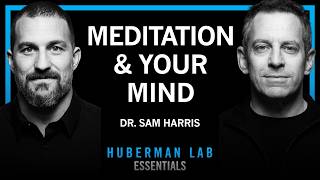

The Self Is an Illusion – Sam Harris Explains
60sProvocative claim about the illusion of self sparks curiosity and philosophical debate.
▶ Play Clip"Delivers on the promise of an essential discussion about meditation and self, though the conversational style may not suit those seeking a structured guide."
In this episode of the Huberman Lab podcast, Dr. Sam Harris discusses the nature of the self as an illusion and how meditation can reveal this truth. He distinguishes between dualistic mindfulness and non-dual awareness, emphasizing that the ultimate goal is to recognize the centerlessness of consciousness. The conversation also touches on the role of psychedelics as a potential catalyst for insight and the importance of finding fulfillment in the present moment.
Sam Harris argues that the sense of a separate self—a subject interior to experience—is an illusion. Most people feel they are behind their face as a locus of awareness, distinct from their experience.
Meditation has a remedial level (stress reduction, focus) and a deeper level: recognizing the nature of consciousness itself. The deeper promise is discovering that the 'I' cannot be found.
Flow experiences, like surfing or athletic performance, involve a brief period where there is no distance between the self and the experience. This unity is a taste of non-duality.
Meditation reveals that there is no separation between you and your experience. The dualistic setup of subject and object is an illusion; you are the river of consciousness, not a bystander.
Most people are constantly talking to themselves internally, which obscures the present moment. This self-talk feels like 'me' but is actually an automatic process that can be observed.
Most people cannot pay attention to a single object for 30 seconds without being lost in thought. This reveals how pervasive distraction is and how meditation trains the mind to notice thoughts as thoughts.
In non-dual mindfulness, there is no subject aiming attention. The dualistic effort to strategically pay attention dissolves, leaving just open awareness where thoughts appear without identification.
The aim is a 'skylike mind' that does not grasp at pleasant experiences or push away unpleasant ones. This equanimity applies even to the sense of self, which is seen as a process ('selfing').
The first step function in meditation is experiencing the difference between being lost in thought and being clearly aware. This gives freedom to observe emotions and choose how long to experience them.
The deeper realization is that there is no separate 'one' who is being mindful. Awareness itself is centerless, and thoughts arise without a watcher.
Psychedelics can prove that a deeper, more integrated state of mind is possible, but their effects are impermanent. Meditation provides a stable path to integrate those insights into ordinary consciousness.
We seek reasons to let attention rest in the present. Meditation reverses the causality of happiness: fulfillment can be experienced before any external event, independent of circumstances.
The ultimate takeaway is that the sense of a separate self is an illusion that can be seen through with consistent meditation practice. By recognizing the centerlessness of awareness, we can access a profound sense of fulfillment that is not dependent on external conditions.
What is the illusion of self according to Sam Harris?
The sense that there is a subject interior to experience in addition to experience itself.
00:31
What are the two levels of meditation mentioned by Harris?
The remedial level (stress reduction, focus) and the deeper level of recognizing the nature of consciousness itself.
02:51
How does flow relate to non-dual awareness?
Flow experiences involve a brief period where there is no distance between the self and the experience, exemplifying non-duality.
05:07
What does Harris mean by 'you are the river, not the observer'?
Meditation reveals that there is no separation between you and your experience; you are the river of consciousness, not a bystander.
06:24
Why is internal chatter considered problematic?
It obscures the present moment and creates a false sense of a self that is thinking, when in fact thoughts arise automatically.
10:55
How long can most people pay attention without being lost in thought?
Most people cannot pay attention to a single object for 30 seconds without being lost in thought.
13:50
What is non-dual mindfulness?
Mindfulness without a subject-object dualism; there is no separate 'one' aiming attention, just open awareness.
17:01
What is the goal of equanimity in meditation?
To have a 'skylike mind' that does not grasp at pleasant experiences or push away unpleasant ones.
21:08
What is the first step function in meditation practice?
Experiencing the difference between being lost in thought and being clearly aware of any part of experience, including thoughts.
24:42
What is the second step function in meditation?
Realizing that there is no one doing the mindfulness; awareness itself is centerless.
26:39
What role do psychedelics play according to Harris?
They can be a catalyst by proving that deeper states are possible, but their effects are impermanent; meditation provides a stable path.
28:03
How does meditation reverse the causality of happiness?
It allows fulfillment to be experienced before any external event, rather than depending on circumstances.
35:27
Self as Illusion
Core thesis that challenges the common sense notion of a unified self, with profound implications for well-being.
00:31You Are the River
Powerful metaphor that encapsulates the non-dual realization, central to the transformative promise of meditation.
06:24First Step: Distinguishing Thought from Awareness
Practical, actionable insight for beginners: the simple act of noticing the difference between being lost in thought and being aware gives immediate freedom.
24:42Second Step: No One Doing the Mindfulness
Deepens the understanding of mindfulness from a dualistic practice to a non-dual recognition, liberating the practitioner from effort.
26:39Happiness Before Events
Offers a radical reframing of how to approach life: fulfillment can be present regardless of external circumstances.
35:27[00:01] [music] where we revisit past episodes for the most potent and actionable health, physical health, and performance. I'm Andrew Huberman and I'm a professor of neurobiology and opthalmology at
[00:16] Stamford School of Medicine. And now for my discussion with Dr. Sam Harris. Dr. Sam Harris, what is this thing that we call a self? You know, as far as I know, we have not localized the region in the brain that can entirely account for our
[00:31] awareness of self. >> The problem is we we use the term self in so many different ways, right? And and there's there's one sense of that term which um is the target of meditation and you'll hear it from me
[00:44] that this self is an illusion, right? And and that there's a there's a experienced on the other side of discovering it to be an illusion. And Some people would would insist that it's not so much an illusion, but it's a it's
[00:59] a construct and it's not what it seems. The thing that doesn't exist, uh it I would I would want to argue that it actually is just a proper illusion is this the sense that there is a subject interior to experience in addition to
[01:15] experience. So most people feel like they're having an experience of the world and they're having their an experience of their bodies in the world. And in addition to that, they feel that they are a subject internal to the body.
[01:29] Most people feel like they're behind their face as a kind of locus of awareness and thought and intention. It's almost like they're you're a don't feel identical to their experience. They feel like they're on
[01:42] the edge of experience, somehow appropriating it from the side. You're kind of on the edge of the world and the world is out there. your body is is in some sense an object in the world uh which you you know it's different from
[01:56] your skin is still meaningful you can sort of you loosely control your body I mean you can't control you can control your gross and subtle you know voluntary controlling everything your body is doing you're not controlling your
[02:10] and all of that and so there's a lot that's going on that is in the dark for you then you give someone an instruction to meditate A and you say, "Okay, let's person's side. Let's look for this thing you're calling I." They're going to
[02:25] they're going to pay attention to something. They're going to pay attention to the breath or the sounds. And it's from the point of view of being a locus of attention that is now aiming attention strategically at an object
[02:39] like the breath that there's this dualism that is set up. and the ultimate promise of meditation. I mean, there really two levels at which you could be really two levels at which you could be interested in in meditation. Um, one is,
[02:51] you know, very straightforward and remedial and non-p paradoxical and very well subscribed and it's it's the usual set of claims about all the benefits right? So you're going to lower your stress and you're going to increase your
[03:04] stave off cortical thinning and there's all kinds of good things that science is saying meditation will will give you. purpose of meditation and its real promise is not in this long list of of
[03:19] discounting any of those though you know the science for many of them is quite provisional. It's in this deeper claim that if you look for this thing you're calling eye, if you look for the sense that that there's a thinker in addition
[03:33] to the the the mere arising of the next thought, say, you won't find that thing and you cannot find it in a way that's conclusive. Uh and that matters, right?
[03:45] and and it and it has a there's a host of benefits that follow from that discovery which are quite a bit deeper and more interesting than engaging meditation on the side of its benefits. You know, de-stressing, increasing focus
[03:57] and all the rest. Many people think meditation is about changing the some some contents you want to get rid of like anxiety. Other contents you want to to encourage like calm and you know unconditional love or you some other you
[04:11] know classically pleasant pro-social emotion. Um, and that's all fine. That's emotion. Um, and that's all fine. That's all possible. But the real, you know, wisdom of, you know, the the 2,000-y old wisdom of meditation that really is the,
[04:25] you know, the the chewy center of the the Tootsie Pop is a recognition of what consciousness itself is always already like, regardless of the contents and the changes in contents. And classic flow experiences have this this quality where
[04:39] there's the and this this tends to be why they're so rewarding. um where there's just if you're in in some you know athletic activity or you know an aesthetic one or you could be having sex or you could be whatever it is some peak
[04:53] or you could be whatever it is some peak experience. Its peakness usually entails there being some brief period where there was no distance between you and the experience. Right? for that moment. You were no longer looking over your own
[05:07] shoulder or anticipating the next moment or trying to get somewhere where where you weren't or, you know, micromanaging errors or you like this, you know, there's not there's just the flow of unity with whatever the, you know,
[05:22] whatever the experience is, you know, a surfer on on the wave, right? And we love those experiences. We are continually abstracted away from them by "Oh my god, that that was so good." Or, "How do I get back to that?" Or, you
[05:37] the most beautiful sunset you've ever seen, and then you're continually interrupting the experience of merely seeing it with a commentary about how what are real estate prices here? I
[05:52] could move here? And like you your your mind is just continually narrating a a yourself. However, paradoxically, I mean, you're telling yourself things yourself things that you already know uh as though there were two of you rather
[06:08] often, right? Like, you know, you're just, you know, I'm looking for, you say, oh, there it is, right? But like I'm the one seeing it. Who am I saying, there's someone else who needs to be informed about the thing I already saw.
[06:24] something about our internal dialogue that is paradoxical. And that's what ultimately meditation is. I mean this kind of meditation you you ultimately learn to recognize that there's no separation from you between you and your
[06:41] experience, right? There's not the experience on the one hand and the self on the other. There's just experience. It's not that you're on the riverbank. in the beginning. Even when you're practicing meditation fairly diligently,
[06:56] it can seem like you're on the riverbank watching the contents of consciousness flow by. And then and meditation is the act of doing that more and more grabbing at the at the pleasant or pushing the unpleasant away. You're just
[07:10] kind of relaxing and in in the most non-judgmental frame of mind, just non-judgmental frame of mind, just witnessing the flow. Right? But if you're doing that dualistically, you feel like the meditator. You feel
[07:24] like the subject aiming attention. And so now you're on the riverbank watching so now you're on the riverbank watching everything go past. But the truth is you are the river. There's a process by which you would eventually recognize
[07:37] that there's no distance between you and your experience. And again, you can you can wait for those moments in life where experience gets so good or so terrifying, you know, or just so salient, right? Your amygdala is driving
[07:51] so hard. I mean, so you're in in a war and you can't think about anything at you and this is the most thrilling video game you've ever played in your life. uh and your life is on the line or you're you're you know at the peak of of
[08:04] some you know athletic event where there's just you don't know how you're doing the things you're doing but it's all happening automatically right but those are 1/100th of 1% of one's life and what I'm calling meditation is a way
[08:19] of simply understanding the mechanics of attention whereby you are denying yourself that unity of experience so much of the time and recognizing that that's, you know, it's based on a a misperception of of
[08:34] the way consciousness always already is. >> Something about our developmental wiring and the algorithms that these neural circuits run tend to bias most people, circuits run tend to bias most people, the non practice meditators to live a
[08:49] the non practice meditators to live a somewhat functional life at least um observer, >> right? And so what you're really talking >> right? And so what you're really talking about is an a deliberate intervention to
[09:03] understand and resolve that gap in the algorithm. So what are your thoughts about the organization of the circuitry to to essentially under normal conditions to not reveal its what seems to be one of its more important and
[09:17] profound and um for you know dare I say enlightening features. Right? It's almost as if that we have to intervene in the self in order to reveal the self. We are not set up by evolution to be as happy as we possibly can be and to do
[09:34] almost anything that interests us. Well, I mean, we're not set up by evolution to I mean, we're not set up by evolution to be mathematicians or musicians or to to create democracies that are healthy. We are doing these things based on
[09:47] cognitive and emotional hardware uh that we are leveraging in new directions, right? Right? I mean, we have we are primates and we are, you know, small mouth noises. I mean, we're language using primates and all of that
[10:01] is clearly evolved and we're doing these amazing things, including science, you know, however improbably where you we're actually able to to, you know, almost actually able to to, you know, almost entirely with language uh understand
[10:15] reality that at at a scale that exceeds us in both directions. I mean the very the very vast and the very small and and you know also temporally the very old. It's amazing that we can do all of those things but evolution is blind to all of
[10:27] that. We have flown the perch that was created for us by evolution. I mean we're just not it's not just the primate things. So, so it is with learning how to regulate our emotions and and you know punch through to a self-concept or
[10:42] beyond a self-concept that is more normative psychologically that allows us normative psychologically that allows us to you know not be um terrorized by our apish genes. Evolution never thought to build us an off switch for this, right?
[10:55] I mean the language is so useful and it gets tuned up so strongly for us. Uh and right? There's never reason to give you this ability to say I wouldn't it be nice to have 4 hours of quiet now like no selft talk for most of us um we are
[11:12] no selft talk for most of us um we are covertly talking basically all the time and and there's an imagistic component of of this for many people you're visualizing things as well but there's just a lot a ton of white noise in the
[11:25] just a lot a ton of white noise in the mind that feels a certain way and you know what I what you discover in meditation ultimately is that the self is what it feels like to be thinking without knowing that you're
[11:39] now you're you know people are listening to us they're struggling to follow the train of this conversation because it is competing with their the conversation it's, you know, the the first discovery people make in meditation is that it's
[11:53] just so hard to pay attention to anything, the breath or a mantra or sound, whatever it is, because you're thinking every you're thinking hour and oh, it's so good that I I downloaded this app. I'm like, this is
[12:07] for me. But and you're but you're that that chatter isn't showing up. you that chatter isn't showing up. you you're not far back enough uh in the in the kind of the theater of consciousness so as to see it emerge. It's it is just
[12:21] sneaking up behind you and it feels like me again. It feels like when someone is thinking the thought, well, what the hell does that mean? Right? They're not seeing it as an emerging object in consciousness. It just feels like me. It
[12:36] just feels that that that's it is it the the you know subjectively it's like the the you know subjectively it's like the mind contracts around this appearance in is just a you know it's just a sound with the voice of the mind if you
[12:51] actually can inspect it. It is it is deeply inscrable that we ever feel identified with our thoughts. I mean how is it that we could be a thought? these passes away. And when you inspect it, when you go to inspect it, it's it, you
[13:08] know, it unravels. It's it's just it's it's the least substantial possible thing. And and it could but yet it could be a thought of self-hatred. You know, it could be a a thought that that
[13:21] unrecognized totally defines your your mood. If you could elaborate a bit on this notion of internal chatter and external stimuli >> is just the recognition that there's a dialogue ongoing internally is that
[13:36] >> Yeah. I mean, so here here's a claim I would make that some people might find would make that some people might find surprising, but I I think uh this is an objectively true claim about the subjectivity of most people, which is
[13:50] amount of training, unless you just happen to be some kind of savant in this area, which, you know, most people by definition aren't, I believe this is a a you put a, you know, a stopwatch on this table and and, you know, people could
[14:06] just watch, you know, 30 seconds elapse And I set, you know, I set all of our And I set, you know, I set all of our listeners or your viewers the task. Uh, for the next 30 seconds, just pay attention to anything, your breath, you
[14:18] know, or, you know, this the sight of your hand or the sight of the clock or uh any object without getting lost in thought, without getting momentarily distracted by this conversation you're having with yourself. A couple things
[14:32] would happen. One is no one would be able to do it. This is not just a superficial inability. I mean, if your life depended on it, you wouldn't be able to do it. I mean, if if the fate of civilization depended on it, none of
[14:45] none of our listeners would be able to do this. Um, and yet some percentage of do this. Um, and yet some percentage of them are are so distracted by thought that they would think that they will actually try this experiment and think
[14:58] people, what what happens is you put them on a meditation retreat and you silence doing nothing but this. Right? So the practice is just pay attention to eventually you know you incorporate everything sounds and other sensations.
[15:14] meditation where they're paying attention just to the sensations of lifting and moving and placing their feet. And then you know once the sounds and sights and everything but so you can pay attention to everything but
[15:26] you can pay attention to everything but the goal is for every moment um you are going to you're going to cultivate the what this this faculty of mind which you know increasingly is known as mindfulness right so and
[15:38] mindfulness is nothing other than this very careful attention to the contents of consciousness. Uh but the crucial piece is it is not a moment of being lost in thought, right? You're not you you're not
[15:53] can arise, but in those moments of being truly mindful, you're noticing thoughts as thoughts. Whether they're whether it's language in the mind or images, you're noticing those two as spontaneous appearances in consciousness. Most
[16:07] thinks they can pay attention to something for 30 seconds without being lost in thought. You put those people on a meditation retreat, what they're going to experience is, you know, on the first day, they're going to feel like, oh
[16:20] breath or I was walk, you know, I was with the sensations of walking and I'd know, solid and then I would get lost in thought, then I come back and, you know, five more minutes I'd be lost in thought and get back. But as the days
[16:33] progressed, you know, even, you know, 10 days into a silent meditation retreat, they're going to experience more and more distraction. They're gonna it's going to seem like, okay, wait a minute. Now I can't pay attention to
[16:46] anything for more than five seconds, right? Because what they're discovering is just how distractable they are. If you train your attention in this way to notice the particularities of of sensory experience and emotional experience,
[17:01] like you're looking for the atoms of experience, you know, um you get better experience, you know, um you get better and better at that and certain things happen. But one thing that you one thing that I really do do think happens is
[17:15] there's a kind of frame rate change in in the the data stream where you really are just you're just noticing much much more. This whole dance of I'm lost in
[17:27] thought now I'm now I'm strategically directing my attention again. All of this seems to ramify this sense of self, the sense of of there there's one to be doing this. There's there's somebody holding the spotlight of attention and
[17:40] getting better at coming back to the object of meditation. But the thing I like to do when I talk about all of this is undercut the false assumptions that are anchoring all of that as early as possible. Because where where I think
[17:55] possible. Because where where I think you want to be is recognizing that there is no place from which to aim attention. Right? This whole dualistic setup of subject and object is the thing that is already not there. And it's not that you
[18:09] meditate it out of existence successfully. It's really not there. And if you if you learn how to look for it, you can see that it's not there and feel seems to be there. Right? Right. It's like it's it's not and it becomes like
[18:24] again like a bstable percept where you looked at it long enough and you thought okay now I see the vase and the face and um I can't unsee it and every time I look it's it's there again. If we were to kind of break it down meditation into
[18:40] some basic component parts, what are the component parts? And where I'm really going with this is why would those component parts eventually allow for the realization that there is no um distinction between uh actor and
[18:52] observer and so on. >> Ultimately, meditation >> Ultimately, meditation is not a practice that you're adding to more of anything. It's actually ceasing to do something. It's ultimately
[19:06] non-distraction. I mean, it's ultimately you're recognizing what consciousness is like when you're no longer distracted by the the automatic arising of of thought. not that you can't use them. It's not that you've become irrational or or um
[19:22] uh you know, unintelligent. I mean, like all of that you you still have all of view. I mean there's an analogy in in Tibetan Buddhism which I love which is um thoughts are like thieves entering an empty house. You know there's nothing
[19:35] for them to steal, right? So you know in in the usual case thoughts are there really is something in jeopardy. Every time a thought comes I'm not meditating anymore and and not only that I feel terrible because of what I'm thinking
[19:48] about most of the time. Right? So it's totally understandable that thoughts seem like a problem in the beginning and for certain types of meditation they are explicitly thought of as a problem because you're trying to focus on one
[20:00] thing to the exclusion of everything else including thought and that's a becomes a tool that you can use for other kinds of of of insight but it's a other kinds of of of insight but it's a very specific and kind of brittle skill
[20:14] skill just like I'm going to pay attention to one thing and I'm going to do that so well that everything else is going to fade out meditatively. If you have a laser focus on any one thing whether it's the breath or whatever it
[20:26] is you can lose all sense of everything. I mean you can lose all sense of hearing mean like literally it can become incredibly subtle and vast and incredibly subtle and vast and drug-like. Um, and many people approach
[20:41] meditation thinking kind of climbing the ladder of those changes into subtlety and vastness. That's the whole that's the whole game, right? And it can be a deeply rewarding game to play. And it also does come with all kinds of
[20:56] focus and the calm and the and the the kind of smoothness of emotional states. concentration and it it can be quite wonderful. But again at best that's a
[21:08] tool to aim in the direction that I'm talking about now with with respect to meditation which relates to more what I would call you know mindfulness generically and ultimately kind of non-dual mindfulness the underlying goal
[21:22] is to be more and more aquamous with changes. So not to grasp at what's pleasant or interesting and not to push what's unpleasant or or you know boring or or you know otherwise non-engaging a way. Um what you want is just a kind of
[21:39] a skylike mind that just allows everything to appear and you're not clinging to anything or or or reacting to anything. This applies not just to something like mindfulness but even to something like the self, right? So the
[21:52] something like the self, right? So the sense of self is also a process. I mean, it's it's a verb. It's not. So, we're we're selfing more than we are selves, right? And even appropriate uses of of of the term self that don't go away even
[22:07] when you when you recognize that the this the core subject self is an illusion. There there are states of self, right, where you you can recognize in your life that you inhabit very different modes of of being depending on
[22:23] the context. So like there are moments where you just by walking into a certain building you suddenly transition into a different state of self like like suddenly you pass through a door and now you're a customer in a store right so we
[22:37] know what that customer feeling is like you're now the person who's getting the formalized type of attention from the person who's running the store. You can teacher. You can be a parent in the presence of a of a son or a daughter.
[22:50] You can be a spouse in presence in the presence of your spouse. The change in presence of your spouse. The change in context really does usher in some fundamental psychological changes in just the states of
[23:02] consciousness that are available. More and more as you become sensitive to these changes and you become sensitive to what it's like to actually not be psychologically reactive and and not be definable by your own self-concept, your
[23:18] anything. You're not hanging your hat on anything. You're not thinking about yourself in the in the kind of terms that you would export to others and then right? Like you're there's a kind of invulnerability
[23:32] invulnerability uh that that arises that's not born of being welldefended. It's born of of of being evaporated. Right? It's like you're no longer keeping score in those ways. You can
[23:46] where it's appropriate to react to someone and you know I'm I'm sure, self-defense and yes, you're not supposed to be just this puddle of goo mistreated by people and and you know, never put up, you know, resistance, but
[24:01] never put up, you know, resistance, but it's um psychologically, you know, even if even if a state like anger or contraction is sometimes normative and appropriate, the question is how long is normative and appropriate
[24:16] for like how how long do you want to stay angry for? In my experience, you kind of classically negative emotions like anger and fear are appropriate as salience cues. You know, they they orient you to, you know, an emergency or
[24:30] a potential emergency, but then in dealing with the emergency, they're almost never the state you want to be in. It's better to actually be calm in an emergency. Would you say that meditation as a practice done for a few
[24:42] minutes each day or with the app that it's a um kind of a step function is it very nonlinear in terms of people's progress? What does the meditation practice look like over time? >> The first step function is to very
[24:54] clearly experience the difference between being lost in thought and being clearly aware of any part of experience including thought. and to notice the freedom the comparative psychological freedom that gives you.
[25:09] something's made you angry and now you're thinking about all the reasons right to be angry and what you're going to tell that person when you see them and and then you notice you're thinking, right? And you notice the connection
[25:22] between the thought and the anger, right? you like like the the minute spent lost in thought about what's making you angry is the thing that making you angry is the thing that dragged through the physiology of anger
[25:35] and from the point of view of the one who's being mindful this is tremendous relief I mean and at minimum it's a degree of freedom you can at that point decide well how long do I want to be angry for right is it useful to stay
[25:47] angry do I want to be angry for 1 minute 2 minutes 5 minutes 10 minutes or because but and but before you have that capacity to be mindful as you're going to be for as long as you're going to be that way just based
[26:00] on the kind of the time course of your thinking about it, brooding about it, telling your wife about it. You are going to be the hostage of that for as long as you'll be the hostage of that. You'll have nothing you can do apart
[26:12] out and watch Game of Thrones again for the third time, right? Like like it's just you can divert your attention to something else, which is, you know, sometimes a good thing to do. But mindfulness even dualistic mindfulness
[26:25] mindfulness even dualistic mindfulness gives you this capacity to just observe the mechanics of this and then get off the ride when you when you whenever you want. The other step function is noticing that there is no one who is
[26:39] doing that. I mean this is the non-duality the the selflessness the the centerlessness of awareness right the fact that there's no place from which the mindfulness is being aimed but the fact that there's just this open
[26:51] condition in which everything is appearing you know thoughts included at that point your mindfulness no longer becomes becomes it's no longer this this dualistic
[27:03] it's no longer this this dualistic effort to strategically pay attention to anything as opposed to being lost in thought It's just what's left when the present recognized thought unravels.
[27:16] Even before it unravels, what's recognized is you are simply identical appearing. >> Could you tell us why psychedelics can be useful, use safely and responsibly, age appropriate, context appropriate,
[27:32] >> ideally with some clinical or other type of guidance. All that stated, what are terms of how they intersect with the discussion that we've been having and what utility do they play in recognition of the self or in other sorts of brain
[27:47] >> I would just say that for many of us, I mean, certainly for me, psychedelics were indispensable in the beginning in proving to me that that a first person interrogation of the mind was worth doing. For somebody like me at 18, the
[28:04] noun meditation meant absolutely nothing to me before before I uh took my first dose of in this case it was MDMA. The the li one of the limitations of a drug is that you know obviously no matter how good the experience the drug wears off
[28:19] and then you're back to you more in more or less your usual form and now you have a memory of the experience and it can be a fairly dim memory. I mean, some of these experiences are so discontinuous with normal waking consciousness that it
[28:33] can be like trying to remember a dream where you recognize, okay, there there was a way of being that is quite different than what I'm tending to access by default. And it is different in ways that are obviously better and
[28:48] and and psychologically more healthy. I mean, it's possible to be healthy psychologically in a way that I I never imagined. Once you have one of these experiences on psychedelics or on a drug like MDMA, you
[29:03] know that there's a there there. You know that unconditional love is is a possibility. If your only framework is the good experiences, the good feels you had on whatever drug it was, I think you can be misled to just seek lots of peak
[29:18] string together a lot of peak experiences, hoping they're going to change you. every one of which by by definition is going to be impermanent. What everyone really wants whether they know it or not and their right to want
[29:31] know it or not and their right to want is a type of freedom that is compatible with even ordinary states of consciousness. I mean so what I I hadn't consciousness. I mean so what I I hadn't done psychedelics for 25 years because I
[29:43] the beginning. Then I discovered meditation on the basis of of those experiences. got really into meditation and realized okay this is a much more you know conceptually this makes much more sense to me this is delivering the
[29:58] goods you know in terms of my experience um there's no need to keep having these you know seeking these peak experiences with with drugs so what I think people want is um a way of be having free attention
[30:14] and unconditional love in this you know totally ordinary and potentially chaotic human experience, you know, which can be psychologically fraught and you can meet, you know, iterations of
[30:29] that are not equipping you to be the best possible person in that relationship. And what we want to do is cut through all of that and actually, you know, be in love with our lives and with the people in our lives more and
[30:45] more of the time. I'm not saying that repeated psychedelic journeys aren't can't be integral to that project but but you know that it can't that the project can't be being high all the time right so whatever is extractable from
[30:59] that the the the occasional you know psychedelic trip has got to be mappable into ordinary waking consciousness and the point of the real point of contact what I've been calling the illusion of the self and again it is that part is
[31:17] discoverable without any changes in contents. >> None of this can really be solved in a single practice it sounds like. But it does seem to me based on what you've told us today is that only through a um
[31:30] a deep understanding of the self as it really is as opposed to this illusion that you framed up could we actually arrive at some answers about like what's actually right for each and every one of us. I mean there's one generic answer
[31:45] us. I mean there's one generic answer that I think can be extracted both from psyched psychedelics and from meditation and just from just thinking more clearly about the nature of of our lives and it's it's to become more processoriented
[32:00] and to be more and more sensitive to the the mirageike character of of achieving against achieving goals. I have a lot of goals. I've, you know, I'm, you know,
[32:12] I want to get done and I'm as satisfied as anyone to finish a project. And but if you look at the time course of all of that, you know, fulfillment and you you you just there few lessons everyone I think has to draw. One is
[32:28] process, right? Right? Like the go like the moment at which the goal is you know fully conquered that is just I mean that has a you know it's a tiny duration and
[32:41] it has a very short halflife and the moment you you arrive at it it begins to all these other goals that are have appeared on the horizon and in some
[32:54] sense if you're if you're focused on goals you really you can never arrive. I think what we're we're all looking for in life, we're looking for good enough reasons to let our attention
[33:08] fully rest in the present. That is the logic of success. Like the the s the want to do. If I could just get rich enough or fit enough or, you know, dial in my sleep well enough or, you know, improve my life in all these ways, get
[33:22] great to be married? You know, I want to start a family. I want all of these these things, right? I'm not I'm not discounting those relative forms of happiness or sources of happiness, but one thing is absolutely clear. It's
[33:37] possible to be miserable in the presence of all of those things, right? It's and you can add you can add great wealth and fame and everything on top of that. It's possible it's possible to be absolutely miserable having everything anyone could
[33:49] seemingly want. So, what is it that we actually want in all of our seeking to arrange the props in our lives and our and our and the story to have a a ourselves that we're doing the right thing? Uh what are what is all of that
[34:05] effort predicated on? is predicated on this desire and this expectation that if we could get all of this stuff in the right place and not have anything terrifying to worry about, right? Everyone we love is
[34:19] healthy and it's you we've got something to look forward to on the weekend and there's not some there's not a you know a plumbing leak in the house that we have to immediately respond to and we like our house and you know our career
[34:32] is going fine. Now, can we just actually give up the war? Right? Can we can we can we fully locate our our sense of well-being in the present moment? Is it can we relax the impulse to brood about the past or think
[34:48] anxiously about the future for long enough to discover that all of this here is enough. Even if we're guarding our time to do the things that are most important to us, we can spend all of that time
[35:03] work, you know, regretting the past or anxiously expecting the future and telling just bouncing between past and future in our thinking about ourselves future in our thinking about ourselves and our lives and basically just dancing
[35:15] over the present and never making contact with it. Right? So what we I I think what we want is a circumstance where attention can be located in the present in a way that's truly fulfilling. And
[35:27] unless you have had some kind of radical insight that allows you to do that on demand, you are in some sense hostage to the that for you. You're you're constantly trying to to engineer a state of the
[35:45] world that will propagate back on a state of self that will make the the present moment good enough. And what meditation does and psychedelics to some degree does this, but meditation very directly does this. It reverses the
[36:00] causality and and lets you actually change change state such that you can be fulfilled before anything happens. Right? nothing. Your your happiness is no longer predicated on the next good thing happening. You can be in the
[36:15] presence of the next good or bad thing already being fulfilled. It's like how already being fulfilled. It's like how much can you puncture that seeking happiness project with the recognition that you're already free. It's not that
[36:29] you just need to be a pushover when you learn how to meditate or do any we work learn how to meditate or do any we work on yourself in any of these ways, but um what I think you I think you want to find is you want to find your point of
[36:42] find is you want to find your point of rest in the midst of of any struggle. >> I feel very blessed um in no small part because of our conversation today. Thank >> To be continued. We'll do it again and again and [music] again.


⚡ Saved you 0h 37m reading this? Transcribe any YouTube video for free — no signup needed.