
Start Meditating in 60 Seconds
60sQuick, actionable start to meditation appeals to viewers seeking immediate stress relief.
▶ Play Clip"The title accurately describes the content: a 10-minute meditation to quiet thoughts and relax. It delivers exactly what it promises, though the repetitive nature of the body scan is inherent to the practice."
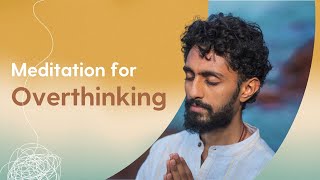
This video is a 10-minute guided meditation designed to reduce overthinking and promote deep relaxation. The narrator leads listeners through a body scan, from head to toe, encouraging the release of tension and a focus on present-moment sensations.
The meditation aims to reduce overthinking and induce relaxation. Listeners are guided to a comfortable seated position, either on a chair or on the floor with legs crossed, and to lean their back against a wall or chair for support.
The practice begins with deep breaths: inhale deeply and exhale to relax further. After three deep breaths, the body is instructed to become completely loose and relaxed.
Awareness is brought to the top of the head, then slowly moved down through the body: forehead, nostrils, lips, throat, shoulders, chest (heartbeat), belly, back, hips, knees, and feet. At each point, the instruction is to observe sensations and release any tension.
After the body scan, the narrator guides another deep breath, and on the exhale, the entire body is instructed to relax even further, from head to toe.
The meditation concludes by slowly bringing awareness back, placing hands over the eyes, and gently opening them.
This guided meditation offers a simple yet effective technique for calming the mind and releasing physical tension through a systematic body scan and focused breathing. It is a practical tool for anyone looking to reduce overthinking and cultivate a state of deep relaxation.
What is the recommended seated position for this meditation?
Sit on a chair or on the floor with legs crossed, leaning your back against a wall or chair.
00:21
Where should you place your hands during the meditation?
In your lap, facing upwards.
01:13
How many deep breaths are taken at the beginning of the meditation?
Three deep breaths.
01:33
What is the purpose of the body scan in this meditation?
To observe sensations and release any tension in each part of the body.
02:21
What is the final step before opening your eyes?
Place your hands over your eyes and gently open them.
09:23
Purpose of Meditation
Clearly states the goal: to reduce overthinking and promote relaxation, setting expectations for the viewer.
00:06Body Scan Technique
Introduces the core technique of the meditation—a systematic body scan—which is a proven method for stress reduction.
02:21Deep Relaxation Cue
Emphasizes the progressive relaxation of the entire body, a key element in achieving a meditative state.
08:43[00:06] Welcome to a guided meditation to reduce overthinking and practice, you will feel extremely relaxed and calm in both body and mind.
[00:21] relaxed and calm in both body and mind. [Music] Come to a comfortable seated pose. Sit either on a chair or pose. Sit either on a chair or preferably on the
[00:42] floor. Keep your legs crossed if you can. Lean your back against a wall or your
[00:56] back against a wall or your chair. Your back should be touching a chair. Your back should be touching a wall or the back of your
[01:13] comfortably. Keep your hands in your lap facing upwards. [Music] Close your
[01:33] exhale, [Music] [Music] relax. Take another deep breath in.
[01:50] exhale, relax even [Music] [Music] further. Take one last deep breath
[02:09] in. And as you exhale, completely relax your body. Leave it [Music]
[02:21] loose. As you return to normal breathing, bring your awareness to the top of your top of your head, the topmost point of your
[02:35] [Music] head. And feel all the sensations going on. sensations going on. At this
[02:57] point now slowly take your awareness to your aware of what sensations are there in your
[03:13] forehead. If there is any heaviness, release it right [Music] now. Try and release
[03:29] awareness to your [Music] nostrils and feel the inhalation and exhalation. exhalation. [Music]
[03:53] [Music] Move your awareness to your sensations created by your lips
[04:07] joining. [Music]
[04:25] of your throat. [Music]
[04:40] foot and stay with all the sensations in this area.
[04:54] awareness to your shoulders and release if there is any tension or stiffness in your shoulders.
[05:06] stiffness in your shoulders. [Music] Now move your awareness to the center of your
[05:19] awareness to the center of your chest where the rib cage meets and observe the sensations of your heartbeat.
[05:49] It's move your awareness to your movement of your belly with your inhalation and
[06:03] exhalation. The slow expansion of your belly and the slow belly and the slow [Music]
[06:25] contraction. Move your awareness to your back. and feel the sensation created between your back and sensation created between your back and the wall or
[06:55] slowly move your awareness to your [Music] hips. And again observe the hips. And again observe the sensations between your hips and the
[07:10] flow beneath. [Music]
[07:24] Bring your awareness to your knees and see if you can relax your knees even knees even [Music]
[07:43] [Laughter] further. Bring your further. Bring your awareness to your feet.
[08:00] feet. And stay with the sensations created at the bottom of your sensations created at the bottom of your [Music]
[08:18] [Music] feet. Take a deep breath in. exhale, relax your [Music]
[08:43] in. And as you exhale, relax your body even exhale, relax your body even further. Let go.
[09:05] exhale, completely relax your entire body from head to toe. Loose, relaxed.
[09:23] [Music] We will very slowly come out of this
[09:38] [Music] hands. Place them on your eyes. And very gently open your eyes.
⚡ Saved you 0h 09m reading this? Transcribe any YouTube video for free — no signup needed.