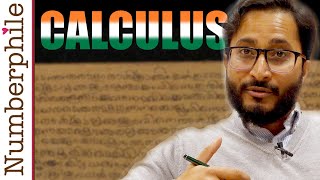

Was Calculus Invented in India Before Newton?
30sChallenges the common narrative that Newton and Leibniz alone invented calculus.
▶ Play Clip"The title hints at a more complete story, but the video focuses specifically on Indian calculus—still informative and valuable."
This video discusses the Kerala school of mathematics, which developed calculus techniques in 14th-15th century India, centuries before Newton and Leibniz. The speaker shares insights from his friend, the late physicist and mathematician Professor PP Divakaran, who worked to bring this history to light.
Professor PP Divakaran, a physicist and mathematician, passed away at 89. He worked on particle physics and later brought Indian calculus from the 14th-15th century to the world.
Divakaran was a particle physicist, PhD from Chicago, worked at Oxford and TIFR. He retired in the late 90s and then got a fellowship to visit institutions, where he encountered Indian calculus research.
The Kerala school, in modern Kerala state, was founded by mathematician Madhava around 1340. It was also known as Nila School, named after a river. The school lasted about 300 years.
The book Yuktibhasa, written in 1520s, compiles the calculus discoveries of the previous 150 years. It is written in Malayalam and covers series expansions for sine, cosine, and arctangent.
Indian mathematicians were concerned with arcs and circles, leading to trigonometric functions. Newton and Leibniz approached calculus through motion and general functions.
Both schools used the same technique of splitting objects into small parts and taking limits. However, Indian calculus was limited to trig functions, while Newton/Leibniz generalized.
Two main reasons: the key text Yuktibhasa was written in Malayalam, not Sanskrit; and Kerala was under Portuguese colony, leading to decline of the school.
Divakaran was not sad about the lack of recognition; he understood the complex reasons and worked to bring attention to Indian calculus. He gave lectures and published a book.
If Kerala calculus had spread, it might have accelerated the development of calculus and mathematics in general, especially if combined with the decimal system known in India.
The speaker feels proud as an Indian and as a scholar to know that such advanced mathematical thinking existed so long ago.
The Kerala school of mathematics developed calculus techniques centuries before Newton and Leibniz, but due to language and colonial isolation, it remained unknown. Professor Divakaran played a key role in bringing this history to light.
Who was the founder of the Kerala school of mathematics?
Madhava
03:01
What is the name of the key text that compiles Kerala calculus?
Yuktibhasa
05:03
In what language was Yuktibhasa written?
Malayalam
09:24
How long before Newton and Leibniz did Kerala calculus develop?
More than 200 years
05:34
What was the main difference in application of calculus between Indian and European mathematicians?
Indian mathematicians focused on trigonometric functions due to circles; Newton and Leibniz generalized to all functions.
08:15
What are two reasons the Kerala school's work remained unknown?
The key text was written in Malayalam rather than Sanskrit, and Portuguese colonization led to decline.
09:07
How did Prof. Divakaran feel about the lack of recognition?
He was not sad; he understood the reasons and worked to bring the work to light.
10:43
Kerala School Founded by Madhava
Establishes the origin of calculus in India centuries before Newton/Leibniz.
03:01Yuktibhasa: The Calculus Compendium
This 1520s text documents advanced series expansions, proving advanced calculus existed in India.
05:03Same Fundamental Technique
Both Indian and European calculus used the limit approach, showing independent parallel development.
07:46Language and Colonialism as Barriers
Explains why Indian calculus remained isolated despite its sophistication.
09:07[00:00] So uh a wonderful physicist and mathematician, professor PP Divakaran, who was uh retired from Tata Institute of Fundamental Research, it's a premier institute in India for physics and maths,
[00:13] passed away at the age of 89 on 23rd of August and he was a close uh friend of mine. He has done incredible amount of work in particle physics and more recently in bringing Indian Calculus that was
[00:28] done in 14th century and 15th century into the world. He has published a lot of papers on this topic and he has this wonderful book published in Springer and since he passed away I thought it's a great opportunity for us to talk about Indian Calculus in the 14th and 15th century. Before you
[00:45] get there you say he's a particle physicist but he's also talking about 14th century or something mathematics. How come this man who's passed away was doing both of those things? Yes, great question. So actually he was mostly a particle physicist all of his life. Um he was
[01:00] picked up by a Indian national talent search uh in the 1950s and after that he went to Chicago for his PhD. He also came to Oxford and worked with professor Dalitz. Then he returned back to
[01:13] India and became a professor in particle physics and did a lot of work on quantum field theory and particle physics. He retired in late 90s and after retiring he got a fellowship to visit other institutions in India. So he was visiting Chennai Mathematical Institute, that's where he
[01:28] came in contact with historians of mathematics doing research on Indian Calculus and since he was a mathematical physicist he could read these books and appreciate it much better than purely a
[01:42] historian of mathematics. It's a fortunate thing that I met such a eminent person in my life. Um I knew about him from my friend circles, from my professors, a lot, because he was well known.
[01:54] Um I met him twice in my life. Uh the first time I met when I was a first year PhD student and he was visiting my institute to give a lot of talks on physics that time, not on mathematics. The second
[02:06] time I met him was last year and I spent about two months with him, every day interacting all throughout the day. So in some in some sense I was kind of taking care of him while he was
[02:18] there. It's an institute called Inter-University Centre for Astronomy and Astrophysics in India. And after I came back to UK we kept in touch, we exchange emails regularly, mostly on physics
[02:31] and mathematics. So so we we knew each other very well, and it's really sad that he passed away. Tell me about Indian calculus then because when I think of calculus I think of Leibniz and Isaac Newton. I've seen all the documents at the Royal Society. There was famously a dispute as to
[02:46] which one of them was first and things like that. You're going to tell me a different story via your friend. Yes. First of all, all credit to Newton and Leibniz. Newton is one of my greatest heroes in physics because of physics reasons, but also he discovered calculus, as well as Leibniz. And so
[03:01] there's no connection between Newton's discovery and the discovery in India that I'm gonna to talk about. Coming back to Kerala school. Kerala in the modern India is a state, it's the southern state. It's a very intellectual state. It's well known for mathematics and culture and physics. In those
[03:18] days it was under a kingdom called Vijayanagaram kingdom. So 14th century, second half. And there was a particular mathematician called Madhava who kind of immigrated from 200 kilometers up
[03:30] in north towards a place where he settled finally and built his school of mathematics. We know a lot about his mathematics because of his disciples. His students wrote a lot about all the theorems
[03:42] and and proofs but we don't know much about his life. We kind of know which village he was born in. So at least that much is clear. And we also know his birth year, which I think is 1340. And
[03:54] very soon he he established this school which today we call Kerala school of Mathematics. In in the western world it is known as that. Uh but I think professor Divakaran will call it Nila School
[04:06] of Mathematics. Now this word 'Nila' is a name of a river, and the mathematicians sort of lived in villages around this river, and it went on, this school of mathematics, for about 300 years. How
[04:18] kind of formalized would this, what would this have looked like if I was there? Yes, that's a great question. So, I think this was a Gurukula culture in the sense the word 'Gurukula' means uh teacherhood in some sense. So the disciples or students would go to a grand teacher or a master
[04:34] and they would stay around that place, and learn. But it was not a big campus basically, it may be just the house of your teacher, and you live around it. But again, I'm not very sure in this particular question. It obviously became the place to go did it and people who had an affinity
[04:48] with mathematics would travel there. Yes, and I should say that this was also a place of cultural revolution in Kerala, in the state. The language is called Malayalam, it's Kerala's language, and a lot of cultural and linguistic and even Ayurveda revolution happened around that place.
[05:03] So definitely that was an important place. Most of the evidence that that we know in the modern day, especially in the western world, about the Kerala School comes from a particular book. It's called Yuktibhasa. It simply means the language of logic and proofs, basically formal mathematics, and it
[05:20] talks about the calculus that was done for the past 150 years. This book was written in 1520s and Madhava arrived in 1350s, so you see the gap. And it talks about several important things that we
[05:34] know in modern calculus. So this book that you're talking about which is talking about something that had happened hundreds of years before is already 100 years before Newton and Leibniz. Yes, 200, more than 200 years before. And it is well known now on Wikipedia on mathematical sources.
[05:50] All - most mathematicians would know this by now. So it's an important uh thing. But Newton and Leibniz wouldn't have had access to this book. So, of course I cannot deny, but there's no evidence and I don't want to push that angle because you know, um I have talked to professor Divakaran
[06:05] who has read seven volumes of Newton's work and he says he did not find any evidence. The ideas were so different - the Indian cultural thinking was so different from the Renaissance thinking uh
[06:17] that uh it sounds unlikely. But who knows! One of the fundamental things about calculus is measuring the length of a curve or an arc. The Indian mathematicians were concerned with measuring the
[06:30] length of an arc. It might have come originally from Astronomy because you know planets rotate around uh sun and you need to cover their arc. The way Newton came to it was through motion, which is very similar. You have a curve which is not linear. It's not a straight line. Your velocity
[06:46] is changing as a function of time and he wanted to capture it. So it's something which is changing as a function of time. The Indian mathematicians were concerned with circles. So they're looking at something which is changing as a function of theta, angle. Okay. So how do you measure the
[07:01] length? If if something is linear, you know the length. If something is curving, to calculate that length, you have to discover calculus. So what you do is take a curved object like a like an arc and
[07:14] split it into small small small small segment and treat each segment as a straight line in the limit when the length goes to zero and then add them up and then you get the arc. So they use this
[07:28] uh to find many important series. So they found the series expansion of sin x, the so-called MacLaurin series. They found the series expansion of cos x and they found the series expansion of arc tangent, tan inverse x, which is very famous Gregory series. Okay, how different were the
[07:46] techniques they were using to what Newton and Leibniz ended up using? If you map it all back, is it all the same stuff fundamentally, or is it really different? Fundamentally, technique-wise, it was exactly the same. The same techniques was being used. splitting a object into small small
[08:02] parts and taking a limit. So, so this was the first time in the history of mathematics where limits were taken carefully. Um, and um, uh, so it's same in that sense. It's different in
[08:15] the sense that Newton and Leibniz talked about all sorts of functions. Any general function you give me, I can give you its derivative. I can integrate it. Uh, in Indian mathematical school in Kerala,
[08:27] it was only trigonometric functions because they were talking about circle. So they are sine, cosine and tangent. That's the main difference. Things like exponential function, logarithm
[08:39] function, never appeared in uh in the Indian school. I won't be surprised if they they they would have been able to do it but they were they got so concerned with the foundational issues that
[08:52] they they stuck to few classes of functions but went into foundational issues of how to expand a function, add corrections carefully and carefully and carefully. So they spent all of those years focusing on that and circles were all they were thinking about. It's a sort of Indian thinking
[09:07] at that time. How did these ideas discovered in the Kerala school not spread around the world and become famous before Newton and Leibniz were even born. There are multiple reasons why this could have happened. First of all, this happened in Kerala and this grand textbook that
[09:24] I'm talking about called Yuktibhasa was, I should not say the word unfortunately, but it was distinctively written in the local Kerala language Malayalam and most scholars knew Sanskrit and they could read and understand Sanskrit. So the later scholars, including western
[09:39] scholars could not get hold of a Malayalam book where detailed of complicated advanced proofs were written in that language. So that is one major reason. The second reason is Kerala was under Portuguese colony. So there were a lot of fights going on at that time. That's one of the reason
[09:55] why the School sort of declined and died and with that the mathematical culture sort of died off, until it was picked up only 50-60 years ago. In fact, a book that was written before this book,
[10:07] by the previous scholar called Nilakantha few years before he wrote his book Aryabhatiya Bhasya. It's about the older Indian mathematician Aryabhata and what he did in Sanskrit and that was very popularly known. We do not know exactly why this book was written in the Malayalam language.
[10:26] Uh but once it is written in Malayalam language it was difficult to break through, especially because the proofs that we are discussing are extremely formal - series expansion, power series expansion proofs which is which was not even conceived in the northern part of India at that time. What did
[10:43] professor Divakaran have to say about this on like a personal level? Like did he feel pride? Did he feel an injustice or a sadness that it never got recognized sooner or what was his opinion about all this? Great question and I know this answer from him directly, but also he has talked about
[10:59] it in many of the lectures. So before I answer let me give reference to some of the lectures. So he gave a set of three famous lectures at the International Centre for Theoretical Sciences, it's in Bangalore in India, in 2020. And those lectures are recorded in a very nice high
[11:16] quality and one can actually watch and see all the proofs he's giving. So it'd be nice to watch those lectures but I've also had this conversation with him in person. He wasn't sad uh that it wasn't well known. He understood the reason why! uh it's sort of nobody's fault, nobody was maliciously
[11:33] trying to hide it. So he understood the complexity of reasons why, but also he worked hard and uh got it out. uh so he was very happy with it and he went deep into it - not just Kerala school,
[11:45] he went back and back. In fact, this book that I'm holding is divided into three sections. The first section goes to 1500 BC Indian number theory, the second one goes to 500 AD Aryabhata, so astronomy
[11:57] and mathematics, and then finally this Kerala School of Mathematics, which is I would call as a very pinnacle of mathematics. Madhava was definitely the most prominent mathematician in the world in the medieval ages, without a doubt. So he would have been known outside of India. It's only
[12:13] in retrospect. If somehow you know this had broken out of India and got into the western world at the time it was happening. Is there any speculation as to where mathematics and physics would be now? Would we be 200 years ahead? I think it would have accelerated a lot, but it also depends on
[12:28] western world understanding decimal system. You might know that Newton was intrigued when he had this polonom binomial expansions, and he was thinking of decimal systems and he's thinking this is a new paradigm. But decimal system has been used in India for thousands of years. So if
[12:44] people understood decimal system very well, then it would have easily broken out. How do you feel about it? Do you feel a pride in this? Do you feel an injustice? What's your opinion of it having you know read the book and spoken to the man and understanding it more? Uh first of all I'm not
[12:59] surprised because I'm born, I I'm an Indian, so I know the cultural heritage of mathematics. So something like mathematics happened in India - I'm not surprised. If something like law of gravitation was known I might be surprised, and be intrigued. Mathematics was was part of culture.
[13:17] So I'm proud, I also feel proud, but not necessarily as an Indian but as a scholar, to know that this modern thinking of mathematics and calculus existed so long back and these
[13:30] people are thinking very very modern way of expanding functions and approximating them.
⚡ Saved you 0h 13m reading this? Transcribe any YouTube video for free — no signup needed.