
Why I Use Soap on Cast Iron (It's Safe!)
40sDebunks the common myth that soap ruins cast iron seasoning, surprising many viewers.
▶ Play Clip"The title promises a secret and what not to do, and the video delivers a clear, detailed process with common mistakes, making it highly accurate."
This video provides a step-by-step guide to seasoning a cast iron skillet, emphasizing the importance of proper cleaning, drying, oil selection, and baking. The creator shares a simple, effective process based on personal trial and error, and highlights common mistakes to avoid for a smooth, non-stick finish.
After research and trial, the creator found a simple, easy, and effective process for seasoning cast iron to achieve a completely smooth surface.
Wash the skillet thoroughly using a chain-mail scrubber for stuck-on food, then dish soap and a sponge to remove rust and uneven oil layers. Soap is acceptable before a new seasoning layer.
Dry the skillet with a towel, then heat it in a preheated oven upside down at 250°F for 10 minutes to evaporate all moisture, which helps oil adhere properly.
Apply a small amount of oil (about the size of a quarter) to the entire skillet, then wipe it off with a second paper towel as if trying to remove it. The skillet should have a slight sheen, not be glistening.
Use a neutral-flavored oil with a smoke point above 400°F. Soybean oil (smoke point 450°F) is recommended for being cheap and effective.
Place the skillet upside down in the oven with a baking sheet on the lower rack. Bake at 25°F above the oil's smoke point (e.g., 475°F for soybean oil) for 15 minutes, wipe excess oil, then bake for another 45 minutes. Let cool in the oven for 1-2 hours.
Mistakes include not cleaning well enough, not drying thoroughly, using the wrong oil (low smoke point or animal fats), using too much oil, not baking at a high enough temperature, and not baking long enough.
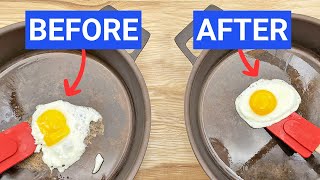
Following this seasoning process yields a smooth, rust-resistant layer that makes cooking non-stick. Patience and attention to detail are crucial for success.
What is the recommended temperature to dry a cast iron skillet in the oven before seasoning?
250°F (about 121°C) for 10 minutes.
01:05
How much oil should be used to season a cast iron skillet?
About the size of a quarter.
01:29
What is the rule of thumb for choosing an oil for seasoning cast iron?
Choose an oil with a smoke point above 400°F and a neutral flavor.
02:08
At what temperature should you bake a cast iron skillet when using soybean oil (smoke point 450°F)?
475°F (25°F above the smoke point).
02:34
How long should the skillet bake in total after the initial 15-minute wipe?
45 minutes.
03:00
Why should you avoid using animal-based fats like lard or bacon grease for seasoning?
Because they will go rancid unless the skillet is used multiple times daily.
04:20
What is the most common mistake when seasoning cast iron?
Using too much oil or not wiping it off enough before baking.
04:33
Why is it important to heat the skillet in the oven before applying oil, even if it looks dry?
To evaporate any lingering moisture that could prevent the oil from adhering.
01:05
The 'Wipe It Off' Technique
Emphasizes using a second paper towel to remove excess oil, preventing a sticky, gummy surface.
01:29Oil Selection Rule
Provides a clear, actionable rule: choose neutral oil with smoke point above 400°F.
02:08Most Common Mistake: Too Much Oil
Highlights the critical error of over-oiling, which leads to flaking and poor seasoning.
04:33Patience is Key
Stresses the importance of baking long enough for the oil to bond and harden properly.
05:10[00:00] I've been cooking with cast iron for years, and I've made every mistake when it comes to seasoning these skillets.
[00:13] But after a ton of research and trial and error, I've found a process that's simple, easy, and works. In this video, I'll show you how I season my cast iron so it's completely smooth.
[00:25] I'll also explain the common mistakes that you need to avoid. Let's get started. The first step is to wash the skillet thoroughly. You want to make sure the surface is completely clean and smooth without any stuck-on food,
[00:37] rust, or uneven layers of baked-on oil from previous seasonings. I usually use a chain-mail scrubber to remove any larger bits of food, and then dish soap and a sponge to get the rest. I wouldn't recommend using a sponge for everyday cleaning because it can degrade the seasoning,
[00:52] but since you're about to apply a new layer, go ahead and use soap. The next step is to dry the skillet completely. Wipe it down really well with a towel, then put it in a preheated oven upside down at 250 degrees for 10 minutes.
[01:05] This will evaporate the rest of the moisture on the skillet. Even if your skillet looks dry after wiping it with a towel, I highly recommend heating it in the oven. Even the tiniest amount of moisture can prevent the oil from adhering to the cast iron.
[01:17] Plus, it's easier to spread a thin layer of oil on a warm pan. Once the skillet is clean and dry, protect your hand and remove the skillet from the oven. Then use a paper towel to rub a small amount of oil on the entire surface.
[01:29] Make sure to get the inside, outside, and the handle. You want to get the entire skillet because seasoning will help prevent rust. The key to this step is to use a small amount of oil, about the size of a quarter, and spread
[01:41] it until it's completely even. After you spread it with one paper towel, take another and wipe it down as if you're trying to remove the oil. The cast iron will have a slight sheen, but it should not be glistening. If that's the case, you've used too much oil. People claim that the lint from the paper towel will stick to the skillet and mess up
[01:56] the seasoning, but I've never had an issue with the paper towels I use. If you're concerned, you can buy lint-free cloths, but I don't think it's necessary. There's a lot of debate about what kind of oil to use. The truth is, several will work just fine.
[02:08] As a rule of thumb, choose oil with a smoke point above 400 degrees Fahrenheit with a neutral flavor. I'm using soybean oil, it's cheap, the smoke point is 450, and it has a neutral flavor. The final step is to bake the skillet.
[02:22] Place the skillet in an oven upside down on the middle rack and place a baking sheet on the lower rack. If you've applied the oil in the previous step the right way, the baking sheet is unnecessary, since there won't be any oil dripping, but I like to put it there just in case.
[02:34] The temperature you bake at depends on the oil you use. A rule to follow is to bake at 25 degrees above the oil's smoke point. So since I use soybean oil, which has a smoke point of 450, I'm going to bake this skillet
[02:46] at 475. You don't need to preheat the oven just let the skillet heat up gradually as the oven heats. Once the oven reaches 475, let the skillet bake for 15 minutes. Carefully take it out and wipe down any excess oil one last time.
[03:00] There really shouldn't be any, but I take this step just in case. After you wipe it, put it back in the oven for another 45 minutes. After the full hour, turn the oven off and let the skillet cool down in the oven for another hour or two.
[03:12] A lot of people will tell you to repeat this process two or three times. In my experience, two times is enough, but if you have the time, seasoning three times will get you a solid base. After that, it's best to just start cooking. If you follow these steps, the result will be a smooth layer of seasoning that prevents
[03:26] rust and makes it easy to cook eggs, chicken, and any other food without sticking. Here's the before and here's the after. Now that you know the best way to season a cast iron skillet, let's review the common mistakes
[03:39] to avoid. The first mistake people make is not cleaning their skillet well enough. If you try to season a pan that's not completely clean, the oil won't adhere to the cast iron and it will clump up and flake. The second mistake is not drying the skillet enough.
[03:53] Even if your skillet has been clean and sitting in the cabinet for days, I highly recommend heating it in the oven before applying the oil to evaporate any lingering moisture. It takes a few extra minutes, but it's worth it. Another common mistake is using the wrong oil.
[04:07] Choose a high smoke point oil. Since you'll be cooking with your cast iron at high temperatures, you don't want your seasoning to be burning every time you cook. Avoid flaxseed oil, olive oil, butter, and other oils with smoke points below 400.
[04:20] Also avoid lard, bacon grease, and other animal-based fats, because those will go rancid unless you're using your skillet multiple times a day every day. The best option is to use a neutral flavor, high smoke point oil, that's 100% pure, and
[04:33] not mixed with other oils. Soybean, peanut, sunflower, grape seed, and canola are all good options. The most common mistake when seasoning cast iron is using too much oil, or not wiping it off enough before baking.
[04:46] Seasoning is like painting. If you use too much paint, it won't adhere properly and it will flake off. The same thing is true for seasoning. If you use too much oil, you'll end up with a sticky, gummy surface that will eventually flake off.
[04:58] Another mistake is not baking the skillet at a high enough temperature. For the oil to properly bond to the cast iron, it needs to be heated slightly above the oil's smoke point. Since ovens are not 100% accurate, aim for 25 degrees higher.
[05:10] If you've avoided all the other mistakes, but the seasoning is still sticky or uneven, there's a good chance you didn't bake it long enough. It takes time for the oil to bond to the cast iron and harden. Pick a time when you're going to be home, and you don't need to use the oven for other
[05:23] things. Patience is key. If you found this video helpful, check out this video where I show you how to prevent food from sticking to stainless steel cookware. Don't forget to click the logo to subscribe to the channel.
[05:36] Thanks for watching, we'll see you in the next video.
⚡ Saved you 0h 05m reading this? Transcribe any YouTube video for free — no signup needed.