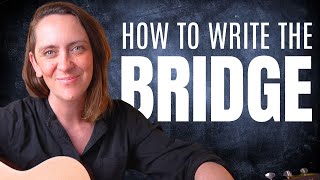

The Bridge Is Your Song's Pattern Breaker
54sReframes the bridge as a pattern-breaker, instantly clarifying one of songwriting's most confusing sections.
▶ Play Clip"Delivers a thorough, actionable guide that matches the 'ultimate' promise, with only minor self-promotion."
This episode of the Songwriting 101 series focuses on writing the bridge of a song. It defines the bridge as a pattern-breaking section that creates contrast and provides a new perspective, then walks through multiple lyrical and musical strategies, including chord and melody techniques, and debunks common misconceptions. The presenter offers a free song map template as a companion tool.
A bridge is a section of music whose job is to break the pattern, creating contrast or variation from anything heard in the song so far. It acts as a palette cleanser.
The bridge often builds tension that is then released by returning to a repeating part, such as the chorus, hook, or refrain line.
Lyrically, the bridge presents a new perspective on the lyrical theme rather than repeating the central message.
Ask yourself: 'What do I have in my song?' and 'What is different to that?' The answer to the second question is where great bridges are born.
Ask the inverse question to create contrasting language. For a troubled relationship song, imagine how different it would feel—leading to imagery like walking on the beach without the pain.
Identify the image set used in verses/choruses (e.g., heat and fire) and use an opposite set (e.g., cold, ice, snow) in the bridge to shift perspective.
English has statements, commands, and questions. If verses use statements, switch to questions in the bridge; if the chorus is full of questions, use commands to change energy.
For narrative songs, the bridge can zoom through time or break the narrative to go inside the mind, emotions, or memories of the protagonist, as in Beth Nielsen Chapman's 'Child Again'.
Treat the bridge as the emotional climax of the song, not an afterthought. Miranda Lambert's 'The House That Built Me' reveals the true emotional consequence in the bridge.
In the key of C, try D minor, E minor, or B diminished—especially as the first chord of the bridge—to signal a departure.
Harmonic rhythm is how long you hold a chord before changing. If verses change every bar, hold one chord for four bars in the bridge to dramatically shift energy.
If the verse melody goes high to low, contrast it with a static or low-to-high melody. 'Somewhere Over the Rainbow' uses a static bridge against a wide-ranging verse.
Use pauses and rests in the bridge. The Beatles' 'Yesterday' places spaces in different spots and lengths in the bridge, creating contrast.
Examine the intervals (distance between notes) in your song. Make the bridge use bigger leaps, smaller steps, or swap the direction of intervals.
You can reprise lyrics from elsewhere. Dua Lipa's 'Dance the Night' reuses the chorus line 'I still keep the party running' in the bridge; the music provides contrast.
Some songs have multiple bridges. Bob Dylan's 'Make You Feel My Love' (made famous by Adele) has two bridges in an extended AABA form.
The convention exists because repetition creates readiness for change. You can place a bridge after other repetitions, like starting the song with a chorus or repeating a verse.
The bridge is a powerful tool for breaking pattern and delivering emotional impact. By asking 'What do I have?' and 'What is different?', songwriters can apply lyrical, chord, and melody strategies to craft bridges that feel fresh and essential.
What is the primary job of a bridge in a song?
To break the pattern and create contrast or variation from anything heard in the song so far.
01:04
What two questions should you ask yourself when writing a bridge?
'What do I have in my song?' and 'What is different to that?'
02:13
Name three types of language in English that can be shifted in a bridge for contrast.
Statements, commands, and questions.
05:35
What is the narrative strategy of 'going internal' in a bridge?
Breaking the narrative to go inside the mind, emotions, or memory of the protagonist rather than describing external events.
06:46
Which song by Miranda Lambert uses the bridge to reveal the emotional climax?
'The House That Built Me'.
08:51
In the key of C, what are two chords you could try as the first chord of a bridge?
A minor (six minor) or F major (four major), if not already used as a main chord.
13:25
What is harmonic rhythm?
How long you hold a chord before moving to the next chord.
14:21
What are the three major characteristics of melody discussed for creating contrast?
Direction, space, and distance.
16:21
How does 'Somewhere Over the Rainbow' create contrast in its bridge melody?
The verse melody goes from high to low with big leaps, while the bridge is mostly static with very little movement.
17:05
What is the misconception about bridge lyrics?
That the bridge must have entirely new lyrics; actually, you can reprise lyrics from elsewhere.
20:30
Which song has two bridges in an extended AABA form?
'Make You Feel My Love' by Bob Dylan (made famous by Adele).
22:09
Bridge as Pattern Breaker
Defines the fundamental purpose of a bridge in a clear, memorable way.
01:04The Two Questions Method
Offers a simple, universal framework that songwriters can apply to any bridge.
02:13Bridge as Emotional Climax
Reframes the bridge from an afterthought to the emotional center of the song.
08:26Melody: Direction, Space, Distance
Provides three concrete, easy-to-understand lenses for melodic contrast.
15:49Busting Bridge Myths
Dispels rigid rules, freeing songwriters to explore creative placements and multiple bridges.
20:30[00:03] songs that we love. But as songwriters, when we sit down to write a bridge, it can feel weirdly out of reach. Like suddenly when we're in the moment doing it ourselves, the challenge of writing a great bridge feels like insurmountable.
[00:20] In this episode of the songwriting 101 series, we are zooming a lens in on one of the trickiest, but often one of the most beautiful and rich sections of a
[00:33] song, the bridge. By the end of this video, you will understand exactly what a bridge is there to do in a song form. You will have several different specific approaches to writing great bridges. And
[00:49] you will also understand some of the common misconceptions about writing bridges which will help you avoid writing boring bridges, writing the same kind of bridge over and over again and hopefully really unlock
[01:04] the writing of bridges as one of the most creative parts of the songwriting most creative parts of the songwriting process. A bridge is very simply a section of music inside your song whose job is to
[01:19] music inside your song whose job is to break the pattern. The bridge is there to create a moment of contrast or variation from anything we've heard in variation from anything we've heard in the song so far. So the bridge is a
[01:33] the song so far. So the bridge is a pallet cleanser or a pattern breaker. pallet cleanser or a pattern breaker. Often its musical role is to build some Often its musical role is to build some kind of tension that is then released by
[01:45] returning to a repeating part that we have heard before. Often returning to the chorus or returning to the hook or returning to a refrain line, a line of lyric that we have actually heard repeat previously in the song. Lyrically, its
[02:00] previously in the song. Lyrically, its job is not to repeat the central message job is not to repeat the central message of the song, but rather to present a new perspective on the lyrical theme. There are two simple questions that you can
[02:13] ask yourself that will always lead you in the right direction when it comes to writing a great bridge. The first question is simply asking yourself, what question is simply asking yourself, what do I have in my song? And the second
[02:27] do I have in my song? And the second question is what is different to that? And it is the answer to the second question, what is different to that where great bridges are born. And just a quick note here to mention that I have
[02:40] created a free song map template that you can download right now. There's a link in the video notes below. It's a series of guide questions that's specifically designed to help you grow the emotional weight of your lyrical
[02:55] ideas in your song. So, it's a perfect companion to bridge writing. And a little later on, we will get to some lyric writing approaches to writing great bridges. And you'll really see where this song map template can come to
[03:09] life in your lyric writing and bridgewriting. So, download it. Our first bridge writing strategy is the lyrical approach. The lyric writing of a bridge causes people lots of trouble and
[03:23] lots of pain. So, what I'm going to do is give you three different strategies is give you three different strategies for how to approach writing lyrics to a bridge that really serve the function of the bridge. really do this job of
[03:37] providing a new perspective, a different way to look at the theme and really using language as the driving force for contrast.
[03:53] a new perspective on the lyrics theme. And there are three different ways that we can immediately approach this. The first question is simply, what if things were different than this? All right. So, let's say you've written a song about a
[04:08] troubled relationship. Whatever that is, whatever part of the relationship the song is about, it's about a troubled relationship. Simply asking the question, what if things were different than this can lead you down a path of
[04:23] contrast? If things weren't troubled, it would feel like this. It would look like other. We would walk down the beach without feeling this way. Simply asking the inverse question, what is different? How could it be different than what it
[04:38] is? Will inevitably lead us to that contrasting language. Another way you can frame that question is, what could things look like a year from now? Another way to show a new perspective is to look at the imagery inside your song
[04:52] and ask if there is a set of imagery that you are using inside the rest of the lyrics. And is there an opposite or a contrast or a polarization to that image set that you can employ in your bridge? For example, let's say you're
[05:08] bridge? For example, let's say you're using a lot of heat and fire language inside the lyrics of the verse or the chorus. Well, what's the opposite or contrasting image set there? It's something like cold, ice, snow.
[05:23] Contrasting heat imagery with cold imagery is a really powerful way to use the language of images to provide that shift in perspective and that
[05:35] contrasting language. And another way to use the tone and type of language to create immediate contrast in your bridge is to understand that generally there are three types of language in English. There are statements, commands and
[05:50] There are statements, commands and questions. If the lyrics of my verses and choruses, for example, are a lot of statements, which tends to be sort of descriptive and narrative information, or commands, for example, do this, go
[06:04] there, take my hand, close the door. If it's statements and commands, well, then it's statements and commands, well, then I can use questions in my bridge. and using question language is a great way to totally change the tone and texture
[06:18] of the language in the contrasting section. The inverse is of course true. If I look at my chorus and I ask myself what do I have? If my chorus is a lot of questions, well then switching to the command voice in the bridge is going to
[06:34] totally shift the whole energy of the bridge lyric. So shifting perspective is our first strategy. Our second strategy is a
[06:46] narrative strategy. If our song is a narrative song, there [music] is a storytelling component. We are describing a series of events that are happening in a sense of chronological time. Often a bridge can be really
[07:00] useful to literally bridge us from one event to another event. It can be there to zoom us through time. If the nature of your song up until this point is narrative, another approach is to actually break the narrative and go
[07:15] internal. So rather than describing things happening, we can go inside the mind, the emotions or the memory of the protagonist of our song. This is exactly
[07:27] what Beth Nielsson Chapman has done in her beautiful song child again. This is a song about an aging person in a nursing home and largely from the perspective of her family who are coming to visit her and really recognizing that
[07:43] as she's getting older and suffering probably the effects of dementia or Alzheimer's or memory loss that in fact she's becoming something like a child again. The lyrics of the bridge double down on this idea and instead of
[07:58] nursing home or that people are coming to visit her, it goes inside the mind of this character. We see her completely immersed in her memories and reveries of
[08:12] immersed in her memories and reveries of childhood. The bridge is nonnarrative where the lyrics to the rest of the song are highly narrative. are highly narrative. A final immediate way that we can use
[08:26] lyrics to create contrast in the bridge is to think of the bridge as the is to think of the bridge as the emotional climax of the whole song. So rather than treating the bridge as an afterthought or a side thought or a side
[08:39] meal, we can really think of the bridge as the moment where we arrive at the true emotional consequence of the whole song. A great example of this is the
[08:51] Miranda Lambert song, The House That Built Me. Now, this is a song about an adult coming back to their childhood home and just asking to look around. But it's actually in the bridge where we understand why. We understand what is
[09:07] the true emotional consequence that is driving this desire. In this case, it's because she feels completely lost. Having left the childhood home to pursue
[09:19] her dreams, she lost a connection to her true authentic self. And it's the bridge true authentic self. And it's the bridge that reveals this emotional climax and then delivers us back to the chorus where we see her at the childhood home
[09:34] requesting to be let in, to take a look around, to reconnect with the house that built me. So we can flip the bridge on its head. Rather than thinking of it as an afterthought or a bit of extra information, we can actually treat the
[09:50] information, we can actually treat the bridge as the emotional climax of the whole song. If you have ever struggled with writing the lyrics to a bridge, I have created this song map template that you can download for free right now in
[10:06] the video notes just below. There's a link right there. This song map template is a series of questions that naturally creates a sequence of escalating ideas where we start with a problem, grow the problem, and actually in the biggest box
[10:22] at the bottom which can represent the bridge, it's where we actually achieve the biggest emotional idea. So, it's a series of guide questions designed to help you take any idea and move it through these boxes that increase in
[10:39] emotional weight and actually arrive at the biggest emotional idea which we can think of as being the bridge. In this case, case, a classic bridge will also introduce new
[10:54] musical information, some kind of change to the chords, the rhythm, the melody, or the dynamics that signals to the ear of a listener that we are taking an off-ramp from the main highway of the song. There are so many different
[11:09] about. So, what I'm going to do is limit myself here to talking about two of the big ones, chords and [music] then melody. The first thing we're going to do is come back to our two basic questions.
[11:23] What do I have and what's different than that? Let's talk about the first question. What do I have? To answer that question, we generally want to know what key we're in. So, let's say I have a verse with these chords and a chorus
[11:39] verse with these chords and a chorus with these chords. It's helpful to know with these chords. It's helpful to know that I'm in the key of C major because that is going to help me answer the second question. What's different than
[11:51] second question. What's different than that? In the key of C, I have these chords. Seeing what's available in the key of C helps me answer the first question. What do I already have? So what I already have is these chords in
[12:08] I can answer that question? What is I can answer that question? What is different from what I already have? The first answer to that question might simply be use a chord that I have not
[12:22] simply be use a chord that I have not yet used from the same key. I could use the D minor chord or the E minor chord or even the B diminished chord. By using a chord that we haven't used yet, it's a strong signal to the ear of a listener
[12:38] that we are going somewhere else. Especially if I use one of those chords Especially if I use one of those chords as the first chord of my bridge. [music]
[12:53] question, what is different than what I've already used is actually simply changing the order of the chords. Even if I use the same chords that I've already used, simply changing the order of them can also perform this very
[13:10] important function. It can tell the ear of a listener that we have arrived at a different place. A little quick trick or hack [laughter] from the world of hack [laughter] from the world of songwriting history is that there are so
[13:25] so many bridges that will actually use the six minor chord or the four major the six minor chord or the four major chord as the first chord of the bridge, chord as the first chord of the bridge, but only if that chord has not been the
[13:40] but only if that chord has not been the main chord of the previous sections. So try it out. If you look at your own chords from your verse or chorus sections and you say, "Well, look, I've used the A minor chord, but not as the
[13:53] first chord." Try it out as the first chord of your bridge. And the same thing is true for that four chord, the F chord in the key of C. A third answer to our very important question, what's different than what
[14:08] I've already been doing, is to look at how quickly you change the chords inside your previous sections and to actually change how quickly or slowly you are
[14:21] next chord. The fancy musical terminology for that is harmonic rhythm. Harmonic rhythm is not the strumming pattern or the playing pattern. Harmonic pattern or the playing pattern. Harmonic rhythm just means how long you are
[14:35] holding a chord before moving on to the next chord. So if my chords are changing next chord. So if my chords are changing every bar inside a chorus for example, imagine the contrast that I can achieve. If I then go to a bridge and hold
[14:52] [snorts] one chord for four bars, the whole energy of the song is going to dramatically shift in that moment. It's not about fancy music theory. I don't need to modulate to a new key. I don't
[15:05] need to introduce modal borrowing in [laughter] this case. All I need to do is hold a chord for longer and magic can happen. [music] A fourth answer to this question is a little bit music theoryish. It does
[15:20] answer the question by saying, well, if I know that I am in the key of C, I can do something different by potentially introducing chords from outside the key of C major. For example, I might borrow some chords from a parallel mode. Now,
[15:37] that about?" You can check out this video right here, which is all about using the parallel method to quite easily and simply find chords outside
[15:49] the key you're in that are still going to sound really, really good in your original key. Once again, we are going to use the lens of these two questions. What do I have? And let that answer determine what we're
[16:06] going to do that is going to create the contrast. Now, there are three major characteristics of melody that are going to help us answer that first question and therefore lead us in the direction of creating something that shifts the
[16:21] music using the melody. Those three characteristics are direction, space, characteristics are direction, space, and distance. If I can use direction and and distance. If I can use direction and shape to describe a melody, it really
[16:35] What's different to that? A beautiful example of that is the classic melody to the song Somewhere Over the Rainbow. If I look at what I have in the melody of the verse section, there is a melody that starts low, then goes high, but
[16:52] fundamentally goes from high to low. The direction of that melody starts high and direction of that melody starts high and then is traveling a road down an octave. What is different from a melody that goes really high and then goes through
[17:05] this massive journey and then eventually comes back down? Well, something completely contrasting to that is a melody that is basically static or has very little movement in it. And that is exactly what the melody of the bridge
[17:18] does in somewhere over the rainbow. If I were so bold as to rewrite the melody of the bridge in somewhere over the rainbow, there is another answer to the already have? If I answer the question that what I already have is a melody
[17:33] that goes from high to low. Well, the other thing I could do is go from a melody that is low to high. And that is also going to create this direction also going to create this direction contrast in the bridge. Our second main
[17:47] characteristic of melody is the characteristic of space. Another word for this is silence or where we use pauses or rests inside a melody. Here is the melody to the song Yesterday by the Beatles. You can see the spaces there in
[18:04] red in the verse sections. And now look at the bridge. See how the spaces are in different places and also have different lengths. So rather than always thinking
[18:16] of melody in terms of the presence of sound, we can also think of melody as the absence of sound where we use silence, pause and rest. and for how
[18:28] long we create those pauses. It's honestly one of the most underutilized and highest impact features of melody that if we think like that in our bridge, we can immediately create something that feels so different to
[18:44] what we have in our verses or choruses. It's just about using the lens of space to ask the question, well, what do I have in these other sections? and then second question, what's different than that? Through the lens of creating
[19:01] that? Through the lens of creating space. A final very easy aspect of melody that we can use to create contrast is the characteristic of distance. The fancy musical term for this is intervals. Intervals just means
[19:16] the distance between two notes. This is super easy to use. We simply look at the melody we have and ask ourselves, well, what intervals do I already have? What's the biggest interval that I have thus far in my song and what's different to
[19:32] that? One way is to go bigger. So, the answer to that question might be, well, I'm going to use a bigger interval inside my bridge. A second answer to that might be to go smaller, as in somewhere over the rainbow. So rather
[19:47] than having a melody that is characterized by big jumps and leaps in the melody, I might use a melody characterized by really small movement of distance between the notes. And a third way might be to say, well, the
[20:00] characteristic of the intervals in my melody thus far is that I'm jumping from a low note to a high note. So my [snorts] contrast might actually be to swap the direction. So I might not need to think about going bigger or smaller.
[20:14] It might be about changing the direction of the interval. So instead, I'm going to sing a higher note and then go down to a lower note. Let's quickly talk about some common misconceptions with writing bridges so
[20:30] that you can basically avoid these and just shortcut to writing great bridges and also avoid writing the same kind of bridge over and over again. bridge over and over again. Misconception number one, a bridge must
[20:43] Misconception number one, a bridge must have entirely new lyrics. No, you can have entirely new lyrics. No, you can absolutely reprise lyrics from somewhere else in your song and simply use those as the lyrics to your bridge. This
[20:57] as the lyrics to your bridge. This approach relies on the music component taking care of creating the contrast, but it's not essential or necessary to use new lyrics in your bridge if other elements are doing the job of creating
[21:12] the contrast. A great example of this is the song Dance the Night by Ju Lipa. We can see the line in the chorus, I still keep the party run and not one hair out of place. and we see a reprisal of that lyric inside the bridge. A second common
[21:29] misconception is that bridges should only happen once. No. There are too many examples of songs that have multiple bridges to stay rigidly attached to the
[21:41] idea that there must be one bridge and it should only happen once and if you It's not wrong. It's just different. It's true to say that the vast majority It's true to say that the vast majority of pop songs do only have one bridge, if
[21:54] they have a bridge at all. But I think as creative people looking at different ourselves, it's also worth looking at some of the excellent songs from the cannon of songwriting that do have more than one bridge. For example, the song
[22:09] Make You Feel My Love written by Bob Dylan and of course made famous again by Adele. When we look inside the lyric of that song, we can see that there are two bridges? Because they are musically functioning like a bridge. They're not
[22:24] functioning like choruses. They do not contain the title. They do not contain the hook. They do create tension and the lyrics are changing. So, this is a great lyrics are changing. So, this is a great example of an extended AABA song form
[22:39] example of an extended AABA song form that in fact has two bridges inside the song. A third misconception is that the bridge must always come after the second chorus. No. Again, it's worth acknowledging that when we listen to pop
[22:53] music with bridges in them, it is true to say that you will see that pattern emerge. But it's more interesting, I think, to ask why has that pattern emerged? Because it actually shows us a different way to do it. The reason that
[23:08] that pattern has emerged is usually because it appears in a verse, chorus, verse, chorus song form. We hear verse, chorus, verse, chorus, and then we hear
[23:20] chorus, verse, chorus, and then we hear the bridge. Why? It's all because the bridge is the pattern breaker. The bridge is coming at the moment where we've heard something repeat. We've heard verse, chorus, verse, chorus, and
[23:33] the ear of a listener is ready for something to change. But there are different ways to achieve this kind of repetition that can really justify having a bridge at a different moment in a song form. For example, imagine we
[23:47] actually start our song with the chorus. We could absolutely introduce the bridge after the second chorus. So yes, technically it is also after the second chorus, but it's a different song form in that we have not heard two verses.
[24:01] We're introducing a bridge in a different environment. We're introducing a bridge in a slightly unconventional moment in the song form. If you also are writing a song with a verse that has enough repeating melodic material inside
[24:16] the verse, especially if you repeat that verse again, that could absolutely create an appropriate moment to introduce a bridge. Let's say after the first chorus, we've already heard the verse repeat. we've already heard those
[24:31] melodies repeat sufficiently that again it creates the desire in the ear of a listener or the readiness in the ear of a listener to hear something break the pattern. So it's really more about creating a sufficient amount of pattern
[24:47] creating a sufficient amount of pattern and repetition that introducing some contrasting section is not going to feel random and directionless. It's going to feel appropriate and necessary and satisfying. There are lots of different
[25:00] ways to break the conventions, but it can be helpful to understand why the conventions are there in the first place. In this case, the conventions place. In this case, the conventions arise because of the need for repetition
[25:13] that then creates the desire for contrast or variation. So understanding the underlying mechanisms by which conventions arise can actually help us to break those conventions or use the rules to actually create something new
[25:29] or novel or surprising or interesting. I hope that that helps break open the writing of a bridge for you and gives you a few solid, specific, actionable ideas on how to approach writing a bridge. Don't forget to download the
[25:45] free song map template. The link is in the show notes below. And if you're interested in diving deeper into bridge writing strategies and looking at three different chord strategies and hearing some examples of that in action, you can
[25:59] check out this video right here. Happy songwriting, guys. See you soon.


⚡ Saved you 0h 26m reading this? Transcribe any YouTube video for free — no signup needed.