
Music Theory in 25 Minutes?
45sThe bold claim of being the last music theory tutorial needed hooks viewers seeking a quick, comprehensive guide.
▶ Play Clip"The title promises a complete crash course, and the video delivers a thorough, structured introduction to music theory fundamentals in under 25 minutes."
This video is a comprehensive music theory crash course for producers, covering everything from basic notes and intervals to scales, chords, chord progressions, and melodies. The instructor explains how to build major and minor scales, construct triads and seventh chords, and use chord progressions to evoke specific emotions. It also covers musical time, inversions, and scale relativity to help beginners write melodies that fit their chord progressions.
A melody is a series of single notes played in succession to create a phrase that conveys emotion. A chord is three or more notes played at once. Harmony is when melody and chords play together simultaneously.
White keys are natural notes (A-G). Black keys are sharps/flats (e.g., C sharp = B flat). An octave is the distance from one note to the next same-note (e.g., A to A).
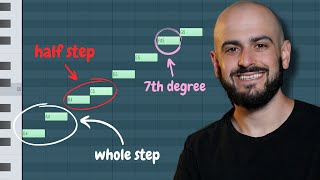
A whole step is two keyboard notes away; a half step is one note away. Example: five half steps from D equals one whole + two whole + half = two and a half steps.
Minor scale pattern: whole, half, whole, whole, half, whole, whole. Major scale pattern: whole, whole, half, whole, whole, whole, half. Major = brighter, minor = darker.
To build a triad: root note, then a fifth (7 half steps up), then either a minor third (3 half steps) or major third (4 half steps). Major chords sound brighter; minor chords sound darker.
In any scale, each degree has a chord. You can build chords by counting scale degrees (e.g., 1-3-5 for a triad). Adding a seventh degree creates a seventh chord, common in jazz/blues.
Most Western music uses 4/4 time: four beats per bar. Chord progressions are typically 4 or 8 bars long. Downbeats are the first beat of each bar.
Examples: 5-6-1-7 in minor = uplifting/dancy; 1-3-5-4 in minor = deep house vibe; 6-7-1-3 in minor = uplifting (used in 'Firestone').
Open voicing spreads out chord notes (e.g., moving the third up an octave). Inversions move the third or fifth down an octave for a smoother feel. Doubling notes (e.g., root or third) adds emphasis.
Every minor scale shares notes with a relative major scale (e.g., A minor and C major). To find relative major, go up three scale degrees from the minor tonic. Rooting a melody on the tonic (e.g., A in A minor) gives a serious feel; rooting on the relative major tonic (C) gives a brighter feel.
What is a melody?
A series of single notes played in succession to create a phrase that conveys emotion.
0:22
What is a chord?
Three or more notes played at the same time.
0:39
What is harmony?
When more than one line of music (e.g., melody and chords) play together simultaneously.
1:11
What is a scale?
A group of notes that sound good together, used to guide emotion in music.
3:32
What is the interval pattern for a minor scale?
Whole, half, whole, whole, half, whole, whole.
3:48
What is the interval pattern for a major scale?
Whole, whole, half, whole, whole, whole, half.
4:05
What is a triad?
A chord with three notes: root, third, and fifth.
9:00
What is the root note of a chord?
The bottom note of a chord.
8:00
How many half steps is a fifth from the root?
Seven half steps up from the root.
8:07
How many half steps is a minor third from the root?
Three half steps up from the root.
8:21
How many half steps is a major third from the root?
Four half steps up from the root.
8:32
What is the most common time signature in Western music?
4/4 time signature: four beats per bar.
12:34
How do you find the relative major of a minor scale?
The third degree of the minor scale.
20:46
How do you find the relative minor of a major scale?
The sixth degree of the major scale.
20:53
Scales as Emotional Guides
Explains that scales are groups of notes that sound good together and help target specific emotions, a foundational concept for all music creation.
3:32Building Triads and Seventh Chords
Provides a clear, step-by-step method for constructing chords using scale degrees, which is essential for creating chord progressions.
9:00Understanding 4/4 Time Signature
Demystifies musical time by explaining bars, beats, and downbeats, a critical skill for arranging chord progressions in any DAW.
12:34Open Voicing and Inversions
Shows how to make chord progressions sound more interesting by spreading out notes or moving them to different octaves, a practical production tip.
17:29Scale Relativity for Melodies
Introduces the concept of relative major/minor scales as a tool to shift the emotional tone of a melody, offering a clear starting point for beginners.
20:14[00:00] if you're a music producer this is the
[00:01] last music theory tutorial you will ever
[00:04] need we're going to cover the basics of
[00:05] Music Theory and everything you need to
[00:07] create really good chords and Melodies
[00:10] let's get started this is a
[00:14] note this is a
[00:22] melody or in other words a series of
[00:24] single notes played in succession to
[00:26] create a phrase that conveys emotion
[00:29] tells a story or forms the backbone of a
[00:31] song Here's a
[00:33] [Music]
[00:39] chord or three or more notes played at
[00:42] one time now here's a progression of
[00:44] [Music]
[00:54] chords now here's our chord progression
[00:56] playing simultaneously with our Melody
[01:11] and together they create Harmony Harmony
[01:15] is when more than one line of Music in
[01:18] this case our first line of music is our
[01:20] Melody our second line is our chords
[01:23] play together simultaneously so how do
[01:25] we get here or in other words how do we
[01:27] have a Melody with a bunch of notes that
[01:29] work together with these chords to form
[01:31] a harmony let's break down what's going
[01:33] on here so we have a better idea music
[01:36] theory is broken down into these pitches
[01:38] we call
[01:39] notes on our keyboard we have all these
[01:42] white notes these are the natural notes
[01:44] and they are labeled from
[01:45] [Music]
[01:50] a through G and then they repeat from a
[01:54] through G again until the end of the
[01:57] keyboard from a to to a is called an
[02:01] octave and that's the same for every
[02:03] other note so from E to e is also an
[02:07] octave octaves go down as well so from a
[02:11] to a is also an octave on our keyboard
[02:14] we also see this repeating pattern of
[02:16] black notes these notes represent the
[02:19] white keys so for example if we take
[02:21] this black note that's right above the C
[02:23] that's called C sharp however each black
[02:25] note has two names this black note also
[02:29] touches this B so it is a B flat here's
[02:32] another example we have this black note
[02:34] here it's up from the G so it is a G
[02:36] sharp and it's down from the a which
[02:39] makes it an A flat as well now that we
[02:41] covered pitches and notes we have to
[02:43] understand two types of movements
[02:45] throughout the keyboard one is whole
[02:47] step movements the other is half step
[02:49] movements for example let's look at this
[02:51] C note here one whole step from this
[02:55] C goes right here or in other words a
[02:59] whole step step is always going to be
[03:01] two keyboard notes away a half
[03:06] step is always going to be one Keyboard
[03:09] Note away here's a quiz for you if we
[03:11] take a d note let's place a note five
[03:14] half steps away try to pause this video
[03:16] and guess 5/ half steps away would be 1
[03:19] 2 3 4
[03:21] 5 right here another way to look at this
[03:24] distance is that it's one whole step two
[03:27] whole steps and a half so two and have
[03:30] whole steps now that we understand steps
[03:32] let's talk about scales scales help you
[03:34] strategically put notes together to form
[03:37] a desired emotion and a scale is just a
[03:39] group of notes that sound good together
[03:41] now there are two main scales that
[03:43] you're going to have to know and that's
[03:44] the minor scale and the major scale
[03:46] let's first make the minor scale we'll
[03:48] start on any note and then we add a
[03:50] whole step a half step whole whole half
[03:54] whole whole now we have the minor scale
[04:01] that alone sounds like a melody now
[04:03] let's make the major scale which is the
[04:05] other popular scale now for this scale
[04:06] you start on any note then you add a
[04:08] whole step whole half whole whole whole
[04:16] half now the words major and minor come
[04:20] from the quality that is generated from
[04:22] the notes within that scale for example
[04:24] the major scale generates a more
[04:26] positive or brighter tone and we can
[04:28] hear that just by flaring the scale like
[04:31] this and now here's the minor scale
[04:34] which generates a more serious
[04:37] [Music]
[04:40] tone hear
[04:42] that is that kind of cool now keep in
[04:44] mind when you know the formula to build
[04:46] a certain scale you can build that scale
[04:49] on any key for example this black note
[04:52] here is called an fshp if I wanted to
[04:54] build the minor scale within the key of
[04:56] f we would start there and build out our
[04:59] scale we start on the F and we go whole
[05:02] half ho ho half whole
[05:08] ho and now we have the Minor Scale based
[05:11] on the F or in other words the F minor
[05:15] [Music]
[05:17] scale now that's how to write a scale
[05:20] but how do you use a scale you use a
[05:23] scale by first picking a scale that will
[05:25] help guide you toward a specific emotion
[05:27] and then you limit yourself to only
[05:29] using the notes within that scale so for
[05:31] example if I want to write a melody for
[05:34] my horror movie score something dark
[05:37] I'll need to pick a scale that'll help
[05:39] guide me toward that emotion remember we
[05:41] said the minor scale carries a darker
[05:45] mood and now to make a Melody within
[05:47] this scale we can use any of these notes
[05:50] but we can't place any Melody notes on
[05:52] these blank spaces otherwise that's
[05:54] called stepping out of key stepping out
[05:56] of key does not sound natural let's make
[05:58] our Melody
[06:01] [Music]
[06:09] let's add a little bit of Reverb to it
[06:11] because we are producers after
[06:14] [Music]
[06:18] all that's pretty creepy but hold on a
[06:21] second you remember earlier we discussed
[06:23] the concept of octaves just because we
[06:25] wrote Our scale here doesn't mean we're
[06:27] stuck to these seven notes we can add
[06:29] some salt and pepper to our Melody by
[06:31] using different octaves to add more
[06:34] notes We'll add a couple notes up
[06:36] here then if you want to get a really
[06:38] creepy effect you scroll down to a
[06:40] really low
[06:43] octave and put one of
[06:45] [Music]
[06:51] them now the world of scales is pretty
[06:54] expansive there's the popular scales
[06:57] like the major and minor scale in
[06:58] western music but there's also the blue
[07:02] scale the pentatonic major
[07:06] scale there's even these seven weird
[07:08] things called modes one of which is
[07:10] called the lockran mode which is known
[07:12] for its uncanny unstable
[07:16] [Music]
[07:18] character and my favorite scale which is
[07:20] the harmonic minor
[07:24] scale and every scale or mode is
[07:27] designed to help you aim toward a
[07:29] specific spefic emotion story or mood
[07:31] for your music so when you're studying
[07:33] make sure to practice and learn the
[07:35] sound of each scale so you can really
[07:37] figure out which scale will help you
[07:39] develop your own unique sound now with
[07:41] that being said let's go ahead and shift
[07:43] our Focus onto chords scales help guide
[07:46] us toward a broad emotional Direction
[07:48] but chords help refine that emotion into
[07:51] something more specific now to build a
[07:53] chord you can pick any note to make it
[07:54] easy we'll start on this a we're going
[07:56] to make this a the bottom note of our
[07:58] chord which is a great place to start
[08:00] when you're practicing the bottom note
[08:02] of the chord is called the root note the
[08:04] second note you add is a
[08:07] fifth the fifth is always going to be
[08:09] seven half steps up from the root 1 2 3
[08:13] 4 5 6 7 the third note your chord
[08:17] gets is either the minor
[08:21] third which is three half steps up from
[08:25] the root or the major third
[08:32] major chords have a brighter tone to
[08:38] them then their chord
[08:41] sibling which are minor
[08:46] [Music]
[08:53] chords do you hear the difference
[09:00] now these chords are called Triads
[09:02] because they have three notes and the
[09:03] way you name a Triad is based on the
[09:05] root note and the position of that third
[09:08] so here our root node is a so we have an
[09:10] a major chord here our root node is also
[09:14] a but we have that minor third so we
[09:16] have an A minor chord now technically if
[09:18] we get rid of these fifths we still have
[09:21] a major third right here and a minor
[09:24] third right here and these are called
[09:26] intervals intervals are two notes played
[09:29] at once then when you add that third
[09:30] note they become that major Triad or
[09:35] that Minor triad now that you know how
[09:37] to make a chord you have to know how
[09:39] chords relate to scales as this will
[09:41] give you what you need to write chord
[09:43] progressions and that's where the fun
[09:45] stuff starts now how do chords relate to
[09:47] scales by the way I'm switching to logic
[09:49] here's the a minor scale again just to
[09:51] make things easy and in any given minor
[09:53] or major scale you have not only seven
[09:56] notes but you also have seven chords one
[10:00] chord for each note one note for each
[10:03] degree of the scale in every scale each
[10:06] degree of the scale is numbered from 1
[10:09] through seven so the chord on the first
[10:11] degree of that scale you could also call
[10:13] the one chord in that scale that's the
[10:15] same for the second third and so on and
[10:17] so forth with that being said another
[10:19] way to make chords is just to count the
[10:22] degrees of the scales instead of doing
[10:24] all this whole step and half step stuff
[10:26] for example if you're in the a minor
[10:28] scale and you you want to make the one
[10:30] chord which in other words is the tonic
[10:32] the first chord of the scale and then
[10:34] add your next note 3° up the scale and
[10:37] then you add your fifth which is 5° up
[10:41] the scale and there's our Triad now the
[10:44] other cool thing about using degrees to
[10:45] build your chords is that you can go a
[10:47] little farther into the chord system for
[10:49] example this is a
[10:50] Triad because it has three notes but you
[10:53] could also add a seventh degree to your
[10:55] Triads to make a seventh chord
[11:01] in other words you could take any chord
[11:03] in your scale add the third 3° up go 5
[11:06] Dees up from the root and add the fifth
[11:09] and then we can add the
[11:12] seventh and that's how we would build
[11:14] our seventh chords wherever we want in
[11:16] the scale now seventh chords give off a
[11:18] different energy than just basic Triads
[11:21] they used to be more common in genres
[11:23] like jazz and blues but now producers
[11:26] are using these chords in any genre
[11:29] to add that very Jazzy and bluesy flavor
[11:33] to anything now check this out here's a
[11:35] little dance beat I made with basic
[11:37] Triads I'm going to play it back and I'm
[11:39] going to add the sevenths to each chord
[11:41] and we'll see if you could hear the
[11:42] difference here's the Triad
[11:46] [Music]
[11:52] version I'll take each of these
[11:55] chords We'll add the seventh degree to
[11:58] each chord
[12:06] now that you understand notes scales
[12:08] steps and chords it's time we talk about
[12:10] chord progressions chord progressions
[12:12] are the emotional backbone of any song
[12:15] now in order to make chord progressions
[12:17] you have to understand two things the
[12:20] first thing is musical time like how
[12:23] music moves the second thing which is a
[12:25] little harder and that is how to string
[12:27] chords together in order to create the
[12:30] desired emotion that you're going for
[12:32] let's first discuss musical time most
[12:34] western music is written in a time
[12:36] signature called 44 this is the most
[12:39] common time signature in songwriting and
[12:41] understanding 44 is essential for
[12:43] writing core progressions the way to
[12:45] understand 44 is to look inside your
[12:48] software of choice I'm in logic and
[12:50] you'll notice these numbers across the
[12:52] arrangement grid these numbers are bars
[12:55] or measures you can call them and you'll
[12:56] notice there's four lines before every
[12:59] bar counts up a number those lines are
[13:02] Beats so 44 means four beats per bar
[13:06] play it with the metronome on so you
[13:07] could hear
[13:12] it if I increase the tempo our musical
[13:15] time will go faster but we will still be
[13:18] in
[13:21] 44 and that latter beat which happens on
[13:24] these thicker grid lines are called down
[13:26] beats this is when that fourth beat
[13:27] resets and it starts over again now
[13:29] because of this 44 time signature most
[13:32] core progressions that you make or here
[13:35] will be four bars long or some multiple
[13:39] of
[13:45] four another common length for chord
[13:48] progressions is an eight bar progression
[13:50] like
[13:57] this you notice it moves a a little
[14:02] slower eight bar progressions are still
[14:05] common in most music although slightly
[14:08] less common than the four bar
[14:09] progression now let's talk about the
[14:11] most important part of chord
[14:12] progressions which is writing chord
[14:14] progressions that actually sound good
[14:16] and that generate the right emotion for
[14:19] the song you're trying to create so to
[14:20] make a cord progression pick any scale
[14:22] I'm going to use the a minor scale
[14:24] remember that there are seven chords
[14:25] that we can choose from in the a minor
[14:28] scale we can use any octave our starting
[14:30] point is to make a progression with four
[14:32] chords that is four bars long you can
[14:34] obviously make your chords however long
[14:36] you want but this is a good starting
[14:42] point here's the first progression that
[14:44] I came up with it is the 1 7 4 and 6 in
[14:49] the a minor
[14:50] [Music]
[14:56] scale now when you're practicing and
[14:58] randomly piece pieing together different
[15:00] chord combinations you want to listen
[15:02] for the emotion that that chord
[15:04] progression is giving off because as you
[15:06] get better at this you will start to
[15:07] remember which chord combinations
[15:10] generate certain emotions here's a
[15:12] couple examples of go-to progressions
[15:13] that I like to use to generate certain
[15:15] emotions for this first one it's the 5 6
[15:18] 1 and 7 in the minor scale this gives me
[15:21] a very uplifting Vibe and it's good for
[15:23] Dancy kind of cheesy EDM music
[15:33] here's an eight bar progression I like
[15:34] to use in deep house songs because of
[15:36] its deep Vibe it's the
[15:39] 1354 in the minor
[15:56] scale here's a 7145 56 in the a minor
[16:00] scale this is the chord progression that
[16:01] Fred again used in adore you it's a fun
[16:05] group of chords to play around with in
[16:06] dance
[16:08] [Music]
[16:14] music here's one of the most popular
[16:16] chord progressions in all of music it's
[16:19] the
[16:20] 6713 in the minor scale and this is how
[16:23] it was used in kao's Firestone
[16:33] it's very uplifting happy progression
[16:35] now I can show you all day different
[16:37] chord progressions that I use to
[16:38] generate different emotions when I'm
[16:40] writing songs however there are still
[16:42] different things that you could do to
[16:43] your chord progressions to make them
[16:44] sound interesting as well for example
[16:47] downward moving progressions tend to
[16:49] give off more of a serious or sad tone
[16:55] [Music]
[16:59] upward progressions or upward movements
[17:02] will tend to give off a more uplifting
[17:04] or positive
[17:06] [Music]
[17:13] tone another thing with progressions is
[17:15] that you can move the notes and the
[17:17] chords around to get a smoother more
[17:19] satisfying sound when your chords are
[17:21] constructed from the root to the third
[17:24] to the fifth that is called root form or
[17:27] in other words their most basic form
[17:29] when all your chords are in the most
[17:30] basic form you might get a pretty basic
[17:32] sound at times so what you can do is you
[17:35] can select some notes in the chords for
[17:37] example we'll take the
[17:39] third you can spread out the third this
[17:42] is called open
[17:44] [Music]
[17:51] voicing here's the chords without open
[17:53] voicing
[17:56] [Music]
[18:02] same chord slightly different sound
[18:04] another thing you can do is double the
[18:05] notes in the chord that you think are
[18:07] more important or helping the song the
[18:09] most so what I like to do is take the
[18:13] base notes of my
[18:15] chords and double them and see if
[18:17] that'll work and I'll also maybe double
[18:19] a high
[18:21] [Music]
[18:26] note that's my chords with a doubled
[18:29] root and a doubled third there's also
[18:31] these things called inversions and
[18:33] that's when you can either take the
[18:34] third or the fifth or
[18:37] both and put it an octave down to give
[18:40] your progression a more tucked in linear
[18:43] feel a lot of times these inversions
[18:45] sound smoother and easier on the
[18:53] ears that's a pretty unique sound oh
[18:57] yeah one more thing don't forget
[18:58] rearticulate your chords at times to
[19:01] either add energy to them for a
[19:03] different part of the song or make them
[19:06] more suitable for the genre you're
[19:08] working in I like to make house music so
[19:10] I might do this a
[19:14] [Music]
[19:15] [Applause]
[19:20] lot I love these chords why didn't I
[19:24] ever use these chords before for this
[19:26] final section of the video I want to
[19:27] talk about Melodies melodies are the
[19:29] most creative part of Music Theory
[19:31] because there are infinite possibilities
[19:34] for how you can write melodies the
[19:36] reason for this is that every other part
[19:37] of Music Theory whether it's chords
[19:39] scales and every other thing we touched
[19:41] on in this video all those things have
[19:44] Frameworks like for example to make a
[19:46] chord you have a root a third and a
[19:48] fifth to make a minor scale there's a
[19:50] formula you follow to make that scale to
[19:52] make a major scale there's a formula you
[19:54] follow to make that scale Melodies are a
[19:56] little different because they are less
[19:58] def find which makes it a little bit
[20:00] more tricky but it also gives you
[20:03] infinite possibilities to really express
[20:07] yourself as a musical artist to write
[20:10] good Melodies I think you have to
[20:11] understand one thing and that is scale
[20:14] relativity so let's start here every
[20:16] minor scale shares the same notes with a
[20:21] relative major scale for example here
[20:24] are all of the notes in the a minor
[20:28] scale notice that all of the notes in
[20:30] the a minor scale are the white keys if
[20:34] we write out the c major scale again
[20:38] it's all the white keys this is because
[20:40] a minor and C major are relative scales
[20:43] to find the relative major scale of your
[20:46] minor scale that you're in you would go
[20:47] to the third degree of that scale and
[20:50] that is your relative major if you're in
[20:52] a major scale and you want to find the
[20:53] relative minor you would go to the sixth
[20:56] degree of that scale and that would be a
[20:58] relative minor so how do we take that
[21:00] information and apply it to building a
[21:03] Melody well with Melodies you can
[21:05] technically start anywhere you want and
[21:08] just go and see where the music takes
[21:10] [Music]
[21:18] you but I think that idea makes it
[21:20] tricky especially if you're a beginner
[21:22] because again you don't have that
[21:23] starting point so you're kind of just
[21:25] throwing darts at a dartboard hoping
[21:26] something will stick and when you get
[21:28] good you're going to do that a lot it'll
[21:30] work for you but when you're just
[21:31] starting out you can use music theory to
[21:34] help give you a starting point for
[21:35] writing your Melodies step one is you
[21:37] want to start with the set of chords it
[21:39] gives you some kind of emotional
[21:41] Foundation to build on I'm going to use
[21:43] the F major G major a minor back to G
[21:46] major they sound like
[21:48] [Music]
[21:54] this now this is a good neutral chord
[21:57] progression in the scale of a minor C
[22:00] major has a mix of minor and major
[22:02] chords so we can use our Melody to
[22:05] either enhance its major side or enhance
[22:08] its minor side with a Melody technically
[22:11] you can start on whichever note you want
[22:13] but here's what I recommend go to the
[22:15] tonic of the scale that you are in or
[22:18] the relative tonic so we're in a minor
[22:22] I'm just going to put a note on a and
[22:25] step one I always do this
[22:28] I write a repetitive note on the tonic
[22:31] and then I play it back to help
[22:33] calibrate my emotions and get myself in
[22:35] a musical
[22:36] [Music]
[22:44] mood so we kind of get like a serious
[22:46] Vibe all right so now I'm going to build
[22:49] My Melody based on this tonic note every
[22:53] Melody focuses on One Singular note no
[22:56] matter how many notes is included in
[22:58] that Melody that Melody is always
[23:00] focused on a singular note usually it's
[23:03] the tonic of the key signature that your
[23:05] song is in so I'm just going to move
[23:07] these notes
[23:08] [Music]
[23:10] around I'm going to keep the first note
[23:12] on that tonic and then we'll get
[23:14] [Music]
[23:25] This Isn't that cool you kind of get
[23:28] like that
[23:28] emphasized serious Vibe drilled into
[23:32] your head now watch this remember I said
[23:36] every Melody is going to have its focus
[23:39] note in this case it's that tonic that
[23:41] we started the melody on if I take this
[23:44] melody now I take this tonic and I put
[23:47] it on the relative major which is the C
[23:50] it's going to emphasize the major side
[23:52] of these chords but I also have to
[23:54] rewrite this
[23:55] melody in the major scale then we get
[24:00] [Music]
[24:07] this See's like more uplifting happy
[24:14] positive that is a big difference from
[24:17] the minor rooted
[24:19] [Music]
[24:27] Melody but that's how I relate Theory to
[24:30] writing Melodies Melodies are going to
[24:32] be a little bit trickier because they
[24:34] are less defined than everything else
[24:36] but if you use that as a starting point
[24:39] like rooting your Melody on a certain
[24:40] tonic I think you'll pick it up pretty
[24:43] quickly that is a video for you thanks
[24:44] so much for watching for more resources
[24:47] like coaching programs courses and
[24:49] soundpacks visit my website at the top
[24:51] of the description below and stay tuned
[24:53] for the next video
⚡ Saved you 0h 24m reading this? Transcribe any YouTube video for free — no signup needed.