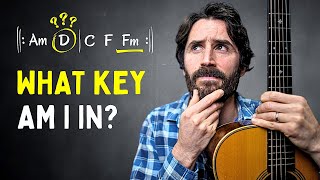

The First Chord Does NOT Determine Your Key
51sThis debunks a common songwriting myth with a quick musical demonstration that makes viewers immediately question their assumptions.
▶ Play Clip"Delivers a solid, practical system for finding your key, though the musical demonstrations stretch the runtime."
This video offers a practical system for songwriters to identify the key of their chord progressions. The instructor explains why key identification can be tricky, demonstrates how chord duration and melody influence perception, and introduces borrowed chords. Viewers learn how to find the tonal center and confidently choose chords that serve their song.
Songwriters often ask what key their chords are in, especially with progressions like Am, D, C, F, Fm, where the relationship isn't obvious.
A free PDF with chord progressions mapped out graphically is offered to help songwriters start new songs.
The mission is to identify the tonal center or home chord — the chord that tells you which key you're in. The first chord does not necessarily determine the key.
Starting on C, then Am, F, and returning to C makes C feel like home. Rearranging changes how the listener perceives the tonal center.
The diatonic chords in C major are C, D minor, E minor, F, G, A minor, B diminished. C, F, and A minor form a common progression regardless of order.
Holding a chord longer draws more attention to it. Spending more time on C makes it feel like home; giving it less time creates ambiguity.
The chord in sixth position of a major key is the relative minor. C major's relative minor is A minor, which can be used to shift to a darker mood.
Chords like G, C, and E minor belong to both G major and C major. Starting on G does not guarantee you're in G.
When chords are ambiguous, the melody is the biggest determining factor. Outlining G major scale vs C major scale changes the key feeling.
Borrowed chords come from outside the key and sound great but can confuse the listener and cause melody clashes.
In the progression Am, D, C, F, Fm, the D major (II) and F minor (iv) are borrowed from outside the key of C.
Melody must be adjusted to avoid clashes. For D major vs D minor, the only difference is F sharp vs F natural; using F sharp highlights the borrowed chord.
Listing all chords in the key helps identify which chords are outside the key and need melody adjustments. The PDF includes all 12 keys.
Two-chord progressions are powerful. When each chord comes from a different key, you get beautiful tension, but you still need a home chord.
Example: G to B flat — B flat is not in the key of G. Treat G as home and B flat as borrowed, adjusting melody between B natural and B flat.
Bounce to out-of-key chords and return to the tonal center to create tension and release, keeping songwriting fresh.
Finding the key of your song comes down to identifying the home chord, using duration and melody as guides, and recognizing borrowed chords that need careful handling. With practice, you gain full control over your chord choices.
What is the first step in finding the key of a chord progression?
Identify the home chord (tonal center).
02:17
Does the first chord of a progression always determine the key?
No, the first chord does not necessarily determine the key.
02:43
What are the seven diatonic chords in the key of C major?
C, D minor, E minor, F, G, A minor, B diminished.
04:22
What is the relative minor of C major?
A minor.
06:13
How can chord duration affect the perceived key?
Holding a chord longer draws more attention to it, making it feel like the tonal center.
04:51
What should you use when chords alone are ambiguous about the key?
The melody.
10:39
What are borrowed chords?
Chords that come from outside the current key, used for color but requiring melody adjustments.
12:04
In the example progression Am, D, C, F, Fm, which two chords are borrowed from outside the key of C?
D major and F minor.
12:32
What is the note difference between D major and D minor in the key of C?
D minor has F natural; D major has F sharp.
13:40
Why must the melody be adjusted when using borrowed chords?
To avoid clashes between the melody notes and the borrowed chord tones.
15:04
Identify the tonal center first
This is the core technique that simplifies key finding in any progression.
02:17Chord duration controls perceived key
A subtle but powerful tool songwriters can use to steer the listener's ear.
04:51Melody is the deciding factor
When chords are shared between keys, the melody unambiguously reveals the true key.
10:39Borrowed chords require melody adjustments
Understanding how borrowed chords work prevents clashes and expands creative options.
12:32Even with ambiguity, a tonal center is needed
Tension only works if the listener knows where home is.
17:12[00:17] delivering programs or giving feedback to our community members, this question to our community members, this question keeps coming up. What key am I in? How do these chords fit together? And if we take that set of chords I was just
[00:30] take that set of chords I was just playing, an A minor, a D, a C, an F, an F minor, it's not necessarily obvious how those chords fit together, or in fact if they come from the same key. So in this
[00:45] video, I want to talk about why this problem arises. But more importantly, different chord progressions and show you a system for identifying which key you're in so you can feel in control of your chord choices and make those
[00:58] your songs. And because I'll be going progressions, I've mapped them out graphically in a free PDF. And these chord progressions can really be the perfect kickstarter for a new song. So,
[01:11] link below. Now, I'm going to come back to that chord progression throughout different ways we can interpret it. But firstly, let's just look at why this problem arises in the first place and why it can be disruptive to your
[01:24] songwriting process. Firstly, you might be a songwriter who writes intuitively and puts together chords in ways that sound pleasing to the ear. And that's a comes to putting a melody to those chords, sometimes you can find a clash
[01:38] those situations, you might feel instinctively that the chords are to blame, but you're not sure how to fix the problem. Secondly, you might feel actually limits your ability to write complete songs or finish songs because
[01:52] you may not be sure what chord options are available to you and you may be stuck using the same three or four chords on a loop throughout the whole song. Thirdly, not knowing what key you're in or not having a clear sense of
[02:04] home can make the whole song feel floaty and a little lost. And it can also create a disconnect between these elements, the chords, the lyrics, and the melody. So, if you identify with any of these challenges, please let me know
[02:17] affects your songwriting. Okay. So, let's now look at the solution. Let's look at the process for identifying what key you're in, as well as identifying all the chord options you might have available to you once you have that
[02:30] information. The first thing that's really on our radar is identifying the home chord. With any set of chords, our mission is to identify the tonal center, the home chord, the chord that really tells us which key we're in. Now, one of
[02:43] the reasons it's not always obvious which chord the home chord is, is because the chord you start on doesn't necessarily determine the key you're in. We cannot assume the first chord in the sequence is the home chord. So, let me
[02:58] demonstrate that with a simple three chord progression. Three. Four. And
[03:18] C chord, we go to an A minor, we go to an F, and we come back to C. Everything about that tells us that C is the home chord. We start there, we come back there. It feels like home. It sounds like home. But what if we rearrange the
[03:34] order of those chords like this? Three, four, and four, and [music]
[03:55] simple rearrangement of the chords reveals a powerful tool that we have at our disposal, which is we get to choose when we bring the listeners back home and when we take them away from home, knowing that the home chord feels most
[04:09] stable and most resolved. So we can use this knowledge strategically to So if we lay out the chords in the key of C, you've got C, D minor, E minor, F,
[04:22] G, A minor, B diminished, back to C. The C, the F, and the A minor all come from regardless of the arrangement, we are going to be in the key of C. But starting on F in this second arrangement is slightly deceptive to the ear because
[04:37] starting away from home and then coming back home. Now, another really powerful tool we have to work with is chord duration. How long we hold each chord. And it turns out that chord duration can actually be a big factor in
[04:51] communicating what key we're in. Because the longer we hold a chord, the more attention we're drawing to it. So just looking at that three chord sequence, looking at that three chord sequence, [music]
[05:11] the same duration. If we really wanted to clearly and unambiguously let the listener know that C is the home chord and get them to feel that, we can chord and get them to feel that, we can just spend longer on the C chord.
[05:37] also give the home chord less air time and make it feel a little less stable. and make it feel a little less stable. >> [music]
[05:59] question. Am I in major or minor? Because in every key there is a relative major and a relative minor. If we look at the key of C, we have our home chord relative minor. And regardless of what key you're in, that chord in sixth
[06:13] position is the relative minor. And the home chord and the relative minor have this special relationship. And you often find in songwriting that these two chords are used interchangeably because they give us different moods. The C
[06:25] major is obviously very grounded. It's the home chord. It's stable. The minor chord is a darker, more melancholy version of the home chord. And so it's perfect for moments in the song where you don't want to go back or resolve to
[06:37] a stable feeling. you want to keep it a little more tense, a little darker perhaps. And this can be great if you're supporting certain kinds of lyrics or a certain kind of melody. And so now we can take this idea of chord duration and
[06:49] can take this idea of chord duration and use it to actually get the ear to pay more attention to the A minor, the relative minor, and less attention to the C chord. And this will shift the focus of the listener. This will get the
[07:02] listener feeling and thinking like we're actually in the minor key.
[07:21] which has a few more chords in it, we can apply this idea of chord durations to shift the focus of the listener. And really, this is something you are in control of as the songwriter. You get to choose how long you hold each chord to
[07:36] serve your intent for the song. So this is the original way I played it.
[07:56] the least amount of time was the C chord, the home chord. And that was done deliberately to try and create a little bit of ambiguity to not make it so obvious that that was the home chord. But there's also some other interesting
[08:09] chord choices in there which we'll look at in a minute. What if we shift the a lot longer? Let's see what happens there. there. [music]
[08:32] >> But we can also shift the focus to the A minor and really make that feel like the minor and really make that feel like the tonal center of this piece.
[08:55] minor after the F minor sends a very clear signal to the listener that we're thinking of A minor as the tonal center. Going back to the C chord after the F minor would send a different signal. It would then send the signal that we're
[09:08] thinking of C as the home chord. So again, you're in control of these choices that you're making with chords. You get to choose where you direct the listener's attention and you get to choose which chords you need to create a
[09:21] certain mood and to support the lyrics that you're writing. Now, what about keys that share the same chords? This scenario can get songwriters into a bit of a pickle because keys do share common chords amongst them. So if we look at
[09:34] chords amongst them. So if we look at this set of three chords, [music] G, C, E minor, we could be thinking in the key of G or its relative minor, E minor. And
[09:46] if we lay out the chords in the key of G, we have G, A minor, B minor, C, D, E minor, F sharp diminished. So if we're thinking in the key of G, we have the one chord, the four chord, and the six chord. But if we look at the key of C,
[09:58] chord. But if we look at the key of C, we have C, D minor, E minor, F, G, A minor, B diminished. So the C, the E minor, and the G all belong to the key of C as well. So here we have three chords that belong to two different
[10:12] keys. And the assumption is often made that we would be in the key of G simply because we're starting with the G chord. But as we've already talked about, that doesn't necessarily determine what key we're in. Lots of chord progressions
[10:26] don't start on the home chord. And in fact, if all of your songs start on the home chord, that can also start to sound a little bit predictable and a bit repetitive. So, we want to experiment with chord progressions where we're not
[10:39] three chords belong to two different keys, how do we determine what key we're in? Well, this is where melody comes into play. Sometimes the chords alone are not enough to tell us what key we're in. Sometimes we need the combination of
[10:54] melody and harmony to tell us what key we're in. So let's think in the key of G for a minute and outline the G major scale. [singing]
[11:07] chords we get [singing and music] [music] What if we think in terms of C? Now What if we think in terms of C? Now here's the C major scale. D. [singing]
[11:35] different feeling, but more importantly, it's a different key. And because we have these chords appearing in two different keys, we get to choose which key we want the song to be in. And the melody here is the big determining
[11:50] melody is usually the thing that will tell you most unambiguously which key you're actually in. Okay, so let's talk about borrowed chords because these are chords that a lot of songwriters love using because they sound great. They
[12:04] create chord sequences where all the chords aren't coming from the same key. But it introduces a problem and that is it can often lead to confusion for the songwriter. It can mess with the melody. It can sound like we've actually changed
[12:18] key in certain situations. And so these borrowed chords are beautiful to talk about how they actually function in the context of your chord progression. progression I played you is it actually has two borrowed chords in it. We have
[12:32] the A minor, the relative minor going to a D chord. That's a two major. That would naturally occur as a minor chord in the key of C. Then we resolve to [music] the home chord C. Then we go to the four chord, F. Then we get the four
[12:47] the four chord, F. Then we get the four minor. [music] imagine that I was writing a song starting with that chord progression. to write. It's how I like to write a lot of my songs, just playing around with
[13:02] different chord combinations and finding something that sounds interesting. The thing we need to be mindful of is the fact that those borrowed chords require fact that those borrowed chords require that we adjust the melody to avoid
[13:14] creating a melody, assuming all those chords are in the same key, and then finding the melody notes don't actually fit. So, let's shift the focus of the chord progression to A minor instead of C, and make A minor the tonal center. I
[13:27] C, and make A minor the tonal center. I need to start with a melody. [singing] That's nice. >> [music] >> Then I've got this D chord, which naturally would occur as a D minor, but
[13:40] borrowed chord. The only difference between the D major and the D minor is this note here. The D minor has a natural F. The D major has
[13:54] an [music] F sharp. So the D note and the A note stay the same regardless of whether we're playing the D major or the D minor. Which means if either of those two notes are the melody note, we're all good. So we could
[14:07] melody note, we're all good. So we could just go back to that A note. [singing]
[14:21] that really highlights and accentuates that borrowed chord, that D chord, I would use the F sharp. And I might use it down low. it down low. [singing]
[14:50] beautiful. They sound great, but the melody needs to be adjusted to accommodate them. Otherwise, we get clashes occurring. For example, that F clashes occurring. For example, that F minor. If I don't adjust the melody note
[15:04] minor. If I don't adjust the melody note D, [singing] whilst playing D. [singing] And that's the kind of clash that
[15:19] happens when we use these kinds of chords which sound great but are from outside of the key. So, if you've written a chord progression that you feel is using chords from outside of the key, it's important to identify that
[15:33] home chord, really understand where the tonal center of the song is. And often your ear is the best way of determining it. And then it's a great practice to write out all the chords in the key. And included in the free PDF, I've actually
[15:46] put all the chords in each of the 12 keys so you can reference that if you get lost and be able to see which chords belong to the key you're writing in. will also let you identify the chords that might be outside of the key. So in
[15:59] this case, if I'd have written A minor, D major, C major, F, F minor, laying out the chords in the key of C clearly shows me that the chords D and F minor are outside of the key. And therefore, I know that I need to adjust the melody
[16:14] some two chord progressions. And don't be fooled by the fact there's only two chords in these sequences. These two chord sequences are very powerful. They foundation of your entire song. And if we're going between two chords in the
[16:29] same key, it really doesn't pose much of a problem. But where it gets really interesting is when we have two chords and each chord is from a different key. So, here's a simple two chord progression.
[16:42] progression. [music]
[16:57] beautiful tension and a little bit of ambiguity because we're so expecting the C to go to the A minor, the relative minor. When we turn the relative minor into a major, we get this beautiful tussle back and forth between these two
[17:12] chords. And this ambiguity is fantastic to experiment with, but we still need to have a home chord. We still need to have a tonal center for our song. So you could think of this as being in the key of C,
[17:29] leaning on the sound of A major instead of A minor again to create that little element of surprise. But we're returning home every time we hit that C chord.
[18:09] We're starting on the G chord. We're establishing it as the tonal center. And then we're moving up a minor third to this B flat. Now, in the key of G, we would normally have a B minor. There is no B flat in this key. So, we're
[18:25] introducing a new bass note here, and we're placing a chord on that note. [music] But that's a really great sound that you hear in a really great sound that you hear in a lot of different music.
[18:38] Again, it's really important to look at G as the home chord with B flat as the borrow chord, which means we need to look at what melody shifts we would make between those two chords. And the real difference is going from a B note, a
[18:53] natural [music] B over a G chord to a B flat with the B flat chord. So if we had flat with the B flat chord. So if we had a melody that went
[19:05] [singing] [music] both of those chords and really outlines those two different chords. And once you
[19:17] get more comfortable using these borrowed chords, you can of course add borrowed chords, you can of course add additional chords to your sequence.
[19:40] the tonal center. But the next chord we hear is a C chord, a chord that isn't in the key of E. Then we go back to the E. Then we bounce to a different chord that's again not in the key of E and A minor. And we can do this
[19:54] back and forth, bouncing to new chords and trying out the sounds of those chords before returning back to our our home chord, our tonal center. And this us to create more tension and release. It keeps our songwriting alive and fresh
[20:10] and moving forward into new territories. And as you start experimenting with some hear any three or four chord sequences you come up with that really resonate with you. Please put them in the comments. I'd love to read them, play
[20:22] keep looking for new and interesting ways of putting musical ideas together. ways of putting musical ideas together. Happy songwriting. Bye.




⚡ Saved you 0h 20m reading this? Transcribe any YouTube video for free — no signup needed.