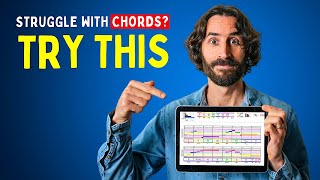

You Don’t Need an Instrument to Write Songs
45sTaps into the common fear of instrument limitations and offers a liberating solution, making viewers immediately curious.
▶ Play Clip"Delivers exactly what the title promises — a practical, hands-on demo of writing songs without an instrument, with only a mild product pitch."
Many songwriters struggle to get musical ideas out of their heads when they can't play an instrument. This video demonstrates Hookpad, a tool that lets you write and experiment with chord progressions, melodies, and lyrics entirely without a keyboard or guitar. The presenter walks through building a song from scratch, emphasizing chord choices, substitutions, and creative freedom.
Many songwriters have musical ideas stuck in their head but no way to play them. Hookpad offers a solution to write and experiment with chord progressions and melodies without a keyboard or guitar.
Hookpad, made by Hook Theory, lets songwriters construct songs one bar or section at a time and immediately hear back the musical choices they make.
At the top of the Hookpad page you set the key (e.g., C major) and tempo (120 BPM). The home chord C is placed first, and you can walk up the scale in chords.
Moving from one chord to another creates mood. In C major, C is the home chord; D minor, E minor, F major, G major, A minor, B diminished are all away chords. Roman numerals shown in Hookpad help when transposing.
Start with 1-4-1 (C-F-C), then replace the four chord with the three chord (E minor), and continue experimenting. You can build a sequence one bar at a time without playing any instrument.
Being away from home creates tension; returning home relieves it. If you return home too often, everything feels too stable. Aim to balance tension and resolution.
Create an eight-bar phrase for a verse, loop it, and listen carefully to each chord transition because each move takes the song in a new direction.
Substitute the six chord with a three, the five with a two, and try a four-to-diminished progression. Even though the diminished chord is hard to play, hearing it in Hookpad is valuable.
Use the panel on the right to add extensions (7ths, 9ths, 11ths, 13ths), susses, or change inversions (e.g., C major 7, F major 7, E minor over G). This gives endless chord combinations.
Use the 'borrow from' drop-down to take chords from other keys or modes. Choosing C minor turns the major four into a minor four, adding a new color.
The flat three chord (borrowed from minor) creates a beautiful modulating effect. In the demo, it works as a surprising first chord of the chorus, adding contrast.
Loop just four bars of the progression and focus on developing melodic/lyric ideas for that short section. This makes the writing process more manageable.
Not reaching for the guitar breaks familiar chord-shape habits, changes how you think about chords and song sections, and leaves your hands free and body relaxed.
Hookpad enables songwriters to write, hear, and refine complete songs using chord progressions and borrowed chords without ever touching an instrument. The process is experimental, creative, and accessible to anyone with musical ideas stuck in their head.
What is Hookpad?
A songwriting tool that lets you construct songs one bar or section at a time and hear back your musical choices.
00:26
How do you set the basic parameters in Hookpad?
Set the key and tempo at the top of the page.
00:53
What is the home chord in the key of C major?
C major.
02:20
What are away chords?
All other chords in the key besides the home chord.
02:20
What is the purpose of the Roman numerals in Hookpad?
They help when transposing to different keys.
02:46
What does substituting chords allow you to do?
Change the mood and direction of the song easily.
03:00
What creates tension and resolution in chord progressions?
Being away from the home chord creates tension; returning home resolves it.
04:42
Why is the diminished chord valuable even if hard to play?
It offers a unique sound that can enhance progressions, and Hookpad lets you hear it easily.
06:56
How do you add extensions and inversions in Hookpad?
Use the panel on the right to add susses, extensions like 9, 11, 13, and change inversions.
07:25
What is a borrowed chord?
A chord taken from outside the key, e.g., using the 'borrow from' menu to choose another key or mode.
08:39
What is the flat three chord and its effect?
A borrowed chord from a minor key that creates a beautiful modulating effect and contrast.
10:44
What technique did the presenter use to write lyrics?
Looping short four-bar sections and developing melodic/lyrical ideas over just that section.
14:08
What is the benefit of writing without an instrument?
It breaks familiar patterns, changes how you think about chords, and keeps your hands free and body relaxed.
17:18
Balance Tension and Resolution
Explains the core principle of effective chord progressions: staying away from home creates tension, and returning resolves it.
04:42Borrowed Chords Expand the Palette
Introduces a powerful songwriting technique—using chords from outside the key—that dramatically changes the mood.
08:39Flat Three for Contrast
Shows how a single borrowed chord can define a chorus and create a memorable, surprising sound.
10:44Short Loops for Lyrics
Suggests looping four-bar sections to make melody and lyric writing more focused and manageable.
14:08Breaking Physical Habits
Highlights the creative benefit of writing without an instrument: it forces new mental patterns and a relaxed state.
17:18[00:01] being held back by your limitations on an instrument, I have a solution for you. And I'm excited about this solution because this is a frustration we hear so many songwriters express. Songwriters who have amazing musical ideas stuck in
[00:13] their head, but no way to actually get them out. So, in this video, I want to show you that it is possible to write a song, experiment with chord progressions and melodies, all without sitting down at a keyboard or picking up the guitar.
[00:26] And the program we'll be using to achieve this is called Hookpad, made by using Hook Theory for some time now to help us deconstruct and analyze contemporary songs. But Hookpad is really aimed at songwriters and give
[00:39] songwriters a way to construct their songs one bar or one section at a time and importantly hear back the musical choices that they're making. So rather how we can start building a song from scratch using Hookpad. And I really want
[00:53] to focus on chord progressions and chord choices because chords are often the songwriting. So this is the hookpad window. And what you can see is that we window. And what you can see is that we can quickly set the key and the tempo at
[01:06] the top of the page. So this allows us to really just get some basic parameters in place. Let's stay in the key of C for the moment and we can keep the tempo at 120 BPM. Now, what I want to do is start with a chord progression and hear the
[01:19] difference when I start changing the order of these chords. So, let's begin by putting in the home chord, the C chord. And we can hear the piano playing back the sound of that chord. If we were to walk up the scale in chords, we could
[01:35] to walk up the scale in chords, we could do that.
[01:48] major scale harmonized in chords. But what we really want to do is start experimenting with chord progressions that could be the basis of a song. So I'm going to delete all of these
[02:07] progression, we need to be mindful of the fact that moving from one chord to another, creates a real mood. And the that is, will change the direction of the song and change the mood that we're
[02:20] creating. It's also important to note that whenever we're in a key, the home center. All the other chords we can think of as away chords. So, in the case
[02:32] of C major, C major is the home chord. D minor, E minor, F major, G major, A minor, B diminished. They're all away chords. I also like the fact that in Hookpad, it's showing the Roman numerals very clearly. And this becomes really
[02:46] useful when we're transposing to different keys. So rather than talk want to get used to talking about them as numbers. Now, we want to put a second chord in this sequence. And really, we could use any of these chords, but I'm
[03:00] going to start with the four chord. And then I'm going to go back to the one. So, if we want to hear what that sounds like,
[03:16] away to the four and back home. This four chord here, we can now start experimenting with and try some substitutions. So, if we take that chord out and replace it with, let's say, the three chord, the E minor,
[03:32] three chord, the E minor, what does that sound like? But what I want to do is now replace this one chord
[03:48] and go from the one to the three to the go from the one to the three to the four. that four we can extend playing around and thinking one bar at a
[04:00] time. But you can already see that without needing to be able to play any of these chords, I can simply start constructing a chord sequence and substituting chords in and out really easily. So, the next chord I might put
[04:13] easily. So, the next chord I might put in here is the A minor. And then we might go to, let's say, the two chord. and then back to the four chord. Now, keep in mind when we're creating chord progressions. When do we want to be back
[04:29] at home in the most stable position, the one chord, and when do we want to be one chord, and when do we want to be away from home? Because this current home briefly at the very beginning and then the rest of the time we're away.
[04:42] And anytime we're away, we're creating a little bit of tension. Going back home then relieves that tension. And we don't want to be back home too often with the often, everything just feels too stable and and too resolved. The only way we
[04:58] create some tension and then resolve that tension. So, let's hear what this that tension. So, let's hear what this sounds like as a looped section.
[05:29] minor and the F chord in those positions. So, let's replace them. Let's go from the A minor down to the five chord, the G.
[05:59] me. And if I was constructing a verse section, I might create this eight bar phrase and then put it on loop and start to come up with some melodic ideas or some lyrical ideas. But I really want to emphasize how important it is to listen
[06:14] back to the sequence that we're creating and listen to each of the transitions between the chords because each time we move to a new chord, it is taking the song in a different direction. It's taking us on a different sonic journey.
[06:27] For example, this six chord here, let's substitute that for another three. Then the five, we'll substitute for the two chord. And then maybe we'll do
[06:42] And then maybe we'll do a four going to the diminished. Now, the that is a difficult chord for a lot of people to play. So a lot of people avoid the diminished chord in their progressions just because they haven't
[06:56] ability to now hear the diminish chord and what it does is really valuable.
[07:25] around with this window over here where we can add some extensions or we can change the inversion and this will change the way the chord sounds. So this C chord here, let's make it a C major 7. This F chord here, we can make it an F
[07:39] This F chord here, we can make it an F major 7. The E minor, let's change the inversion to an E minor over G. And let's see how to an E minor over G. And let's see how that sounds.
[08:10] endless. Just playing around with this panel on the right here. Adding susses, panel on the right here. Adding susses, adding extensions of 9, 11,13s, changing the inversions. We can get so many different combinations of these chords.
[08:24] just click on one of these bars and change the chord, hear it played back, that feels so effortless and almost gifies the whole process. Okay, let's just wipe all of those and start again because so far we've just been hearing
[08:39] dietonic chords, chords within the key. And that's easy to do because they're arranged up here for you to see and click on. But what happens if we want to start experimenting with borrowed chords, chords from outside of the key?
[08:52] Well, let's start a new progression and see what happens when we take some chords from different modes or different keys. We'll start again with our C major. We'll go to our three minor.
[09:07] We'll go to our three minor. We'll go to our four major. And then We'll go to our four major. And then this chord here, I want to change that this chord here, I want to change that four chord to a four minor chord. So,
[09:19] I'm going to go over to this window here that says borrow from. And I'm going to go down to minor. And now you can see that the chords up here have changed so that it's now giving me the chords in the key of C minor rather than C major.
[09:33] So here we have a minor four instead of a a major 4. And now we can go back to the one. So let's just hear that.
[09:56] borrowed chord moves that we as songwriters love to experiment with. But if we go back to this borrow from drop-own menu, you can see that the modes are actually listed and clicking on any of these will change the options
[10:11] that become available to us up here. So this flat three for example
[10:26] Let's hear what that sounds like. [Music]
[10:44] and it creates this beautiful modulating effect before quickly snapping back to the home chord C. But if I was writing a song, I don't know if I'd want to use it in the same section as I'm hearing the minor 4. So, let's go back and take
[10:58] these out and pretend that this eight bars here is a verse that we're writing. So, I'm going to do this.
[11:19] And this might be a great moment to bring that flat three back. So, what if we were to make the flat three a surprising first chord of a new section? And maybe think of this as the chorus. So, here I'm now going to borrow from
[11:35] minor. I'm going to hit that flat three there. And I'm going to hit two of them in a row row before going back.
[11:53] with contrasting chords. And that flat three is really standing out now as a sound that's surprising but also creates a lot of contrast between the verse and this new section which we're calling the chorus.
[12:08] chorus. [Music]
[12:39] Okay, I like that chorus. I like the flat three, but I'm feeling that there's too much of the home chord in the verse. I want to try and save the home chord more for the chorus. So, I'm just going to jump back in and take out this one
[12:53] to jump back in and take out this one here now with the tempo and the groove. So, I'm going to go over to here and play
[13:08] actually tap tempo if you want, but I'm going to just ramp up the tempo a little bit. 135. I'm also going to go into the band tab. And the band tab really allows band tab. And the band tab really allows us to change some of the sounds or the
[13:23] way that the piano is being played, as well as add some other instruments. But right now, I'm just going to change the piano sound. And what I'm really looking activating the piano. So we can go with full chords.
[13:49] which is what we've been hearing. We can go with this. space for me to come up with some melodies. melodies. [Music]
[14:08] I want to go back in and start looping short sections of this chord progression and start developing some lyric ideas or some melody ideas. So, I'm going to go back over here and I'm going to shorten this loop to these four bars here. And
[14:23] this is really a great process if you're starting with a chord progression to go back and just focus on shorter sections within the progression and develop some melodic ideas just for that shorter section rather than having to try and do
[14:37] it over a longer section. Focusing on short four bar phrases I find much easier and more manageable. So, if we've got this section here,
[14:52] [Music] something you said something you said I can't get out of my head.
[15:11] from hearing that chord progression on loop. Something you said, something you just using those as placeholder lyrics for the moment. But I may actually want go to the second half. So, I'm going to open up the lyrics section here and just
[15:28] open up the lyrics section here and just take note of those lyrics. idea with a fourth line. And I and I don't want it to rhyme. I'm going to
[15:42] create an unrime fourth line is keeping me up at night. to mind. I don't really know what I'm trying to say yet. I'm just finding some lyrics and and really circling around a concept, but it's clearly a conversation
[15:58] between two people. So now what I can do is cycle those first four chords and is cycle those first four chords and then see what it feels like to jump to then see what it feels like to jump to the chorus. Let's try that.
[16:14] Something you said I can't get it out of my head. Something you said is keeping me up at night.
[16:34] Can't take it back. You can't take it back. You can't take it back. You can't take it back. If something you said is the setup line in the verse, maybe the chorus is expressing this kind
[16:49] of idea where once it's said, it's said. You can't take it back. And it might just be a repetition of that line. I'm also feeling that that flat three is giving us a little agitation. That particular chord choice that we can hear
[17:03] is destabilizing the whole progression. It feels like it's got some agitation in it. So the line and you can't take it back feels appropriate to the chord. Again, this is completely experimental on the fly, just responding to the chord
[17:18] progression, but it feels like an incredibly creative way to start building a song. And there's also something liberating about not reaching for the guitar, which is what I would normally do. I often go to chord moves
[17:30] or to shapes that I'm familiar with, that I know will work. Breaking that pattern and sitting in front of an application like this changes the way I'm thinking about chords. Now, it's changing the way I'm
[17:42] thinking about developing the sections. It's also changing the way I come up with lyrics and melodies because I'm sitting here with my hands free. My body feels relaxed. I'm not hunched over the instrument. So, even if you are
[17:55] still encourage you to experiment with this kind of writing. It really does material. And if you're interested in getting your hands on Hookpad and trying these features out for yourself, you'll find a discount link in the show notes.
[18:09] find a discount link in the show notes. Happy songwriting. Bye.


⚡ Saved you 0h 18m reading this? Transcribe any YouTube video for free — no signup needed.