
Start Options Trading with Small Capital?
46sHighlights the appealing idea that beginners can generate good returns with small capital, directly addressing a common aspiration.
▶ Play Clip"The title promises a 'Brahmastra' (ultimate weapon) but delivers a basic beginner's guide; solid content but not revolutionary."
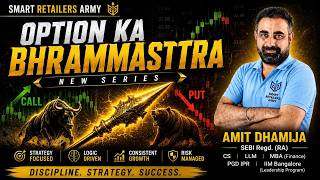
This video is the first episode of a new series on options trading, designed for absolute beginners. It explains the basic concepts of options, including call and put options, premiums, strike prices, and lot sizes, using relatable examples like property booking. The video also highlights common mistakes made by beginners and emphasizes the importance of risk management and discipline.
The video starts a new series on options trading from zero level, promising to explain concepts from basic to advanced in simple language with examples and option chain.
An option is a financial contract that gives you the right, but not the obligation, to buy or sell an asset. This means you can choose not to proceed if the trade is unfavorable.
Using a property booking analogy, the video illustrates how options work: paying a small premium (booking amount) gives you the right to profit if the asset value rises, but limits your loss to the premium if it falls.
Options offer limited loss and unlimited profit potential. They require small capital, provide leverage, and can be used for hedging.
If you have a bullish view (market will go up), you buy a call option. Example: Nifty spot at 24,000, buying a 24,000 call with premium ₹100, lot size 65, total investment ₹6,500.
If you have a bearish view (market will fall), you buy a put option. Example: Buying a 24,000 put with same premium and lot size, profit if Nifty falls below 24,000.
Premium is the price paid to buy the option. Strike price is the predetermined price at which the option can be exercised. In the examples, the strike price is 24,000.
Lot size is the fixed quantity for trading options (e.g., 65 for Nifty). Expiry date is when the option contract ends. Options with longer expiry have higher premiums due to higher risk.
Beginners often think options are quick money, trade without learning, get overconfident after initial profits, rely on social media tips, ignore risk management, and assume bigger positions mean guaranteed profits.
Before investing real money, learn and practice paper trading. Define your trading strategy, know entry and exit points, set stop losses, and maintain emotional control.
This introductory episode lays the foundation for options trading, covering essential concepts and warning against common pitfalls. The series promises to guide viewers from beginner to advanced levels with practical strategies.
What is an option in financial trading?
A financial contract that gives you the right, but not the obligation, to buy or sell an asset.
02:05
What is the main advantage of options trading?
Limited loss and unlimited profit potential.
05:12
When should you buy a call option?
When you have a bullish view, expecting the market to go up.
07:26
What is the strike price?
The predetermined price at which the option can be exercised.
11:47
What is the lot size for Nifty options as mentioned in the video?
65 units.
12:46
Why do options with longer expiry have higher premiums?
Because the seller has higher risk, giving you more opportunity to profit.
13:13
What is a common mistake beginners make in options trading?
Trading without proper learning and relying on social media tips.
13:58
What is the maximum loss when buying an option?
The premium paid.
08:20
Definition of an Option
Provides a clear, foundational definition that is crucial for beginners.
02:05Property Booking Analogy
Uses a relatable real-world example to explain complex options concepts.
03:31Limited Loss, Unlimited Profit
Highlights the key risk-reward characteristic of options.
05:12Common Beginner Mistakes
Lists actionable pitfalls to avoid, valuable for new traders.
13:58Learn Before Earning
Emphasizes the importance of education and paper trading before risking real money.
17:07[00:02] wrong bet, you will not know where to exit and there will be a huge loss of your capital, how the option is valued and how we can use the option. That means you have to keep in mind
[00:15] when to buy the call option. So what will happen if the market falls? What should I do? Either I what is strike ? What are the biggest mistakes made by strike price ? Those who are beginners. Small capital
[00:28] can also generate good returns and it is not necessary that you invest big capital and earn huge profits. You are very welcome friends. Friends, we are going to start a new series for you in which
[00:42] we will talk about options trading from the zero level, that is, even if someone does not know about options, then starting from there we will explain the concepts till the advanced level and along with that we will tell you the most important thing that
[01:00] very meaningful for you and the biggest thing is that it will be and the biggest thing is that it will be explained in simple language i.e. the simplest possible language, it will be so easy to understand that you will also
[01:13] enjoy understanding it because we will use examples and will use option chain. We will use examples and will use option chain. We will
[01:27] talk about basic units. That is, what is the basic concept of options trading? What is a call option? What is a put option? What is premium? What is the strike price? What mistakes do beginners make when buying options? That
[01:40] is the most important aspect. And more importantly, what do successful traders do in options trading ? So today we will discuss all these things in a small module. So let me start today's
[01:52] chapter and in this, friends, first I would like to show you a disclaimer which is a requirement because I am a SEBI registered research analyst. Now friends, first of all let us understand the definition of what is an option? Only then will we be
[02:05] able to understand option trading. So if you can see here in the definition part, this is a financial contract, friends. In which you get a right i.e. you get a right. But you don't have any obligation. That means you do not have the responsibility to do
[02:18] that work. That means you have made a contract with someone. If then you should move ahead in that contract. But if you feel that brother, if I proceed further in this contract, I will incur loss, then
[02:32] So this is the benefit. That is why you must have heard its name and understood it just by hearing the name. Option This is an empty option. There is no obligation. So that is why now the trading of their options is called option trading. What are the
[02:47] things that are there in Nifty, like in the context of stock market, Nifty, Bank Nifty, Reliance, HDFC Bank, which are stocks. There are many stocks in which futures and options are available. So trading in options takes place within it.
[03:01] A. Commodities, gold, silver, crude oil, [nasal sound] Then currencies, i.e. USD IAR, i.e. dollar and currencies, i.e. USD IAR, i.e. dollar and rupee pair, Great British Pound and rupee
[03:16] pair like that and crypto currencies. So now option trading takes place within all this. After this, now I will talk about the example. Now you can understand from the example how the option is valued and how we can use the option.
[03:31] Now take the example of property booking. Suppose a builder launched a project. He priced that flat at ₹50 lakh for a two bedroom flat. He told you that
[03:49] So you made the booking by paying ₹50,000. Now made the booking by paying ₹50,000. Now you gave that ₹50,000 and the project became a huge hit and was sold out overnight and its value
[04:04] suddenly increased to ₹55 lakh. So now you have paid a premium of ₹00, so you have the option that brother, now its value is ₹55 lakh, so I can earn some money from it. If you want, you can book profit and exit from there and if you
[04:18] want, you can also continue to hold it there. So there you have the option that if it is going in your favor then you will do the exercise. But if something happens overnight that his flats are not sold. Rather the builder reduced the price.
[04:31] He thought that I had launched it at the wrong rate and now he started selling it for ₹45 lakh, what will you do? You will let that ₹0000 go. You will not make any further payment. Because otherwise you are already incurring a loss of Rs 5 lakh on the very first day. So
[04:44] this is what options are, you have the option to amount and you can buy it. If you see it going in your favor, then you continue it. You make profit there. But at the same time, if you are incurring
[04:59] loss, that is, if that thing goes against you, then you suffer a limited loss there. That means if you know how to earn, you can earn even Rs 5 lakh. You can also earn Rs 10 lakh. In the context of a property example, right? But if there is a loss, then
[05:12] So this was just an example to share with you guys. Its biggest main advantage is that the losses incurred are limited. But the profit that is made is unlimited.
[05:26] So the main feature of this is why people trade it in options, the first point is its capital requirement, as we discussed, you can enter with a small amount,
[05:39] you can take a big position with a small amount, leverage now because in these assets in which it is traded, you can get big profit there, you can get big profit there, hence you get the use of this leverage there.
[05:53] Second and third thing, you can also use options for hedging. can also use options for hedging. How can hazing be done? For example, if you have taken a big position in the market and you have taken a bullish position, then
[06:06] for example, you that concept also now. So you can buy put option there and your put option works as hedging somewhere or the other.
[06:23] we have also taken an example of lower capital. If the stock is worth ₹100 and you are buying only 100 quantity, then your buying will be for ₹10,000. 100 * 100 But if you buy the option for ₹5 and the lot size is 100 then 5 * 100,
[06:40] you will be able to take a position worth ₹10,000 for just ₹500. That means there will be a loss in that case, if the price of this option goes below ₹100, then your loss will be only ₹ 500 because you would not want to exercise that option, but if the
[06:55] price goes above ₹100 and becomes favourable, then the value of your option will increase, but your loss will be limited to only ₹500, but it is also important to keep in mind that when we were talking about leverage, leverage works on both sides, small capital
[07:10] can also generate good returns and it is not necessary that by investing big capital you will earn big profits. There may also be a big loss. Therefore, there are many rules which are very important to understand. Now let us talk about if your view is bullish then you have to
[07:26] buy call option. That means you have to keep in mind when to buy the call option. So if you are having a bullish view. If you feel that the market will go up, you feel that the market will go up, you will buy a call option. Now let us
[07:38] take one example. Suppose the current spot price of Nifty is 24,000 and your view is that Nifty will go up, then what action will you take? You would like to buy the call of ₹24,000. How much premium will you pay? Let
[07:52] us talk for example. But you will pay a premium of ₹100 per unit. exchange fixes a lot size. It is not that you can trade a quantity. They have fixed the lot size. Currently, what is going on is 65 units. That means, in
[08:07] a way, you can understand that you are buying 65 shares there. You are taking 65 quantity. So 65 quantity you are buying is priced at ₹100 per unit. So priced at ₹100 per unit. So you will buy one lot of ₹6500. That means, now
[08:20] if you buy this one lot, then the maximum loss you can incur in this call will be ₹6500. But if the market goes upwards, then if we talk about the same scenario, let us first talk about scenario A below. If it goes up, let us
[08:34] take the example of 25300. How much is the market doing right now? We discussed 24000 and in the example we see that Nifty went up by 300 points. What this means is that if it goes up by 300 points,
[08:47] your value will also increase and it will go beyond the minimum of about 300 points. It's 100 now. Now since that 300 thing is already in the money, that is, it has gone up by that much, then its value will be 300 plus and you will minus that value, suppose
[09:05] its value has gone down by 320. How much did you take? 100, you made a profit of ₹220. At the same time, if Nifty goes down below 24,000, then your option value will be lost and suppose if you hold till the last day, then your entire money of Rs
[09:20] 6500 can be lost. But your maximum loss is capped at ₹6500. Whereas when you are earning, if you have the benefit of even 200 points, then you are getting more than ₹13,000 there. So this concept will be clear to you here
[09:36] that if we have to call buy during the bullish time, then in which scenario you are getting profit. In which scenario are you incurring loss? Exactly the opposite of that. If in this example our view is that the market is going to fall. So
[09:50] what will happen if the market falls? What should I do? Or I would think about selling some things like index futures. I have another option. I have less capital so I will try to buy the put there.
[10:04] Because what is my view? The market is about to fall. So I buy a put option. I buy a put at ₹24,000. I took the same price as an example that the unit is ₹100. The lot size is 65 units. Total investment is ₹6500. So
[10:20] suppose Nifty falls by 300 points then I will make profit there. Because 300 points have already fallen below ₹24,000. That means the approximate value of this option will be above ₹300. That means I made a profit of more than ₹200. Because 300 has already been done.
[10:34] My costing was Rs 100. The balance difference became 200 points. So it will be more than Rs 200 because some premium might still be there. So I got more benefit than that. Let us take an example that I held till the last day
[10:47] and the closing was at 300 only, so I got only 200 points. So I made a profit of ₹13,000 here. Plus my capital also came back. And if the market goes up then my maximum loss is only ₹6500. Because then its value will become
[11:02] zero. So this was the basic difference between call and put. Now we discussed call and put. Now we discussed that the option which we are purchasing, its price was ₹100 per unit at the time of purchase but when it was increasing, at the
[11:16] time of call as well as at the time of put, we took the example that it would be around 300 or 320. This value per unit is what we call premium. That is called premium. This is the price we pay to buy that option.
[11:32] We call that premium. Ok? Now which strike did we buy? What is a strike? Strike Price: We used a strike price of 24,000 for both the options, both for the call and the put. That options, both for the call and the put. That
[11:47] You can buy it for Rs 24,000 or even for Rs 24.50. [nasal sound] So which in these examples we had made a purchase worth Rs 24,000. So that 24,000 becomes the strike
[12:02] price. Now, let us assume the at the money level, that is, the current spot level of Nifty is 24,000, then the at the money option will be called 24,000 and most of the people prefer to buy that. If you buy options at a slightly higher price, then the
[12:16] market will first have to come to that price. That means the spot will come there and then it will be profitable for you. So those are called different strike prices. So we call that the strike price. So, in the example we just took, the strike price of call
[12:31] and put is 24,000, so the strike price is 24,000. Ok? We just discussed the lot size 24,000. Ok? We just discussed the lot size of 65, so 65 is our lot size. That is, what quantity was earlier 75, so 75 was a
[12:46] quantity was earlier 75, so 75 was a lot size of Nifty. So this is ours and the expiry date is the day on which the validity of the option ends. That validity is called the expiry date. Options with different expiry dates are available. It
[13:01] also happens near week. Like Nifty expires every Tuesday. Nifty expires every Tuesday. So this week also you will get the option of Tuesday. Also available next Tuesday. The further you go, that is, the
[13:13] more time passes, the more the value of the premium will increase. Because the person selling the option has a increase. Because the person selling the option has a higher risk for you. There are more chances of making profits if higher risk for you. There are more chances of making profits if that option comes in your favor in the long term.
[13:27] that option comes in your favor in the long term. because his risk is higher. You have more opportunity to earn and as your opportunity increases, the risk of the person who sold you that option will increase. So
[13:42] that is why the premium will increase more for the one with farther expiry. Most people buy options with near expiry dates because they have a slightly lower premium. because they have a slightly lower premium.
[13:58] biggest mistakes that beginners make. What are the biggest mistakes that beginners make. First of all, many people think that these are some options of quick risk. This means that money can be earned very quickly.
[14:11] jump in without learning. I understand a little bit. Understand the basics, open a demat trading account and start trading and that is where the mistake happens because without proper knowledge, they incur losses. The second mistake is
[14:27] that they think that big profits are common and will come for beginners. Many times what happens is that the market actually gives profit in the beginning because now what happens is that it is a fluke, in the beginning you started and there is a
[14:41] profit and you might have made profit, you will get overconfident, if you get overconfident then you will try to take more wrong trades, sometimes suppose the first trade is successful, second, third, fourth, sometimes you will make a wrong bet
[14:57] and on the day when you make a wrong bet, at that time you do not know how to correct it, where to exit and there you will suffer a huge loss of your capital. There will be a huge loss in your capital and you will have to understand that when there is a huge
[15:12] market itself is not doing well. This doesn't suit me. But if this is done like a business , with proper risk management , only then you get proper profits. For those of you beginners, the biggest mistake is
[15:27] that on the basis of social media tips, they think that if I get some tips from somewhere, I can trade on that basis. Be it social media or learning is not involved anywhere. You are just making a copy of the thing.
[15:41] Started working on it without testing it. is no need for risk management. Some beginners also think like this and they do not know that brother, risk also has to be managed or it is necessary to manage risk.
[15:56] So how to do it? These are some questions which beginners, i.e. those who start trading in the initial time, do not have answers to and somewhere or the other they cause them huge losses. They also feel that the bigger the
[16:10] position, the bigger the guaranteed profit. it's not like that at all. the bigger the guaranteed profit. it's not like that at all. In the beginning, one should try to take more steps with caution. It is
[16:26] management discipline: So your risk management should be there and the discipline should also be proper. Only then will you act properly. That means you should know where to place the stop loss. How to exit. So it is very important to know those things.
[16:39] So it is very important to know those things. What should your position sizing be like ? In what quantity should you start buying? It We will talk about all these topics in detail in the upcoming videos. But here
[16:53] I am telling you a glimpse because you are joining at the beginner level, if you are starting then these are small basic aspects which it is important to tell you from the beginning. know this from the beginning then it will always remain in your mind. That is why
[17:07] always remain in your mind. That is why it is being covered here. You also have to learn a little before earning real money. That means, whenever you invest actual money in the market, before that, take proper learning and by doing paper trading etc., that is, a little bit of
[17:22] what is called dummy, you take a pen paper and write it down, if you feel that you have learnt, then you write that if I had invested real money in this trade, now you will start getting some experience, you will have to give some time,
[17:40] along with learning, your trading strategy should be properly defined. You should know where I have to enter and where I have to exit. And the first point is how to manage the risk in it.
[17:53] That means where is your stop loss? So if your trade is not going in your favor, then that if it does not go in my favor then at what point it is very important for me to exit. Because if you decide it in advance then decision making
[18:08] cannot happen later. If you haven't already decided. If you are working after deciding in advance then there must be a stop loss in your system. Risk management will be proper and you will be able to work properly according to your strategy. And
[18:21] important because many times the market behaves in such a way that we are not able to control our emotions and the operator moves the
[18:33] market in such a way that you get confused and that is where the beginners make mistakes. If you have understood the market properly and have learned it, then maintaining emotional control is very
[18:48] important. If your knowledge is good and risk management is proper, then your emotions will automatically be controlled. The problem arises when you create a setup and do not execute it properly,
[19:00] there is a lot of problem in emotional control. So friends, these were some basics which we have tried to summarize for you in a crisp way.
[19:13] fun. We will share a lot of knowledge with you people. As different videos come in, you'll get enhancements. Intermediate intermediate level, we will go to the advanced level, we will go to case studies.
[19:28] After that we will discuss strategies with you. So much better. So there's a lot of great content coming your way. Please do subscribe to our channel. content coming your way. Please do subscribe to our channel.
⚡ Saved you 0h 19m reading this? Transcribe any YouTube video for free — no signup needed.