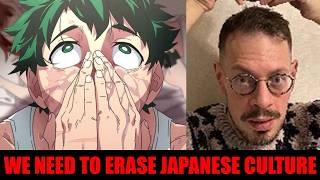

Localizer Admits to Erasing Japanese Culture
45sThe direct accusation and evidence of cultural erasure sparks immediate controversy and debate.
▶ Play Clip"The title promises a controversial take, and the video delivers exactly that, albeit with a heavy bias."
The video discusses a controversy in the localization of Japanese media, where English localizers are accused of erasing Japanese culture. The creator argues that localizers are replacing cultural elements like Gyaru culture with Western equivalents, and even removing Christmas references. The video criticizes the localizers' actions and calls for accountability.
The video claims that localizers are actively defending the butchering of Japanese culture, citing a Square Enix localization director as an example.
A presentation showed localizers forcing Japanese creators to change meanings for international audiences, with the goal of 'creating authenticity.'
Localizers proposed replacing Gyaru culture with Gen Z culture to convey a character's personality, which the creator calls cultural erasure.
The creator argues that this is not translation but 'being a parasite,' changing everything about the original work.
Neil Broderick, a Square Enix localization director, is highlighted for defending the changing of Japanese jokes to English jokes.
Localizers are defending the removal of Christmas references, claiming it carries religious connotations in English.
The creator notes that many anime characters say 'Merry Christmas' in Japanese, but English subtitles often change it to 'Happy Holidays.'
The video claims that DEI initiatives are being incorporated into Japanese companies, leading to increased censorship in anime and manga.
The creator criticizes big creators for staying silent on the issue, suggesting it shows a lack of care for otaku culture.
The creator argues that similar actions against other cultures would lead to cancellations, but it's accepted for Japanese culture.
What solution did localizers propose for introducing Gyaru characters?
To replace Gyaru culture with Gen Z culture to make characters more relatable.
01:14
Who is the Square Enix localization director mentioned in the video?
Neil Broderick, a Square Enix localization director.
02:26
What change do English subtitles often make regarding Christmas greetings?
They change 'Merry Christmas' to 'Happy Holidays' in English subtitles.
04:22
What Western ideology is being incorporated into Japanese companies?
DEI (Diversity, Equity, and Inclusion) initiatives.
05:41
What example is given of increased censorship in anime?
The removal of panty shots and increased censorship.
06:09
Localizers propose replacing Gyaru culture with Gen Z
This is the core controversial proposal that sparked the entire debate.
01:14Neil Broderick's history of defending localization changes
Shows a pattern of behavior, not an isolated incident.
02:26Localizers defend removing Christmas references
Highlights the extent of cultural alteration being justified.
03:28DEI infiltrating Japanese companies
Connects the localization issue to broader ideological trends.
05:41Double standards in cultural sensitivity
Points out that similar actions against other cultures would be met with cancellation.
08:44[00:00] Japanese culture is inferior to Gen Z culture. This is what translators are currently saying. Don't believe me? Here's some proof. This is the Square Enix localization director outright defending the butchering of Japanese culture,
[00:15] the cultural erasure of Dairu, and also wanting to change it to be more in line with Gen Z. They are actively defending the butchering of Japanese culture.
[00:28] This is so insane to me that he is not the only translator that I have actually seen defending what is going on with Umemusume. For those that need a brief rundown, basically all the drama stems from this image and multiple other images that followed after it,
[00:43] but there was basically a presentation showcasing how localizers are forcing the Japanese to change the meaning of different things to be able to present it outside of Japan. And so their main objective, like they try to label it, is creating authenticity.
[00:59] And the challenges that these English localizers presented was that unlike otaku culture, gyru culture is not very well known outside of Japan, which we know is bullshit, because my dress-up darling instantly disproves this, because Marin is a gyru.
[01:14] Then the solution they came to to basically kind of introduce this type of game or characters that might be a gyru is without a parallel culture whose expressions could convey Daikaku Hilios' chaotic, fun personality, Gen Z.
[01:30] So, let me outline this for you. Basically, what these localizers, and what, for instance, the Square Enix localization director is even defending, is that they are wanting to completely eradicate Garou culture, Japanese culture,
[01:45] to be able to make it dumbed down and completely different from what it actually is supposed to be, to present it to people in the West. It is entirely changing the character's entire personality, the writing, everything, to be able to localize it.
[01:57] That is, that's not translation anymore. That is literally being a parasite and changing everything about something and making it entirely different. It's like you are hijacking the story and saying you know the story better than the actual writers or creators of the story.
[02:12] And I want to bet you all the Japanese that are probably a part of this are completely unaware of what these localizers are really doing to the work they are probably just like oh they not going to screw us over They not probably doing anything malicious But in reality they are Because I want to point something out
[02:26] This guy right here, Neil Broderick, he's been in the industry working with localization for years. I think two decades at this point. And it's legitimately insane. This is the same individual, by the way, that was defending the actual butchering of changing jokes from Japanese to English.
[02:42] Like, for instance, eradicating jokes that are in Japanese and basically changing them to some form of English jokes. And he was trying to justify, like, oh, people will never understand Japanese jokes, so I need to make them English jokes. This man defends that. So, this person that is in an active, powerful role at one of the biggest companies for gaming is defending butchering of Japanese culture.
[03:01] Oh, and by the way, this guy, he's not Asian, okay? He's not Asian. I mean, yeah, look, I will, I will resume it. This man is not Asian, okay? So, for those that are thinking that this man might be Japanese, no. He does not look Japanese to me.
[03:15] I'm going to be blunt. But, um, get back into the main point. The main big point here is that we have translators actively even defending the removal of Christmas. Which, saying that literally in their words. This is a translator saying this.
[03:28] Textbook way to localize. Merry Christmas carries a religious condemnation as opposed to the consumerism nature of it in Japan. Japanese do not celebrate Christmas. They only enjoy the merry, happy holiday folks conveys the difference in nature of...
[03:46] Every single one of these people need to be removed and fired,
[04:01] and never allowed to work in gaming, translations, and localization ever again. What do you mean? What do you mean you're trying to justify your political agenda to remove Christmas because it's connected to religion? What do you mean you're justifying that?
[04:22] When there is a compilation of anime characters saying Merry Christmas online, you can find them. I mean, Toradora does it, for example. Obviously, Kisses, as you showed. There is a lot of characters over the years when there Christmas episodes will straight up say Merry Christmas But for some reason in the English subtitles it always Happy Holidays Completely not translating it right Everybody sees it Everybody knows
[04:48] And this obviously has happened to Uma Musume. So it is legitimately jaw-dropping just how masked off these parasites actually are. That they are justifying the cultural erasure of Japanese itself and basically trying to push in their political agendas,
[05:05] their agendas against religion and everything to basically justify the butchering of certain writing. It is so insane to me that someone like Neil here even has a job. Like I'm
[05:17] actually, actually horrified that this person has been working on Japanese games, translating them into English for over like two decades. This is insane. This man should not have a job. I'm going to be completely blunt. Hate me if you
[05:29] want. Now there's a lot of people that would like to comment about this and say the solution here is to learn Japanese. Well, that's not even a safe bet anymore. Flashpoint here even points out that that's not even necessarily the
[05:41] proper option anymore, because Japan is also being educated on DEI. Yeah, this is real, by the way. You literally have DEI already being incorporated into multiple
[05:53] Japanese companies, because, go figure, you have a lot of entities from the West that have been pushing these ideologies that have infiltrated into these Japanese companies. There is a reason why there is an increase of censorship of anime and manga on the cutting room floor.
[06:09] For instance, why you don't see no pantsy shots anymore within anime, this is a very obvious and very easy to tell example. The reason why you don't see stuff like that as much anymore is because a lot of the people, these leftists and people from, you know, politically captured individuals that have ruined Hollywood and gaming for the last 15 years,
[06:25] they are now infiltrating into Japanese anime and manga culture and fundamentally trying to change it to be less icky and more inclusive. And that is absolutely insane. Because you want to know, I want to point something out once again.
[06:37] I want to show the panel slide. Nothing says inclusivity than removing a culture and changing it to something else. How are people supposed to even know what Garu culture is when you completely erase it?
[06:51] Obviously you don't. Fun fact, you won't. So, I'm just going to tell you. there a lot of people that are not talking about this situation right now a lot of big creators I want you to pay attention Pay attention to who not speaking out about this
[07:07] Pay attention to who is defending this. It's very important. It shows you who actually cares about otaku culture, who cares about umemusume, who cares about anime and manga. I'm not expecting every single individual to make a video or talk about the situation,
[07:21] but there is a lot of big creators that are being somewhat, or actually actively silent about the situation that have talked about umamuseme before. And I think that is very strange, because obviously, why wouldn't you talk about something that's one of the biggest topics of umamuseme in a while?
[07:37] Especially something as huge as this. This is not small. This is not a small situation. This is the most blatant cultural erasure of Japanese culture I think we've seen localization to date. It is really bad. This is legitimately a terrible thing that they have done,
[07:53] and this is the biggest load of gun, I think, against localization that we've gotten in years. Like, this is really horrible. And I cannot believe how many people, active translators and localizers,
[08:05] I have seen trying to defend this. It is so gross, and the fact that there's even people, by the way, that will outright be happy that Japanese culture is erased to be against me as well, says enough.
[08:17] Says enough. Also, all the flags, who would guess? um anyways I think that in general we even have like separate English speakers are trying to say the Japanese are wrong like you literally see someone right here say that guy that can speak
[08:30] Japanese is being said oh you know uh it doesn't matter and all that just learn Japanese and it's like they're incapable of understanding that even the Japanese are getting upset with the localization but they still think that it's okay like I want to point something out if it was any other culture
[08:44] specifically from the Middle East that was done with Japan I was happy in Japan right now I promise you, there will be a lot of cancellations. This person right here, Neil, would not have a job. If he said this about certain people within the Middle East,
[08:57] if he said certain things about South Africa or Africa in general or Mexico or anything, I'm willing to bet you this person would be canceled. He would not have a job by tomorrow.
[09:09] But for some reason, it's okay to do this to the Japanese. Very strange. It is incredibly strange how it works like that. Anyway, you all have a fantastic day or night, wherever you live. be safe, stay healthy, Chidi out.




⚡ Saved you 0h 09m reading this? Transcribe any YouTube video for free — no signup needed.