
Why White Light Fails in Double Slit
45sIt challenges a common expectation and reveals a surprising physics insight about white light.
▶ Play Clip"Title is modest and accurate; video delivers a clear explanation of the double-slit experiment without overpromising."
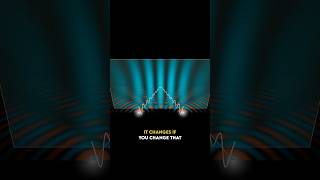
This video explains the physics behind the double-slit experiment, a classic demonstration of wave interference. It uses a physical demo and simplified models to show how light waves from two slits create patterns of bright and dark spots on a wall, and why this pattern is only visible with monochromatic light.
A laser is shot through two thin slits, producing multiple bright and dark spots on a wall, not just two bright spots.
If slits are thin enough, each can be modeled as a source of a pure sine wave with a single wavelength.
At the center of the wall, distances to both slits are equal, so waves are in phase, creating constructive interference and a bright spot.
At a point where the path difference is half a wavelength, waves cancel out (peaks align with troughs), producing a dark spot.
Opening a second slit can make a point on the wall darker despite more total light being let through, due to wave cancellation.
The interference pattern changes with wavelength; white light (a mix of wavelengths) washes out the pattern, explaining why it wasn't noticed until 1800.
The double-slit experiment reveals the wave nature of light through interference, but the effect is only observable with monochromatic light, which is why it wasn't discovered until the 19th century.
What pattern appears on a wall when a laser is shot through two thin slits?
Multiple bright and dark spots (interference pattern).
00:01
How can each slit be modeled if thin enough?
As a source of a pure sine wave with a single wavelength.
00:16
What causes a bright spot at the center of the wall?
Equal distances to both slits make waves in phase, causing constructive interference.
00:30
What happens at a point where the path difference is half a wavelength?
Waves cancel out (destructive interference), creating a dark spot.
00:44
Why does opening a second slit make a point darker?
Because waves from the two slits can cancel each other out, reducing intensity despite more total light.
01:09
Why is the interference pattern not visible with white light?
White light is a mix of many wavelengths, which washes out the pattern.
01:23
Double-slit demo
Shows the actual physical phenomenon of interference with a laser.
00:01Destructive interference
Explains the counterintuitive cancellation of waves.
00:44Darkening with more light
Highlights the surprising result of adding a second slit.
01:09Wavelength dependence
Explains why the effect wasn't observed until 1800.
01:23[00:01] slit interference but have you ever thought about exactly what it is why it you don't observe it with things like white light right here is a nice physical demo at the Exploratorium where a laser is shot through two very thin
[00:16] slits and down on a wall several feet away from the slits you don't just see two bright spots you see many let's go ahead and pull up a simplified what's happening if the slits are thin enough you can model each one of them as
[00:30] what follows for the light coming from each one to be a pure sine wave with just a single wavelength think about a point on the middle of the wall behind these slits the distance to each slit is the same so those two waves are in Phase
[00:44] with each other and this gives what we call constructive interference so you see a bright spot but if you shift a little to the side to a point such that the distance to one slit is exactly half a wavelength longer than the distance to
[00:56] the other then the two waves actually cancel out the peaks of one line up with the troughs of the other the net result is nothing and you get a dark spot when you think about it this actually feels really bizarre at first because it means
[01:09] when you go from having one slit to opening a second this specific point of the wall will actually become darker despite more Total light being let consequence of the fact that you're adding waves similarly if you scan from
[01:23] left to right these waves fall in and out of sync with each other giving oscillations between bright and dark spots but but that specific pattern depends a lot on the specific wavelength of the light it changes if you change
[01:35] that wavelength this is why if you tried it with white light which is a mix of a lot of different pure sine waves you wouldn't see the distinctive pattern other which is why it took until 1800 for anyone to notice this phenomenon


⚡ Saved you 0h 01m reading this? Transcribe any YouTube video for free — no signup needed.