
AI Summary
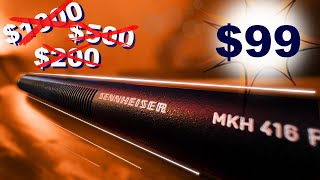
In this video, Rick McIver compares the Sennheiser MKH-416, a $1000 microphone beloved by voice actors, with the PG-181, a $99 budget alternative. He highlights the 416's strengths and the PG-181's surprising similarity in sound quality, while also discussing technical differences like pickup patterns and self-noise. The video aims to help viewers decide if the 416 is worth ten times the price.
Chapters
The Sennheiser MKH-416 is a popular microphone among voice actors due to its quiet operation, good articulation, and noise rejection. However, it costs around $1000.
The PG-181, a $99 microphone, is introduced as a potential budget alternative that sounds surprisingly close to the 416.
The 416 has a hypercardioid pickup pattern, while the PG-181 is cardioid. The PG-181 has a bit more self-noise, but it can be reduced with downward expansion.
The PG-181 is very sensitive to plosives, so a pop filter is essential. The Hawkings pop filter is recommended.
The video concludes by asking viewers to decide if the 416 is worth 10 times more than the PG-181, suggesting the budget option is a great entry-level choice.
Mentioned in this Video
Study Flashcards (8)
What is the $1000 microphone compared in the video?
easy
Click to reveal answer
What is the $1000 microphone compared in the video?
The Sennheiser MKH-416.
00:17
What is the $99 microphone that is compared to the 416?
easy
Click to reveal answer
What is the $99 microphone that is compared to the 416?
The PG-181.
01:46
What pickup pattern does the Sennheiser 416 have?
medium
Click to reveal answer
What pickup pattern does the Sennheiser 416 have?
Hypercardioid.
03:02
What pickup pattern does the PG-181 have?
medium
Click to reveal answer
What pickup pattern does the PG-181 have?
Cardioid.
03:02
What is the main downside of the PG-181's self-noise?
medium
Click to reveal answer
What is the main downside of the PG-181's self-noise?
It has a bit of self-noise, but it can be removed with downward expansion.
03:31
What gain level is the PG-181 set to in the comparison?
hard
Click to reveal answer
What gain level is the PG-181 set to in the comparison?
41 dB.
03:46
What gain level is the Sennheiser 416 set to in the comparison?
hard
Click to reveal answer
What gain level is the Sennheiser 416 set to in the comparison?
34 dB.
03:46
What is a notable issue with the PG-181?
medium
Click to reveal answer
What is a notable issue with the PG-181?
It is extremely plosive sensitive, requiring a pop filter.
04:00
💡 Key Takeaways
416's strengths
Clearly outlines the key features that make the 416 a professional standard, setting the benchmark for comparison.
00:48PG-181's value proposition
Directly states the core claim of the video: the PG-181 offers a similar sound at a tenth of the price, making it a compelling budget option.
02:32Managing self-noise
Provides a practical solution (downward expansion) for a common issue with budget microphones, making the PG-181 more viable.
03:31Plosive management
Highlights the importance of pop filters and offers a specific solution (Hawkins) to a significant problem with the PG-181.
04:00Full Transcript
[00:03] with the 416 at a tenth of the price hey villagers welcome back to the voiceover village i'm rick mciver your voiceover village i'm rick mciver your village idiot and welcome to my booth we
[00:17] are going to be doing a microphone comparison today and you'll notice right here to my left or your right or this is the 416 the sennheiser mkh-416 voice actors really love this microphone and i gotta tell you it's a
[00:33] good one i love it too and i use it a lot some of the reasons that people love this microphone is a it's very very quiet it has great articulation when you get right up on it and you use that proximity effect you don't lose that
[00:48] high end that crispness it does pretty good job at noise rejection for the room so a lot of voice actors travel with this microphone however the downside of the 416 it's a thousand dollars it's an
[01:01] expensive mic throughout the years on youtube there are a lot of people that youtube there are a lot of people that make videos that say this is the 416 killer and they're never quite there this
[01:14] microphone is one of those that's just about untouchable however i have found a microphone and i've used it several times to great effect that is
[01:26] much much cheaper than the 416. i give you [Music]
[01:46] bunch of condenser microphones that were a hundred dollars and under this is the a hundred dollars and under this is the pg-181 it was a shocker i liked this one a lot a lot more than i thought i would mostly because i had never really ever
[02:01] heard of it it came out of nowhere i was thinking the at2020 would be the money this one did really really well i liked it so much i kind of compared it sonically
[02:16] against the 416. so i thought why not make a video comparing the two this is the sennheiser 416 it's a thousand dollars it's a fantastic microphone you're not gonna find another mic that beats it
[02:32] however for a tenth of the price at a hundred dollars you can get the pg-181 it sounds pretty darn close i mean there's been a lot of videos lately about orders of magnitude right is this
[02:47] sound ten times better than this one does as a voice actor if you're starting out and you need that 416 sound take a look at the pg-181 just like the 416 it is a small
[03:02] diaphragm condenser microphone small diaphragm condenser microphone this one is hypercardioid meaning it has a really tight pickup pattern this one just plain cardioid it's bigger but you still get the good sound and if
[03:17] you're in a fairly well treated space that hyper cardioid pattern is not as another thing is the self noise now the 416 super low self noise the pg-181 has
[03:31] a bit of self noise but if you can use a little bit of downward expansion you can get rid of that now for this video i have no effects on both of these microphones are perfectly dry they are gain balanced uh the sennheiser sits at
[03:46] 34 db and this one is at 41 db so you need a little more oomph with the pg-181 which is probably why it has a little bit more self-noise another thing to know is that the pg-181 is incredibly
[04:00] plosive sensitive which is why i have the hawkins sitting right in front of it if i don't have the hawkin on it i have to use that tone whenever i say hawk and whenever i don't ha if i don't have the hawking on it
[04:13] it plosives really really easy so you really have to be careful with peas and bees it's just insane but you throw the hawking on there and it's not a problem anymore pizza is perfect with pineapple on top it's fine
[04:26] the hook pop filter here also works really well for the 416. put it up here in a link if you want to watch it but these two are the best pop filters i have by far i don't know listen back and forth i've been
[04:39] switching back and forth between these two microphones as this video has gone on my question to you really is is this worth 10 times more is the sound that comes out of the 416 10 times
[04:52] better than the sound that comes out of the pg-181 i'll let you decide if you're looking for an entry-level microphone and you want something that sounds a little bit smoother than the 181 i'll put a link to
[05:05] the video i made all about the 100 condenser microphones right there thanks for watching i appreciate it until next time