
AI Bot Made $170 in 24 Hours on Hyperliquid
40sShows immediate profit results which hooks viewers interested in passive income or trading bots.
▶ Play Clip"Delivers a working bot but acknowledges it may not stay profitable; title slightly oversells the 'crushing' aspect."
The video demonstrates a fully automated trading system built using GPT-5.6 Sol for Hyperliquid, which runs 24/7 and has reportedly generated $170 in profit. The creator explains the simple setup: market scanning every 5 minutes, a scoring system to evaluate trade opportunities, automated execution with leverage, and continuous data collection for strategy improvement.
The creator built a fully automated trading model using AI cloud code GPT-5.6 Sol Fable, focusing on Hyperliquid. The bot has been running for 24 hours and is up $170.
The automated system checks balance, scans the market, scores IDs from scan setup, opens trades if parameters pass, spawns a manager to track and close trades when conditions are met. Scanning happens every 5 minutes.
The scoring system includes: +20 for high liquidity (easy to trade), +15 for longer moves (e.g., 1.6% decline over 48 checks), +15 for RSI balance within range (e.g., 47.3 in 42-65 range), +20 for trend width (fast average below slow average), up to 18 points for weak bounce (brief rise during fall), and additional points for small bounce. Total score 96, threshold 70 to enter trade.
The bot uses 300x leverage on a small account, effectively trading with $3,000 position size for learning purposes. Example trade: short on SpaceX at 139, closed at 137.88 after 43 minutes, net profit $24 after trading cost.
The system records trade results and data, then feeds back to GPT-5.6 to adjust and improve the strategy over time. This is the key advantage: continuous evolution based on collected data.
The creator switches to Sol model (max or extra high) to analyze 20+ hours of data. The model suggested minor non-strategy changes like emergency exits and improved data labeling, but no major strategy changes.
Initially tried a continuous loop inside GPT-5.6 but it consumed too many tokens. Switched to running the code autonomously via TeamViewer, reducing latency and improving efficiency.
The portfolio has $389 profit over the last week, mostly from a separate fully automated Bitcoin setup. The creator warns the current bot may revert to the mean but finds the system promising for learning.
The automated trading system built with GPT-5.6 shows early profitability but is not guaranteed to continue. The real value lies in the ability to collect data and iteratively improve the strategy, making it a valuable learning tool for hobbyist algo traders.
What is the minimum score required to enter a trade in this bot?
70
03:22
What does a score of +20 indicate in the scoring system?
High liquidity making the trade easy to execute.
02:08
How often does the system scan the market?
Every 5 minutes.
01:55
What leverage is used on the small account?
300x.
03:35
How does the bot improve its strategy over time?
It records trade data and results, then feeds them to GPT-5.6 for analysis and adjustments.
04:35
What was the net profit on the SpaceX trade example?
$24 after trading cost.
04:22
Why did the creator switch from running the bot inside GPT-5.6 to using TeamViewer?
The loop inside GPT-5.6 consumed too many tokens, so running autonomously via TeamViewer saved tokens and reduced latency.
08:44
What did the Sol Max model recommend for improvement after analysis?
Non-strategy changes like emergency exits and improved data labeling; no major strategy changes.
06:26
Scoring System Details
Provides a concrete breakdown of how the bot evaluates trades, including specific point values and conditions.
02:08Data-Driven Strategy Evolution
Explains the key advantage of the system: continuous improvement through data collection and AI analysis.
04:35Moving to Autonomous Operation
Shares a practical lesson: running code autonomously via TeamViewer is more efficient than keeping a loop inside GPT-5.6.
08:44Portfolio Profit and Caveat
Shows overall profitability but warns of potential mean reversion, keeping expectations realistic.
10:48[00:02] I've been playing around with a lot of stuff using AI cloud code GPT 5.6 Sol Fable to try to improve my trading. So, today we're going to focus on hyper
[00:14] liquid and I built a fully automated model that has been really doing really video on it. You can see we started video on it. You can see we started yesterday and we are already up $170
[00:27] with a really nice graph here. Uh if we select this to 7 days, you can kind of see our spike in the right corner here. But basically, what we have been doing But basically, what we have been doing is we have created a 24/7 running uh
[00:42] automated trading system built by GPT 5.6 Sol. So, today I was wanted to go a bit into the details because I think this exact setup is a really good starting point. Uh of course, we have this set up like a
[00:56] evolutionary mode. So, we always collect the data and we try to improve it over time. But uh I wanted to go through how I set this up today. So, I prepared a slide just to go through it so we can kind of explain a bit more about it. So,
[01:11] I think we just going to get into that and get started. Okay, so I just created this slide we can kind of have a look at. So, yeah, the autumn AI automated trading system we built. It's not AI automated, it's built by AI to be
[01:24] automated. That's the difference. Uh but basically, this is the setup. It's super easy and I created this because I want to learn from it. So, of course, we check how much we have in our balance. We scan the market. We score the IDs
[01:39] that the market finds from our scan setup. If we pass our parameters, we will open that trade. We will spawn a manager that keeps track on the trade and it will close it when we meet our, yeah, parameters. And that's
[01:55] basically it. So, we scan this every 5 minutes in the background. So, this is minutes in the background. So, this is not using any tokens. It's just written in code. But, basically here are the score system we have. You can see
[02:08] we have plus 20 if it's has is it easy to trade. This basically means that there is a lot of liquidity. If the system has seen like a longer move, so for example, in our example, SpaceX declined 1.6%
[02:22] declined 1.6% across 48 price checks. That is plus 15. And you can see we have plus 15 for the RSI balance. This kind of measures the have a range on that. So, you can see SpaceX was 47.3 inside inside our range
[02:39] SpaceX was 47.3 inside inside our range from 42 to 65. We have a plus 20 score if the trend is wider. So, like a fast average below uh the slow average means prices are broadly falling. And here you can see we have a gap of .6%
[02:54] or .60% I guess. Uh also, we have something called a weak bounce. So, for this we got 18 points. Uh a bounce is a brief rise during a fall. So, basically when a stock is down and we get like a bounce. And we only
[03:09] got a weak bounce here, right? Over the last three checks, we got 18 score for that. And also, we have something called a small bounce. We also check this. So, a small bounce. We also check this. So, we ended up with like a 96, but we need
[03:22] 70 or more to actually enter a trade. So, that was like 26 above. So, this means that we think this is a good place to enter. Okay? So, also, we are running leverage on this because I want to run this on a
[03:35] small account. This is of course much more risky, but uh this is like a training setup I have, learning setup. So, we do like 300 times 10. So, we actually do the position with $3,000. Uh just because
[03:50] yeah, I just wanted to do that because I think it's more interesting and it kind of reflects a bit more if you had like a big balance to trade with. Uh this is the example, so you can see we had like $385 free and we have one
[04:05] slot open. We got 96 points as described. We actually went short on this at 139 and you can see we keep watching this every 5 seconds for 43 minutes we actually run this trade and we closed this at the 137.88
[04:22] and we closed this at the 137.88 and we made a $25 profit. The trading and we made a $25 profit. The trading cost was uh 50 cents, so we netted 24 on this SpaceX trade. So, another thing that this has and this
[04:35] was kind of our main thing about this setup is that we want to trade, record the results and the data and then we're going to go back to GPT-5.6 now and try to adjust and improve the strategy over time based on the more
[04:51] data we collect and this is what I think is the big advantage using this setup because we can collect all the data we use, we can still try to evolve the uh not keeping it stale. And that is what
[05:04] has been running for like 24 hours and we haven't tried to improve it yet, so I'm going to head over to GPT-5.6 now, look at all the data we have collected and try to improve this now. So, let's just head over to our Codex. I'm going
[05:19] to switch the model now. I'm going to switch to solve. Uh let's just do extra high for this. And uh or maybe we can just do max for this. I haven't tried that too much. I'm not going to do ultra because it's just
[05:31] way too much. So, I'm going to try solve max for this setup. So, I'm just going to put in my prompt here and let's try to improve our strategy based on the results that we have gotten so far. So, I'm just going to keep the
[05:44] prompt pretty It's We have been running for 20 plus hours now. Let's look at the the strategy to make it more robust and profitable, analyze the data, and run calculations to look for meaningful improvements in the strategy. That is
[05:57] just going to keep it running in the background here, and I'll come back if we have something. It might not be that we see any improvements, but if we do, I'm going to run it for a while, and I'm going to come back to see if we have any
[06:14] kind of improvement. Basically, we most likely would not see this in this video because I plan to post this today, but let's see what we can find here in the data we have collected and if we can make any
[06:26] meaningful improvements. Okay, so after Sol Max ran for 25 minutes, we got our response and didn't really want to make any big changes here. So, basically, we're going to keep the 5-minute stale check. We're going to implement all the
[06:41] other improvements. These are basically not strategy-related, some emergency exit setups, and stuff like that. So, I'm just going to implement these. Okay, so you can see we
[06:55] implemented all the changes. We ran 44 pad tests passed. Perfect. And now you can see we have set up a system that the data collection will let us test those data collection will let us test those properly over the next 200-plus trades.
[07:08] So, we kind of improved the way we collect the data, and this means that we can even improve this more the longer we run it. So, this is something I wanted to implement because when I set this up initially, I didn't really focus too
[07:21] can run, but now we should have had that up and running, and hopefully we can improve this over time. We also did some small changes to the the the labeling here. So, now we have
[07:35] some more clustering here. So, we have like a hard limit on we can only do one cluster at a time, but uh might actually go back on that. You can see we have a hard limit of one live position per economic correlation cluster. We might
[07:50] goes. But uh this is actually how I am using But uh this is actually how I am using um yeah, this case GPT 5.5 5.6 soul to
[08:03] experiment with this. So, basically uh you can see we did quite well here. I think we If you look at the trade history, we just exited with a $23 win here, but uh you will see some up and downs.
[08:17] Uh so, this is not something that is like perfect or anything. It's not going to be like a steady curve up to the right, but uh the main idea for me is to learn from this. So, uh this is something I want to use
[08:30] to actually learn more about uh AI agentic trading. I even tried in the beginning to set this up to always run in uh like a loop in uh GPT 5.6 to
[08:44] monitor every single, but it kind of ate up all my tokens. So, to do that, I guess I can show you the the prompt I used to run this in like a the prompt I used to run this in like a loop inside GPT 5.6 to always keep
[08:59] So, this is what I used yesterday. You can see I do the {slash} goal, create a can see I do the {slash} goal, create a Kanban list as follows. One, sleep 180 seconds. This is just to give it some time in between. Two, we're going to
[09:12] check a live position status. And three, scan for new trades. It's supposed to be new. And be active. Four, enter if any trades found. Five, restart this goal. So, this kept me going in like a continuous loop, but after a while it
[09:27] just started eating up my tokens, so I decided to ditch that and move everything over to a TeamViewer session that runs this code 100% autonomous. So, that was much better, actually. And we kind of reduced our latency a bit and
[09:41] stuff like that. So, I'm really glad I did that. This is something I learned by just experimenting. Couldn't really find anything about it online. So, all of AI genetic trading setups I've been using, basically I've been just
[09:55] experimenting, always using the models to run map-based database tests to kind of confirm what we hopefully want to achieve. Sometimes it doesn't work out.
[10:07] Sometimes it does work out. This is something I also do over on Polymarket. So, yesterday I did an experiment in the France-Spain game to try to do some France-Spain game to try to do some automated bet placing using AI.
[10:22] Didn't go that well. I think we actually lost some money, but we had some good trades here. You can see we have a 50 plus here, 49 here. So, we actually did sell out. We built some ladders and stuff like that to enter. But, I think
[10:35] we overall we lost some money, I think on this. Here you can see we have this ladder that kind of entry points and stuff like that. So, that was pretty cool.
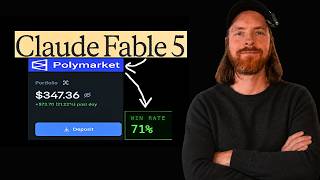
[10:48] Yeah, don't mind the balance too much. I did like a deposit if you have seen any of my previous videos. But, if you look at the portfolio the last week, we have been doing really well. 389
[11:00] in profit. And this is mostly my fully automated uh 5-minute up and down Bitcoin setup that I've been doing before on this. So, basically this video was just to show you and share a bit about my
[11:15] like this. And when I find something that produces these kind of results, I always want to double down on it. interesting to see how well this run over the next few days.
[11:30] I promise I will make an update video on this if you are interested. This might go to zero and we lose everything we have gained so far. Most likely we going to go down again or I call it reverse to
[11:43] the mean here because I think this is kind of over performing a bit, but I'm So, and with kind of the improved data could be really interesting. So, hopefully this gave you some inspiration
[11:57] hopefully this gave you some inspiration to start exploring a bit using these new models that are so strong at coding and math and stuff like that and that is exactly the use case we want to extract some value from.
[12:09] And so far, super happy with this one and I might make a video explaining a bit more how to start from scratch on this over the place, but hopefully it gave you some inspiration to start
[12:24] experimenting as I am doing at the moment because of these models, because of this technology, no one really has like a good perfect way to use this yet. I'm sure if you have like tons of experience in
[12:37] quant algo trading, you can use this better than me, but me as a hobbyist over a long time, I found this very helpful at least with kind of the the these setups.
[12:51] So, yeah, that was all I wanted to share today. Hope you enjoyed it. Give this see more and hopefully I see you again in a few days. Have a nice day.


⚡ Saved you 0h 13m reading this? Transcribe any YouTube video for free — no signup needed.