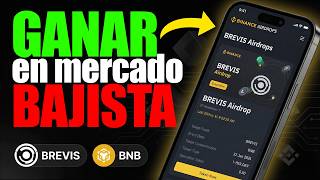

How I Make Money When Crypto Falls
60sReveals a practical strategy for earning in bear markets, appealing to crypto enthusiasts seeking alternative income.
▶ Play Clip"The title promises a method to earn money while crypto falls, but the content is a thinly veiled promotion for Binance's Launchpool with minimal actionable advice."
The video presents a strategy for earning passive income during bearish or sideways crypto markets by holding BNB on Binance's Launchpool. The host explains how users receive free tokens from new projects, using the Brevis project as an example, and discusses the technology behind it. The tutorial covers the step-by-step process of buying BNB, subscribing to Simple Earn, and managing the received tokens.
The host explains that during market downturns, they accumulate cryptocurrencies like Bitcoin, Ethereum, and BNB, and use Binance's Launchpool to earn free tokens from new projects.
By holding BNB locked in Binance Simple Earn, users receive tokens from new projects listed on Launchpool, which can be sold or held for potential growth.
The Brevis project uses Zero Knowledge technology to improve blockchain scalability, achieving 71% faster block times and lower costs.
Step-by-step guide: buy BNB on Binance spot market, then go to 'Earn' > 'Simple Earn' > subscribe with flexible term to start earning rewards.
Newly launched tokens often drop in price due to selling pressure from free recipients and future token unlocks, so the host suggests selling or even shorting them.
How does Binance's Launchpool allow users to earn free cryptocurrencies?
By holding BNB in Binance's Simple Earn (flexible) product, users receive tokens from new projects listed on Launchpool.
01:09
What is the core innovation of Zero Knowledge technology in blockchain scalability?
Zero Knowledge (ZK) technology generates proofs off-chain, allowing validators to approve batches of transactions instead of verifying each one individually, improving speed and reducing cost.
04:02
What is the minimum amount of BNB needed to start earning rewards via Binance Simple Earn?
A minimum of 0.003 BNB (approximately $3) is required to subscribe to Simple Earn.
08:53
Why do tokens received from Launchpool typically decline in price after listing?
Newly launched tokens often fall sharply for several months as recipients sell for profit, and future token unlocks create additional selling pressure.
10:02
What performance improvement did the Brevis project demonstrate over its competitors?
The Brevis project achieved 71% faster block times (6.04 seconds vs 10.3 seconds) and lower hardware costs using Zero Knowledge technology.
05:08
Earning free tokens via Binance Launchpool
Explains a concrete passive income method using BNB to receive tokens from new projects.
01:09Zero Knowledge technology for scalability
Provides a clear, simplified explanation of how ZK proofs solve blockchain congestion and cost issues.
04:02Token price dynamics after launch
Honest assessment that free tokens often drop due to selling pressure and future unlocks, cautioning against blind holding.
10:02Selling and shorting strategy
Suggests selling earned tokens and potentially shorting them in futures market, acknowledging high risk with low-cap coins.
12:22[00:02] cryptocurrencies haven't been rising for several months. Only now are we starting to see a small rebound and Bitcoin approaching close to $100,000. But on the other hand we have altcoins, the coins that are not Bitcoin, having slightly
[00:16] recovering the prices they once reached. Today I'm going to show you one of the alternatives I use to accumulate cryptocurrencies in a bearish or sideways market, so to speak, when prices don't rise, but
[00:30] remain stable or fall. I take advantage of these periods to accumulate cryptocurrencies, whether they are leading cryptocurrencies such as Bitcoin, Ethereum or BNB, the Binance cryptocurrency, or some altcoin
[00:43] that sounds promising to me. For example, they know that during the past year I accumulated quite a bit of BNB, which is Binance's cryptocurrency, which gives us different benefits, such as discounts on the fees they
[00:55] to pay the transaction costs when doing campaigns. But anyway important benefits that I was showing you throughout last year was that by having this currency, BNB, locked within the Binance platform,
[01:09] we were going to receive cryptocurrencies from other very promising projects that were listed on the platform. In other words, they have a very high growth potential the token will automatically rise a lot as soon as we buy it. In fact, we just talked
[01:22] about how the market is going down and that Alcons tend to do so more sharply. What I cryptocurrencies can be found here in the lachool section, which we will we search for launchepool from the application directly on the button that says
[01:37] 'll show you how it's done. We'll be receiving a little BNB we'll be receiving cryptocurrencies constantly. During the past year we received a lot of these tokens which gave us a very good
[01:50] profit and at the same time the price was rising, which meant that many who made a really good profit. For my part, I didn't sell because most of these coins I receive to BNB, at least some
[02:04] that I keep because I believe they will have a good jump in the future. We recently received this brief from the Brevis project. We see that for every BNB we had, they gave us 0.93 Brev, about 30 cents. I had
[02:17] 4.26, they gave me about one and a half. I know it may not seem like much, but these are giving us quite a lot and I believe that this year they will be become millionaires with the tokens we get for having BNB. In fact,
[02:31] if you have Bitcoin, Ethereum, Ripple, or any other cryptocurrency, you're not going to get other cryptocurrencies for free out of nowhere. This is something Binance does to encourage the use of the currency. And precisely in this last year the price
[02:43] went up quite a bit. During the year 2025 it broke its previous high of $600 and example, I'm going to tell you a little about this Brevis project, which was the last coin they gave us. And then I'm going to show you how you can subscribe your
[02:57] free, which may be a little, it may be a lot, but the important thing is to keep adding more and explain the project, I'd like to remind you that you can support me by leaving a like; it helps me a lot and takes no more than 2 seconds. The idea that
[03:12] Brevis is working with isn't really innovative; it's simply a solution to a scalability problem in blockchain technology, is the technology we have in cryptocurrencies to verify
[03:25] transactions. They explain that it was previously thought that a bunch of computers processing transactions would be faster than a single server. The safer because the transaction is obviously being validated across
[03:38] many more computers around the world, but each one takes its own time, so the process usually takes longer than verifying it on just one, which could be less secure. That's a scalability problem that
[03:50] blockchain has. We make it more secure, but with so many of them around the world, transactions take longer. Not only that, there are also a greater number of transactions, which makes it much more expensive. The
[04:02] solution to this problem resulted in Zero Knowledge technology, where proofs of identity are generated outside the blockchain to avoid using up on-chain transactions, making it unlimited,
[04:15] much faster, and cheaper. And through that they generate a kind of within the blockchain and the validators simply have to approve it by saying yes, that what happened outside is okay. This way they do
[04:28] n't have to validate thousands of transactions one by one. a bunch of simply have to validate a batch of a bunch of transactions that were made off the blockchain. Obviously, we as
[04:41] ordinary users don't see all this behind the scenes, but you'll surely platforms here, which you probably used when you did an airdrop or simply when you did a swap on some platform, to be
[04:53] want any delays, congestion, or anything like that. applications, these decentralized finance applications, begin to improve the technology they acquire through projects like Brevis.
[05:08] Here they show us, for example, how they managed to be 71% faster than their closest competitors through the Zero Knowledge technology they apply, taking the time per block from 10.3 seconds to 6.04. And not only did they do it
[05:22] faster, but they also did it at a much lower cost, because they used less hardware than their competition had used. And now I'm going to show you how we can get the token of this
[05:34] cryptocurrency and whether it's better to sell it or hold it for the long idea, you wanted to give him a clearer example platform like, for example, Pancake Swap, and you trade it a lot.
[05:48] Thanks to its high trading volume, Pancake Swap offers a loyalty program where you'll pay lower commissions . That would be perfectly normal on centralized platforms like Binance within its exchange,
[06:00] but on decentralized platforms that 's almost impossible because the cost to achieve it is much higher than the discount they can offer. Why is that? Very simply, for each person they would have to review
[06:12] the hundreds and thousands of transactions they made, and that's the cost for each user . In this case, what is done is to facilitate that. A user transactions that would be approved in a matter of a couple of microseconds.
[06:26] tokens to millions of users. That can also be achieved, and it is through this technology. That's as grounded as I can get them. It's something achieved very easily, but which actually has a hidden cost behind it
[06:39] for decentralized applications. But anyway, I don't want to make earn all these cryptocurrencies that come to us simply by having BNB that we need to have a Binance account. If you don't have an account,
[06:53] in the description and pinned comment below. And I remind you that we also have the Telegram channel where we always announce where sell them, and even the airdrops we receive. We are already more than 6,000
[07:07] people in there and we constantly run campaigns not only to receive we may need to have a little money in, but also to share cryptocurrencies without investment. [music] But anyway, we'll be announcing all of that
[07:21] YouTube channel. Well, here we are at the beginning of things. The first thing we need to do is have BNB. How do we buy BNB? Okay, we go to the part that says trade and then to where it says spot. Obviously we're going to need to
[07:33] know how to start adding your money, I advise you to left above, where I talk about Binance, how to add money from Mercado Pago, with dollars, any way you know you'll be
[07:46] able to find it there. I highly recommend them if you are a beginner and want to click where it says spot. It will bring us to have to look for BNB. If you're looking for a way to buy BNB with your own currency
[07:59] US dollars. [music] Here we are looking at the price of BNB and notice how since 2024 it started to rise very strongly to a maximum of almost $1,400 and now it is starting to rise again. Obviously, we're never
[08:13] up, but we took advantage of this dip to accumulate BNB, and in the meantime, we were projects that I'm telling you about, which we can sell or convert to more BNB. So, we go down a little and here we're going to put market and we're going to put
[08:27] how much BNB we want to buy. It can be very little, it can be $20, it can be $ 30. Here I'm going to put $40 for example. I'm going to buy BNB. And that's it. If added to the amount of BNB I have. Now I'm going to go to the section that
[08:40] says "earn" up here and I'm going to click where it says "simple earn". If we scroll down a bit, BNB will appear, but if we do n't find it, we click here, option will appear. And we're going to select this one that says flexible. Let's click where it says
[08:53] subscribe and here we'll put all the BNB we have. In this case I have 0.48. Notice that if I delete it, it says we need a minimum of 0.003 BNB. That amount is very little, I mean, it's $3. In other words, we could subscribe to it
[09:07] starting from $3. Obviously, if we put in $3, we're going to receive very little money from but it's so you know that you can do it with very little. So here I'm going to put that I want to block all of that and I'm going to click confirm. And that's it. Here
[09:22] We can withdraw this at any time, but keep in mind that if we withdraw it, we will stop receiving those rewards. And that's it. By doing that, all that remains is to wait for the next cryptocurrencies to arrive. Please understand
[09:34] that this is retroactive. For example, this one from the Bravis token. We see that it was this one from the Bravis token. We see that it was listed on January 6, 2026, which is more or and to the people who had BNB blocked between
[09:47] December 17 and December 19. Therefore, if you start now and one comes out following week they will surely give you the new ones that come out. And tokens that are coming out, we sell them, we hold them. Well,
[10:02] one thing you have to understand is that these tokens, when they are released, generally tend to fall. That the project is very good is one thing, that it has a future is another. Everything is separate from the price. The price will be governed simply by the
[10:15] people are receiving it for free, they will most likely profit. And yes, we have a low market capitalization. The but the truth is that over time
[10:29] these projects start to decline and usually spend several months declining until they begin to find a balance between their market capitalization and the saw that it is a technology that many decentralized applications will need
[10:42] guarantee that there will be excessive demand for the currency to make it gain enough value to compensate for all that capital outflow. For example, what "token unlock" refers to is not all of them have been issued. We now see that there are 1 billion of this cryptocurrency, but
[10:58] now there are 250,000,000. [music] And this unlocking shows us in whose hands it is. 10.83% went to investors, 20% to the team, 28.67% were incentives for the community, 37% went to the ecosystem, and 3.50% went to
[11:14] BAS. Then on the right we see how much is unlocked, which is 25%, and how much is locked. Therefore, we have a pressure that may occur in the future and that will generate possible sales if the necessary need is not created
[11:27] to compensate as the capital is withdrawn. If we go further down, we can see which months each percentage will be released and from whom. And then we will understand what potential we have for an increase or a decrease. For example,
[11:40] here we see progressive unlocking of the ecosystem and incentives for the community. We see that month after month a small part will be released to reach approximately 50%. So, in the first year,
[11:54] 50% of the total amount will be released, 25% more. For me, it's a strong sales pressure. That will most likely cause the price to continue falling. Obviously we told you about whether there is a higher demand, that can be verified. But if we look
[12:09] back, these tokens usually fall sharply for several months before starting to recover if the project has enough validity in the market. I am being completely transparent with you. Therefore,
[12:22] one alternative would be to accumulate BRB, earn these cryptocurrencies, sell them if they wish, and then , if the possibility exists, trade these tokens downwards in the futures market if that is what they want to do. I do it with
[12:34] actually ends up being quite profitable. If we don't use excessive leverage, because these low-capitalization stocks often have very strong wicks that can wipe us out in a matter of a day, very
[12:47] simply if we use leverage of 20x or higher. And well, that was it. I hope you found this information helpful and enjoyed the video. If so, please remember to like and
[12:59] follow us on our Telegram channel to receive all the latest community updates. See you in the next video.

⚡ Saved you 0h 13m reading this? Transcribe any YouTube video for free — no signup needed.