
AI Summary
This Numberphile video explores the Jordan Curve Theorem and its surprising failure in three dimensions, introducing the Alexander Horned Sphere as a pathological object that defies common sense. The discussion highlights how topology, which studies properties preserved under continuous deformation, reveals that intuitive expectations about space can be false.
Chapters
A simple closed curve in the plane divides the plane into two regions: a bounded inside and an unbounded outside. This seemingly obvious statement required a formal proof, first realized by Bernard Bolzano and proved by Camille Jordan in 1887.
Arthur Schoenflies strengthened the Jordan Curve Theorem: any simple closed curve can be continuously deformed into a circle, with the inside mapping to the disk and the outside to the plane with a disk removed. This is a topological equivalence.
In three dimensions, any sphere-like surface (a 'wonky sphere') divides space into a bounded inside and an unbounded outside. This is the 3D analogue of the Jordan Curve Theorem.
James Alexander constructed a shape in 1924 that is topologically a sphere, but its outside is not topologically equivalent to the outside of a ball. This defies the common-sense expectation that the outside of a sphere is always the same.
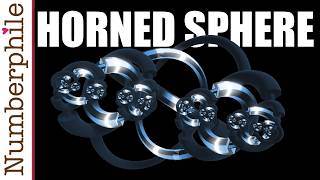
The construction starts with a cylinder, then each end splits into two interlocking horns that almost meet but never do, and this process repeats infinitely. It is a fractal-like object that cannot be built in finite time but is defined by infinite iteration.
In the outside of a ball, any loop can be shrunk to a point. But in the horned sphere's exterior, a loop can be entangled in the horns and cannot be shrunk away, proving the outside is not simply connected and thus topologically different.
In two dimensions, common sense holds—no such pathological shapes exist. But in three dimensions, objects like the horned sphere show that intuitive expectations can be false, and 'impossible' things can arise.
The Alexander Horned Sphere is a striking example of how topology reveals that our geometric intuition can fail in higher dimensions. It underscores the importance of rigorous proof and the surprising complexity of three-dimensional space.
Mentioned in this Video
💡 Key Takeaways
Common sense breaks down in 3D
This is the core revelation: the intuitive expectation that any sphere's outside is like a ball's outside is false, illustrating the limits of geometric intuition.
04:02Infinite construction
The horned sphere is defined by an infinite iterative process, making it a fractal-like object that cannot be physically realized, yet is mathematically valid.
05:59Loop entanglement proves difference
The use of a loop that cannot be shrunk is a concrete, testable criterion that demonstrates the topological difference between the horned sphere's exterior and a ball's exterior.
07:213D space is weirder than 2D
This principle highlights that higher-dimensional spaces can harbor pathological objects that defy common sense, a key lesson in topology.
10:45Full Transcript
[00:02] expect should be impossible in fact arises. So there are sometimes in maths where people work long and hard to prove something which to everyone else just seems absolutely obvious. A famous example of this called the Jordan curve
[00:18] theorem. It was in the early 19th century a guy called Bernard Baltzano realized that this statement of common sense actually was something that needed a proof. And then Camille Jordan proved it. It says that if you draw a loop on
[00:33] the plane, it can be as jaggedy and wonky as you like, but it can't have any jumps in it and it's got to sort of end where it began and it can't have crossed over itself anywhere. Any sort of wonky loop like that. The result always
[00:47] divides two dimensional space, that's the plane, into two parts. In other words, you can't get from the inside to the outside without crossing the curve somewhere. And furthermore, one of those parts is bounded, meaning there's the
[01:02] sort of maximum, if you wanted to sort of put a straight line segment in it, there's a maximum length you could put in. And the other is unbounded. You like. Right? >> So, you can't put a line of infinite
[01:14] length in inside it. >> You can't put a line of infinite length or you can't even uh even slightly weaken that. You can't put lines of finite length in it. vote for arbitrary long finite nature. So there'll be a
[01:26] that's what the Jordan curve theorem says. It was proved in 1887 and um I obviously right okay so there was a slight strengthening of it which came a
[01:38] little bit later from a guy called Arthur Shernfle. So this takes us into Arthur Shernfle. So this takes us into topology. Okay. So topology is um the branch of math that studies similar objects that we study in geometry but
[01:51] with a point of view that they can be bent and stretched and shrunk and so on. we're interested in. So we're not interested in things like lengths or angles but what we're interested in is anything that survives that. So, for
[02:06] example, the ex the the Shernfly strengthening of the Jordan curve theorem says that if you take my wonky loop here, you will be able to stretch it or squish it or something so that it turns into an ordinary circle. And when
[02:20] turns into an ordinary circle. And when you do that, the inside will turn into the inside of an ordinary circle. And when you and the outside will turn into think once you've understood the ideas of topology, once again, that seems like
[02:35] common sense, right? That's what you would expect. course, I could turn that into a >> Yeah. Okay. >> Yeah. Exactly. Yeah. So, what we're sort of keeping an eye on here is the string
[02:48] can turn into a circle, but as well as that, the area inside turns into the a disc essentially, and the area outside turns into a plane with a disc removed. Seems obvious, right? And maybe what seems equally obvious is that if we do
[03:02] the same thing, we're lifting up to three dimensions, right? So in that in instead of a wonky loop, we imagine a wonky sphere. So it could be as knobbybly or bumpy as you like, but again, it can't cut through itself.
[03:16] Can't have holes in it. It's got to be it's got to be a sphere as mangled as you like. The result we have there is the Jordan Brower separation theorem which says that any sphere however wonky it is again divides up three-dimensional
[03:31] space so that the you've got the bounded bit inside the sphere and the unbounded bit outside right okay and again seems that seems completely obvious is that you should be able to deform that wonky
[03:48] sphere into an ordinary sphere so that the inside of your wonky sphere turns into a ball. Basically, the inside of the ordinary sphere and the outside of the wonky sphere turns in to the outside of the ordinary sphere, right? And that
[04:02] seems like common sense, right? But it isn't true. So, this is um where common sense breaks down. Um and this was the work of a mathematician called James Alexander who basically created a shape which defies
[04:18] common sense. It's called Alexander's horned sphere. It is a wonky sphere. It itself is topologically the same as a sphere. The inside of it is topologically the same as a ball. I the inside of an ordinary sphere, but the
[04:33] outside of it is not topologically the same as the outside of a of a ball, removed. Okay. >> What does this horn look like? >> You start off as if maybe we've got a like a rod or cylinder. uh it's only the
[04:46] surface of the cylinder, not the contents of the cylinder. Okay? And what Taurus, but you don't quite get there. You you almost join the ends to make the Taurus, but then instead what happens is the end of each part splits into two.
[05:00] And then you're going to interlink those two, right? Like that. Except you don't two, right? Like that. Except you don't quite let them meet. So you get So each one gets to about there. And then the same thing happens. That then splits in
[05:13] two again. And those two are going to meet, but they don't quite. And you keep meet, but they don't quite. And you keep on doing that forever. the uh picture that James Alexander produced in his paper in 1924. This is a
[05:30] Taurus going all the way around here. And then here it splits into these two horns. And they interlink. Each of the horns doesn't quite connect. Itself splits. And then that carries on forever and ever and ever and ever and ever,
[05:45] right? >> If you never finish the job though, if a sphere? >> Well, you can't. So, you can't ever do this in finite amount of time. Okay. So, you can't construct one in real life.
[05:59] have absolutely no trouble as just saying let's jump to the end. Let's just let's look at the structure that emerges from iterating. You can define iterative structure this iterative process generates? It's like, you know, you
[06:13] could ask, you know, do do all do all the whole numbers exist? Right? You can >> What's the sum of the integers? >> What's what's the sum of the integers? to go down. Um yeah. Um so yeah, in this field of
[06:27] maths, I mean there are there are people who would have who would agree with that objection by the way. Um but I think most mathematicians are quite happy with to the end. And this is how fractal objects of all kinds arise. So this is
[06:40] an example of a fractal object. >> Okay. And so it has the property that it itself is topologically identical to a sphere because you can sort of retract all the horns and and and sort of smooth it all out and the inside smooths out
[06:55] three-dimensional space you've got out here is not the same as the three-dimensional space outside a ball. And the reason you can see that is that for example if if you've just got a ball in threedimensional space if you have
[07:08] any sort of loop in threedimensional space avoiding this ball you can always space avoiding this ball you can always shrink it away get smaller and smaller shrink it away to a point right it can vanish away to nothing. But in this in
[07:21] this shape here you could put your original loop you could sort of entangle it in these horns. And if you entangle it in the horns, you can never you can't shrink it away. Right? So, and that's telling us the
[07:34] can't be shrunk away to a z to to nothing is telling us that um this is um the outside of of this shape is is topologically different to the outside
[07:46] of um an ordinary ball. >> Yeah. So you're telling me that one of >> Yeah. So you're telling me that one of the the definitions or criteria of outside space >> is that a loop can be shrunk away in it.
[08:00] >> Yes, because that is so this is a this is a topological property. So if we if itself that's also true, right? If you imagine drawing a loop on the surface of a sphere, you can always shrink that away too. So the phrase here is being
[08:14] simply connected. Being simply connected is is the buzz phrase that people know. shrink it to zero. It's a shape that satisfies that is simply connected. But could draw there's two different loops I could draw. I could draw a loop going
[08:27] around like that. That loop can't be shrunk away because the shape of the >> Why did we need the horns? Why couldn't you have taken that cylinder you told me about at the start, just tapered it away forever, left and right, not not cur
[08:42] because it never joins. Why can't you just taper a cylinder forever to these infantesimal points and me make the same argument now if there's a if there's a loop around that? >> Uh so what are you left with? You're
[08:54] left with a a sort of um a a sort of a sort of Taurus which >> No, no, no, no. Like um like you start with your cylinder. >> Yeah. >> But then these things just go off
[09:06] closer and closer. >> Go off forever. >> Forever tapering. Tapering. tapering to a point. That's what it felt like your never touching, but they just kept doing it and doing it.
[09:18] it and doing it. >> Yes. So that cylinder there is not you never get the end points. >> But you never got to your end points >> Okay. It's a fair It's a fair point. It's a fair point. So I So we never get
[09:32] in in the finite process of constructing the shape, we never get to the end. But >> Oh, I'm making the same argument here. >> Yeah. But but either this goes on for if it goes infinitely far then within threedimensional space we never get to
[09:48] the end. Right. Right. So it's not just so I'm saying this may you may not be able to do this in a finite amount of time but everything is happening within your tapering sphere which is a nice example but because you never get to the
[10:04] have those end points. So it's actually not a sphere cuz it's got two holes in >> I Well, I think I could wiggle this around and fit it into a, you know, have smarter people than me figure this out. I acknowledge that.
[10:17] sphere. Tinker with your example because the point is that it is possible to come up with examples like this which are spheres. sphere is a sphere. Topologically, obviously geometrically, it's nothing
[10:31] like, but topologically it is a sphere, but the outside of its space is That's one example. There going to be others for sure. So I yeah, you would be turn it turn it into one. But the moral is that threedimensional space is just
[10:45] two-dimensional space, right? Because in two dimensional space, common sense works, right? You don't get these sorts of weird constructions which defeat it. But in three-dimensional space, these weird pathological uh shapes can happen
[10:59] and stuff you expect should be impossible in fact arises.
[11:23] now going to see what is the biggest circle I can fit in the middle. So, I've got my containing box. I've got my padding spheres or circles. I've now got care about. And I'm now going to try and fit the biggest circle possible in the
[11:39] fit the biggest circle possible in the middle.