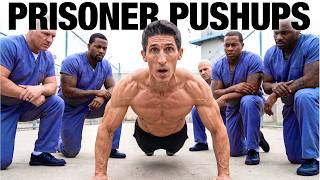

Half Reps Build Bigger Chest?
45sChallenges conventional wisdom about full range of motion, sparking debate among fitness enthusiasts.
▶ Play Clip"The title promises a 'pushup variation that changes everything' and the deliverable — prisoner push-ups — is a legitimate, well-explained technique; the content matches the title closely."
This video explains how to build a bigger chest using push-ups by focusing on a specific variation called 'prisoner push-ups'. The technique involves using only the lower half of the push-up range of motion to target the chest while reducing triceps fatigue, allowing for higher volume.
Prisoner push-ups are performed in the lower range of motion to focus more on the chest.
Full range push-ups work triceps in the top portion, which can fatigue the triceps and limit reps.
To build muscle with bodyweight, higher volume is needed because mechanical tension is lower.
The bottom range of motion (initial push-off) is dominated by shoulders and chest.
Bottom range: ~75% chest contribution; upper range: ~60% chest contribution.
Prisoner push-ups allow 1.5 to 2 times more reps per set than traditional push-ups.
To keep progressing, vary the exercise: angled push-ups, staggered push-ups (plyometric), archer push-ups.
Volume and intensity are key: low intensity requires high volume; high intensity allows lower volume.
Mechanical tension, eccentric overload, and metabolic stress build muscle.
Keep rest periods short and aim to increase reps or exercise difficulty.
Prisoner push-ups are an effective variation to build chest size because they increase volume and metabolic stress without overloading triceps. To keep growing, you must either do more reps or increase the exercise difficulty.
What is the main advantage of prisoner push-ups compared to full range push-ups?
They reduce triceps fatigue, allowing more reps to focus on the chest.
00:14
What percentage of chest contribution occurs in the bottom range of motion of a push-up?
About 75%.
01:34
What percentage of chest contribution occurs in the upper range of motion of a push-up?
About 60%.
01:34
How many more repetitions can you typically perform with prisoner push-ups in one set compared to traditional push-ups?
1.5 to 2 times more.
01:51
What are the three factors that build muscle?
Mechanical tension, eccentric overload, and metabolic stress.
03:58
How should you adjust the number of reps when you increase the difficulty of a push-up variation?
You can reduce the volume because intensity compensates.
03:45
Name one of the three variations mentioned to progress from basic prisoner push-ups.
Angled push-ups, staggered push-ups, or archer push-ups.
02:18
Prisoner push-up technique
Introduces a counterintuitive method by using half reps to build more chest mass.
00:14Chest contribution percentages
Provides concrete data on why bottom range is more effective for chest growth.
01:34Increased rep capacity
Explains the volume advantage that makes bodyweight training viable for muscle growth.
01:51Three muscle-building factors
Summarizes the foundational science of muscle hypertrophy in a simple model.
03:58[00:00] So, if you want to build a bigger chest with just push-ups, then you might want to try changing the type of push-up that you're doing and adopting a technique that the prisoner workouts have actually been famous for, and it's this push-up right here. Now, I know you're thinking, those look like half reps, Jeff, those aren't even full range
[00:14] of motion. That's the point. See, these are actually called prisoner push-ups, and they're done in the lower range of motion. And here's the reason why, and why you might want to try doing this yourself. Because we know one thing, when we do a full range of motion push-up, as I always advocate,
[00:28] for building the entire upper body, is that last bit of extension here that really works to triceps, and is responsible for helping complete the development of the upper body beyond just the shoulders and chest. That being said, is also a fatiguing portion of the repetition.
[00:43] Every time I have to get to full extension, it's going to fatigue my triceps, and therefore limit the number of repetitions I can do in total. When we're looking to build any muscle with just a body weight exercise, your volumes are
[00:55] going to have to be higher, because your overall mechanical tensions are going to be lower. It's not going to be the same amount of tension that you would have under a heavy dumbbell bench press or a heavy barbell bench press. So how do we drive that up and get higher volumes?
[01:07] And also focus more of that attention on the chest itself, like sticking in that bottom range of motion. And the bottom portion of a bench press, we know that the initial push-off of the chest of the bar, is going to be dominated by the shoulders and the chest.
[01:20] And again, when we get towards that top, it's when the triceps take over. So if we stay here, again, this is the prisoner push-up, and we try to go a little bit faster. And we take advantage of the metabolic stress that we could drive to the pecs specifically
[01:34] here or in a large part, can 75% contribution towards the chest in this portion of the range of motion versus a drop down to around 60% in the upper portion of the range of motion. Then we can focus more of that effort and actually guess what, do a lot more repetitions.
[01:51] We'll find that doing this half rep prisoner push-up is going to get you around one and a half to two times a number of repetitions that you could do in any single set of a traditional push-up. Now what does that do?
[02:03] Again, it drives the volume higher on a lower tension exercise that can actually start to equate your ability to build muscle with just that exercise. Now I'm also an advocate for not just continuing to do the same thing over and over again
[02:18] and expect a different result. You want to find either how to do more repetitions or how to increase the difficulty. So what you could do is maintain that prisoner push-up bottom range of motion concept and just
[02:31] change the exercise up a little bit. So you could do an angled push-up. You come down to one side and push up here and stay down in the bottom, but giving you a chance to keep increasing the stimulus on the chest because I stay in that lower range
[02:45] of motion. You can make it more explosive by doing the staggered push-up here. Little bit of plyometric, hardly lifting the hands, but staying in that bottom range of
[02:57] motion like this. Again, increasing the intensity. So even though I can't do as high a volume there, I will increase the intensity to compensate for that. I could also do the archer push-up, which stays down this variation here.
[03:15] Side to side. Again, all happening down in this lower portion of the range of motion. Here you're trying to just push through the heel of your hands, push off side to side.
[03:28] All of these things are giving you an opportunity to do one thing. This is what you need to understand whenever you're trying to build muscle, volume and intensity or what matters. If you want the exercise to be more effective and you're already dealing with a low intensity
[03:45] level, then that volume is going to have to be high. If you increase the intensity, the volume can come down. It's mechanical tension, eccentric overload, metabolic stress. Those are three things that build muscle.
[03:58] You're not getting as much of it as you would with dumbbells or barbells. You're not getting as much. You're going to go overload because we don't have that tension there in the first place. What you do have an opportunity to do this, keep your rest periods short, do as many
[04:11] repetitions as you can and continue to try to overload, but either increase in the difficulty of that push-up variation or do more repetitions. It's possible, but you got another right way to do it. If you're looking for a complete step-by-step program, by the way, only you can find it at ATHLEAN0
[04:25] at ATHLEANX.COM. If you haven't done stuff, click subscribe, and turn on notifications before I lose my breath and I can't talk another second. All right, guys. Back here again soon. See ya.

⚡ Saved you 0h 04m reading this? Transcribe any YouTube video for free — no signup needed.