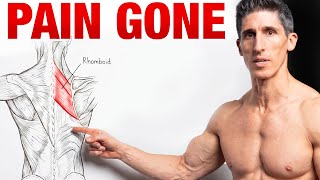

Why your shoulder blade knots won't go away
45sChallenges common belief that muscles need targeting, revealing joint mobility as root cause.
▶ Play Clip"The title accurately promises a solution for rhomboid pain, and the transcript delivers exactly that with specific exercises."
This video addresses rhomboid pain (knots between shoulder blades) by targeting the underlying thoracic spine mobility rather than just the muscles. It provides a series of mobility and strength exercises to restore function and eliminate pain.
Pain between shoulder blades is caused by stiff thoracic joints, not tight muscles. Muscles lock up to compensate for lack of joint movement.
On all fours, drop chest toward floor letting shoulder blades pinch (retraction), then push through floor lifting chest (protraction). Gravity helps.
Place hands at 10 and 2 o'clock on a wall, step back with one leg, sink hips, drive chest toward wall to extend thoracic spine.
One forearm flat on floor, opposite hand behind head, rotate elbow toward ceiling to add rotation to the spine.
Lay flat, arm overhead, drop chest toward floor, then rotate to side keeping hip down, reaching to 3 o'clock. Actively pull shoulder blade back.
Bridge and reach over combines rotation, extension, and glute activation for full kinetic chain.
Lie face down, arms overhead, slide hands back along floor while lifting chest, keeping hands an inch off ground. 2-3 sets of 10-12 reps, 2-3 times per week.
Grab left handle with right hand and right handle with left hand, round thoracic spine, pull hands to chest, extend lumbar spine and lean back.
What is the real cause of rhomboid pain according to the video?
The underlying joints (thoracic spine) not moving properly, causing muscles to lock up.
Describe the all-fours thoracic extension exercise.
Drop chest toward floor letting shoulder blades pinch (retraction), then push through floor lifting chest (protraction).
00:27
How do you perform the wall splat exercise?
Hands at 10 and 2 o'clock on a wall, step back with one leg, sink hips, drive chest toward wall.
01:08
What is the can opener exercise?
One forearm flat on floor, opposite hand behind head, rotate elbow toward ceiling.
01:48
Describe the 1115 stretch.
Lay flat, arm overhead, drop chest toward floor, then rotate to side keeping hip down, reaching to 3 o'clock.
02:31
What is the recommended frequency and volume for the strength exercises?
2–3 sets of 10–12 reps, 2–3 times per week.
04:44
How do you perform the no-equipment strength exercise for the upper back?
Lie face down, arms overhead, slide hands back along floor while lifting chest, keeping hands an inch off ground.
03:54
Describe the cable machine exercise for thoracic extension strength.
Grab left handle with right hand and right handle with left hand, round thoracic spine, pull hands to chest, extend lumbar spine and lean back.
04:57
Root Cause of Rhomboid Pain
Identifies that the pain is due to stiff thoracic joints, not tight muscles, shifting the treatment approach.
All Fours Thoracic Extension
A simple, gravity-assisted mobility exercise to restore retraction and protraction range of motion.
00:27Wall Splat Exercise
Uses a wall to guide sagittal plane thoracic extension, accessible for anyone.
01:081115 Stretch
Combines overhead reach with rotation to target both extension and rotation mobility.
02:31Strength to Maintain Mobility
Emphasizes that strength training is essential to keep the improved range of motion and prevent pain recurrence.
03:41[00:00] Do you have pain in this whole area that's really hard to get to? I'm going to help you today because to target this, you're likely probably trying to target the muscles when that's not going to get to the bottom of the issue. It's the underlying joints that aren't moving properly that's causing these muscles to lock
[00:15] up. We've got to fix that. We're going to start right here on the floor. And the focus of your effort has to be at least I'm feeling the fact that you don't have this mobility that you need. So I have to get down in this position on all fours.
[00:27] You're on your fours, flat on the floor, and on your knees. Your butt could be up here in the air. And what we do is we basically allow ourselves to drop straight down to where the shoulder blades pinch together. And this should actually happen pretty naturally for you because gravity's helping you to fall
[00:41] straight down towards the ground. But when you come back out of this, you try to leave your elbows down and push through the floor as you lift your chest as high as you can. That's protraction. You'll be surprised to see how much of this mobility you actually have, and you never actually
[00:55] really even experienced because you stopped moving a long time ago. All you have to do is just get the sense of what it's supposed to feel like to move that way, because let's be honest, it's probably been a long time since it has. Now of course in the last exercise, you may not have a whole hell of a lot of range of motion
[01:08] to move through, but that's where we do this, which is going to help you with that. We call this a wall splat. It's so easy to do on any wall. You want to put your hands up and out wide. You don't want to have them too narrow because people with shoulder issues might find it to
[01:22] be uncomfortable. But when you open them up to about two o'clock and ten o'clock on a clock, you're good to go. Now you step back with one leg, and what we're going to do here is try to just allow our hips to sink and our chest to move towards the wall.
[01:36] And the knee is actually attempting to touch the walls we go in, closer and closer every single time. You're going to feel yourself extending more through that locked up area. Now, if we've worked that sagginal plane of motion, that front to back, lack that you're
[01:48] having right now through a thrashing spine, what can we do about the rotation that you're missing? Because it needs to rotate. You're not doing enough of it. What we can do is a can opener, what you do is you put one forearm down here flat and pointing straight ahead towards you, and the other one's going to go and put your hand
[02:02] on the back of your head. Now all I want you to do is open this arm up, rotate up towards the ceiling as high as you can, and push down through this elbow and forearm to allow you to get some more of that height. And you should try to get at least to this 45 degree angle if possible.
[02:17] Keep working on opening up further and further in successive attempts here, and I promise you the reintroduction of some rotation to a spine that's certainly lacking it is going to feel really, really damn good. And now we can do what we call the 1115 stretch.
[02:31] What you want to do is lay flat on the floor and then put your arm straight out up over your head. Now, even this could be step one of making you feel a hell of a lot better because what you're going to do is just try to drop your chest straight down through the floor, try to reach
[02:43] your sternum to touch the floor because they can guarantee you when your arms are up overhead, it's not touching right now. But if you reach further, you're going to start to feel a little stretch right through this X marks the spot.
[02:55] Now, we've got to take it to the next level, so I want you to start rotating to the other side, keeping this side of your body down on the ground. In other words, this hip and outer thigh have to stay down. And when you reach, you reach for the three o'clock position on the clock, hence the 1115 of
[03:12] the left arm and right arm. If you are in this position now, don't just hang out there, actively try to pull your shoulder blade back so you get some activation of the muscles that you're now starting to loosen up and waking up.
[03:25] And with your newfound range into extension and rotation, this would be a great thing to follow it up with and tie it all together. Recall this, a bridge and reach over. Not only are you getting that rotation and extension, but you're also getting the glues to participate too, so it's sort of that kinetic chain from the bottom to the top, through
[03:41] your feet, to your fingertips, everything working the way it should. Now, when it comes to keeping that pain away, strength is always going to be part of the equation. Here's two exercises that you can do, regardless of what equipment you have access to. The first one requires actually zero equipment at all.
[03:54] And what you have to do is just lay flat on your stomach and put those arms back overhead like we were in that other exercise. Because remember, just getting your chest down from the ground is going to help to get some of that thoracic extension mobility, but again, this is about strength.
[04:08] So all you have to do is just slide your hands back along the floor at the same time lifting your chest off the ground. By getting through lumbar extension here in the low back, you're going to actually facilitate
[04:20] that thoracic extension that we're looking for. But the strength component comes from the fact that your hands aren't in contact with the ground, pushing your chest up. They have to actually be off the ground by just about an inch by the time they get back down
[04:32] next to your side. So you'll feel all these muscles here in the back, the ones that we're trying to get strong to keep you in this improved position. And with just two to three sets of 10 to 12 high quality repetitions done about two
[04:44] or three times a week, you have everything you need to do to make sure this stays strong and keeps that pain away for good. And for those of you who are training at a gym or want that next level strength exercise, when you've gotten to the point where you need more resistance, this is a weighted one
[04:57] you could do with a cable machine at your local gym. And what you do is grab the left handle with the right hand and the right handle with the left hand and you round out the thoracic spine. Exactly the opposite we've been talking about this whole time.
[05:09] But setting you up for the proper exercise execution because from here we're going to pull our hands close to our chest and extend through that lumbar spine and lean back, giving us that good combination of thoracic extension, again facilitated by that lumbar extension and
[05:26] keeping those elbows tight and driving back behind your body to strengthen all those muscles. You can see that area that we've been targeting all along really effectively being hit on the exercise. Again, it doesn't take much one exercise a couple times a week, two to three sets with
[05:42] well executed repetitions is all you're going to need to do to strengthen this area to make sure that that pain doesn't come back. And so with this targeted attack you're going to be able to focus on that area that's causing problems right now. But if you're one of the many that has a problem down here in the low back, I've got a video
[05:57] for you as well to help that out. You can find that one right here, 30 million other people have found it to be helpful. I think you will too. If you're looking for the science-based way to train, make sure you head to ATHLEANX.com. If you haven't done so, please subscribe, turn notifications, or never miss a video when
[06:10] we put one out. Guys, I hope you find this helpful. Leave your comments to let me know how it is. See ya.

⚡ Saved you 0h 06m reading this? Transcribe any YouTube video for free — no signup needed.