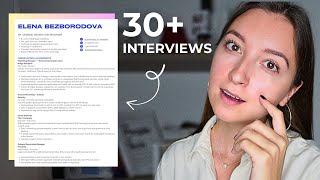

From Rejections to 30+ Interviews
44sThe classic 'before and after' hook with a specific, surprising result (30+ interviews) instantly grabs attention and promises a transformation.
▶ Play Clip"Delivers on the core promise with actionable tips, but the 'just copy me' framing oversells the simplicity—it's more about strategy than copying."
Elena, a marketing professional with 10 years of experience, shares five key changes she made to her CV that resulted in over 30 interview invites, including from companies she thought were out of reach. She emphasizes tailoring the CV to each role, showing business impact, and strategically handling personal details like location.
Adjust your CV for each job application by rephrasing your experience to match the exact words in the job ad. Also, scan the company's website and LinkedIn to highlight relevant milestones, such as a recent Series A raise or a pivot from B2C to B2B.
Recruiters spend only 5-6 seconds on average reviewing a CV. While one-page CVs are common, a two-page CV is acceptable, but anything longer will likely be skimmed or ignored.
Use business language and quantify results. For example, instead of 'developed a multi-channel digital strategy,' say 'delivered +65% pipeline growth in Q1 by executing a multi-channel GTM strategy.'
Remove irrelevant courses and tools. Only list tools that are explicitly mentioned in the job ad. With over 500 applications per role, your CV must be completely to the point.
Your location can cause automatic rejections. If open to relocation, state it clearly. Consider listing your dream company's city as your location to start the conversation, then clarify your situation later.
Treat your CV as a sales page, not a list of past roles. By tailoring it, showing impact, and strategically managing details like location, you can significantly increase your interview chances.
What is the average time a recruiter spends looking at a CV?
5-6 seconds
03:26
What is the recommended maximum length for a CV?
Two pages
03:10
Give an example of a 'bad' vs 'good' CV bullet point for showing business impact.
Bad: 'developed a multi-channel digital strategy.' Good: 'delivered +65% pipeline growth in Q1 by executing a multi-channel GTM strategy.'
03:55
What should you do with the 'courses' section on your CV?
Remove irrelevant courses; Elena doesn't mention any courses in her latest CV.
04:52
How can you handle the location section if you are open to relocation?
Add a line about being open to relocation, or list your dream company's city as your location to start the conversation.
06:53
What happened when Elena listed Helsinki, Finland as her location?
She got an immediate rejection from a dream company because their policy didn't allow recruiting in Finland, but after clarifying she was open to relocation, she got an interview invite.
05:59
Tailoring is the #1 Mistake
Most candidates send the same CV everywhere, but tailoring to each role is a simple yet powerful differentiator.
00:44Speak Business Language
Quantifying results (e.g., +65% pipeline growth) makes your CV stand out to recruiters who scan for impact.
03:40Location Can Auto-Reject You
A simple location field can trigger automatic rejections, but a strategic tweak can open doors.
05:59Your CV is a Sales Page
Reframing your CV as a sales tool changes how you write it, making it more compelling and targeted.
07:35[00:01] various marketing jobs and my inbox was just full of rejections. After that, I just full of rejections. After that, I made a few very simple changes to my CV. Suddenly, I got more than 30 interview invites, including from the companies
[00:15] that I thought were out of my league. In this video, I'll show you five key things I've changed in my CV and why exactly it helped me. By the way, number five is actually no one really talks about. I'm Elena. I spent the last 10
[00:29] years in marketing and on this channel I help other marketers land their dream roles. If you want to more tips like this, make sure you subscribe and also join my weekly newsletter. Both links are in the description below. And number
[00:44] one tweak that I've made is adjusting my CV for every single role. Actually, when I review your CV, guys, in one-on-one career consultations that I host occasionally, not tailoring your CV is one of the biggest mistakes that I see
[00:59] offering something that I've never done before. I'm hosting completely free 20-minute calls and uh you are completely free to sign up for them.
[01:11] This is sort of a safe space where you can share any kind of struggles that you have whether it's in your job hunt or in your current career and I'll try my best to help as much as possible. The feedback from the sessions has been so
[01:25] far incredible and I want to speak to you more guys. Spots are limited so make sure you book your next call by jumping to the link in the description below. So how exactly can you actually adjust your CV to every single role? Yes, I know
[01:41] it's time consuming, but trust me, the effort completely worth it. So, for example, go through the job ad itself, of course, and take a look at the specific requirements that they have, and you have to rephrase your experience
[01:55] to match these exact words that they have in the job ad. What you can also do is scan their website, take a look at their business trajectory. For example, maybe you've noticed that they used to be, I don't know, solely a B2C product
[02:11] and now they are jumping into the B2B world. And maybe in your CV, you can highlight exactly that. Maybe you've worked both for B2C and uh B2B corporations. What you can also do is of course check out their LinkedIn and try
[02:27] to notice some of the biggest milestones that they've recently had. It could be maybe I don't know raising an a series and uh in that case you can highlight in your CV that throughout your journey with your previous company the company
[02:41] with your previous company the company went from a seed stage to raising a went from a seed stage to raising a series A from this incredible uh VC fund or whatever. Number two length matters way more than you think. So I used to
[02:55] have different CVs. Some of them were just one page CV, others were a maximum of two pages. Honestly, I haven't noticed any difference as in I would get an equal number of interview invites whenever I would had a one or a two
[03:10] pager. I've seen different recommendations here. A lot of people say that your CV should be a maximum of one page long. But my recommendation is that yes, you can make it a little bit longer, but not more than two pages
[03:26] because trust me, recruiters spend on average from five to six seconds looking at your CV. So if it's more than two pages long, they just not going to have that much time to dive deep. Number
[03:40] three, you have to show your business impact. As soon as I started speaking the business language in my CV, I realized that I was getting way more interview invites. A bad example, developed a multi- channelannel digital
[03:55] developed a multi- channelannel digital strategy. A good example, delivered plus 65% pipeline growth in Q1 by, for example, executing a multi- channelannel example, executing a multi- channelannel GTM strategy. A bad example, set up paid
[04:08] advertising campaigns. Boring. A good example, launched high ROI paid social and search campaigns and achieved 3.5x return on ad spend. A bad example,
[04:21] developed retention programs. A good example, increased LCV by more than 30% in just one month. While life cycle email sequences and uh re-engagement workflows. Number four, cut the fluff from the courses and tools section. This
[04:39] is another big thing that I've noticed whenever I review your CV in oneonone whenever I review your CV in oneonone consultations, guys. Your CV has a huge part where you list some of the completely irrelevant at times courses
[04:52] course in your first year at university or whatever. Actually, in my latest versions of my CV, I don't even mention any courses that I've taken, even though I usually try to take at least one or two marketing courses per year because
[05:06] it's just I feel it's completely irrelevant to be honest. Think about it this way. So, last time we were hiring uh for a marketing role in the company I work for, I spoke to our HR and she told me that for one role, we've got more
[05:20] me that for one role, we've got more than 500 applications. So imagine recruiters are just drowning in the number of CVs that they have and this just means that your CV has to be completely to the point. When it comes
[05:33] to the tools part, I actually mention some of the tools I can use but still even that I just try to take a look at the exact requirements that they have in the exact requirements that they have in a job ad and I only add the tools that
[05:47] they mention there. And number five is your location. I have a personal story here. So I lived in Finland and I was looking for marketing jobs basically in
[05:59] any location because I was open to relocation but I still had Helsinki Finland in my location section in any CV that I've sent. And there was this one dream company and I've applied to them and I got an immediate rejection. I
[06:14] decided to follow up with the HR on LinkedIn and she responded that my CV according to the policy of their company, they can't recruit anyone in
[06:26] Finland. And I actually noted to her, so I replied and I mentioned that I'm open I replied and I mentioned that I'm open to relocation. I got a interview invite immediately after that. I made it to the very last stage. I didn't get the job at
[06:40] the end, but that was an incredible experience that I should be really careful when it comes to the location section. So, what you can do is if you're open to remote jobs, make sure that you add a line about that right
[06:53] next to your location section. What you can also do is for example, your dream company is let's say located in Berlin, but you don't really live there. You live in another European country. You can still add Berlin as your location
[07:07] because your main goal here is just to start this initial conversation with the start this initial conversation with the HR person and after that you can work it out. You can mention that right now you're not really in Berlin anymore, but
[07:19] you are either open to relocation or you have legal rights to work from any other European country. Bottom line, guys, your CV isn't just a page where you list down everything that you've done. It's actually a sales page for you. So once
[07:35] you start treating it this way, you will be surprised how many doors it can open. following the link in the description below. And if you want to find out how
[07:47] questions in your next job interview, continue watching this next video.
⚡ Saved you 0h 08m reading this? Transcribe any YouTube video for free — no signup needed.