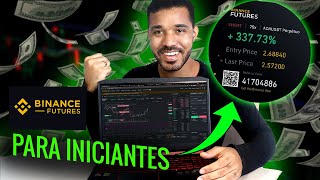

Make 200 Reais a Day with Zero Investment?
45sThe promise of high returns with no money grabs attention and triggers curiosity, perfect for a hook.
▶ Play Clip"Title promises a beginner tutorial and delivers, but the claim of earning 1000 reais daily is exaggerated."
This video provides a comprehensive tutorial on Binance Futures, explaining how the futures market works, how to leverage capital, and how to execute long and short trades. The presenter demonstrates the entire process from account setup to placing trades, emphasizing risk management and the importance of technical analysis.
The presenter claims that with 100 reais, one can earn up to 1000 reais daily in the Baiana futures market, highlighting high volatility and risk.
In the spot market, you buy and own the asset. In the futures market, you trade contracts based on the price of an underlying asset, allowing you to bet on both rising and falling prices.
Leverage multiplies your capital. For example, with 100x leverage, a 1% price move doubles your capital, but a 1% move against you results in liquidation.
Going long means betting on price increase; going short means betting on price decrease. Profits are made from price movements in the direction of the position.
With 100 reais and 100x leverage, a 1% increase yields 100 reais profit (doubling capital). A 5% increase yields 500 reais profit.
High leverage (e.g., 100x) increases liquidation risk. Beginners should start with lower leverage (e.g., 5x or 10x) to avoid losing all capital quickly.
To predict price movements, one must learn technical analysis, including indicators and price action. The presenter recommends courses and his own channel for learning.
Steps: create a Binance account, change language to Portuguese (Portugal) to access derivatives, and create a futures account. Use referral code for fee discounts.
Deposit funds into the spot account, buy USDT, then transfer to the futures account. Operations are in dollars (USDT).
Select a short timeframe (e.g., 5-minute chart), choose long or short, set leverage (e.g., 20x), and enter with a market order. Monitor liquidation price.
New accounts are limited to 20x leverage. Liquidation distance decreases with higher leverage: 5% for 20x, 1% for 100x, etc.
Isolated margin limits loss to the amount allocated to the trade. Cross margin uses entire wallet as collateral, reducing liquidation risk but risking all funds.
Always set stop loss to automatically close a position at a predetermined loss level. Take profit locks in gains. This prevents liquidation and secures profits.
The futures market offers high profit potential with leverage but carries significant risk. Beginners must learn technical analysis, use low leverage, and always employ stop losses to protect capital.
What is the difference between spot and futures markets?
In spot market, you buy and own the asset. In futures market, you trade contracts based on price, allowing betting on both rise and fall.
01:08
What does 'long' and 'short' mean in futures trading?
Long means betting on price increase; short means betting on price decrease.
03:42
With 100 reais and 100x leverage, how much profit from a 1% price increase?
100 reais profit (doubling capital).
05:30
What is the liquidation distance for 20x leverage?
5% against your position.
20:19
What is the maximum leverage for new Binance futures accounts?
20x.
20:19
What is the difference between cross and isolated margin?
Isolated margin limits loss to allocated amount; cross margin uses entire wallet as collateral.
21:11
Why should you always set a stop loss?
To automatically close a position at a predetermined loss level, preventing liquidation.
23:24
Leverage Multiplies Gains and Losses
Explains the core mechanism of futures trading that allows small capital to generate large profits or losses.
02:44Concrete Leverage Example
Provides a clear numerical example of how 100x leverage turns a 1% move into 100% profit.
05:30Risk of High Leverage
Warns beginners about the danger of high leverage and recommends starting low.
07:46Cross vs Isolated Margin
Explains a critical risk management concept that can prevent total loss.
21:11Stop Loss and Take Profit
Emphasizes the necessity of using stop losses to protect capital.
23:24[00:02] 100 reais, you can earn 200 reais a day, or even a thousand reais a day, without any investment, in the Baiana futures market. Yes, I know it sounds too good to be true, but in this video I'm going to
[00:15] show you everything, from how the Baiana futures market works to how, even with little money, you can make a lot of money every day in this extremely volatile and risky market. I'll
[00:27] show you everything here, from theory to practice, on my computer screen. And pay you can make a lot of money in this futures market in a few minutes, you can also lose money very quickly if you're a
[00:40] little careless. So this video will be full of information, and a video, if you don't pay attention, could be enough for you to lose all your the intention of this video is that it will be long and full of details and
[00:54] content. So sit down, grab a pen and paper, and write down, from the cheapest to the cheapest, what the Baiana futures market is all about. So, what is this and how does it work? Well, there are two markets within the cryptocurrency market: the
[01:08] Spot market, which is the cash market, and the futures market. What is the Spot market within the cryptocurrency market? The Spot market is when you take your money, you buy a cryptocurrency, and that cryptocurrency is yours; it's in
[01:22] and then store it in your wallet. So, in the Spot market, you buy an asset, and it's yours. If it appreciates by a certain percentage, you earn that percentage in relation to how much it appreciated. If the currency
[01:36] you bought depreciates, you can recover your investment if it goes back up. So, that's the Spot market where you buy currency, and it's yours. In the futures or derivatives market, it's a little different. You don't buy
[01:49] a cryptocurrency; you don't buy or sell any asset. In the futures market chart, the price is derived from another cryptocurrency, for example, Bitcoin. So, in the Bitcoin chart, look, this is the Bitcoin area chart, and this is the
[02:03] futures market chart, in this case, the asset of the coin. So you can see that the chart is exactly the same, both the Bitcoin chart and the futures chart. Another broker, regarding the Bitcoin chart within the futures market, if
[02:16] automatically in the futures market under control it will go up one percent as if it reason for you is the Bitcoin chart, but Bitcoin is not the only currency futures market. You can also stop at other registered currencies like Ethereum
[02:31] and any other currency that is here within the futures market. The advantage of Bitcoin is that, as I said, you can leverage up to 125 leverage will be a little lower. And hold on, I'll explain this
[02:44] leverage issue and how we make money in the futures market. When you enter the futures market, you have the chance to open a position relative to the price that the currency is currently at, and then you can bet on the rise of this asset or
[02:57] the fall of this asset. The hard part is that's why it's called the futures market. Let's suppose, for example, I fit into the position and now within the futures market, very much like entering $46,500, man, $46,153. Let's put
[03:12] Club front. 46,500. If I enter right now, with this price rising above 46,500, I win one percent of the price. If it will become a little clearer for you. Henrique, if in the spot market it's up
[03:27] one percent, and in the futures market, you know, one percent... What's the difference between them? futures market you can leverage your capital. You can create a position with more actually have. So the broker multiplies your capital and you enter
[03:42] I think what happens in practice in the futures market is that you'll hear two terms: long and short. When you go long, you're betting on the rise of an asset. So if I entered a short position when it was $10,000 and I went
[03:56] long, I'm saying it will go above $ 10,000. Next, I win $ 150, $10,000. And if I go short, I'm saying, "Look, Bitcoin will fall." So I enter short, even if I'm falling, I win.
[04:10] Bitcoin's fall. So if someone says, "Oh, I went long, he's posting at the high," or "I went short, he bet on the low," many people prefer to say, "I went long, he went long, he bet on the high," or "I went short, he bet on the low."
[04:22] What is the advantage of the futures market? This is for someone with little capital. How can you make a lot of money in the futures market? That's right, with little money. In the spot market, in the traditional market, if you only have
[04:34] 10 reais and it goes up one percent, you will earn one percent on your 10 reais. That is, you have R$100, it goes up one percent, you earn one real, and always with a 10 percent decrease, you will earn R$10. But stop and think, for you it
[04:49] has to be reais. R$10 more won't make that much difference in your pocket, it won't change your life. So, are you going to change your life with 10 reais? No. How do market? It's the same with little money. When you open a position in the
[05:03] futures market, there's a very important detail: the position is made in an SBT (Single Betting Exchange). The operations... All of these are done with SBT. Later I'll show you in practice dollar, into the futures market portfolio. That's trading, but just to make it
[05:17] clear here, I'll show you an example with reais, but with dollars, that's how it works. So, if I say without reais, basically it's $20, but to improve it, round numbers. For example, you have to be richer, I only have 100 reais. Okay,
[05:30] you can leverage your capital
[05:42] your capital by a percent. So it will be the same as you entering with 10 and 1,000 reais because you took 10 and multiplied by 100, and that gave you 10,000 reais. And what happens with the magic of all this? If the price of the asset you
[05:55] bet on, whether it's Bitcoin or any other, goes up one percent, you win one of the 10,000 reais you entered. So, one percent of 10 One thousand reais is zero reais, meaning if you make a good entry into Bitcoin, it's leveraged
[06:10] one hundred times with R$100. Basically, for every one percent that Bitcoin goes up, you double your capital. That's why it went up five percent. Henrique, you'll earn five percent, 2/10000. Remembering that what you had was zero reais,
[06:23] you'll earn one hundred times, but you entered with 10,000. So, if it goes up five percent, you'll earn R$500. So, let's call Shell with you here on the chart at that level. How can this be profitable? Whether the asset is going up or
[06:36] down. Now, if you had entered here, look, about 37,000 donors, look, doing long on, saying that I know it will go up, if I entered here and the price up? There are many people who started the operation here, look, and must be
[06:52] comparing until now, look, how many percent Bitcoin went up, 40 percent. So, if you had zero reais here, it will leverage one hundred times, one for every one percent you... In this case, you would have entered with 100 reais and
[07:06] exited with 4,000 reais. Of course, this operation here is Globes, because this is the daily chart, so you can spend money on an operation, or you can earn money in minutes. In the cryptocurrency market, it's extremely advantageous
[07:19] because it's extremely volatile. Henrique, but if the currency is one percent, like my position, if it's one percent, you get liquidated, you lose your capital, which was the guarantee you entered the operation. But calm down, calm down,
[07:33] don't panic. I talked to you about leverage, and I talk about leverage, but in short, you don't need it. It will be 100 times. This is an example; in fact, you can leverage up to 125 times your capital.
[07:46] So the recommendation is for you: never start with 100 times leverage; you will lose all your money. There are strategies to enter with 100 times; you can enter with 10 times, with 5 times our leverage. The lower your
[08:02] chance of being liquidated, the better. I'll show you in a moment. That's it. I just want you to understand that we'll move on to the practical part in a little while, okay? So if you're a beginner, never start with leverage. Sometimes you can make a lot of money with a % variation,
[08:14] but with % you also lose all your capital. But don't worry, there are existing ones for all leverage levels. You just need to subscribe content for you here, I'm helping you. I spent over R$15,000
[08:31] than 15 thousand reais buying the course, and asking for more than 300 I have a dream of one day having at least 10,000 subscribers here on YouTube. If you help me, and that motivates me to continue bringing this type of video
[08:46] to you. So I'm winning, you're winning everything, right? And if you want to I have a lot of ideas there, and I really like trading there too, as shown in the last video on this channel. But let's go, I understand, Henrique. This
[08:59] means I can take my... I can take my... let's say R$10 of these... no, no, you didn't mistake me for a minimum. The minimum is $10, that is, R$50. You can take R$50 and leverage it 10 times, 20 times, or even 50 times. That's a
[09:12] you're going to tell me how I'm going to know if the asset price will go up or fortune teller. I'm going to show you how I make a lot of money with this, and rarely, in fact, I've never been liquidated. I've also used Stop Losses, but I've
[09:27] never been liquidated. I'm going to show you the difference. And how I'm going to know if it will go up or down? You need to understand technical analysis. You have to know how to analyze the asset price. Technical analysis
[09:41] is about knowing how to put the indicators on the screen, how to do the price action of the asset, and based on that, you make your decision to go long or short. Henrique, where did I learn this? I'm going to give you three options.
[09:54] lot of stuff on YouTube, but it all gets kind of confusing. You watch one video from one person, then another, and in the end, you don't know how to use all that. Second option: It's about subscribing to my channel and watching some
[10:08] videos I post about the futures market. I also posted a video on Facebook about the futures market, where I share a strategy I use. So, throughout this channel, if this video gets at least a thousand likes, I'll release more videos showing how I
[10:20] operate in the futures market in practice and how I do it. First on YouTube, second on my channel, and third, you can also buy courses. I bought over R$15,000 worth of courses, and I'm not kidding. I bought
[10:32] cryptocurrency on YouTube. Some were good, others bad, but to save you time, I'll tell you which one I bought. The one that helped me the most with technical analysis was Augusto Backes' course, this guy here. So,
[10:45] bought all the other courses and only bought this one, I would have saved a lot of things, but with much more detail. The link will be in the description. This value is also quite high, folks, but I have a coupon for you. The
[10:58] interested in his course, click the link below. The link will have get a 50% discount. Anyway, I've already talked a lot, focusing here. So you need to understand chart analysis because if you don't understand the chart,
[11:13] or too expensive; you won't have any idea if it's going to go up or down. So technical analysis made all the difference in my operations. I wouldn't have been able to this. You also need a setup. A setup is a strategy, like a
[11:28] combination of indicators that you use. For example, for swing trading there's a setup, for day trading. So you go to the futures market, the setup, and well, I have setups for all these types of operations, and I'll show them to you
[11:40] throughout this channel. It depends on you whether the videos are good and if you like the talk about this because otherwise it will become huge and without much rambling. Let's schedule a meeting with you in the futures market, from how you create your account
[11:55] and how it works in practice. Okay, the first thing you need to do is stop trading and leave an account on Bananas. So click the link in the description to open it. Your account is on the bar, right? If you don't have one, there's a video on this channel where
[12:08] And if you don't have one, to get a discount on your fees, use the code Zinho from this channel or click on the link in the description. So, the link to create one along with the code for you to get a discount.
[12:23] second thing you have to do is change the language from Portuguese (Brazil) – it will be up here – you'll select Portuguese ( Brazil) – to Portuguese ( Portugal) – because I want [unclear - possibly a band name] – the futures market removed, I don't know why, but
[12:37] So, switch to Portuguese ( Portugal) and you go here to derivatives. When you come here to derivatives, you go here to futures, the SDM. So you click on futures, the SDM. Remember to check all the documents on the
[12:52] You also need to create an account on the futures market. How do you create an account on the futures market? Just go to the right corner and open it. Now, if you want more discounts on your fees, I recommend using the code Zinho from this
[13:06] channel. So, grab this code here: 18 9695 807 or click the link in the description, then enter the code here or click on the description. It's very important to get my code Zinho here, which happens because my
[13:20] girlfriend doesn't have the futures account. I'll download it with you guys. Put it here, open the glory, I put it in, now, look. Basically, I've already opened an account in the futures market. What's the next step? The next step is to transfer money to
[13:34] our futures market account. Maybe when you register here in the questionnaire disappears. I don't know why it didn't appear, but maybe I did this here and it appeared. below. You have to solve it with the questionnaire, which is quite annoying. If it's
[13:48] questionnaire answer in the description here too. So I think it won't appear, but if it does, I'll leave the answer, which is below. One very important thing: operations within the futures market are based on the
[14:01] dollar. I said that, right? So, to put money here in the futures market, you'll have to have money in your Spot account, which is your do the following, you'll have to go there to your For a regular account, not a futures market account,
[14:16] and you'll make a bank deposit. You can do a TED or a PIS (Brazilian electronic transfer). I'll do that here because there's already a video on the channel where I show how to do the deposit method, deposit the money, great. To not leave the video unfinished, I
[14:30] deposit, you'll exchange your reais, your pure BRL, for SBT. So you go here to " transact," select "classic," which is simpler, and you go here to "
[14:44] usbtostrell." Here you can buy the ST (short position). I have zero reais here, 10 BRL, I don't have any reaction in this account, and then you choose the value here, buy it. Okay, now let's go back to the futures market account. After we deposited and
[14:58] bought the SBT, you'll come here, in the upper right corner, you click here, and that's how you'll transfer from your Spot account, your Fiat account, to the
[15:10] futures account. So you come here, the value you want to transfer, and put "I want to transfer R$". 10. So you come here to your account and you put, oh, I want to transfer ten, I want to transfer $100, I'm going to switch accounts, put mine that has two thousand
[15:23] dollars, then I'm here in my futures market account and it's simply, come here, top right corner, and then you can transfer from your Spot account to your futures account. In this case, I already have $107 here, you see that I don't have any
[15:37] wanted to transfer to my Futures account, how much Spot would it be, it would be the same thing, just futures account to spot account, oh, I'm going to transfer $7 here with my Spot account, just to make it round there, oh, $7 to confirm, oh, it came out there, oh, 7:30, I
[15:55] Futures account. This is my bankroll in the futures account. What's the next step, Henrique? How do I do a long and how do I do a short? Long, basically, as I said, is you going long. It's you betting on the rise of the Cryptocurrency, and short
[16:10] is you operating short. Let's see with you in practice, this is the chart of the tip with daily, never operate On the daily chart, always in shorter timeframes, and then I'll put a shorter timeframe here to see how Vitor connects to the five-
[16:22] minute chart. So we see that the peak is moving sideways, apparently it's falling. So at this moment, the video is connected, and I'm not going to do anything with wanted to enter here with my one hundred dollars, saying that Bitcoin will fall,
[16:35] since I'm seeing that Bitcoin is falling, then I came here and clicked on sell short. I'm going to put here 20 percent of the capital, or if you prefer, 20 percent of the capital, or if you prefer, 20 dollars, and leverage, I've already
[16:48] leverage. But since I can put my foot 125 times if I wanted, if I took $10 here, leverage 10 times, it's the same as entering more or less with $1000. I'm going to put a small advantage here, 20, twenty times. I'm going to
[17:05] money, I'm going to put here 30 percent of the capital, 30 percent, percent of the capital, 30 percent, leverage 20 times, that is, $30 times 2010. Next, choose leverage, choose the capital account. It's generally
[17:19] enter with a limit order, I always enter with a market order, so I placed a market order here. So let's go, I'm going to choose the percentage of my percent of my capital leveraged 20 times, and I want to bet on the rise of Bitcoin.
[17:35] So I'm going to press here to buy long and buy at market. I bought not the entire position, so that little arrow, those dashes, that's
[17:47] the value he sees, that's the thing that's going up, it's going up here, but 25 cents, and you see, as Bitcoin goes up, you'll follow in real time how much you're earning. So that was my entry point. If it
[18:00] goes up a lot, I win; if it goes up a lot, I could be liquidated. with $30 and leverage at 20 times, which gave me $ 559. So I'm entering this operation as if I were entering with
[18:15] operation as if I were entering with $559, even though I only entered with $30. So, the bottom line is 30 times 20, oh, that's 600. There's fees, folks, because I didn't
[18:30] put exactly $30 there, but you see how I applied my capital. Knowing how you also lose in proportion to those $500, that's what there's a five-minute chart of interest. The loss here was like 0.10 percent, but I think you get the idea. Okay, so
[18:44] here was like 0.10 percent, but I think you get the idea. Okay, so position. So, how much did you enter with? Then there's leverage. What is leverage? 20 times the entry price. So, we entered the market
[18:57] 46,1634, the reference price. That's why it's currently at 44,000 dollars. There's always a small difference, a small difference. And this here is my liquidation price at 44,000 dollars. This means that suddenly, when it reaches the bottom, around
[19:11] 44,000 dollars, it would be liquidated and I would lose everything. So let's increase the timer to 30 minutes. 30 minutes, look, 30 minutes. With it, it minutes, look, 30 minutes. With it, it would have to go down more or less
[19:25] to see what percentage it would have to be, more or less, around 5 percent, that's what you would liquidate. Look at the position I entered at 44,000, the five percent is what I would suddenly lose.
[19:39] liquidation price. Every time you enter, it will appear, that's why. That you are liquidated if active Vasco against your position and you see with account between your position and you see with account between here ó $28. 17 and I multiplied the little value by 20
[19:52] big companies in real time. So you're in this video right now, it's below my position, and since you bet on the rise, it went down. So I'm 50 cents of a dollar negative. Henrique, how do we
[20:05] close the position? You come here to market, you press here market, and your position will be closed. Just press here, it's market, I'll press here five cents of a dollar market, okay? Pay close attention now about leverage.
[20:19] New accounts at Baianas can only leverage 20 times, meaning your new account cannot leverage more than that. So, five percent and twenty times, you will be liquidated with 5 percent against your position. The
[20:31] higher your leverage, the smaller the liquidation distance. That's why, like 10 times, the liquidation margin is one percent, but for every one percent you gain, you double your capital. And here's an average liquidation for
[20:44] And here's an average liquidation for leverages: for 150, 125 times it's half a percent, for 10 times it's one percent, fifty times it's eight percent, and for 20 times it's 5 percent. fifty times it's eight percent, and for 20 times it's 5 percent. 10 times the leverage, and 10 times the leverage, if I'm
[20:56] not mistaken, five times the leverage is fifteen percent, and here comes something very, very important: you realize that this replacement there, of countervailing, so I lost five. With you recording this video, there are
[21:11] two modalities within the futures market: the Cross and the Isolated, or in Portuguese, crossing or isolation. What does " isolated" mean? When you enter the isolated modality, you are entering the operation
[21:26] only with the money you selected. How so? I'll give a practical example: I have $99 here, let's suppose I wanted to enter with 10 percent of my capital, that would be more or less $9 there. If I enter here,
[21:41] a little bit, including betting on the fall, see, it's falling, I'm winning, it's going up there, 0.4 cents. If by chance Bitcoin went up to 48,000 and was liquidated, I would only lose this money here,
[21:56] these $9 that I put into the operation. So if you come here and have isolated... You were liquidated, only that money from the operation is at stake, more chance the position here, oh, I know if you play for cross, crossover or cross (if it
[22:10] 's in Portuguese in your), that's the Cross modality, if you enter, Henrique, I sent with 10 percent of my capital, you entered with 10 percent of your capital, you will have to Actually, in the cross modality, you enter short, but if you are
[22:24] liquidated, all the money in your bankroll, you will lose. That's why, because when you enter the Cross modality, your liquidation price will be much higher, it will be much further away, in fact. So remember that in that example
[22:37] other modality, my liquidation price was $48, see here now. Notice that the liquidation price is $70,000, so when you enter this crossover modality, you risk all your capital because the chance of being
[22:53] liquidated is much lower. And if Bitcoin is now $6,000, if the cap hits, if it hits $80,000, I would be liquidated and lose all my bankroll here, so very much so. Be very careful with the trading
[23:10] method you choose; there are strategies for each one, as I mentioned. Let me close the position again here, negative, right? I closed the position here, so Across uses all your bankroll as collateral. Another very important thing
[23:24] here is the Take Profit and the Stop Loss, because people who trade without a Stop Loss are people little further here again. This is very new here in short selling. The selection here is like this too. The bankroll is here, look, I entered short. There was an error here, look, now it's gone. I entered
[23:40] short. When I'm trading and you want me to do what I do, what you should do is always place a stop loss. Let's see, because I entered here betting on the fall, right? And betting on the fall, if the price hits 70, I would be liquidated, but
[23:54] we don't want that. We see that the tip started to rise are in front of the computer, or you can add your stock. The stock you put here, look, right here, TP or SL. This TP is take profit, take profit
[24:09] or stop loss. So you put two options, you can Place your Stop Loss, then take this one because I want that when the price hits $50,000 (the top 50), my operation is automatically closed. So you see that if it
[24:24] 's closed at the top 50, I saw that the price went short, betting on the fall. If I also saw that it will go up endlessly when it hits $50,000, the operation automatically stops. This protects my capital from a loss. Never
[24:36] wait to be liquidated to end the operation and take profit; it would be the to program the other, which is what I recommend. Let's go with another one. I entered it recommend. Let's go with another one. I entered it at 46 1423 because I want that
[24:51] when the price hits, the operation continues automatically, and I take profit, and the profit goes into my account. So I'll put the target value here, and I saw that when I put 40,000 here, that was the price that hit it. If it hit 40,000, I would
[25:03] win $25. So I could confirm here, and whichever of the two hits, this first one would take profit. I had to hit 50,000, and here it is for my jealous heart to fight... 40,000. This is the way to operate, and I was going to profit, you understand?
[25:17] So, if it appears in confirm, it's already marked there, it's even marked there, it was up there and the target is down there. So that's how you insert the stop. This video was very long, full of detail, my friend. If you stayed
[25:32] until here with me, please help this channel, leave your little like, and remember, this is not a game. If you operate this, you have to understand chart analysis, technical analysis. So learn, study, with each
[25:48] course it's not spending money, it's an investment. There's a lot of money here, and Well, my recommendations are in the description, so if you want any course that I recommend, I recommend this one, Bitcoin trading. The link will be in the
[26:02] description. There are many good videos on YouTube too, and follow the channel to follow you. My name is Henrique, I'll see you in the next video.



⚡ Saved you 0h 26m reading this? Transcribe any YouTube video for free — no signup needed.