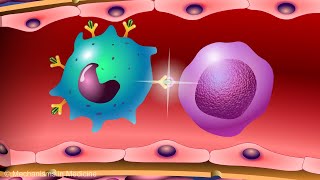

How Vaccines Mimic Infection
45sExplains the core concept of vaccines tricking the immune system, which is both educational and counterintuitive.
▶ Play Clip"Title accurately describes the content: a straightforward explanation of vaccine immune response."
Vaccines trigger an immune response by mimicking viral infection. Influenza vaccines use inactivated virus particles containing hemagglutinin (HA) and neuraminidase (NA) antigens. These antigens activate immune cells like macrophages, T cells, and B cells to produce antibodies and memory cells.
Influenza vaccines are made from inactivated or killed virus particles from circulating strains, containing HA and NA antigens.
Macrophages phagocytose HA, break it into fragments, and present it on MHC receptors to T cells.
T cells bind to MHC-antigen complexes, activating into cytotoxic, regulatory, or helper T cells. Helper T cells express HA receptors and aid antibody generation.
B cells internalize HA independently, present it with MHC, and upon helper T cell interaction, secrete lymphokines that trigger proliferation into plasma cells (producing antibodies) or memory B cells.
Memory B cells enable future immune response. If the vaccine strain matches the live virus, HA antibodies block viral attachment to host cells, reducing disease severity.
Vaccines work by training the immune system to recognize and neutralize pathogens through antigen presentation, T and B cell activation, and memory cell formation, ultimately preventing or lessening infection.
What antigens are present in influenza vaccines?
Hemagglutinin (HA) and neuraminidase (NA).
How do macrophages process hemagglutinin?
They phagocytose HA, break it into smaller components, and display it on MHC receptors.
What are the three types of T cells that helper T cells can proliferate into?
Cytotoxic T cells, regulatory suppressor T cells, or helper T cells.
What do plasma cells produce?
Hemagglutinin antibodies specific to the vaccine strain.
What is the role of memory B cells?
They aid in future immune response upon exposure to active influenza virus.
Key Mechanism: Macrophage Antigen Presentation
Explains the crucial step where macrophages display HA fragments on MHC, enabling T cell recognition.
B Cell Activation by Helper T Cells
Describes the interaction between helper T cells and B cells leading to lymphokine secretion and B cell proliferation.
Protection via Antibody Blocking
Summarizes how vaccine-induced antibodies block viral attachment, preventing infection.
[00:00] vaccines and the immune response how vaccines work influenza vaccines are able to trigger an immune response by mimicking viral infection they are usually manufactured using inactivated or killed virus particles taken from various circulating influenza strains inactive fractioned viral components contain the sub-virian particles hemagglutinin ha and neurominidase n a in Canada influenza vaccines are administered via intramuscular injection these fractioned particles containing the foreign antigens hemagglutinin and uraminidase are released from the vaccine into the bloodstream there they
[00:45] are met with an immune response mediated by various immune cells including macrophages T lymphocytes or T cells and B lymphocytes or B cells a major mechanism of action involves macrophage phagocytosis of hemoglutinin breaking it into smaller components after ingestion macrophages display the hemagglutin and antigen on their surface in combination with a specific receptor known as the major histocompatibility complex or MHC T cells are now able to recognize and bind foreign antigens that are associated with the
[01:29] MHC upon binding to the MHC receptor T cells become activated and proliferate into either cytotoxic T cells regulatory suppressor T cells or helper T cells activated helper T cells Express hemagglutinin receptors specific to the vaccine strand on their surface and play a major role in antibody generation and memory B Cell Activation unlike T cells B cells are able to ingest hemagglutin and independent of the MHC once internalized B cells process the hemagglutin and antigen and presented
[02:14] on their surface in combination with an MHC when activated helper T cells interact with activated B cells expressing antigen MHC receptors they begin secreting lymphokines which have several effects lymphokines trigger activated B cell proliferation which leads to either their differentiation into memory B cells or into plasma cells plasma cells produce hemagglutin and antibodies specific to the strain of influenza contained in the vaccine memory B cells Aid in future immune response when exposed to an active influenza
[02:59] virus when an infected host sneezes towards an uninfected person the nasopharynx is exposed to aerosol droplets containing whole live influenza virus once inhaled the influenza virus attempts viral colonization of nasopharyngeal epithelial cells assuming that the vaccine strain matches that of the live virus hemagglutinin antibodies block viral attachment of live influenza virus to host epithelial cells and overall disease is either avoided or diminished in severity
⚡ Saved you 0h 03m reading this? Transcribe any YouTube video for free — no signup needed.