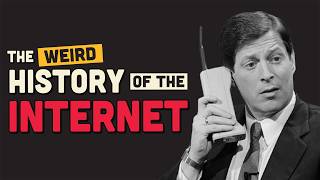

How the Internet Started: Sneaker Net
45sThe humorous contrast between ancient data transport methods and modern tech makes for a surprising and shareable origin story.
▶ Play Clip"The title 'The History of the Internet in 8 Minutes' is largely accurate as the video delivers a comprehensive, fast-paced history within the promised timeframe, though the final minute is a sponsor segment."
This video provides a fast-paced, eight-minute history of the internet, from the early days of computer networking to the modern era of AI and social media. It highlights key inventions, people, and cultural shifts that shaped the digital world.
The earliest form of computer networking involved physically transporting data on magnetic tape, known as the sneaker net, which was the fastest network for about 20 years.
The phone network used circuit switching, which reserved a dedicated line for the entire conversation. If any link in the chain broke, the entire connection died.
Paul Baran proposed packet switching: slicing messages into small chunks (packets) with destination addresses, allowing them to route independently through surviving network nodes.
In 1969, ARPANET sent its first message from UCLA to Stanford Research Institute. The system crashed after typing 'log' for the word 'login'.
Ray Tomlinson invented email and chose the @ symbol to separate the user's name from the host's name.
Vint Cerf and Bob Kahn developed TCP/IP, a universal language for networks. On January 1, 1983 (Flag Day), every machine on ARPANET switched to TCP/IP, marking the birth of the internet.
Paul Mockapetris invented the Domain Name System (DNS), a global phone book that translates human-friendly domain names into IP addresses.
In 1989, Tim Berners-Lee at CERN proposed the World Wide Web to link information across different computers and formats. He invented HTML, HTTP, URLs, the first browser, and web server, then gave it away for free.
In 1993, Marc Andreessen released the Mosaic browser, which could display images inline. It evolved into Netscape Navigator, the first popular web browser.
Microsoft built Internet Explorer and bundled it with Windows, crushing Netscape. Netscape's code was open-sourced, eventually becoming Firefox.
AOL brought the masses online with free trial CDs. Dial-up modems connected by screaming over copper phone lines, limited to 56 kilobytes per second.
Investors poured money into any company with a '.com' in its name. The bubble burst in March 2000, wiping out trillions of dollars and thousands of companies.
Larry Page and Sergey Brin developed PageRank, treating hyperlinks as votes weighted by the linking page's importance. Combined with an ad auction, it became a massive money printer.
Ajax allowed JavaScript to fetch data in the background with XHR requests, enabling websites to feel like apps without full page refreshes.
Mark Zuckerberg gave everyone a 'printing press' (Facebook). Steve Jobs introduced the iPhone, a phone with a real browser and constant cellular connection, putting the internet in people's pockets.
The internet's evolution from a military research project to a global, mobile, and AI-driven ecosystem has profoundly transformed communication, commerce, and culture. The video highlights the continuous cycle of innovation, disruption, and unintended consequences that defines the digital age.
What was the 'sneaker net'?
The sneaker net was the earliest form of computer networking that involved physically transporting data on magnetic tape by walking or driving.
00:20
Who invented packet switching?
Paul Baran invented packet switching.
01:02
What was the first message sent over ARPANET?
The first message was 'login', but the system crashed after typing 'log'.
01:17
What is TCP/IP and why is it important?
TCP/IP is a universal networking protocol invented by Vint Cerf and Bob Kahn. TCP chops data into packets and ensures delivery; IP gives each machine a numbered address. Its adoption on January 1, 1983, marked the birth of the internet.
02:09
What is the Domain Name System (DNS)?
DNS is a global phone book that translates human-friendly domain names (e.g., google.com) into IP addresses.
02:21
Who invented the World Wide Web?
Tim Berners-Lee invented the World Wide Web while working at CERN in 1989.
02:36
What technologies did Tim Berners-Lee invent for the Web?
He invented HTML, HTTP, URLs, the first web browser, and the first web server.
03:04
What was the first popular graphical web browser?
Mosaic, created by Marc Andreessen, was the first browser to display images inline. It later evolved into Netscape Navigator.
03:30
What caused the dot-com bubble to burst?
The bubble burst in March 2000 when the Nasdaq lost most of its value because many internet companies were not sustainable.
05:23
What is PageRank?
PageRank is an algorithm that treats every hyperlink as a vote, weighted by the importance of the linking page, to rank search results.
05:36
What is Ajax and how did it change the web?
Ajax (Asynchronous JavaScript and XML) allows JavaScript to fetch data in the background without a full page refresh, enabling websites to feel like apps.
06:13
The Sneaker Net
It highlights how far networking has come from physically transporting data to instant global communication.
00:20Packet Switching as a Military Solution
Shows the unexpected origin of a foundational internet technology born from Cold War military needs.
01:02Tim Berners-Lee Gives Away the Web
His decision to release the World Wide Web for free was crucial to its open and universal adoption.
02:36The Browser Wars and Microsoft's Strategy
Demonstrates how corporate strategy and bundling can shape technology landscapes, for better or worse.
03:43PageRank's Recursive Voting Mechanism
Explains a simple but powerful algorithm that became the foundation of Google's search dominance.
05:36[00:00] In the beginning, there were humans, and those humans captured the power of the skies, put it into rocks, tricked those rocks into thinking, and called them computers. But those computers are lonely. They can't talk to each other. If you want to move data from one computer to another, you ride it into a magnetic tape, walk outside, get in your car, light up a dart, and drive it across town.
[00:20] This is called the sneaker net, and for about 20 years, it's the fastest network on Earth. Then, in 1957, the Soviets launch Sputnik, a metal ball that literally does nothing but beep and scare Americans. In a panic, the U.S. government creates an agency named ARPA to ensure that they would never be big dork again.
[00:37] A few years later, a guy at the Rand Corporation named Paul gets handed a military problem. The Air Force wants to know how its command and control links could survive a nuclear first strike and stay alive long enough to order a counter-strike.
[00:50] The phone network of the day runs on circuit switching, where two machines reserve one dedicated end-to-end line for the whole conversation. Break any link in the chain, and the entire connection dies. Paul is smart. He comes up with an idea.
[01:02] What if instead of a dedicated line, you slice the message into small chunks called packets, and stamp each one with its own destination address, and let them scramble across the network independently, each one finding its own route through whatever nodes are still standing before getting reassembled on the other end.
[01:17] He invents what a rater be called packet switching, and in 1969, ARPA actually decides to build a thing, and they call it ARPANET. The first message is sent from a computer at UCLA, 350 miles away, to the Stanford Research Institute in Menlo Park.
[01:31] They try to type the word bargain, the system crashes after two rudders, the next thing you know... By 1971, the network connects 15 computers, and a man named Ray needs a symbol to separate humans from machines.
[01:46] He brings Shilin to his family by choosing the at symbol and inventing email. But there's another problem. ARPANET is just one network, but it's lonely too. There are other networks but none of them can talk to each other So two guys Vint and Bob sit down and invent a universal language called TCP slash IP The TCP chops your data into packets and makes sure they show up and IP gives every
[02:09] machine a numbered address so packets know where to go. On January 1st, 1983, every machine on ARPANET switches to TCP IP on the same day. They call it flag day, and the internet is born. But
[02:21] now we have another problem. Remembering numbered addresses is hard. So that same year, a different guy named Paul invents the domain name system, a giant global phone book that turns human-friendly domain names into the IP address where the computer lives. So now there's a global network
[02:36] connecting thinking rocks all over the planet. But it's the last place you'd want to be since it's only accessible to academics. Then in 1989, a British scientist named Tim is working at CERN, a particle physics lab in Switzerland. Tim is a smart guy and he has an idea. All these academics
[02:52] have information trapped on different computers in different formats, and there's no easy way to link any of it together. So he writes a proposal to fix it. His boss reads it and scribbles three words across the top. Vague, but exciting.
[03:04] That proposal was the World Wide Web. Tim goes on to invent HTML, HTTP, and a URL. The first web browser and the first web server on a computer with a sticky note begging people to not turn it off,
[03:16] because if they did, the entire internet would go down. But the coolest part is that he then gives it all away for free, because he wants it to belong to everyone. But for the next few years, the web is just an ugly wall of blue text until 1993 when a college kid named Mark
[03:30] releases a browser called Mosaic that can display images in line with the words. The browser shows promise, Mark graduates, moves to California, and turns Mosaic into Netscape Navigator, which quickly becomes the most popular software on Earth.
[03:43] From there, the information superhighway becomes mainstream and Bryant Gumbel asks, what is internet anyway? On the Today Show. Then, Microsoft wakes up, notices the internet exists, and panics. A horndog named Bill declares war.
[03:56] Microsoft builds its own browser called Internet Explorer and bundles it for free with Windows which is on about 9 out of every 10 computers on the planet by this point This gets unsealed by the government for being a monopoly but it kills Netscape whose dying body is scattered to the open source gods and is eventually reborn as Firefox
[04:13] Meanwhile, normal people are getting online for the first time through a company called AOL, which carpet bombs the planet with free trial CDs through the mail that 7-year-old me thinks would be fun to microwave. It is. Oh no. The microwave is on fire. Ouch, ouch, hot.
[04:27] To connect to the internet, your modem dials a phone number, then screams into the line to make a digital handshake. The two modems negotiate a baud rate and modulate ones and zeros into audible tones over a copper line that was originally built for human voices.
[04:41] You top out around 56 kilobytes per second, which means it takes roughly 8 minutes to download one song off Napster and give your computer aids. And because the modem is hijacked the same line your telephone uses, the second anyone picks up the kitchen phone, their voice gets dumped right on top of the modem signal.
[04:56] the two modems panic, fail to rethink, and the download flatlines. Now it's the late 90s. Everyone realizes you can make money on the internet, or at least convince other people that you're about to. Investors grow billions at any company with a dot-com in the name,
[05:10] and so companies will use OC-3 lines and stuffed data centers full of stunned servers to handle traffic that never comes. One company sells pet food online and lights its entire war chest on fire for a soft puppet Super Bowl ad.
[05:23] Another offers to drive a single candy bar to your door for free. None of it is sustainable, but Wall Street doesn't care until March of 2000 when the bubble pops, when the Nasdaq loses most of its value and thousands of companies vanish overnight.
[05:36] Sadly, a generation of young men on that mamakoko have to move back in with their parents. But a few survivors manage to crawl out of the wreckage, the biggest being two guys named Larry and Sergey who write an algorithm they call PageRank.
[05:48] The idea is to treat every hyperlink as a vote, then weight each vote by how important the linking page is recursively, so a link from a famous site counts for far more than a link from your blog. They take this idea then wire it up to an ad auction and turn it into the most profitable money printer ever built Meanwhile the browser continues to evolve and some call it Web 2 Under the hood a trick called Ajax lets JavaScript quietly fetch data in the background
[06:13] with XML HTTP requests and update a page without a full refresh, so a website can finally feel like an app instead of a pamphlet you need to keep reprinting. And now it's 2007. Civilization has peaked, but we don't know it yet.
[06:26] yet. A guy named Mark gives everyone their own printing press with a built-in back door for his shareholders. Around the same time, a guy named Steve pulls a rectangle out of his pocket. It's a phone that runs a real browser with an always-on cellular connection. The information superhighway
[06:41] escapes from our desk into our pockets. And the good news is that we no longer need MapQuest to navigate around the world. But the bad news is that it'll eventually rot our children's brains. And that brings us to today. When you visit an average website, you must first accept cookies.
[06:55] decline the newsletter pop-up, dismiss the app download nag, wait for 10 megabytes of JavaScript to download, before you can even read the content that probably wasn't even written by a human. Thankfully, two guys named Sam and Dario ingested the entire internet
[07:08] while tricking the rocks into thinking harder, and now they're renting it back to us at a premium. But while some companies are filling the internet with slop, others are trying to clean it up. Which brings us to CodeRabbit, the sponsor of today's video.
[07:20] AI can write code faster than ever, but reviewing 40 files of PR swap still feels like reading your code base through a paper shredder. The CodeRabbit review turns pull requests into guided walkthroughs. It groups related changes into cohorts, orders them into layers,
[07:34] and adds AI summaries so you can move through the change in an order that actually makes sense. Instead of one giant flat disk, you get what feels like an IDE for your pull requests. Your comments and approvals still go back to GitHub natively,
[07:46] and when it helps, CodeRabbit can generate diagrams in line for call flows, state changes, or schema updates. Over 100,000 open source projects like Bunn and Nux.js use CodeRabbit, and you can try it out for free with the link below. This has been the history
[08:01] of the internet in eight minutes. Thanks for watching, and I will see you in the next one.


⚡ Saved you 0h 08m reading this? Transcribe any YouTube video for free — no signup needed.