
Can I Master the Perfect Croissant in Paris?
45sPersonal challenge with an expert baker creates relatable aspiration and curiosity.
▶ Play Clip"The title accurately reflects the content: a chef learning to make croissants from a Parisian baker, with detailed steps and a speed challenge."
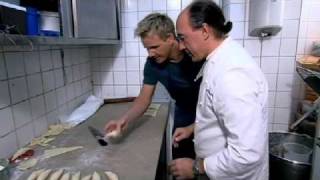
A chef returns to Paris to learn the art of making perfect croissants from a master baker. The process involves simple ingredients, precise technique, and a gentle touch to create over 70 layers of flaky pastry.
The dough uses flour, sugar, milk, salt, yeast, water, and eggs, then rests for 24 hours.
A slab of high-quality butter is added, making up almost a third of each croissant.
The dough is rolled and folded three times to create over 70 layers.
The baker hand-rolls 400 croissants daily; the chef managed only 13 in three minutes.
The final croissants are crispy on the outside, moist and layered inside.
What are the basic ingredients for croissant dough?
Flour, sugar, milk, salt, yeast, water, and eggs.
00:49
How long is the croissant dough rested before use?
The dough is chilled and rested for 24 hours.
01:05
What proportion of a croissant is butter according to the baker?
Butter makes up almost a third of each mouthful.
01:30
How many times is the dough folded to create layers, and how many layers result?
The dough is rolled and folded three times to create over 70 layers.
01:44
How many croissants did the chef manage to roll in three minutes?
13 croissants in three minutes.
02:55
How many croissants does the baker hand-roll each morning?
400 croissants every morning.
02:19
Layering technique
Explains the precise rolling and folding process that creates over 70 layers, a key to flaky croissants.
01:44Butter content
Reveals that almost a third of a croissant is butter, emphasizing the richness of traditional French baking.
01:30Gentle rolling
The baker's advice to 'caress, don't crush' the dough highlights the delicate handling required.
02:05Secret ingredients
The baker's simple answer—love, butter, good ingredients—underscores the philosophy behind quality baking.
00:37[00:00] As a young chef, I spent a couple of years working my ass off in Paris. I was very fortunate to live above the most amazing boulanger, eating croissants seven days a week. What I never got a chance to do was perfect the perfect croissant,
[00:12] so I'm going back to the floor to see if I can turn out a batch of croissants as a pro baker. Arnaud Delmontel has been hand-making croissants for over 20 years.
[00:24] He's a Parisian baker who's still producing the delicious rare handmade versions we're all missing out on. What's the secret behind your croissants? Um, love, butter, good ingredients.
[00:37] Yes. And can you teach the perfect croissant, or is it all in the feel? Ah, it depends of the student. Right. I hope I don't disappoint him. OK, so whose recipe is this?
[00:49] Did you steal it from an English chef? Not really. The ingredients to make the dough are simple. Flour, sugar, milk, salt, and yeast. But they're perfectly balanced, and the smallest mistake will ruin the entire batch.
[01:05] With water and eggs added, the dough is then chilled and rested to use for the next day's baking. Okay. 24 hours. So you're that far in advance every time you're always in advance? Yes.
[01:17] Using yesterday's pastry, the dough is gently rolled before we add the key ingredient. Okay. And that's the butter? That's the butter. So it's like a whole slab of butter in the middle. Voilà. The French love rich foods.
[01:30] And almost a third of every mouthful of Arnaud's croissants will be butter. The best butter you can find on the market. Which is rare today because a lot of croissants are made with margarine and cheap forms of fat. To produce the all-important layers in a croissant,
[01:44] the dough has to be rolled, then folded, rolled, then folded three times to create over 70 layers of dough and butter in each croissant. The pastry is cut into triangles and rolled into the famous croissant shape But you need to be gentle so as not to crush the layers It a technique the French have perfected
[02:05] And do it like this. So you're caressing it, like you're caressing a stroke. You caress, but you don't crush it. Right. Caress, but don't crush it. Every morning, he has the challenge of hand-rolling 400 croissants
[02:19] for discerning Parisiennes. Can I match his lightning speed? So there's 40 croissants here. Yeah. Normally, how long would that take to make a roll? Around three minutes. Three minutes. Okay.
[02:31] Three, two, one. To match Arnaud, I needed to be able to roll one every four and a half seconds. Attention. Two guys.
[02:43] Don't crush. Oh, shit. Ah, merde. Fifty seconds left. Cinq. Quatre. Trois. Deux. Un, zero.
[02:55] Shit. Fuck. So that's 13 in three minutes. So I'm ten behind. I thought coming back to Paris wouldn't be like what it was like 20 years ago when I was getting my ass kicked.
[03:07] The rolled croissants are then gently heated to activate the yeast so they rise. They're glazed with egg, and then they're baked. Right, it's been 20 minutes. I've come out crispy, golden, and delicious.
[03:22] Je t'aime. The smell was taking me back 20 years. The smell is amazing. I couldn't wait to taste if all our hard work was worth it. Oh, my God.
[03:34] Inside, perfect. Slight, moist, crisp on the outside, and that bit there. You see all the layers here? 25 years of experience. Le don, inside.
[03:47] Yeah. And some love. Oh, my God. That is amazing, honestly. And thank you for giving me a proper insight to a bit of French history.
⚡ Saved you 0h 03m reading this? Transcribe any YouTube video for free — no signup needed.