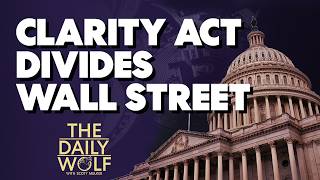

Wall Street Was Against Crypto Until It Made Money
55sThe dramatic reversal of major financial giants backing crypto is a perfect viral narrative for skeptics and believers alike.
▶ Play Clip"Delivers the promised Wall Street split, but pads with several unrelated news segments."
In this episode of the Daily Wolf, Scott Melker breaks down how Wall Street is picking sides on crypto regulation, with asset managers like BlackRock and Fidelity backing the Clarity Act while JP Morgan leads opposition. The show also covers Morgan Stanley's aggressive expansion into crypto ETPs and spot trading, Bitcoin miners pivoting to AI, a record-breaking hack year, and a cautionary trading tale.
BlackRock, Fidelity, Franklin Templeton, Goldman Sachs, and SoFi publicly endorse the crypto market structure bill, creating a divide with banks led by JP Morgan.
Jamie Dimon and the banks oppose stablecoin rewards and yield, fearing capital flight, while asset managers support the bill that could boost the industry.
The Senate recess begins on August 8th, leaving less than two weeks for Congress to pass the Clarity Act before the timeline tightens.
The Ethereum Trust (MSSE) and Solana Trust (MSOL) start trading on NYSE Arca with ultra-low 14 bps fees, and part of the holdings will be staked, with rewards passed to buyers.
Morgan Stanley's E*Trade now offers Bitcoin, Ethereum, and Solana spot trading to its nearly 9 million customers, completing a major retail crypto expansion.
Amy Oldenberg reveals that the first $200M in Morgan Stanley's Bitcoin ETF came from self-directed clients, before financial advisors even began positioning the product.
A 15-year infrastructure partnership for approximately 530 megawatts across five states, with initial deployments in 2027 and potential to scale to 2.5 gigawatts.
Q2 revenue hit $164.2M, but 83% ($136.7M) came from AI and high-density colocation; Bitcoin self-mining generated only $21.5M against $33.7M in costs.
A coalition of state attorneys general argues the CFTC lacks authority over sports prediction markets, deepening the turf war between state and federal regulators.
212 verified on-chain exploits — one every 20 hours — caused over $1B in losses; the Bybit hack last year was larger than all of them combined.
A trader grew $1.2M into $27M on memecoin options, then fell back to $3.8M in weeks — a cautionary tale about taking profits and avoiding roundtrips.
Scott Melker
person
Jamie Dimon
person
Brian Armstrong
person
Amy Oldenberg
person
Chris John Carlo
person
Fred Teal
person
BlackRock
service
Fidelity
service
Franklin Templeton
service
Goldman Sachs
service
SoFi
service
JP Morgan
service
Morgan Stanley
service
E*Trade
service
Core Scientific
service
AMD
service
Marathon Digital
service
Coinbase
service
Bybit
service
Which asset managers publicly backed the Clarity Act?
BlackRock, Fidelity, Franklin Templeton, Goldman Sachs, and SoFi.
00:56
When does the Senate recess begin?
August 8th.
03:28
What are the tickers for Morgan Stanley's Ethereum and Solana trusts?
MSSE for Ethereum, MSOL for Solana.
04:09
What fee does Morgan Stanley charge on its new crypto ETPs?
14 basis points.
04:25
How many customers does E*Trade have?
Almost 9 million.
04:52
What percentage of Core Scientific's Q2 revenue came from AI and high-density colocation?
Approximately 83% ($136.7M of $164.2M).
08:22
How much did Core Scientific lose on Bitcoin mining in Q2 before corporate expenses?
Spent $33.7M and earned $21.5M, a loss of $12.2M.
08:38
How many on-chain exploits were verified in H1 2026?
212, about one every 20 hours.
12:03
What was the potential contracted revenue in the Core Scientific-AMD partnership?
More than $14 billion.
07:30
Wall Street splits on crypto
Asset managers now publicly back crypto legislation while banks oppose it, showing institutional money is driving the industry shift.
00:40Morgan Stanley undercuts rivals with 14 bps ETH/SOL ETPs
The lowest-fee product launch signals aggressive competition for crypto ETF inflows.
04:09Bitcoin miners find AI more profitable than mining
Core Scientific's $14B AMD deal shows the pivot to AI is a wholesale industry change.
07:30Crypto hacks hit record $1B in half a year
212 exploits, one every 20 hours, with AI expected to worsen the threat.
11:50Roundtripping $27M is how not to invest
A concrete reminder to take profits on life-changing gains and not compare yourself to the peak.
14:08[00:02] publicly backing the Clarity Act. We basically have the asset managers on one side supporting it and of course the banks led by JP Diamond and JP Morgan many stories that we're going to break down today on the Daily Wolf. Let's go.
[00:26] Daily Wolf on Yahoo Finance. I am your host, Scott Melker, also known as the Wolf of All Streets. I have your undivided attention for 15 minutes, so sorry in advance. Tune out anytime you like, though. But I'm hoping that we can
[00:40] find some important signal here in all of the noise in the news that is the crypto media. And this first story, definitely more signal than noise. We've got Black Rockck, Fidelity, other Wall Street giants back the Clarity Act. So
[00:56] to to complete that list, it's Black Rockck, Fidelity, Franklin Templeton, Goldman Sachs, and of course, Sofly. All publicly endorsing the crypto market structure bill as the Senate's timeline tightens. So now I've told you that
[01:09] we've only got about a week and a half now to get the Clarity Act done. There's a major divide on Wall Street over who supports it and who is against it. We'll there was a time, I remember, when almost everybody was against it, right?
[01:22] everyone about crypto. Then they Once you realize you can make money in something, it becomes not so evil anymore. So of course, now we have some of them backing this fight alongside the
[01:37] crypto world. So listen, they're not watching from the sidelines anymore. is very simple. Black Rockck dominates the crypto ETF market. This has been their most profitable profitable product in history. Fidelity and Franklin
[01:51] businesses. You probably heard my interview with Sandy call from Franklin everything that they're doing in the space. So obviously they have a vested interest in seeing this pass. And then of course you have the banks like SoFi
[02:05] and Goldman Sachs here who have their own plans in crypto. And you know they want regulatory and legislative certainty here because this uncertainty right now interferes with their ability to launch products to allocate capital
[02:17] and to service clients. So they've pointed out in their random statements, they really want to see. They want to know clearly whether this is the CSDC, C SEC or CFDC's jurisdiction or which assets fall under each. They want very
[02:31] They want very defined rules for companies and assets and what they can do to create as they've called it a competitive American market. Now obviously the real fight is on the other side with Jamie Diamond and his bank JP
[02:46] Morgan. They've been leading the charge over stable coin rewards, right? Uh the fight over stable coin rewards. We know that uh Coinbase and Brian Armstrong industry and Jamie Diamond and the banks on the other. They think that stable
[03:01] coin rewards and yield could cause capital flight. And they said that they would fight tooth the nail. Jaime Diamond dropped Sbombs. Referring to Brian Armstrong, the CEO of Coinbase has gotten ugly. So, as I mentioned before,
[03:13] we kind of have the asset managers who benefit from the industry supporting it and JP Morgan and the big banks going against it. But most importantly, Senate recess begins on August 8th, and we have very, very little time to get this done.
[03:28] We will see if it does get done. Hopefully, we can stop talking about it Hopefully, we can stop talking about it soon, although I have my doubts. Uh, but getting some backing and they're not the only ones who are coming wholesale into
[03:40] Rockck Fidelity, Franklin Templeton, they've been here. They're back in the Clarity Act. There's another major institution that took a little longer to the industry, and that of course is Morgan Stanley. Here's the first story.
[03:55] Morgan Stanley Investment Management expands ETP offerings with launch of expands ETP offerings with launch of Ethereum and Salana exchange traded First of all, the Ethereum Trust is MSSE. Morgan Stanley Salana Trust Salana
[04:09] Trust is MSOL. MS. They're both trading on New York Stock Exchange ARCA. The big story, like their Bitcoin ETF with shock the market, they're coming in with the the market, they're coming in with the lowest fees of any product. 14% 14 bips.
[04:25] If you're in the industry, you say BIPS because it makes you sound like a smart person. So, they intend to stake part of their holdings in both of these. And profit from the staking rewards for
[04:38] back to the buyers of these products. Now listen, we we've talked a lot about Morgan Stanley being quiet and then coming in like a freight train to the recently. I told you E Trade for Morgan Stanley completes roll out of crypto
[04:52] spot trading. So now you can trade Bitcoin, Ethereum, and Salana spot on Erade owned by Morgan Stanley. They have almost 9 million customers there. and there and everywhere else you can trade Bitcoin, Ethereum, and Salana ETFs from
[05:08] Morgan Stanley. Now, I had a conversation with Amy Oldenberg, who is the machine behind everything happening in crypto at Morgan Stanley last week at the Audi Summit on this very show, and my assumption was that they were really
[05:20] my assumption was that they were really doing this to push to their own adviser I just want to play the clip really quickly. You obviously have a massive a Morgan Stanley product and you came in as you sort of alluded to at much
[05:33] cheaper. Was it 14 bit 16 bit? >> Well, you know what I have to say? I mean, it's interesting that you say that it it Salesforce, we do have a fantastic people that I get to work with on a regular basis, but I would uh I would
[05:46] have to say that first 200 million or so that was fully self-directed. So, we basically barely came out to market. That just came in um from clients that were placing trades. So, not even positioned yet by the financial advisors
[06:00] uh or by our sales team. Of course, that's picked up now uh in the last couple weeks to date, but it's been amazing to see even in those first weeks just how much was coming in just on on brand and effort alone. So,
[06:13] >> I found that fascinating and surprising. So that means that there were a lot of people sitting on Morgan Stanley or on E Trade who had accounts and waited until
[06:25] Morgan Stanley had a profit to actually allocate into the Bitcoin spot ETF in that case. And we're probably seeing the same with their spot offerings. And it's the numbers and the volume that comes
[06:38] which are being launched here in the depths of a bare market. let's be honest and if that's organic and what that means because imagine when they do turn on that sales force of 15 16,000 people and they really start pushing these
[06:51] products just how popular they could become. So Morgan Stanley's no longer giving clients permission to buy crypto here. They're competing to sell it to them and I think that that is the big story. Now another big story we have
[07:03] today is a continuation of a theme that I've been talking about here endlessly. Here's the story. Horse Scientific and AMD announced infrastructure partnership. So Horses Scientific was one of the biggest Bitcoin miners. You
[07:16] may remember I think they filed Chapter 11. They restructured. They were almost here. It's a 15-year agreement for approximately 530 megawatts with capacity across five states. This is more than 14 billion in potential
[07:30] contracted revenue. The initial deployments will be begin in 2027 and deployments will be begin in 2027 and this could scale up to 2.5 gawatt. So that we've been tracking here for all
[07:42] thing as a publicly traded Bitcoin miner anymore. All of them has realized that there's greener pastures and have officially rebranded as AI data centers. So, you know, Core Scientific finally discovered the most profitable thing it
[07:57] could possibly mine was a 15-year contract with AMD, right? I mean, apparently the real proof of work here was convincing an AI company to lease proof is in the pudding. I mean, you can dive into the numbers. Look at the
[08:10] second quarter results here from Course Scientific. Their total revenue was 164.2 million. 136.7 of that 164.2 too came from AI and
[08:22] high density collocation. That's approximately 83% of their total revenues. Now, here's where it gets really cool. Bitcoin self-mining revenue 21.5 million. So, 21.5 in Bitcoin versus 136.7 on AI. The cost of that mining
[08:38] $33.7 million. So, of course, Scientific spent roughly 12.2 million more mining Bitcoin than that mining generated in revenue before corporate expenses. So,
[08:50] it just shows how hard it is to be a pure Bitcoin miner in this industry, especially when prices are depressed. I saw a recent uh interview with Fred Teal from Marathon. He's the CEO, and he basically pointed out there's just way
[09:03] more profit to be made in AI than there is in Bitcoin. And Bitcoin miners have the infrastructure for this, build out these data centers, cool the machines, and flipping over to AI for them is relatively easier than building out
[09:18] entirely new infrastructure. These are no longer Bitcoin treasury companies. They're selling their Bitcoin to fund AI expansion. We're seeing a wholesale change in the way that Bitcoin miners, especially publicly traded Bitcoin
[09:31] miners, are operating. Now, our next story is another one we've been tracking story is another one we've been tracking and we got this coalition of 44 state attorneys general say CFTC lacks authority over sports to predict your
[09:45] market. So, it was either yesterday or Monday. Who knows which day it is, right? That we talked about the fact that Minnesota had basically tried to ban and criminalize prediction markets and the federal judge came over the top
[09:59] would probably win in court. So they didn't have the right to ban those we've told you over the last few months about this turf war between the CFTC and the United States federal government and the states over who gets to regulate and
[10:15] control and in the end of the day to some degree profit from prediction markets and whether these are in fact event contracts or whether they are simply gambling. Now I for a very long time was of the opinion that like if
[10:29] gambling on sports. As I told you yesterday though, my conversation that's coming out this Sunday with Chris John Carlo somewhat changed my mind because mechanically they are not the same and I can see the new odds. But I think that
[10:41] safest prediction right now is that the lawyers are going to make a hell of a lot of money. Right? This is going to keep going on for seemingly ever as the states say that a contract who wins a on who wins a game is functionally a sports
[10:54] bet even if there is not a bookie or the house in the middle which technically is what makes a sports bet or gambling a gamble that there's a house in the middle and they said that putting it on a federally federally regulated exchange
[11:08] does not magically turn into it into a financial derivative. So is it sports gambling or not? Obviously, these platforms say that these are event contracts and they say that that gives the CFTC exclusive jurisdiction and they
[11:22] say the states cannot individually ban regulated contracts. down the road between sports and other things or between betting on Love Island as we talked about yesterday and other things. But either way, that's 44
[11:37] things. But either way, that's 44 states. That is a lot of state attorneys coming in against the CFTC and the prediction market platforms. Now, here's a story we always loved, Dell. Not really. Crypto hacks hit record high at
[11:50] really. Crypto hacks hit record high at H1 2026 has lost his top $1 billion. So, listen. Bybits hack last year was bigger than all of these combined. So, I guess it's good news that we haven't lost as much money, but 212 verified onchain
[12:03] exploits. That's one hacked every 20 hours. I mean, these hackers officially have a healthier work life balance than I do. I mean, these guys are killing it. Just show up every 20 hours, take a couple million dollars here, hack your
[12:15] own government in North Korea, as we talked about. Very easy. So, listen, we Blockade, which sounds like a uh concert from the 1980s, but this company to get a hell of a lot worse when we get AI AI agents and AI deeply involved. And
[12:30] I think we can all agree that is true. Now for your favorite thing that happens every once in a while on this show. We're going to hit the music for our it. >> How Not [music] to [singing] invest.
[12:44] >> How Not [music] to [singing] invest. >> How Not to invest. >> Now, in past segments of our amazing part of the show called How Not to Invest, we made some pretty incredible calls, right? I would show the clips,
[12:56] but I can just tell you about it. You may remember that the day that it was reported that Korean retirees were selling their insurance and savings to buy SKH Highix and Samsung leverage ETFs. I pointed out that that could only
[13:10] end one way. You have seen the Cosby the Korean stock market circuit breaker down Korean stock market circuit breaker down almost every week since down now 40 50% down 96% the finance minister saying oops we
[13:24] shouldn't have approved those products. I told you when somebody put all their retirement account that they were an idiot. SpaceX was trading around 110 bucks, right? That guy is down 50% in a
[13:37] matter of weeks. Well, today we have a cautionary tale. It's one we can't tell already happened. This is going wildly viral. Bottom. This guy ran an account on memory stock options from $1.2 2 million in December all the way up to
[13:53] million in December all the way up to $27 million and back to $3.8 million in $27 million and back to $3.8 million in just a matter of weeks. Guys, if you hit a lottery ticket in markets that takes you up 27x and you have generational
[14:08] wealth, you sell some, right? You don't crypto, you've probably ridden things like this and roundtrip them. I certainly have. So, it's a cautionary tale for myself and others as well.
[14:20] Personally, I think he kind of made an idiotic move, but he has $3.84 million investment. Who thinks he should just sell it all right now, except that he over three times his money in a matter
[14:35] of months and go live on a beach. Can't compare yourself to that $27 million compare yourself to that $27 million top. How not to invest. Well, how not to getting done in the next week. Although I could be wrong about that. A lot of
[14:47] That's all we got today. See you tomorrow on the next Daily Wolf. Peace.


⚡ Saved you 0h 14m reading this? Transcribe any YouTube video for free — no signup needed.