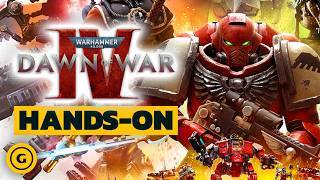

Dawn of War 4: A Return to Form?
45sFans of the series will be hooked by the promise of a comeback after the disappointment of Dawn of War 3.
▶ Play Clip"Delivers a solid preview of Dawn of War 4 with detailed impressions, though the title's promise of a 'return to form' is based on limited preview content."
Warhammer 40,000: Dawn of War 4 is set to release on December 3rd for PC, nearly a decade after the disappointing Dawn of War 3. Developed by King Art Games, the game aims to blend the large-scale base building of the original with the tactical squad focus of the sequel, creating a more active and mechanically rich RTS experience.
Dawn of War 4 is arriving almost ten years after Dawn of War 3, and previews suggest it is a return to form after the ill-received changes of the third game.
Dawn of War 2 moved away from large armies to micromanaging smaller groups, removing base building and using more enclosed maps, which was bold and positively received despite not being a traditional RTS.
Dawn of War 3 tried to meld both games' mechanics and chase esports, resulting in shallow systems and MOBA-like maps that disappointed both RTS players and the esports scene.
King Art Games, developer of Iron Harvest, takes over. Dawn of War 4 is billed as a modern interpretation of the first game, but previews show a more faithful melding of the original and sequel than Dawn of War 3.
The game feels very active, juggling large squads, upgrades, hero characters, vehicles, and a deep base-building system, making every mechanic feel important for victory.
The variety of mechanics often made the player feel too busy making decisions to see them play out, tempting use of the pause function, but the clicking was satisfying and better than being too inactive.
Dawn of War 4 brings back proper base building, adapting the first game's system with faction-specific mechanics. Orcs build quickly but weakly, while Adepta rely on interconnected networks that are strong but vulnerable.
The combat melds the large armies of Dawn of War 1 with the tactical squads of Dawn of War 2, allowing more units than ever while encouraging upgrades over replacement, and making unit loss more impactful.
Unlike Dawn of War 3's overpowered heroes, Dawn of War 4's commanders have helpful abilities but are vulnerable without support, allowing other units to shine.
The player looks forward to the Necrons and Space Marines campaigns, multiplayer, and innovations in the painter mode for miniature painting enthusiasts.
Dawn of War 3's Failure
Explains the exact reasons the previous game failed, setting context for the new entry's design choices.
01:08Active Gameplay
Highlights the core design philosophy of making every mechanic feel vital, a key differentiator from previous titles.
02:13Base Building Returns
Shows how the game adapts a classic feature with faction-specific mechanics, adding depth and variety.
03:53Hero Characters Balanced
Addresses a major criticism of Dawn of War 3 by making heroes supportive rather than game-breaking.
06:14[00:02] arriving nearly a decade after the release of the third game in the realtime strategy series. And after spending some time with an extensive preview build that covered the opening missions of two of its campaigns, I'm
[00:17] happy to report that it seems to be a return to form after the ill-received return to form after the ill-received changes in Dawn of War II.
[00:29] reinvented itself with each entry. Dawn of War II escued the first game's focus on amassing large armies in favor of micromanaging smaller groups or sometimes individual units. It removed the original's base building mechanics,
[00:44] and its maps were less of an open-ended sandbox, queuing closer to being an isometric action RPG. While these changes didn't sit well with some players of the original Dawn of War, others found the alterations to be bold
[00:59] and the game was received positively with many today heralding it as the best entry in the series despite it not being much of an RTS. With Dawn of War II, developer Relic Entertainment tried to meld the mechanics of both games while
[01:14] also attempting to capitalize on the growing popularity of esports. It was a textbook case of something made for everyone is something for no one, resulting in a game that largely disappointed the community. Players felt
[01:28] its systems were too shallow and disliked its mobile maps, mechanics, and focus on hero characters. As such, Dawn of War II never found success with either RTS players or the esports scene. Now, almost 10 years later, the
[01:44] Now, almost 10 years later, the franchise is back with Dawn of War 4. The reigns have been handed to King Art Games, the developer behind the steampunk RTS Iron Harvest, which was released in 2020. Dawn of War 4 is built
[01:57] as a modern interpretation of the first entry in the series. But after my time with its preview, the game appears to be a more faithful and functional melding of both the original game and its sequel than Dawn of War 3 ever was. The first
[02:13] word that came to mind after multiple campaign missions was active. You very quickly wind up juggling not only large squads of grunts, but also their upgrades and abilities, powerful hero characters that supplement said squads,
[02:27] plus all their skills, destructive vehicles and mechs, and a deep base building system that made me feel like I had just scratched the surface of what it had to offer. Dawn of War 4 makes every mechanic feel important and vital
[02:41] couple of core systems that make or break a match. Typically, I avoid using an RTS's pause functionality, as I like to lean into the real-time aspect of the genre when I play, but there were moments in my preview when I was tempted
[02:56] to click it because it always felt like I was playing catch-up to actions I needed to be taking and choices I needed to be making due to the meaningful variety of mechanics. However, this did often result in the feeling that I was
[03:10] too busy making my decisions to ever see them fully play out on the screen. By the time I'd clicked everything I needed to, my units were already wrapping up their current confrontation. It's been a while since I've capital P played an
[03:23] RTS, so it definitely felt like I was getting my sea legs again. And the pause functionality was of course always available for me to help get caught up. But even though I wished I had a bit more time to soak in all the grim dark
[03:37] battles, oh boy, was all that clicking satisfying. And I'd much rather my RTS games be too active than too inactive. A big part of why the game feels so hectic is a return to proper base building. After its removal in the second game and
[03:54] overly simplified implementation in the third release, Dawn of War 4 takes the fundamentals of the first game's mechanic and adapts it even further, leaning more into what makes each faction unique. For example, orcs can
[04:07] whip up ramshackle structures in a flash, utilizing any of their infantry units, and they have more freedom than other factions in where to build on the map. However, its scrap together nature means that orc construction is not
[04:21] nearly as durable as that of the other factions, and the decentralized nature of their facilities makes managing them more chaotic. Adeptus Mechanica spaces couldn't be more different, relying on a tightly connected network of buildings.
[04:36] This offers the faction strong fortifications, but it also means that if one link in the chain goes down, the whole system is threatened. For anyone who really enjoys the base building aspect of an RTS, King Art Games seems
[04:50] to have invested so heavily in fleshing out that feature that it could be a game unto itself. Of course, base building is only relevant if there are troops to deploy and enemies to defend against.
[05:02] consideration appears to have been put into the game's combat as its fortification construction. Dawns of War I 1 and 2 both approached conflicts in radically different ways, and the third
[05:14] entry was an ill-conceived attempt to marry the two. Dawn of War 4 attempts the same melding, but with far better connective tissue to create an entirely new system that stands on its own. The first Dawn of War was all about big
[05:28] armies smashing into one another, pushing players to feed their units into the meat grinder and replenish their forces back at base. Dawn of War 4 allows for more units on the battlefield than any previous entry, but it also
[05:42] encourages you to upgrade and bolster the squads already in the fight rather than cycling through them. Losing a unit has a much bigger impact on the game strategy than in the first game, as the squad you'll be replacing it with is not
[05:56] nearly as battleh hardened when jumping into the muck. Dawn of War II had a focus on smaller tactical squads. And those are also here too, bringing some dynamism to the battlefield with their unique mechanics that supplement the
[06:09] more straightforward offensive capabilities of the larger infantry capabilities of the larger infantry units. Players derided the uber powerful game-changing hero characters of Dawn of War II. And while this new entry
[06:21] features some potent commanders with very helpful abilities, they ultimately allow the rest of the units to do their best work, being extremely vulnerable and ineffective if caught without support. I cannot wait to dive deeper
[06:35] campaigns of the two other factions, the Nekrons and Space Marines, as well as put all these new systems to the test against other players. And as someone who loves to paint miniatures IRL even more than playing with them, I'm excited
[06:50] to see what innovations the game brings to its painter mode and if this will finally be the game that makes the hobby just as much fun digitally as it is physically. Dawn of War 4 will be released on December 3rd for PC.



⚡ Saved you 0h 07m reading this? Transcribe any YouTube video for free — no signup needed.