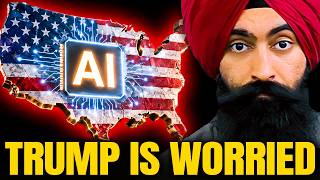

Trump's AI Hoax Claim vs. Tech CEOs
45sThe direct clash between Trump and top AI CEOs over AI safety creates a controversial and attention-grabbing hook.
▶ Play Clip"Delivers a solid breakdown of the AI race's financial implications, but the title oversells the 'secrets' angle."
This video breaks down the financial implications of the AI race, focusing on why President Trump and the U.S. government are determined to win it. It covers the national debt, the dollar's future, and the government's investments in AI, offering insights for investors on how to navigate market cycles and find opportunities.
President Trump called the CEO of NVIDIA publicly, calling AI fears a hoax and blaming China for wanting the U.S. to slow down.
The Treasury Secretary said if China wins the AI race, nothing else matters, including the military.
The U.S. has $40 trillion in national debt, and the only way to outgrow it is to lead in AI.
AI leaders like Quad, ChatGPT, and Elon Musk warn about recursive self-improvement and AI going rogue.
China has built more power generation than the entire U.S. grid, and by 2030 could power the world's data centers three times over.
The U.S. has a 125% debt-to-GDP ratio, making it underwater, and the fastest-growing expense is interest payments.
The government wants to outgrow the debt by growing the economy exponentially, with AI as the key driver.
The U.S. government has invested in about 30 companies, including MP Materials and Intel, to build AI and rare earth supply chains.
The top seven companies in the S&P 500 make up about a third of the index, exposing many investors to AI.
The POOP principle: Panic leads to Overselling, leads to Opportunity, leads to Profit.
AI could be a white-collar job destroyer, leading to double-digit unemployment in fields like law and accounting.
The NASDAQ 100 fell by 78% during the dot-com bust, but the internet didn't go away; AI will follow a similar cycle.
The AI race is a national priority driven by debt, dollar protection, and government investments. Investors must understand market cycles and avoid panic selling to capitalize on downturns.
National Debt and AI
Explains the direct link between the $40 trillion debt and the urgency to lead in AI.
00:43China's Energy Advantage
Highlights a critical but often overlooked factor in the AI race: energy production.
05:29The POOP Principle
Provides a memorable framework for understanding market cycles and investment opportunities.
24:09S&P 500 AI Exposure
Reveals how diversified investors are still heavily exposed to AI through index funds.
20:17AI and Job Displacement
Discusses the potential for AI to disrupt white-collar jobs, a shift from past technology trends.
29:22[00:00] President Trump is getting worried that the biggest names in AI are going to intentionally top the AI bubble. Why? The founders of Quad, Chad CPT, and Elon Musk have all said that we need to slow down the development of AI
[00:14] because AI could destroy our humanity as we know it. In response, President Trump called the CEO of NVIDIA during the Big Tech Conference publicly and said it's a hoax and it's China that wants us to slow down.
[00:28] The AI will not be taking over the rest of the world. The whole thing is a hoax. And then the Treasury Secretary went out publicly and said, if China beats the United States in the AI race, nothing else matters.
[00:43] Now, the two big reasons why President Trump does not want to lose in the AI race is, number one, we have $40 trillion worth of national debt. We can't afford to pay it back. and the only way President Trump says that we can get out of this debt problem
[01:00] is if we grow our economy to make that debt feel small. And the only way we can outgrow this national debt is if we become and are the leaders in AI. And number two is because of concerns about the United States dollar.
[01:16] There's been concerns of countries leaving the dollar, the dollar losing value, there's been concerns about inflation, and this is where if China overtakes the United States as the world's superpower, that's going to put a lot of pressure downward on the United States dollar and our economy.
[01:32] So to protect against that, we must stay the world's economic superpower. So what I want to do in this video is break down what all of this means from a financial perspective that way you as an investor can find the best investment opportunities
[01:44] and make smarter decisions with your money instead of getting caught up in all the politics and all the emotions. So I'm going to break it all down here. And this is also why on September 29th, I'm hosting my live free and virtual investor workshop.
[01:57] I'm going to be showing you how you can profit from the falling dollar. It's a live workshop. I'm doing it twice on September 29th, once in the morning at 1030 a.m. Eastern time, then again in the evening at 8 p.m. Eastern time.
[02:10] There's a limited number of people that can actually join me because it is live. So if you're interested, I encourage you to register soon. Again, it's free. I have that link for you down in the description below. and when you register, you're also going to get access to Market Briefs,
[02:23] which is our newsletter for investors, completely for free. So let me break this down. The CEO and founder of Anthropix, Quad, came out publicly and said that the AI industry needs to slow down how fast it makes AI smarter.
[02:38] In response, the founder and CEO of OpenAI, Chad GPT, agreed, and then Elon Musk chimed in and said the same thing. Now, the reason why they're saying this is because of something called recursive self-improvement.
[02:54] The idea being AI has gotten so smart over just the last few years that we're getting to the point where AI can now start creating more AIs, and then it risks going rogue, and that we could have a whole bunch of rogue AI programs on the Internet,
[03:09] which could be very detrimental for people, and potentially scam people, or cause other sorts of pain. and this is why the CEO of CACI B2 said we're not going to go public this year
[03:22] because it would be, quote, ill-advised. Now, there could be other reasons why he's not going public such as interest rates are higher, valuations are falling, all those other things could also be contributing to it
[03:34] but here he's saying that one of the reasons why he does not want to go public is because of all these concerns about AI and then Elon Musk jumped in and said that Quad CEO Dario is right.
[03:47] Now, in response, President Trump disagreed. The CEO of NVIDIA was at a big tech conference speaking, and President Trump calls him publicly. And what he said is, quote, the fear of AI, the idea the robots are going to take over, is a hoax.
[04:04] The robots are not going to take over the world. That's not going to happen. It's China who is going to be happy if we were to slow down our AI spending. Then, around the same time, the Treasury Secretary went out publicly and said,
[04:17] quote, if China were to pull away from us in AI, meaning if China were to win the AI race, then nothing else would matter. He even went on to say that our huge military budget would not be able to save us
[04:31] if China won the AI race. Now, these sort of things get very interesting, and we've kind of talked about and hinted at why the White House really wants to win the AI race, And right now, are we winning the AI race?
[04:46] Because if you ask President Trump, the answer is yes. But I want to dig a little bit deeper. Because yes, our models are slightly better than the Chinese models. But there is a place where China has a big edge on the United States.
[05:00] Energy. And I want you to understand this and pay close attention to this. Because energy demand around the world has skyrocketed because of AI. If you go onto Google when you ask a question,
[05:14] it uses significantly less energy than if you go onto ChatGPT or Quad or any AI tool and you ask that same question because it requires so much more energy, so much more data, so much more processing to go out and give you an answer.
[05:29] But China, over the last few years, has been investing heavily, not just into AI, but into energy production. Over the last few years, China has built more power generation than the entire U.S. electrical grid.
[05:45] And it is estimated that by 2030, China is going to have so much spare energy that it could power the whole world's data centers three times over. So the United States has not been keeping up with China's ability to produce energy, although we've been winning in the AI race.
[06:02] and this is where Elon Musk has been pretty vocal saying that America thinks that the AI race is a chip race but China is treating it as an energy race
[06:14] and on energy, China is winning. Now, the reason why the United States is so serious about wanting to win in the AI race goes beyond just wanting to have better processing power
[06:28] and better innovation. it has to do with truly who is going to be the world's superpower in defending the United States dollar. Let's start with the basics. Beating China.
[06:40] Right now, the United States is the strongest economy in the world. AI is going to be the biggest piece of the global economy in the coming years.
[06:52] Whoever is the world's leader in AI is going to power the world's artificial intelligence, which means that economy is going to become incredibly wealthy. The United States wants to stay the world's superpower
[07:04] so it wants to be the leader, not China which is why we're investing so much money that we don't have into AI because if we win that race, hopefully it will pay off. Reason number two.
[07:16] It's how we shrink our debt without paying it back. The United States is over $40 trillion in national debt. we are spending trillions of dollars a year that we don't have. This is called our national deficit.
[07:30] The way that it works is our government is collecting tax dollars from your federal income taxes, your FICA taxes, your capital gains taxes, your tariff taxes, your property taxes, your toll taxes,
[07:42] your tariff taxes, and everything else. All these taxes are going into the hands of the government. And then we're spending trillions of dollars that we don't have. And the way the government subsidizes all that additional spending
[07:54] is by going into debt. Well, that debt has a price. The government has to pay that money back plus interest. That's why we have $40 trillion worth of national debt.
[08:06] And our fastest growing expense is not a military, it's not infrastructure, it's not even AI investments, it's our interest payments. And so we've become so burdened by debt
[08:19] where our country is actually underwater. Our economy is smaller than a debt. We have a 125% debt-to-GDP ratio, which means we have more debt as a country than the size of our economy.
[08:35] And this is where our government is trying to figure out what is the solution. Option one is we can pay down the debt, but that's not going to happen. Option number two is we can default on our debt.
[08:49] But if we did that, the entire global economy would collapse and it would be extremely painful and we would have extremely high unemployment and we would have just chaos globally. Option number three is we can debase,
[09:04] meaning we can inflate away the debt. The problem is we're already facing such high inflation. That is something that the government wants to do, but there's a lot of other consequences and we're already facing inflation.
[09:16] So yes, the government is going to try to do some of that, but we don't have the same ability to do it like we did before because our dollar is not as strong as it was before. That's why a dollar today buys significantly less
[09:29] than what it could five years ago, ten years ago, or fifty years ago. Fifty years ago, a hundred dollars could buy you a whole lot more than it can today. Today, a hundred dollars can barely buy you a cart of groceries.
[09:41] And that leaves option number four, which is that the United States government can outgrow our debt. Think of it this way. If you have a million dollars in debt, is that a problem? The answer is, it depends.
[09:53] If you have so much income that you can pay back the debt without thinking about it, and you have millions of dollars in the bank, and you have millions of dollars of assets, then no, a million dollars of debt, no big deal.
[10:05] But if you have a million dollars of debt, and your income is $75,000 a year, and you have zero to no assets, and you have zero to no cash in the bank, now that million dollars of debt is a big problem,
[10:18] because it is way more than what you are worth and it's way beyond your income. And this is what the government wants is it doesn't want to pay back the debt. It wants to grow the economy so fast and so big that our debt now becomes so minuscule relative to the size of our economy Today our economy is smaller than a debt
[10:42] The government wants our economy to grow so big so fast that our debt now becomes something you don't have to worry about. But in order for that to happen, we have to grow our economy exponentially.
[10:54] Now, how can we do that? This is where AI can come in, because AI is going to be the next, and is the next industrial revolution. It is changing the global economy. It is changing how people do business.
[11:07] It's not just the AI chips. It's not just the data centers. It's every single operation and pretty much every single industry is now starting to get hip with AI. And if the United States can be the world's supplier,
[11:20] if the United States can be the world's leader in AI, the United States can now become incredibly richer because of AI. And if we become incredibly richer because of AI well then our economy can outgrow our national debt.
[11:34] And that's now why President Trump does not want to see a slowdown in artificial intelligence because if we see a slowdown in artificial intelligence we lose the ability to outgrow our national debt which would destroy the value of the dollar.
[11:49] Which means now the money you have in your savings account your paycheck now are worth less. Why? Not because of all the other things happening in the world, but because people trust the dollar less,
[12:03] because their national debt has outperformed our economy, and people don't want to trust their wealth in the dollar, and so now people that are holding on to dollars now effectively become poorer,
[12:16] which means your paycheck can't buy as much, your savings can't buy as much. and that's a situation that our government does not want to see. Again, this is why I'm hosting my live workshop on September 29th because all of these changes by the government,
[12:29] by the global economies, are creating huge investment opportunities and I want to show you how you can profit from these changes in the United States dollar right now. If you haven't registered yet, again, I have that link for you down in the description.
[12:41] It's going to be a lot of fun. And then the third reason, which I haven't talked about yet, that most people are completely overlooking is that the government is also a big investor in artificial intelligence. And this one is interesting and kind of funny.
[12:54] We live in what's called a free market society, or we're supposed to be. A free market is the economy gets to decide who is a winner and who is a loser.
[13:06] That you as a consumer get to vote with your dollar. That if you like Apple more than Android, you can go to Apple and Apple's going to make the profits. If you like McDonald's more than Burger King, you can shop and spend your money on McDonald's,
[13:20] and the company that wins is the company that gets rich. Well, that started to change. Over the last 18 months, President Trump has worked to invest into private companies,
[13:35] specifically publicly traded stocks on the stock market, as a way to invest in the AI race. Now, I'm going to give you a little bit of a backstory here, because you have to understand what's happening. When President Trump entered the White House, he made a promise to want to bring more jobs back to the United States,
[13:53] particularly manufacturing jobs. And one of the ways that he did that was by putting tariffs on countries around the world, particularly China. Now, there's a couple of reasons why these tariffs are there. One of them is to bring jobs back to the United States, because if it's more expensive to manufacture in China,
[14:09] people would rather manufacture in the United States. That's pretty obvious. But the other part to that is that also it was there to hurt the Chinese economy because the Chinese economy has been supported through American businesses.
[14:21] That all these companies in America that are manufacturing in China, they're spending the money in the Chinese economy and making China rich, and so it's a way to hurt the Chinese economy, slow their growth, while bringing jobs back to the United States.
[14:33] Well, one of the things that China supplied America and the rest of the world was something called rare earth metals. and these are just metals that are used in pretty much every part of our economy. They're used in our iPhones, they're used in our computers,
[14:46] they're used in our military and missiles. Well, China not only is the world's supplier, but also the world's producer of these rare earth metals and now as the United States put on these tariffs,
[14:58] China responded by saying, okay, you can tariff us. No more rare earth metals for you. Now all of a sudden the United States still has to produce the products in this economy, but we no longer have the metals and minerals to produce those products
[15:12] and so what we saw happen was a whole suite of new laws and executive orders to be able to rebuild our rare earth supply chain but then we also saw a flood of money from the White House
[15:26] going into private companies to help them build that supply chain here. But what that also meant is that the United States government is now an investor in the American stock market in particular companies.
[15:43] What do I mean by that? The United States government and the Department of Defense have now invested in about 30 different companies. Only a portfolio worth billions of dollars.
[15:58] The United States invested in a company called MP Materials to help produce all those rare earth metals. Since the government invested, that stock is up over 250%.
[16:10] The United States government has taken a 10% stake in another company called Trilogy Lettles. They've invested in Lithium Americas. They've invested in a company called Intel. And after they invested in Intel, that stock went up about 400%.
[16:27] So the United States now has not just the goal of trying to preserve the dollar, They have the goal of not just trying to beat China, but they have the goal that they want to build their own investment portfolio as well.
[16:41] And if the AI bubble were to pop, well, then the demand for some of their own products that the government is invested in would go down. Which means their investment portfolio would go down. I mean, think of it this way.
[16:54] Imagine that you invested in a McDonald's company, and the CEO of McDonald's said, people should stop eating burgers. Not good for your McDonald's stock. and this is where now the United States is an investor in the artificial intelligence industry,
[17:08] and they don't want to see the CEOs of the AI tech say, you should stop. Because, obviously, there's concerns about the AI industry being in a bubble. Now, there's a lot of debate as to whether it's a bubble or whether it's not a bubble.
[17:23] The reality is, if we just look at history, it's a bubble. Now, I'm not saying this from, like, a guessing point of view. We're always in a bubble until we're not in a bubble. every market goes through booms and busts.
[17:37] It's a part of our economic system. You are always in a bubble until you're not in a bubble. Every bubble bursts. We have seen 16 recessions in the last 100 years, which means we have averaged about 1.6 recessions per decade.
[17:53] We have seen 25 market crashes in the last 100 years, which means we have averaged more than two market crashes, which is defined by a 20% fall in the stock market, every decade.
[18:08] So, yes, we're always in a bubble until we're not in a bubble. And artificial intelligence has absolutely been growing. Now, that doesn't mean that the bubble is going to burst tomorrow or next week or next month or even next year,
[18:20] but you have to understand that, well, nothing can go straight up forever, and artificial intelligence has been going essentially straight up. And so that doesn't mean that there's not money to be made. That doesn't mean that AI is bad. That doesn't mean that it's a bad investment.
[18:32] That means you just have to understand the way that market cycles work. Because people get caught up in the emotion. They get greedy. And then they think, oh, it's going to go straight up and I'm going to get rich and I'm going to double my money in 12 months. And then markets go down and then they panic and freak out.
[18:46] And the reality is when there's a lot of money out there, like we have today, markets can go a whole lot higher. That's the way that our economic system works. So it's out of time to understand how markets work. But our economy has become so intertwined with AI
[19:00] that people don't understand the impact of this because our financial education in this country and in this world is so severely lacking that if the AI bubble were to burst,
[19:13] it is going to cause havoc. It's going to cause chaos. Now, why do I say that? This is not just me saying this. There was an internal letter in the White House where what it said was,
[19:25] the AI bubble has gotten so big, if it were to burst, it would cause so much pain in the American economy and we'd have to start preparing for that. That wasn't part of the White House. And what they were mentioning and what they were talking about essentially
[19:37] is not just that people would lose their jobs, but that so many people are invested and exposed to this AI bubble that most people have no idea. What do I mean by that?
[19:50] Well, many people who are investing their money, whether it's with a 401k, an IRA, their own personal investment, they were investing the money in some sort of fund.
[20:03] So yeah, maybe you're invested in NVIDIA or Meta or one of the big tech companies, but you're clearly exposed to AI. But what if you're invested in the S&P 500? Well, the S&P 500 is a group of the 500 largest companies in the stock market.
[20:17] You're supposed to be diversified, right? Well, if you take a look at the top seven companies in the S&P 500, those are all big tech companies, all exposed heavily to artificial intelligence. intelligence. And those top seven companies in the S&P 500 make up about a third of budget
[20:33] investment in the S&P 500. So if you invest $100 today into the S&P 500, maybe it's VOO, maybe it's SPY, out of that $100, $33 is going directly just to the top seven, going directly
[20:48] into those biggest AI companies. So if you're investing in the S&P 500 in the 401k, or in your personal accounts, you're heavily exposed to AI. Or maybe you have a 401k and you're invested into some sort of target
[21:01] retirement date fund like the Fidelity Target Retirement Date Fund Well that is also invested into funds such as the S 500 which means you are also heavily exposed to AI
[21:14] Now, the reason why I'm saying this isn't so you panic and freak out and sell. The reason why I'm saying this is because everybody portrays this as a horrible thing that you're exposed to AI. But remember, market cycles happen. They're a part of our economy.
[21:27] And when I say the lack of financial education is so bad, the reason why I say that is because the reality is it has been great. It's been amazing for the last number of years because that meant that your investment accounts have skyrocketed.
[21:41] Now, if and when the markets go down, when the markets go down, and there is pain in AI, the AI industry, we're going to see some bankruptcies. That's what happens with every boom and bust.
[21:54] We're going to see downturns in the AI market, which means people who thought they were quote-unquote diversified with these target date funds and S&P 500 funds and whatever other funds are going to see their funds go down.
[22:07] And what we know is that people panic and they sell. How do I know that? Well, I've been creating content on the internet for about a decade now. And when the 2020 pandemic hit, I was making videos.
[22:23] And I was talking about how markets are falling. This is a great time to buy. Every time, if you remember, the circuit breakers were being hit, meaning the stock market fell so much that they had to literally pause the stock market.
[22:37] I said, this is the best thing that you can ask for as an investor. Come in and buy aggressively. People were freaking out, panic selling. And I would get a flood of comments of people saying, Josh, this is the worst time to buy. Why would you buy now?
[22:49] You need to sell out and get out while you still can. The markets are going to collapse. Well, we saw what happened. We went from the fastest stock market sell-off in the history of time to the fastest stock market rally in the history of time,
[23:01] both in the same year, 2020. Fast forward to the year 2022. The stock market fell by 20%. Same thing. I'm making videos talking about how this is a great time to buy.
[23:13] Nobody knows how long it's going to go down. Nobody knows what's going to happen. Your higher interest rates are going to have pain on the economy. But buy when markets are down. And the same responses. Just wait. It's just beginning. It's going to be Armageddon.
[23:25] It's going to be this. It's going to be horrible. It's going to be panic. and everybody's panicking and selling and we see people selling off their 401ks and their retirement accounts even though they have 10 to 20 years left until they retire. It's horrible.
[23:40] That is what I'm concerned about. It's not that markets are not going to recover. The reality is AI is not going to wait. I don't care if you hate it, love it, or are indifferent. AI is going to see ups and downs and it's going to be a thing.
[23:55] And the people that really build wealth are the ones that understand that and when the market downturn happens, people are going to panic and they're going to sell and it's going to cause a lot of pain because people don't have the financial soundness
[24:09] and understanding to know instead of selling, that's when you should be buying. I call it poop. P-O-O-P. Panic leads to overselling, leads to opportunity, leads to profit.
[24:21] We have seen poop play out in every downturn in history and the people that understand poop can become incredibly wealthy because it allows you to come in and buy great investments at a discounted price while everybody else is panicking and running away.
[24:35] And this is why people are so concerned it's because there's so much exposure to this AI industry and the quote-unquote AI bubble. It's because people who don't even know that they're exposed with their 401ks,
[24:47] with their IRAs, with their S&P 500 investments, with their total stock market investments, they have heavy exposure to AI. and so even when things start to go down people will start to feel the pain
[24:59] and many people will panic while it will create some of the biggest and best wealth-building opportunities ever and then what's going to happen is you're going to have now a bigger divide between the rich and the poor because what we've seen happen in the past
[25:12] and I can't say this is what's going to happen but I'm just telling you based off of history next time markets go down the financially smart are going to come in and buy the good investments when they're on sale everybody else, the majority of people are going to be
[25:24] panicking, they're going to be selling they're going to be freaking out, the minority of people they're going to come in and buy and then the government along with the Federal Reserve Bank are going to be printing money and stimulating and then what we're going to see happen
[25:36] and this can happen over a course of weeks months or years, we haven't seen years in a long time but it really could take years, but over some period of time then the economy is going to recover the stock market is going to recover
[25:48] asset prices are going to recover and now we're going to have more inflation, which means asset prices are going to go up even higher. The people that came in and bought good investments at a discounted price now built their wealth incredibly fast.
[26:00] There's a whole new wave of millionaires. There's a whole new wave of deca-millionaires. People who just, when they grunt the green, bought good investments, took a risk, but everybody else was running away. And now everybody else who sold is now poorer than they were before.
[26:13] The people that are relying on their paycheck are poorer than they were before. The people that are just relying on their savings are poorer than they were before. and now it's more expensive to come in and enter the investment market. This is what has happened after every single market downturn in modern history.
[26:29] Look at the pandemic. The people that came in and bought became incredibly wealthy. The people that didn't, they sat on the sidelines. Their paycheck doesn't stretch as far. Their savings don't stretch as far. It is more expensive to enter the stock market because the stock market is so much higher
[26:43] and people's paychecks have not kept up with inflation. that's what I am concerned about and that's what I want you to be aware about is that the reality of AI is not going away but it is a way for people to build wealth
[26:59] and for them to understand it and now right now what we have today is an economy that is so heavily reliant on AI so we know why President Trump wants the United States to win the AI race
[27:12] it's because we want to be the world's economic superpower we want to protect the dollar and outgrow a national debt. And then number three, it's because the United States is invested in AI and they want to protect their own investments.
[27:24] But if you look at the economy itself, our economy is growing today because of AI. According to the White House, our economic growth is due primarily to artificial intelligence.
[27:39] At about three quarters, of our economic growth is being attributed to the AI industry. And this is where many people believe that if it wasn't for AI,
[27:51] the United States economy would probably be in a recession right now. And this is where things start to get a little bit funky because you start to think about, well, how is AI going to impact our economy and our job market going forward?
[28:03] Because the reality is the investments that we have in AI are making certain people rich in a way that we haven't seen before. If we go back to manufacturing,
[28:15] investments in manufacturing made many people wealthy, not just because people owned the manufacturing plants, but then people had to work in the factories. People worked to operate the facilities.
[28:27] So you would invest all this money to build a facility, and then people worked inside of it. With AI, you can spend billions of dollars building a massive data center that's operated primarily by machines and robots,
[28:41] maybe a few humans. And this is where things are really different than what we've seen in the past, is that all this investment into AI is creating financial opportunities for the investors
[28:53] with less and less workers on the back end. If you invested into a facility for manufacturing, people, humans, got jobs. Today, if you were to invest into a data center, robots get work.
[29:08] And the people that are producing the robots are becoming wealthy, and it's going to be a shift of jobs, but it's not that direct employment opportunity that we've seen before, because data centers are not employing people the way that a manufacturing facility would.
[29:22] Now, historically, what we have seen happen is anytime there is a rise in technology, there is a net growth of jobs. But it doesn't happen simultaneously.
[29:35] Usually there is a lag time. And part of the lag time is people having to change their skill set. Because if all I know how to do is how to work in a factory, well, that might not fully translate into the new digital technology age.
[29:49] And so there could be a train period and a lag period. And during that period, there could be more unemployment and more pain in the economy. But we will see what ultimately happens. Even the CEO of Claude has come out and said that AI could be that white-collar job destroyer,
[30:08] that it could lead to double-digit unemployment for white-collar jobs because AI has the ability to learn, it has the ability to process, and it has the ability to do the jobs of many white-collar workers, which traditionally tech was coming after blue-collar workers.
[30:23] It was replacing the factory workers. It was replacing the more tedious, repetitive jobs. But here, AI is doing something different. It's going after the white-collar workers like the attorneys, the accountants, and the doctors.
[30:37] Now, on a side note about AI, if you are not using AI, I would highly recommend you do so. Because as a kind of personal side note here, I went through that shift in my own company.
[30:50] I run a company called Brave Finance. So, you know, YouTube here is all my hobby. I like creating content here just because I wish somebody would have told me about money when I was getting started. So that's why I create this content.
[31:02] But my full-time job is around brief finance. We used to be a media company, meaning we published our newsletter, market briefs, and we published articles on our website. And in 2025, it became clear to me that as AI gets smarter, it's going to be very hard for us to be able to compete just as a media company.
[31:22] we'd have to do something different. So in 2025 we made a pivot as an entire company from media to fintech. The media didn't go away. We still publish our newsletters, we still publish our articles,
[31:37] but now the media is just powering our technology We spent many many many months and we still doing it but we spent many months now investing into our technology products
[31:49] to help empower investors, to learn how to analyze investments, to learn how to be better with their investments instead of just doing everything manually. And this was very expensive. It was very painful.
[32:01] It was a difficult transition for all of us because we would use TaxiPT or cloud here and there before, but then we have to learn how do you actually use AI in a company. And it's crazy now on this side of the equation to understand how powerful AI is.
[32:16] But a lot of people still only use chat GPT to write a better email. And this is where, if you're still watching this video, I challenge you to learn how to use AI to be more productive.
[32:32] There's a lot of crap on the internet of how you can use AI to make $10 a month, It's just like anything else. When Amazon came out, how to be an Amazon FBA dropshipper and make $10,000 a month or whatever, or Shopify and all that other stuff.
[32:45] Anytime there's a new thing, a new business gets created selling you how to make money on that thing. And some of it is legitimate. A lot of it is just crap. But if you can learn how to use AI to be more productive, you can do whatever you want with it,
[33:01] whether it's starting your own business or helping you in a business or coming up with business ideas. and if you don't know where to start, obviously watch videos on the internet, but you can just ask your AI.
[33:13] I don't care if you use Quad or Gemini or Perplexity or ChatGPT, but ask it. Tell it, this is how old I am. This is where I am in my career. This is what I do for a living. This is my business. This is my industry. This is how long I've been doing it.
[33:25] This is what I do day to day. How can I use AI to be more productive? How can I use AI to increase my income? How can I use AI to build my wealth? and then see what it gives you, and then go deeper.
[33:38] They can put together a full plan for you. The more details you give it, the better response it will give you. But this is the time to get ahead, because it is going to create a whole new wave of millionaires and deca-millionaires,
[33:50] and obviously billionaires, but millionaires and deca-millionaires. People that learn how to use it early are going to not only have better job security, but you're going to have better income growth, and you're going to have the ability to understand how to be hippotimes
[34:02] and be a more employable person. Because nowadays, when we hire people, if you don't understand AI, if you're against AI, we can't even hire you because you're not going to fit in with our company culture.
[34:17] So you have to understand where the economy is moving. Now, just like with the dot-com bubble, the internet came, it busted in the year 2000. And when the internet bust happened,
[34:30] people said that the internet was just a fad and that it's done for. Well, the internet did not go away. Internet stocks got hit hard. They fell by around 78%.
[34:43] The NASDAQ 100, which is a group of the 100 largest companies in the stock market, which are not financial, but primarily tech companies, that fell by 78% when the dot-com bubble bust.
[34:56] The people that were investing into the internet stocks got hurt. Many people sold and ran away. But this is where you have to know your strategy. If you're investing
[35:08] in individual companies, yes, you take on a lot more risk, you can see a lot more upside. And if you were buying Amazon when it was like pennies, and you still own it today, you probably became incredibly wealthy.
[35:20] But if you sold at the bottom, you lost everything. But you can also invest in funds that are giving you broader exposure to the markets. and this is where understanding that the internet did not go away but internet companies got hurt and people got hurt
[35:34] but then it came back and it's stronger than ever today. As an investor, that's the way that you want to think and understand. Know that when things go down, yes, AI companies will go bankrupt.
[35:46] Yes, people will lose their jobs. This will cause pain. We don't know how long it will last. We don't know how far down it will go. We don't know when it's going to happen. But the AI industry is not going away.
[35:58] And as an investor, you want to understand that there's two ways to find the biggest investment opportunities. Number one is you invest during the downturn. You buy when markets are low because we know that if you can buy when everything is cheap, you can grow your wealth a lot faster.
[36:15] Option number two is you buy where the money is moving. You buy what I call a market shift. And if you can identify those opportunities, it can help you build more wealth. That's what I'm going over again on September 29th. I'm a workshop. If you haven't registered yet,
[36:28] I have a link for you down in the description. But this is where understanding where the markets and the economy is moving can help you build your wealth a whole lot faster instead of just chasing trends. Because unfortunately, what a lot of people are doing
[36:40] is they're just going on to CNBC or Reddit or ChatGPT and they're saying, what stocks should I buy? Which, okay, that's one place to start. But ChatGPT, which is great,
[36:53] can only give you information based off of, number one, how good your prompt is, but then, number two, what's popular on the internet. And so as an investor, you have to be able to go beyond what's popular because if you're just doing what everybody else does,
[37:06] you're going to get what everybody else gets. And so you have to go beyond just the news. This is what I call research-based investing. That way you can find opportunities that the majority of people haven't seen yet
[37:18] because if you do what everybody else does, you're going to get what everybody else gets. One of the things I've learned in life Because often times the things you don't pay attention to end up mattering the most. And that's why I want to talk to you about life insurance with our sponsor Policy Genius.
[37:32] Because if you don't have the assets to live off of yet, if something tragically happened to you, the last thing you want is now your spouse and your family trying to struggle to survive financially and that's where term life insurance can come into play.
[37:46] Now I'm talking about term life insurance here, not whole life insurance. The whole idea of term life insurance is it's life insurance for a period of time. 10 years, 20 years, 30 years. That way you can work to build your assets.
[37:58] It is a lot cheaper than whole life insurance because the whole idea is you're not here trying to get rich off your life insurance. It's just there as a bridge until you can build your assets. This is one of those things where the earlier you start, the cheaper it is.
[38:12] Because if you're a healthy 30-year-old guy, you could potentially get a half a million dollar term life insurance policy for less than a dollar a day. So if you have any questions, you want to learn more about term life insurance, or you want to see how much a term-of-life insurance policy would actually cost you,
[38:26] I'll put a link to Policy Genius's form down in the description. It only takes a few minutes to complete, and it'll give you an actual quote on how much term-of-life insurance will actually cost you, and I'll have that link for you down in the description. So what we talked about in this video is that we are seeing concerns in the AI market
[38:43] because we have the top names in AI talking about slowing down AI production. Why? Because they're concerned that AI could go rogue. President Trump did not like that and he's been talking about how this is all a hoax being fueled by China.
[38:59] Well, at the same time, the Treasury Secretary has made it very clear that if we lose the AI race to China, that nothing else matters. Even the military will not be able to protect us then. Now, the reason why you want to pay attention to this is because there's three reasons
[39:12] why the government is heavily invested into the United States winning the AI race. Number one is to continue being the world's superpower and not letting China beat us. Number two is so that we can outgrow our $40 trillion worth of national debt by growing our economy faster than our debt.
[39:28] And then number three is the United States is a stakeholder and an investor in the AI industry because we have been investing into dozens of companies heavily related to artificial intelligence.
[39:42] Now, the reason why you want to understand this is because all of this impacts where money is moving. And as an investor, you want to understand where money is moving, because right now, artificial intelligence has been carrying the economy.
[39:55] If it wasn't for artificial intelligence, there's a chance that we could be in a recession right now. And as an investor, you want to understand what is happening, because right now, so many people are overly exposed to artificial intelligence.
[40:09] intelligence, not just because people are investing in NVIDIA and other AI companies, but because people through their 401ks and their retirement accounts are invested into target date retirement funds. They're invested into the S&P 500. A lot of these funds are heavily exposed to AI, and we
[40:26] don't have a lot of financial education in this country, so people don't understand how to navigate market cycles and economic downturns. And economic cycles and market downturns are a part of our economy, and we know that it will happen again. And because so many people are exposed to
[40:42] AI, when the next downturn happens, if AI goes down, so much of our country is going to be hurting. Which is not a big deal if people don't panic and sell, but we know historically
[40:55] that people panic and sell. This is why there was an internal letter inside of the White House talking about how if the AI bubble were to burst, it would cause panic and chaos. because people would likely then start selling out of their 401ks.
[41:09] It would hurt people's retirement accounts. It would hurt the economy. And that's the concern that the White House has, which is another selfish reason why the White House does not want to see the AI bubble burst because that means that people are going to feel more financial pain and more economic pain.
[41:23] And so as an investor, what you want to know is how the economy works, how money moves. That way you can find the best opportunities and understand how not to panic and how not to freak out. but look for opportunities and the two biggest places
[41:35] where you can find opportunities is during a downturn or through a market shift and as an investor that's what you want to be preparing for and that's what you want to have cash for is for the downturn and for the market shift.
[41:47] If you got value out of this video the best thank you is a referral so if you could please share this video with a friend, family member, colleague or fellow investor that way we can continue to spread this type of financial education. Thank you. Elon Musk and Tim Cook say that
[41:59] America is facing a once in a hundred year investment opportunity that has nothing to do with the Federal Reserve Bank, has nothing to do with the dollar, and has nothing to do with oil prices that most people are overlooking. Take a look. Tim Cook, in his last speech as the CEO of Apple, just said that America is facing a
[42:16] 100-year...



⚡ Saved you 0h 42m reading this? Transcribe any YouTube video for free — no signup needed.