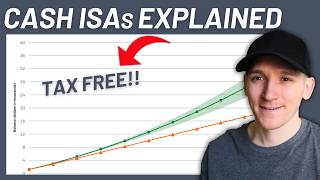

What is a Cash ISA? Tax-Free Savings Explained
45sEducational hook that clarifies a common personal finance term with clear benefits.
▶ Play Clip"Delivers a clear explanation of Cash ISAs with practical details, though some sections are repetitive."
This video explains what a Cash ISA is, how it differs from a Stocks and Shares ISA, and the recent changes to ISA rules in the UK. It covers the tax-free benefits, contribution limits, and considerations for choosing between cash and investment ISAs.
An ISA (Individual Savings Account) is a special account at a bank or brokerage where any gains are completely tax-free.
Cash ISA: you give cash to the bank, they lend it out, and you earn interest. Stocks and Shares ISA: you invest in shares, index funds, ETFs, and gains are tax-free.
Each tax year, you can invest up to £20,000 into ISAs. This limit applies across all ISA accounts combined.
In the next tax year (2017-18), the total limit remains £20,000, but due to inflation, the real value is reduced. Also, a new limit of £12,000 is introduced for cash ISAs.
You can only put £12,000 into a cash ISA; the remaining £8,000 must go into a stocks and shares ISA to max out the total limit.
Cash held within a stocks and shares ISA will be taxed at 22%, whereas cash in a cash ISA remains tax-free.
Cash ISAs are flexible; you can withdraw money anytime, but banks may offer better rates for fixed-term accounts with penalties for early withdrawal.
ISA providers calculate net contributions per tax year, so if you withdraw money, you can add it back later without exceeding the annual limit.
If you move abroad, you cannot open or add to ISAs, but you can keep them open and withdraw. You must inform your provider, and the account goes into withdraw-only mode.
Over long periods (10-20 years), cash ISAs generally underperform broad equity indexes like the S&P 500 or NASDAQ 100.
Pros: safe, non-volatile, protected up to £85,000 per person per institution under FSCS, simple, flexible, no tax. Cons: underperform equities over long term, may not beat inflation, best rates only for fixed-term accounts.
Easiest to open with your existing bank. Rates are competitive, and the hassle of switching for a slightly better rate may not be worth it.
Cash ISAs offer a safe, tax-free way to save, but they may not keep up with inflation or match equity returns over the long term. Understanding the rules and your time horizon is key to choosing the right ISA.
What does ISA stand for?
Individual Savings Account
00:01
What is the annual ISA contribution limit in the UK?
£20,000
01:11
What is the new limit for cash ISAs in the next tax year?
£12,000
02:51
What tax rate applies to cash held in a stocks and shares ISA?
22%
03:45
What happens to your ISA if you move abroad?
You cannot open or add to ISAs, but you can keep them open and withdraw. The account goes into withdraw-only mode.
06:14
What is the FSCS protection limit for cash ISAs?
£85,000 per person per institution
09:10
Annual ISA limit
The £20,000 annual limit is a key figure for UK savers.
01:11New cash ISA limit
The reduction to £12,000 for cash ISAs is a significant rule change.
02:51Tax on cash in stocks and shares ISA
This 22% tax is a surprising penalty for holding cash in an investment ISA.
03:45Long-term underperformance of cash
Highlights the opportunity cost of holding cash over long periods.
07:32FSCS protection
The £85,000 protection is crucial for risk assessment.
09:10[00:01] benefits of actually having one? An ISA stands for individual savings account. This is just a special type of account that you can open up either at a bank or office does these. And any gains that you make within this
[00:16] account should be completely tax-free. So, that's brilliant. With a cash ISA, you're just giving your cash to the bank and they're using that as they normally would. They're going to lend it out for mortgages or for credit
[00:29] cards or anything else. They'll invest it as they normally do and an interest rate will be earned on that and that interest will be passed back to you of account that people often go for is a stocks and shares ISA.
[00:42] This is again a special type of account that you can open either at a bank or a brokerage and you can invest in that stocks and shares ISA and you can invest in company shares, index funds, exchange-traded funds and any gains that
[00:57] tax-free. Mostly with stocks and shares, you'll be looking at capital gains. So, let's say you invest 20,000 and prices go up and now you've got 30,000. You can sell it, you get a 10,000 pound gain and that won't be taxed any capital gains
[01:11] get a limit each tax year that we can invest into the ISA account and any gains in that account will accrue tax-free into the future. So, each and every year you can max out your account. So, you can put 20,000 pounds in year
[01:25] one and then the next tax year comes along, you can put another 20,000 pounds in and another 20,000 pounds and that will just accrue over time completely However, these rules can change over time and
[01:39] that's just what has happened in the recent tax year. So, what has been the case is that all gains within all ISA accounts have And in the next tax year under current proposed rules, that's going to change.
[01:54] So, in this current tax year as I'm making this video, the limit that you can put in is £20,000. Now, you can put that between different ISA accounts. So, you can have a cash ISA where you're just investing your cash savings, and
[02:06] where you're buying stocks and shares or index funds. And the total limit is £20,000 between each of those funds. You can split that up as you want. change things. The total limit in the next tax year,
[02:22] 2017-18, will remain £20,000. Now, that's actually a net reduction in the amount that you can invest because inflation has to be taken into account. Inflation is running, let's say, 4 or 5%. Well, if
[02:37] you've got the same limit now, inflation-adjusted, you can invest less So, that's actually a reduction in the tax-free amount that you can invest, even though the £20,000 is the same. Now, the new limits
[02:51] prevent you from putting more than £12,000 into a cash ISA. So, you still have the £20,000 limit, but you can only put 12,000 in a The rest has to be made up if you want to max out your total limit for the
[03:05] year, the rest 8,000 has to be put into a stocks and shares ISA. ISA at all, you can still put the ISA. This is a big change because previously
[03:18] you could put the whole 20,000 into a cash ISA, no problem. And cash ISAs are great for people that have some fixed a liability in the short term. Maybe that, and you know that within 2 years you need this cash.
[03:33] their ISAs there. Well, unfortunately, that's been reduced here to 12,000. ISA, the current rules are going to tax cash
[03:45] within the stocks and shares ISA at 22%. Now, if you have cash within your cash ISA, that won't be taxed. What a lot of people do is open a stocks and shares ISA, and they get paid dividends from companies, and so they will accrue some
[03:58] usually leave it in there for a while before they start investing it again. Well, unfortunately, that's going to be taxed at 22% now. Now, what I will say taxed at 22% now. Now, what I will say is that these rules change often, and if
[04:10] you get a new chancellor, they may change them again. They may get better, government, they're probably going to change again. So, whenever you're check the rules at the current time that you're watching this video. Any money
[04:22] that you put into a cash ISA should be completely flexible. So, there's nothing in the law that says the ISA provider can lock up your money and not let you have it. You should be able to get that out, no problem. However, in practice,
[04:35] banks are going to give you better rates for guaranteeing your money with them show you how this works. You can see this is just a bank. You can look at rates and the accounts and the terms and conditions. But, let's say for a 1-year
[04:50] fixed-rate cash ISA, at the moment you're getting 4.55%. Now, if you get a 2-year ISA, so you're locking it up for 2 years, you get a higher rate, 4.65. If you want an account that acts more like a very
[05:04] liquid cash savings account, you can do that, but you're getting 0.75%. happens here is that the bank is going to give you more interest for locking up your cash. Now, that doesn't mean that
[05:19] accounts, but if you look at the terms and conditions, there may be a fixed fee, there may be a high withdrawal fee, or they may bring down your interest though you might get the money out, there may be some penalties for doing
[05:33] so. Most ISA providers will calculate your net contributions per tax year, and that means that our contributions aren't double-counted. For example, let's say we max out the account when we open it with 20,000 in, but 6 months later, we
[05:47] Well, are we done for the year cuz we've already put 20,000 in? just take that out of your net contribution. So, your net contribution now is 10,000, which means that you can also add another 10,000 in, bringing
[06:02] your net contribution for that year up to 20,000 again. What happens if you have a cash ISA and then you move abroad? Well, ISAs are for UK tax residents. So, if you're moving abroad for work or you're retiring, then you
[06:14] cannot open new ISA accounts and you cannot add to existing ISA accounts. However, you don't need to close them immediately. What you do have to do is tell your ISA provider that you are no longer a UK tax resident. And what they
[06:27] into withdraw only mode, which means that you can withdraw cash from the account, you can set it down, but you can't add anything new into it. All of the tax benefits that you receive are pretty irrelevant at that point
[06:41] so you're not being taxed in the UK at all. you do move abroad, the money that you had in your ISA the money that you had in your ISA accounts is now no longer under the UK
[06:53] about interest or capital gains or anything else. However, the place that is going to count those assets as your assets, and they may be taxed. They don't care about ISA accounts, they don't care about any of that. If in your
[07:06] country that you move to, your interest is taxed, then you'll have So, if you move out of the UK, any benefits whatsoever, and you may just want to draw them down. Or, if you
[07:19] know that you're going to move back into the UK, then definitely keep them open. you're making in those accounts when you're abroad, but when you move back to the UK, then those accounts will be active again and will be shielding you
[07:32] from any UK taxes that you may have to pay. For the most part, cash ISAs, these. So, if you look over a very long time horizon, 10, 15, 20 years, for the most part, cash and interest on cash is going to underperform broad stock
[07:47] indexes. So, if you're looking at something like the S&P 500, NASDAQ 100, maybe a world index which has, you know, thousands of stocks in there, right? Just really broad index investing, for the most part, it is expected that
[08:01] equity indexes, over the long term, outperform interest that you can gain on time horizon, then you may just want to consider your asset allocation in terms of buying equities rather than holding cash. And
[08:17] you, you may want to go for the stocks and shares ISA. There is risk and reward here. So, when you buy stocks, these are volatile. Now, if you buy a stock, there's probably a 100% chance that within a week it's
[08:29] at. That's just the way it works, right? Very volatile, and there's risk there to the asset class itself. With cash, virtually no risk, apart from the bank itself or something like that. But, cash ISA accounts
[08:44] do have uh financial compensation scheme limits, as well. So, if you're using a big bank in the UK, you don't have to worry about the bank going bust. Even if you out there with that. So, there's risk and reward. For the
[08:56] most part, stocks and shares, broad equity indexes, outperform over the longer term. However, cash is obviously much more reliable in the shorter term, got a savings goal that you need money for, then obviously cash is going to be
[09:10] more reliable in terms of its purchasing power over the short term. Pros and cons of cash ISAs versus other types of ISA accounts. They're safe, non-volatile cash savings, protected under the UK FSCS up to £85,000 per person, per
[09:26] institution, and simple, flexible, and no tax and reporting. Very good. they do underperform equity indexes over very long periods. If you're looking for your retirement, like in 15, 20 years, it is, for the most part, going to be uh
[09:41] underperforming an equity index. And they may not beat real inflation. And they may not beat real inflation. So, if you're getting, let's say, 3%, 4% in an ISA, the real inflation rate may be 6% or 7%.
[09:53] with inflation. Whereas, equity indexes are, for the most part, uh assumed to keep up with inflation broadly. Now, the best rates are only offered for fixed-term cash ISAs, right? So, the more flexibility that you want, the
[10:08] can see that, right? So, the 1-year fixed rate, 4.55. 2-year fixed rate, fixed rate, 4.55. 2-year fixed rate, 4.65. And then, cash ISA, flexible, need to open a cash ISA. Just go to your bank, building society, post office,
[10:23] account. What I would suggest is that, for the most part, it's probably going to be easiest to open a cash ISA where you bank already. Unless you want to open a new account somewhere, go through all of the that, and then you're going
[10:36] have a different login. It's probably going to be a mess. For the most part, cash ISAs are quite competitive in the UK at the major banks. And getting 10 provider probably isn't worth the headache of opening that account versus
[10:51] already with. I'll leave some other helpful information and videos on cash the description below. I'm James as Maziji. Cheers to watching, and I'll see Maziji. Cheers to watching, and I'll see you in the next one.
⚡ Saved you 0h 11m reading this? Transcribe any YouTube video for free — no signup needed.