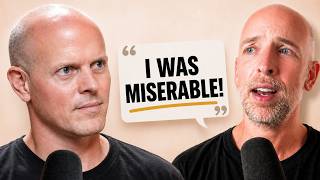

The Treadmill Trap After Selling
45sRelatable confession about immediately jumping into another startup without reflecting, which resonates with ambitious entrepreneurs.
▶ Play Clip"The title accurately reflects the transcript's focus on the founder's post-sale experience and advice."
The speaker recounts the emotional and psychological aftermath of selling his company Backlinko, describing how he immediately jumped into another startup without taking time to reflect. He later realized the importance of a hard reset, as stress levels remained high and he struggled with loss of structure, purpose, and connection. Following advice from a Yale study, he took a year off from major commitments, which allowed him to decompress and eventually fill the void with tennis and a new community.
After selling Backlinko, the speaker went back to working on his next startup the very next day, feeling he had to prove he wasn't resting on his laurels.
He wishes he had taken time off to reflect, but felt awkward telling his new team to work hard while he relaxed.
Selling Backlinko made him financially secure for life, but he still felt compelled to keep working.
Despite the financial windfall, his stress levels (measured by an Oura ring) were double the baseline for two months after the sale.
A Yale School of Management study identified three dangers: loss of structure, loss of purpose, and loss of connection with the team.
The study recommended taking at least a year before making any major commitments; founders who started new companies within a year often regretted it.
He went on a trip to reset his brain, which helped reduce stress back to baseline.
After a year, he joined a tennis club and found a new community of entrepreneurs, which replaced the urge to start another company.
The speaker emphasizes the importance of taking a deliberate pause after a major exit to avoid burnout and regret, and suggests finding a new passion or community to fill the void left by the startup life.
What did the speaker do the day after selling Backlinko?
He went back to working on his next startup.
What did the speaker wish he had done differently after the sale?
He wished he had taken some time off to reflect.
00:30
What physical symptom did the speaker experience after selling Backlinko?
His stress levels (measured by an Oura ring) were double the baseline for two months.
01:30
What three psychological dangers did the Yale study identify for founders after an exit?
Loss of structure, loss of purpose, and loss of connection with the team.
02:00
What advice did the Yale study give about starting a new company after selling?
Wait at least a year before making any major commitments; founders who started within a year often regretted it.
02:30
How did the speaker eventually reduce his stress after the sale?
He went on a trip to reset his brain, which brought stress back to baseline.
03:00
What activity did the speaker use to fill the void left by startups?
He joined a tennis club and became obsessed with the game.
03:30
Immediate Return to Work
Shows the common founder tendency to avoid rest after a big win.
Post-Sale Stress Surge
Contradicts the assumption that financial success reduces stress.
01:30Three Psychological Dangers
Provides a framework for understanding post-exit challenges.
02:00One-Year Rule
Actionable advice backed by research to avoid regret.
02:30[00:00] you sell the company. Presumably, there's some type of [sighs] earnout or period of time for which you're required to still work on Backlinko. Let's just flash forward like 2 or 3 months after the acquisition. What is your what does your life look like when I sold Back Linko? That one day that the announcement was made, especially the next day cuz it was late here. So like the next day was really when I was sending messages to
[00:23] people and stuff and getting congratulations and whatnot. But after that day I was pretty much back working on the next thing. Didn't reflect too much on it because I had another startup that I was already working on. >> I was basically running on a treadmill and then I just hopped onto another treadmill that was right [laughter] next to it and just kept going. I kind of wish I approached it differently. Yeah. And looking back I was
[00:45] wish I took some time off. It was just tricky because you know how it is when you have a startup. It's kind of a strange situation. Like I had a new company that was growing. I had this old company that I sold and it felt weird to say to the new team like, "Hey guys, I need to reflect about how great my life is. I need to chill out. You guys still work though. Like you work
[01:08] your asses off. I'm going to I'm going to chill on the beach for a while." So it felt a little weird. I felt like I kind of had to go back into the trenches with them right away. Almost even more so to prove like look, I'm not done. like I'm not going to rest on my laurels. We're still in it to win it. It wasn't really 100% financial. Like when I sold back Linko before then I
[01:31] was probably okay for most of my life. Then when I sold back Linko, it was like, okay, I'm probably good for forever. And then I wouldn't have probably started something else right away if I hadn't already. And then about two years later, sold Exploding Topics and was just kind of going full-time. not super crazy working all the time because I was fairly efficient but still working all the time and then went from that to like basically
[01:53] stopped to zero and a lot of people I think they have this feeling of listlessness no direction maybe a bit of depression for me the symptom was stress like I think I was wired for stress not only just in general but also because of the sale process is stressful and then just because the sale is done your [clears throat] body and I think part of your like reptilian brain doesn't really recognize that and it still is
[02:16] looking it's looking for threats and it's looking for opportunities and it's just not chilled out. I struggled for like 2 months with stress on my aura ring. My stress was like 2x baseline from after I sold. And you'd think it'd be the opposite. It be like this is great. Like I sold two companies, I'm good for the rest of my life. Like what is there to be stressed about? And [snorts] then I realized what I needed
[02:39] was a hard reset. And I read this, someone sent me this who another friend who had a big acquisition. He sent me this thing. I think it was in the Yell School of Management and it was basically they interviewed founders that had just exited and they asked him their advice. >> What was it like? What were the good ups and the downs? And they basically said when you sell there were like psychological dangers that can occur.
[03:01] One is that you lose your sense of structure. The other is you lose your sense of purpose and you lose your sense of connection with your team. it all goes away like you have it and then one day you literally don't. So different people react to it in different ways but they warned that the a lot of case studies in this paper were saying people that started companies within a year of selling usually regretted it. >>
[03:24] So it's [clears throat] basically take a year and don't make any major commitments whatsoever. That was the first step. We went on a trip, got away from the environment, got away from the day-to-day life, and then it somehow was able to hack my brain to be like, "Okay, you're safe or like things are chill now." So, when I went back home, the stress was gone. It was like back to baseline or below baseline. And I was
[03:47] tempted to start another startup, but a lot of case studies in this paper were saying people that started companies within a year of selling usually regretted it. Mhm. >> So, it's basically take a year and don't make any major commitments whatsoever. So, that's what I did. It kept me from starting these. I had all these ideas. I'm going to start a soft and then I would be like going to wait a year, wait a year, wait
[04:09] a year. And then by the time a year came around, I didn't really want to because I was able to fill the void largely with tennis. I joined a tennis club >> and [clears throat] there's a lot of other entrepreneurs there. A lot of Americans, man. It's like the 51st state over there to be honest. [laughter] It's getting a little crazy. But anyway, so I filled the void with this community of people that are playing tennis,
[04:32] trying to improve, obsessed with the game, like watching YouTube videos, reading about it, practicing all the time. And now I don't have that same sense of like wanting to start something
⚡ Saved you 0h 04m reading this? Transcribe any YouTube video for free — no signup needed.