
Our Sun Had a Twin?
50sThe twist that our Sun might have once had a companion star sparks curiosity and challenges common assumptions.
▶ Play Clip"The title promises a fascinating scenario, and the video delivers a decent explanation, though it could be more concise."
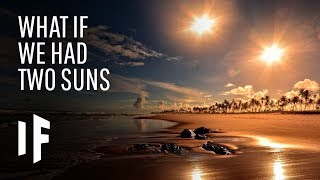
This video explores the hypothetical scenario of Earth having two suns, examining the scientific conditions required for such a system to exist and whether life could survive. It discusses the stability of orbits, the effects on climate and day-night cycles, and the potential for habitable planets in binary star systems.
Sunsets on other planets could be more spectacular than on Earth, especially with two suns setting.
Not all star systems form around a single star; some scientists suggest our Sun once had a companion star that broke free.
Binary star systems have habitable zones, and Earth could potentially sustain life with two suns under certain conditions.
Earth's fate in a binary system depends on star masses and positions; a larger star could pull the planet, or the planet could become a rogue planet.
Two suns would bring double doses of UV radiation and solar winds, making life difficult without protection.
The best case is replacing our Sun with two closely matched stars, keeping the planet warm enough for life.
With two suns, Earth's year would be 280 days instead of 365, and the stars would need to be less than 15 million km apart for stability.
The two stars would orbit each other every ten days, causing eclipses that last about 5 hours instead of 7.5 minutes.
The smallest known planet circling two suns exists, suggesting rocky planets like Earth could orbit binary stars.
While Earth could theoretically survive with two suns under specific conditions, the challenges of radiation and orbital stability make it a delicate balance. The possibility of life on exoplanets in binary systems remains an intriguing area of study.
What is the best-case scenario for Earth to sustain life with two suns?
Replacing our Sun with two closely matched stars that keep the planet warm enough.
02:25
How long would Earth's year be with two suns?
280 days instead of 365.
02:38
What is the maximum distance between the two stars for stable orbits?
Less than 15 million km (9 million miles).
02:54
How often would the two stars orbit each other in the stable scenario?
Once every ten days.
03:06
How long would a solar eclipse last with two suns?
About 5 hours instead of 7.5 minutes.
03:19
Sun's Lost Companion
Suggests our Sun may have once had a binary companion, adding depth to the discussion.
00:26Double UV Radiation
Highlights a critical challenge for life with two suns.
01:54280-Day Year
Provides a concrete, testable number for the hypothetical scenario.
02:38Exoplanets in Binary Systems
Connects the hypothetical to real astronomical discoveries.
03:33[00:04] There are sunsets on other planets even more spectacular than the ones on Earth. What if we could see not just one, but two suns falling below the Earth's horizon?
[00:26] and here's what would happen Not all star systems form around a single star. Some scientists even suggest that our Sun once had a star companion -
[00:41] It broke free of the Sun's gravity and melted into the Milky Way billions of years ago. Our search for Earth-size planets throughout the galaxy showed us that
[00:54] but they also have habitable zones and planets within them. It looks like the Earth could sustain life with two suns, instead of just one. But only under certain conditions.
[01:08] In a binary star system, Earth's fate would depend on many factors - from the masses of the stars to their position relative to Earth and each other. If one of the suns was bigger and brighter,
[01:24] that sun could pull the planet towards itself. On the other hand, if neither stars' gravitational pull was strong enough,
[01:37] We'd become one of those rogue planets that travel the Universe all alone Let's assume that the Earth's orbit would be stable. But that's no good for complex life on the planet.
[01:54] Because at some point the stars would face both sides of the planet at the same time. but it would also bring double doses of UV radiation and solar winds. No sunscreen would prevent you from getting toasted by two suns.
[02:09] The Earth's orbit could be stable if the planet rotated around the two stars. and the Earth's orbit would be further away. where the heat of the suns wouldn't be enough to keep our water in a liquid state.
[02:25] The planet would turn into a frozen, lifeless rock. The best-case scenario for our planet would be if we replaced our Sun with two closely matched stars,
[02:38] This would keep the planet warm enough to sustain life. it would take the Earth 280 days instead of 365 to make a whole circle around them.
[02:54] would have to be less than 15 million km apart (9 million miles). That way, the orbits of all the planets in our system would be stable. But let's play safe and assume the distance between the stars
[03:06] In that scenario, the two stars would orbit each other once every ten days. From Earth, that would look like a solar eclipse.
[03:19] it would be one star blocking another one. And instead 7.5 minutes, that eclipse would last for about 5 hours. Under those conditions, the Earth could be just fine orbiting two suns.
[03:33] in a binary star system in the first place. As far as we know, the smallest known planet circling two suns Maybe there is a small, rocky planet like Earth orbiting two suns somewhere in the Universe.
[03:49] It might even sustain life, intelligent enough to send a signal to our planet. But that's a topic for another WHAT IF.
⚡ Saved you 0h 04m reading this? Transcribe any YouTube video for free — no signup needed.
