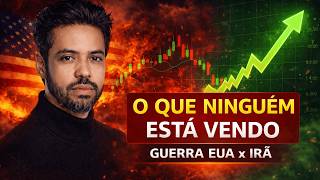
Mercado quebra quando ninguém espera
45sRevela um padrão contraintuitivo de que crises geopolíticas raramente derrubam o mercado no início, mas sim quando a atenção se desvia.
▶ Play Clip
[00:02] to a region that has already changed the global economy several times. And whenever that happens, the market goes on high alert. Oil prices rise, volatility protection. But there is a curious detail about
[00:17] geopolitical crises. The market almost never crashes when the conflict [in music] begins. It breaks when everyone is looking the when everyone is looking the wrong way.
[00:30] What if the real risk of this war isn't the escalation of the conflict? precisely [music] when the fear starts to disappear?
[00:45] trying to figure out where to make money, but there's a risk in the market that almost no one is talking about. And curiously, he is not involved in the escalation of the conflict. The real risk may arise precisely if everything calms down
[00:58] too quickly. There's something curious about the financial market. It rarely breaks down when a problem arises. It breaks down when the dominant narrative is wrong. Today, the [music] prices we see are a direct reflection of
[01:11] geopolitical fear. Oil prices pushed upwards, inflation expectations more resilient, central banks proceeding with much more caution. In other words, fear has already been incorporated into the assets. And when fear is already priced in, the event itself
[01:25] loses its power. What starts to move the market is [music] that nobody expected. Most people are looking at a single scenario, [music] an escalation of conflict, blocked energy routes, an oil shock.
[01:38] Yes, that risk exists, but the entire market is already discussing that possibility. Now imagine the opposite scenario, a process of reducing tension, some guarantee of security on shipping routes, maintained energy flow
[01:52] , perhaps not even a formal agreement, but a balance [music] that prevents interruptions. If that happens, something changes quickly. The risk premium is starting to disappear. And when that reward disappears, the adjustment can
[02:08] important detail. The [music] market doesn't need oil prices to collapse. He just needs the price of oil to stop rising. If oil prices cease to exert pressure, inflation expectations begin to ease, interest rate curves
[02:21] may flatten, central bank rhetoric changes, and the dollar loses some of the strength it had been gaining. Meanwhile, risk assets may rise even before news confirms any change, because the market always moves
[02:36] change, because the market always moves ahead of the official narrative. military move, large funds observe something else:
[02:50] energy production, supply flows, trade routes. The question that really matters is simple. Was production affected? Was the [music] transport interrupted? Has the global supply changed structurally? If the answer is
[03:03] no, then much of the current movement is psychological, and psychological movements can reverse quickly. There's even a curious sign that sometimes appears. Even with global tension, gold could start to fall. This could
[03:19] mean two things: a search for liquidity or simply a market that . In other words, gold may fall not because risk has disappeared, but because the financial system does not expect a real disruption.
[03:34] While the average investor chases fear, institutional money does the opposite: it reduces hedging, realizes profits on energy, and starts looking for assets that became cheap during the panic. Because smart money rarely buys
[03:48] fear. He usually sells to people who are afraid. The biggest mistake in moments like this is reacting only to the headlines. The market doesn't punish conflict; it punishes collective certainties that were wrong. If
[04:02] everyone believes in the same scenario, the symmetry might be exactly on the opposite side. Perhaps the best position in this war is not to bet on escalation. Perhaps it's time to be ready for the moment when the fear begins to disappear. Because
[04:16] in the market, it's not the event itself that moves prices, it's what nobody was prices, it's what nobody was expecting.
⚡ Saved you 0h 04m reading this? Transcribe any YouTube video for free — no signup needed.