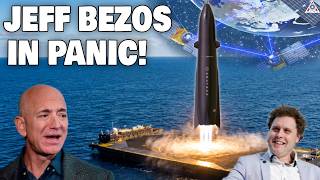

Rocket Lab Buys Iridium for $8B – Humiliates Blue Origin?
60sThe dramatic contrast between a scrappy startup and a giant's failure sparks curiosity and debate.
▶ Play Clip"The title overstates the humiliation, but the content delivers a detailed analysis of the deal and its competitive implications."
Rocket Lab's $8 billion acquisition of Iridium is a transformative deal in the space industry, positioning the company as a vertically integrated satellite operator with a prized L-band spectrum asset. The deal humiliates Blue Origin, which has struggled with rocket failures, and puts SpaceX on notice as Rocket Lab moves to compete in direct-to-device and satellite IoT markets.
Peter Beck, CEO of Rocket Lab, buys Iridium, a profitable satellite network with 2.55 million customers, for $8 billion. The deal is seen as transformative and humiliating to Blue Origin.
Iridium, founded by Motorola in the late 1980s, operates 80 satellites in LEO. It went bankrupt in 1999 but revived with new satellites launched by SpaceX. Its most valuable asset is the L-band spectrum, which is scarce and licensed by governments.
SpaceX spent nearly $20 billion to acquire spectrum from EchoStar for Starlink's direct-to-cell service, highlighting the cutthroat nature of spectrum acquisition. L-band is valuable for its ability to penetrate weather.
Building a global satellite network from scratch would cost tens of billions and take years. For $8 billion, Rocket Lab gets an operating network, customers, spectrum, and a trusted brand.
SpaceX's success comes from vertical integration: launching its own satellites and selling services directly. Rocket Lab is replicating this by buying Iridium instead of building from zero.
Blue Origin, founded in 2000 with vast resources, has failed to build orbital launch capability. Its New Glenn rocket exploded on the pad in May 2026, damaging its only launch site.
Rocket Lab launched a US Space Force mission just 17 hours after receiving the order, setting a world record and demonstrating its operational efficiency.
Iridium's L-band provides low-bandwidth but reliable connections, ideal for direct-to-device and satellite IoT. Rocket Lab plans to expand this offering to compete with Starlink and Amazon LEO.
SpaceX, Amazon, and Rocket Lab are all acquiring spectrum assets (EchoStar, Globalstar, Iridium) to own the pipe for connecting devices to space. The timing follows SpaceX's $86 billion IPO.
Rocket Lab's reusable Neutron rocket, designed for constellation deployment, will enable it to launch its own satellites, reducing reliance on SpaceX. First launch targeted for Q4 2026.
Rocket Lab publicly disclosed a fuel tank rupture during testing, showing transparency. The timeline remains on track, with Neutron's first launch expected in Q4 2026.
Beck started as an apprentice, founded Rocket Lab in 2006 with little money, and built a track record of reliable launches. The Iridium deal is the next logical step in his long-term plan.
Rocket Lab's acquisition of Iridium is a strategic masterstroke that positions it as a vertically integrated space power, directly challenging SpaceX and humiliating Blue Origin. With the Neutron rocket on the horizon, Rocket Lab is set to become a major player in the space industry.
What is the most valuable asset Iridium owns?
The L-band spectrum.
01:33
How much did Rocket Lab pay for Iridium?
$8 billion.
00:14
Why is L-band spectrum valuable?
It cuts through clouds, rain, and bad weather better than most frequency bands.
02:15
What is the vertical integration model in space?
Launching your own satellites, operating the constellation, and selling services directly to end customers.
03:23
What happened to Blue Origin's New Glenn rocket in May 2026?
It exploded on the launch pad during a static fire test.
05:00
How fast did Rocket Lab launch a US Space Force mission?
17 hours after receiving the order.
06:53
What is the target for Neutron's first launch?
Q4 2026.
10:19
Why did Amazon buy Globalstar?
To get a foothold in direct-to-device (D2D) satellite services.
08:01
What is the payload capacity of Neutron to LEO?
13 tons.
09:08
What was the outcome of the hydrostatic pressure test on Neutron's fuel tank?
The tank ruptured, but it was an intentional failure test.
09:53
Transformative deal
The $8 billion acquisition of Iridium is a major strategic move that reshapes the competitive landscape.
00:02L-band spectrum as gold mine
Highlights the scarcity and strategic value of spectrum, a key insight for understanding the space industry.
01:33Vertical integration model
Explains why SpaceX's success is based on vertical integration, a principle Rocket Lab is adopting.
03:09Record turnaround
Demonstrates Rocket Lab's operational excellence, contrasting with Blue Origin's failures.
06:38Consolidation race
Shows the industry-wide race to acquire spectrum, indicating a closing window for entry.
08:15[00:02] We believe this will be one of the most transformative deals in the space industry. >> That's Peter Beck, CEO of Rocket Lab. 20 years ago, this man was digging through a scrapyard, scavenging metal to build
[00:14] his first rocket. And now, he's just done something extraordinary. He bought Iridium for $8 billion. Sounds ordinary on the surface. It's not. That deal completely humiliated Blue Origin, and it might have even put
[00:27] Blue Origin, and it might have even put SpaceX on notice. Why? First, let's understand what this deal actually is. Iridium isn't some obscure name. Founded by Motorola back in the late 1980s, it was one of the first commercial
[00:39] satellite networks in the world. 80 satellites in low Earth orbit, covering the entire globe, including places with zero terrestrial cell coverage. In 1999, Iridium went bankrupt. Building the network cost far more than it ever
[00:53] brought in, and the US government had to step in just to keep it alive. Then it came back from the dead. The new generation of Iridium satellites, launched by SpaceX itself on Falcon 9 throughout the 2010s, became critical
[01:07] communications infrastructure for maritime, aviation, military, and government users in places no terrestrial network could ever reach. terrestrial network could ever reach. Today, Iridium has 2.55 million paying
[01:20] customers and steady revenue. A satellite company that's actually profitable. That's rare in this industry. But the most valuable thing Iridium owns isn't the 80 satellites. It isn't the 2.55 million customers,
[01:33] either. It's the L-band spectrum. Spectrum isn't something you can just buy off a shelf or order when you need it. It's licensed by governments, it's brutally scarce, and once it's granted, it's almost impossible to take back.
[01:47] SpaceX knows this pain better than anyone. Even with all their money and momentum, Elon Musk's team had to fight tooth and nail for years, battling competitors in court, lobbying the FCC, and eventually dropping nearly
[02:01] 20 billion dollars to buy a huge chunk of spectrum from EchoStar just to make Starlink's direct-to-cell service possible. That's how cutthroat the spectrum game is. L-band matters because it cuts through clouds, rain, and bad
[02:15] weather better than most other frequency bands. Exactly what the military, maritime, and aviation industries need most. Iridium has been sitting on an invisible gold mine that most people outside the industry never noticed.
[02:27] outside the industry never noticed. Beck number in perspective. Building a global satellite network from scratch would take Rocket Lab years and tens of billions of dollars with zero guarantee
[02:42] it would work. For 8 billion, they get a network that's already operating, millions of paying customers, spectrum they could never buy anywhere else, and a brand that governments and militaries have trusted for over two decades. As
[02:55] Beck put it, >> This is a deal where 1 + 1 = 3, not just two. One being Rocket Lab, we have unfitted access to space and the ability >> understand why that's not just a sound bite, you need to understand what SpaceX
[03:09] has already proven over the last 10 years. SpaceX isn't just a rocket company, that's the part people still don't fully get. Yes, they have Falcon 9 to launch satellites, but they also have Starlink, a network of over 9,000
[03:23] satellites delivering internet to millions of people from rural Alaska to remote villages in Africa. That vertical integration, launch it yourself, operate the constellation yourself, sell the service directly to the end customer, is
[03:37] exactly why SpaceX keeps needing fewer and fewer outside customers. They generate their own demand. Rocket Lab is building the exact same structure, just smarter. Instead of spending years and tens of billions building a
[03:51] constellation from zero, the way SpaceX did with Starlink, they just bought one that already exists and already turns a profit. And here's the part Blue Origin really doesn't want anyone talking about. Jeff Bezos founded Blue Origin in
[04:06] 2000, 2 years before SpaceX existed, 6 years before Beck started Rocket Lab. With nearly unlimited resources from the personal fortune of the richest man on the planet, Blue Origin has had two decades and more than 10 billion dollars
[04:20] to build real satellite launch capability. And for most of those two decades, that's not really what they built. Bezos spent years polishing New Shepard, an 11-minute joyride to the edge of space for billionaires and
[04:33] celebrities who wanted a zero-gravity selfie. Meanwhile, Rocket Lab was in the mud, launching Electron over and over, building the boring, unglamorous track record that actually earns you trust in this industry. It wasn't until SpaceX
[04:47] had pulled so far ahead that the gap became embarrassing that Blue Origin finally snapped awake and threw real weight behind orbital launch and satellites. And they'd barely gotten that focus off the ground when, on May
[05:00] 28th, 2026, New Glenn, Blue Origin's flagship heavy-lift rocket, exploded on the launch pad during a static fire test at Cape Canaveral. It's considered the most powerful rocket explosion since the
[05:13] Soviet N-1 back in 1969. Launch Complex 36, New Glenn's only launch site, was badly damaged. The transporter erector was reduced to scrap metal. A lightning tower came down. SpaceX veterans who dealt with the Amos
[05:27] 6 explosion back in 2016 didn't mince words. Blue Origin's target of returning to flight by the end of 2026 is unrealistic. NASA had to step in to support the investigation and recovery. And credit where it's due, Blue Origin
[05:42] actually moved fast. Debris was fully cleared within 9 days and reconstruction has already started. So, right now, there are real signs New Glenn could fly again before the end of this year. But, that's not even the most embarrassing
[05:56] part. New Glenn was supposed to be carrying Amazon Leo satellites into orbit, Jeff Bezos' own satellite internet constellation, the direct rival to Starlink. Blue Origin was contracted for 12 Amazon Leo launches with options
[06:10] for 15 more. Bezos wanted his own rocket launching his own satellites. The exact same vertical integration model SpaceX has been running. But, because New Glenn keeps failing, the third flight in April 2026 failed when the second stage didn't
[06:25] reach orbit, then it blew up on the pad in May. Amazon Leo has had to turn to in May. Amazon Leo has had to turn to SpaceX, ULA, and Arianespace to launch instead, which means Bezos is now paying his own competitor to get his own
[06:38] satellites into space, while his own rocket sits in a pile of wreckage at Cape Canaveral. Meanwhile, that same week, Rocket Lab broke a world record launching a US Space Force mission just 17 hours after receiving the order, the
[06:53] fastest turnaround in history. That's the real gap between these two companies right now. Now, here's an important distinction. Iridium isn't a broadband Netflix to your phone in the middle of the ocean the way Starlink or Amazon Leo
[07:08] eventually wants to. Iridium runs on L-band, which means low bandwidth, but extremely reliable, low latency connections that punch through weather no broadband constellation can match. So, this isn't Rocket Lab suddenly
[07:21] racing Starlink or Kuiper for home internet customers. It's something more specific and arguably smarter. The real battlefield here is direct-to-device and satellite IoT. Your phone texting a satellite with zero
[07:34] extra hardware, a shipping container reporting its location from the middle of the Pacific, a tractor in a dead zone still talking to the cloud. Rocket Lab said flat out it plans to expand Iridium's direct-to-device offering to
[07:48] go head-to-head with Starlink and Amazon LEO once LEO opens up to customers and Amazon knows exactly how valuable this space is. That's precisely why they space is. That's precisely why they spent $11.57 billion buying Globalstar
[08:01] earlier this year just to get their own foothold in D2D. So, picture the board now. SpaceX paired up with EchoStar for spectrum, Amazon paired up with Globalstar, and now Rocket Lab has paired up with Iridium, arguably holding
[08:15] the single best spectrum asset of the three. Three vertically integrated space powers, all racing for the same prize, owning the pipe that connects billions of ordinary devices to space without anyone needing to buy a satellite phone
[08:29] or a special antenna. And the timing here is not a coincidence. This deal landed just weeks after SpaceX closed the largest IPO in history, raising roughly $86 billion. The entire space
[08:41] industry is going through the same moment at once. Money is flooding in and down the pieces they'll need before someone else does. Consolidation like this doesn't happen by accident. It happens when everyone in the room
[08:54] suddenly realizes the window to grab what's left is closing fast. Neutron, Rocket Lab's reusable medium-lift rocket, still in development, is the next step in the plan. It can carry 13 tons to low Earth orbit. The first stage
[09:08] lands back on a barge at sea. And it was designed from day one to deploy constellations at scale. Once Neutron is flying, Rocket Lab won't need to hire anymore, the way the old Iridium constellation once had to. And that's
[09:23] the whole point. The current generation of Iridium satellites was launched by SpaceX. Once Rocket Lab owns Iridium and Neutron is operational, they'll be launching their own next-generation satellites themselves. SpaceX loses a
[09:37] major customer, and Rocket Lab steps into a role that until now only SpaceX has ever played. Of course, this entire plan only works if Neutron actually flies. And that's the one risk still hanging over it. In January 2026, during
[09:53] structural testing of the first stage fuel tank, it ruptured during a hydrostatic pressure test. Rocket Lab announced it the very next day. A level of transparency that's genuinely rare in an industry where failures usually get
[10:06] buried. Beck explained it was an intentional failure test. You push the material to its limit to find out exactly where that limit is. The next tank was already in production. The timeline didn't change. Neutron's first
[10:19] timeline didn't change. Neutron's first launch is targeted for Q4 2026. Around the same window the Iridium deal is expected to clear regulatory approval. If both go according to plan, Rocket Lab enters 2027 with a reusable medium lift
[10:32] rocket, a global satellite constellation, 2.55 million customers, and spectrum nobody else has. And that's when Peter Beck's story actually starts college. He started as an apprentice at an appliance factory in New Zealand,
[10:49] building rockets in the company workshop at night, off the books, with nobody watching. In 2006, he founded Rocket Lab with almost no money and a vision Silicon Valley called delusional. He got turned down again and again. No degree
[11:03] and coming from an island nation the aerospace world barely acknowledged. But school. He knew how to make something actually work, not on paper, in reality with metal and fuel and fire. And he proved it launch after launch for 10
[11:19] straight years, while everyone else was still drafting slide decks and holding press conferences. The Iridium deal isn't some impulsive bet. It's the next logical step in a plan that's been building quietly for a very long time.
[11:33] Peter Beck isn't trying to become Elon Musk. Musk places huge bets, accepts a high failure rate, and reshapes the architecture of an entire industry. Beck is doing something narrower, but in some ways harder. He builds things that work
[11:48] ways harder. He builds things that work on time, on budget, over and over again. And now, with $8 billion and a global constellation in hand, he's setting up the next move. Not to catch up to SpaceX, to make SpaceX look over its
[12:01] SpaceX, to make SpaceX look over its shoulder.




⚡ Saved you 0h 12m reading this? Transcribe any YouTube video for free — no signup needed.