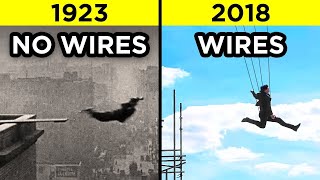

Buster Keaton's Near-Fatal Fail
34sShocking stunt failure turned into comedy is both thrilling and funny.
▶ Play Clip"The title promises a transformative history of special effects, and the video delivers a comprehensive timeline, though not every change is deeply 'forever' changing."
This video traces the evolution of movie special effects from the silent film era to modern CGI and deepfake technology. It highlights key techniques like forced perspective, stop-motion animation, blue/green screen, and motion capture, showcasing how they revolutionized filmmaking.
Early technique using relative distance to make objects appear closer or farther; used in 'Princess Nicotine' (1909) and 'Safety Last' (1920s).
In 'Modern Times' (1936), a painted glass placed in front of the camera created the illusion of a dangerous drop while Chaplin skated blindfolded.
Keaton performed dangerous jumps without wires; a failed 13.5-foot jump in 'Three Ages' (1932) was kept in the film for comedic effect.
Willis O'Brien used stop-motion models with aluminum skeletons and rubber muscles; live-action footage was projected frame-by-frame onto miniature sets to blend creatures with humans.
Claude Rains was shot separately in black velvet, then mattes were used to combine background, clothing, and invisible figure into one shot.
Harryhausen's technique used matte glass to split shots into background and foreground, allowing stop-motion creatures to interact with live-action actors through contact points.
Blue screen (chroma key) was first used in 'The Thief of Bagdad' (1940); green screen became standard in the 1990s due to camera sensor sensitivity.
Cecil B. DeMille filmed a trench with 300,000 gallons of water and played it in reverse; water footage was composited with separately shot actors.
Saul Bass used an M5 gun director (mechanical computer) to create Lissajou spirals, technically the first computer animation in cinema.
Petro Vlahos developed a sodium vapor yellow screen that isolated specific wavelength (589 nm), eliminating halo effects and capturing fine details like hair and mesh.
Ed Catmull and Fred Parke created the first computer-animated film in 1972; CGI first used in feature film 'Westworld' (1973), scanning frames line by line.
George Lucas founded ILM for 'Star Wars' (1977); they used computer-controlled motion cameras and later pioneered LED screens and quad-optical printers.
The 1982 film featured unprecedented CGI, with actors filmed against black backgrounds and animators adding digital scenes frame by frame; was snubbed for Oscar because computer animation was considered 'cheating'.
In 'Young Sherlock Holmes' (1985), a stained glass knight was the first entirely computer-animated character, animated by future Pixar chief John Lasseter.
James Cameron's 1989 film used CGI to create a water creature that mimicked actors' faces; faces were scanned with a Cyberware scanner.
Digital cameras made green screen standard; used extensively in 'The Matrix' and other blockbusters.
James Cameron used a grid painted on actor Robert Patrick to rotoscope his movements, creating the shapeshifting T-1000; renderers worked 24-hour shifts.
Originally planned as stop-motion, Spielberg switched to CGI after seeing ILM test footage; practical animatronics still used for 9 minutes of screen time.
Ed Catmull built software Menv for the first feature-length CGI film; allowed animators to isolate motion frames and let computer complete sequences.
Mo-cap uses reflective markers tracked by infrared cameras; early attempts like 'Final Fantasy: The Spirits Within' (2001) were mixed, but 'Lord of the Rings' Gollum (2002) set a benchmark.
Cameron used head-mounted cameras to capture facial performances live; rendered Na'vi aliens in real-time on stage, allowing instant visual feedback.
Jon Favreau's remake used over 800 CGI shots; animal movements studied, and puppets used as stand-ins for actor interactions.
ILM's de-aging in 'The Irishman' (2019) used a special camera rig and Flux software; YouTube artist Shamook later created a deepfake version, leading to his hiring by ILM.
Films like 'Top Gun: Maverick' and 'The Mandalorian' use StageCraft (wraparound digital screens) to achieve natural lighting and backgrounds, moving away from green screen.
The journey from forced perspective to AI-powered deepfakes shows that movie magic continuously evolves, yet filmmakers increasingly blend practical and digital effects for more immersive and realistic cinema.
Willis O'Brien
person
Ray Harryhausen
person
Lawrence Butler
person
Petro Vlahos
person
Ed Catmull
person
Fred Parke
person
John Dykstra
person
John Lasseter
person
James Cameron
person
Andy Serkis
person
Jon Favreau
person
Shamook
person
StageCraft
tool
Flux
tool
Menv
tool
Industrial Light & Magic (ILM)
tool
M5 gun director
tool
Cyberware scanner
tool
Weta Digital
service
Moving Picture Company
service
What was the first computer-animated film ever?
A Computer Animated Hand (1972) by Ed Catmull and Fred Parke.
[15:01]
Which film first used blue screen (chroma key) technology?
The Thief of Bagdad (1940).
[8:10]
What is the specific wavelength of sodium vapor light used in yellow screen?
589 nanometers.
[13:15]
Which film featured the first entirely computer-animated character?
Young Sherlock Holmes (1985) – the stained glass knight.
[19:51]
What technique did Ray Harryhausen use to combine stop-motion with live-action?
Dynamation – using matte glass to sandwich the creature between background and foreground.
[5:42]
How did filmmakers create the illusion of the Invisible Man in 1933?
They shot scenes without the actor, then draped the set in black velvet, had the actor wear black, and used mattes to combine background, clothes, and invisible figure.
[4:21]
What was the first film to use CGI?
Westworld (1973) – pixelated POV shots of the robot gunslinger.
[15:22]
Which film was the first feature-length computer-animated film?
Toy Story (1995).
[23:01]
What innovation did James Cameron introduce for motion capture in Avatar?
Head-mounted boom cameras to capture facial performances live, allowing real-time rendering of Na'vi aliens.
[26:02]
What is StageCraft, and which show used it?
Wraparound digital screens that move with the camera to create photorealistic 3D backgrounds; used in The Mandalorian.
[30:16]
What was the first use of computer-controlled motion cameras?
In Star Wars (1977) by ILM to add realism to dogfight scenes.
[16:19]
Which film first used a sodium vapor yellow screen?
Mary Poppins (1964).
[12:54]
Glass Painting Illusion
Demonstrates an early practical effect that created a dangerous illusion without digital technology.
[1:33]First Computer Animation in Cinema
Vertigo's opening used a mechanical computer to create complex spirals, marking the first instance of computer animation in film.
[11:04]Yellow Screen Precision
Sodium vapor screen provided cleaner compositing than blue screen, allowing fine detail preservation like mesh and hair.
[12:33]First Fully CGI Character
The stained glass knight in 'Young Sherlock Holmes' was a milestone for entirely computer-generated characters.
[19:51]Pixar's Software Innovation
Menv software allowed animators to isolate motion frames, automating sequences and reducing tedious frame-by-frame work.
[23:01]Real-Time Motion Capture Rendering
Avatar's live rendering of mo-cap data enabled instant visual feedback, revolutionizing virtual production.
[25:56]StageCraft Blends Practical and Digital
The Mandalorian's wraparound screens eliminate green screen lighting issues, creating more natural backgrounds.
[30:16]Deepfake Hires by ILM
Shamook's deepfake version of 'The Irishman' led to his recruitment by ILM, indicating industry shift toward AI.
[31:14][00:00] - [Narrator] Have you ever watched a movie
[00:02] and had your mind blown
[00:05] and wondered, how did they do that?
[00:07] Well, I'm going to take that question
[00:09] all the way back to the beginning of film,
[00:12] looking at the magic
[00:14] to bring its stories to life.
[00:16] From stop-motion monsters to
[00:19] this is the evolution of movie magic.
[00:23] (soft music)
[00:29] Silence is Golden.
[00:31] Camera tricks have existed
[00:33] since there were cameras to trick us.
[00:35] One of the earliest techniques
[00:38] used to whimsical effect
[00:42] like here in the 1909
[00:46] (mellow music)
[00:54] It's a basic a technique
[00:57] to make objects appear
[01:00] or smaller than they actually are.
[01:03] Jump forward to the 1920s and
[01:06] Check out this classic
[01:09] with silent comic actor Harold Lloyd.
[01:12] How do you think this stunt
[01:15] That'd require CGI, or
[01:20] and digital computers
[01:23] In reality, the crew built
[01:26] and rigged the camera to
[01:28] was dangling perilously above the street.
[01:31] Ingenious.
[01:33] Now, Charlie Chaplin was
[01:37] Check out this scene from
[01:41] where he skates around
[01:44] with a blindfold on.
[01:46] Now don't worry, he
[01:48] The crew painted that
[01:51] on a piece of glass
[01:53] and placed it in front of the camera,
[01:55] so it only looks like
[01:58] Now that's a shift in perspective.
[02:01] As comedic as Lloyd and Chaplin were,
[02:04] they didn't compare to Buster Keaton.
[02:07] Despite being a funnyman, his
[02:11] because unlike Mister Mission Impossible,
[02:14] Buster never used wires.
[02:17] When shooting his 1932
[02:20] Keaton was supposed to jump
[02:23] without support wires.
[02:25] The jump was 13.5 feet,
[02:27] so unsurprisingly, Keaton missed the mark.
[02:31] If he had made it,
[02:32] he would've broken the
[02:36] Thankfully, there was a safety net
[02:37] underneath the camera line.
[02:39] However, this failure was a
[02:42] who found it so funny
[02:44] that Keaton decided to
[02:47] Just remember, kids,
[02:48] nothing's funnier than a near-fatal fail.
[02:51] Wait, that's a terrible moral.
[02:55] Fearsome 30s.
[02:57] You know what I love
[03:00] And back in the 1930s,
[03:01] the world met the biggest
[03:05] The great ape first appeared in 1933,
[03:08] brought to life by the
[03:11] of Willis O'Brien.
[03:12] Kong himself was created
[03:16] with aluminum skeletons
[03:19] which they moved slightly frame by frame
[03:21] to make it seem as if the
[03:25] To make it appear that Kong
[03:27] and the other creatures of Skull Island
[03:28] were interacting with real humans though,
[03:31] O'Brien projected live action
[03:36] onto a miniature set from behind.
[03:38] Doing this meant the animators
[03:39] could blend the live action
[03:43] one frame at a time,
[03:45] making it seem like real actors and beasts
[03:47] were inhabiting the same space.
[03:50] When Kong needed to touch the humans,
[03:52] they used a 20-foot-tall head.
[03:54] Makes the modern-day Kong look cute.
[03:57] And a giant hand big enough to
[04:02] If you look closely here,
[04:04] where live action footage meets animation.
[04:07] Kong wasn't the only movie monster
[04:09] to get his big break in the '30s, however.
[04:11] In the world of sci-fi horror,
[04:13] there was "The Invisible Man".
[04:16] The biggest trick here
[04:17] was getting lead actor
[04:21] When he needed to look invisible,
[04:22] they shot things without him,
[04:24] carefully timing the action
[04:26] to happen without him in the shot.
[04:28] Once this was complete,
[04:30] the same set would be entirely
[04:34] with Rains covered in
[04:37] Over this, the actor would wear
[04:39] any clothes needed for the shot.
[04:41] From the footage of the
[04:44] they created two high-contrast
[04:48] One matte blocked out the background,
[04:50] while the other blocked out
[04:51] the partially clothed invisible man.
[04:54] Then, all four pieces of film,
[04:56] the background, the clothes,
[05:00] were blended into a single shot.
[05:02] And that wasn't all.
[05:03] To capture the invisible
[05:07] a custom wooden platform
[05:08] was built with foot-shaped
[05:12] When covered with artificial snow,
[05:14] the blocks would be released one by one,
[05:16] creating the illusion
[05:17] that someone was walking unseen
[05:21] These methods were tedious and expensive,
[05:24] but the results had to ironically
[05:31] Word About Ray.
[05:33] From the '50s right up to the early '80s,
[05:36] Ray Harryhausen was the
[05:40] To breathe life into his creatures,
[05:42] the animator developed a
[05:46] It worked like this.
[05:48] Harryhausen would use a
[05:51] that he could advance one frame at a time.
[05:54] In front of that was the
[05:57] and 35-millimeter camera.
[06:00] To position the creature
[06:01] between the background and the foreground,
[06:03] the animator would slip
[06:06] between the model on the
[06:09] essentially creating two
[06:13] For the first shot,
[06:14] he'd paint the glass black
[06:17] allowing only the model and rear projector
[06:20] to be seen on camera.
[06:22] Frame by frame, he then
[06:25] behind the blackened-out foreground.
[06:28] For the second shot, the
[06:30] The background would be blacked out
[06:32] and the creature would be
[06:35] placing the monster in the real world.
[06:38] When a live action actor needed
[06:42] Harryhausen used contact points,
[06:44] where a live action fragment
[06:46] would be replaced with stop motion.
[06:48] Obviously, when filming,
[06:50] Sinbad's sword wasn't striking anything.
[06:53] So, in his studio,
[06:56] of Sinbad's sword to the skeleton's,
[06:58] making it appear that
[07:00] were hitting each other.
[07:02] The switch was so quick that
[07:06] Whilst Harryhausen's
[07:09] the frames he used to
[07:12] mostly medium or long shots.
[07:14] The animator regretted
[07:15] not having more interesting
[07:19] but time and budget constraints
[07:20] forced him to keep things simple.
[07:23] While stop motion monsters
[07:24] have disappeared from the big screen,
[07:26] the techniques Harryhausen pioneered
[07:29] influenced special effects wizards
[07:31] at houses like Industrial Light & Magic,
[07:34] not to mention the dinosaurs
[07:37] Forget dinosaurs, Harryhausen
[07:42] Green Dreams.
[07:44] You're probably familiar
[07:47] you know, an actor steps in front of one,
[07:50] the background is swapped out
[07:51] to make it look like
[07:53] How exactly this effect
[07:56] is less well known.
[07:58] Back in the 1940s when this
[08:02] the screen wasn't green at all, but blue.
[08:06] The blue screen,
[08:07] or chroma key process as
[08:10] was first utilized in
[08:14] "The Thief of Bagdad",
[08:16] a fantasy picture set in
[08:19] which later inspired the
[08:22] The blue screen was used
[08:24] to bring all sorts of
[08:27] including a gigantic, insidious jinn,
[08:30] and a spirit from Arabic
[08:33] The clever inventor of the blue
[08:37] He figured out that by placing a subject
[08:39] in front of a specific color like blue,
[08:42] he could later remove
[08:45] to separate subject from background.
[08:48] The isolated subjects
[08:49] would then be placed on top
[08:52] known as a plate, to
[08:55] He chose blue as it seems to be the color
[08:58] furthest from human skin tones,
[09:00] unless you're Will Smith's version
[09:02] of the genie in "Aladdin".
[09:04] However, if the lighting for
[09:07] you'd end up with a weird glowing halo
[09:09] around characters and objects.
[09:12] Just look at that flying carpet,
[09:13] you can see where the two shots
[09:17] While it may not be perfect to us,
[09:18] it was a major breakthrough
[09:20] for filmmakers over 80 years ago,
[09:22] and the film won an Academy Award
[09:24] for best special effects that same year.
[09:27] Hmm, I wonder how those audiences
[09:29] would have reacted to Will Smith's genie?
[09:33] Faithful 50s.
[09:35] Back in the 1950s,
[09:37] Western audiences were
[09:41] and the most biblically epic of them all
[09:43] was 1956's "The Ten Commandments".
[09:47] Wanting to beat his earlier
[09:51] director Cecil B. DeMille
[09:53] employed the latest in special effects,
[09:56] particularly in the iconic scene
[09:58] where Moses parts the Red Sea.
[10:01] For this effect,
[10:02] DeMille filmed a trench
[10:05] being pumped with 300,000 gallons of water
[10:09] and then played it in reverse.
[10:11] To make it look like the
[10:14] they shot sideways footage
[10:18] The filming of Moses and his
[10:21] to make up the foreground plate.
[10:24] The water shots were
[10:26] To create the clouds,
[10:28] they poured gray paint into a
[10:32] resulting in the illusion of a dark storm.
[10:35] The finished scene showed off
[10:39] even Moses only parted the Red Sea once.
[10:43] However, much like "The Thief of Bagdad",
[10:46] the film is plagued with
[10:50] A while later in 1958,
[10:53] master of suspense Alfred Hitchcock
[10:55] was working on his classic "Vertigo",
[10:58] and wanted a striking opening sequence.
[11:01] So he said, "I better call Saul."
[11:04] This Saul in question
[11:08] who decided the opening
[11:12] and lots of them.
[11:14] Spirals are a recurring
[11:17] and Bass insisted that these shapes
[11:19] be based on Lissajou spirals,
[11:21] mathematically calculated
[11:24] they couldn't be accurately drawn freehand
[11:27] and needed the motion of a pendulum
[11:29] on a moving animation stand.
[11:31] At the time, no animation
[11:35] without the wires getting twisted up.
[11:38] The crew decided to
[11:42] This is a mechanical computer
[11:43] used for aiming weapons at moving targets.
[11:47] These things can move non-stop
[11:49] and match the swing of a pendulum.
[11:51] So, the crew set up a
[11:55] and suspended a pendulum from the ceiling.
[11:58] This pendulum had a pen attached to it
[12:00] and was connected
[12:01] to a 24-foot-high
[12:05] As the gun director rotated,
[12:07] the pendulum would swing back and forth,
[12:10] applying paint to the cels,
[12:12] and creating the spiral drawings
[12:14] you see in the opening of "Vertigo".
[12:16] This means the opening is technically
[12:19] the first example of
[12:23] because hey, it was animation
[12:28] Huh.
[12:31] Blue to Yellow.
[12:33] As the '60s swung in,
[12:35] an engineer called Petro Vlahos
[12:38] got sick of the odd, leftover
[12:42] He wanted a much cleaner result,
[12:44] so he turned to the best
[12:48] He developed this special screen
[12:50] for the Walt Disney company,
[12:51] which was used in one of
[12:54] "Mary Poppins", released in 1964.
[12:58] The process was used to
[13:01] to an animated wonderland.
[13:03] To achieve the effect,
[13:05] the actors would stand in
[13:07] lit by a yellow hue from
[13:11] the same lights we see
[13:13] Sodium gas produces light
[13:15] at a very exact
[13:20] whereas blue screen
[13:25] Vlahos created a unique prism
[13:27] that isolated this specific
[13:31] narrowing the wavelength range.
[13:33] By shrinking the range,
[13:35] it made it easier to focus on a subject
[13:38] and capture fine details such as hair,
[13:40] smoke, motion blur, and shadows.
[13:43] You can see how the process
[13:44] managed to keep the fine mesh
[13:49] without any trace of a halo,
[13:51] which would have been
[13:55] It was better than blue
[13:58] Things on screen didn't
[14:01] and there was no limitation
[14:02] to the colors of props or costumes.
[14:05] Dick Van Dyke could
[14:07] without worrying about it
[14:09] being absorbed into the background,
[14:11] a common problem with blue screen.
[14:14] It seems like yellow screen
[14:15] was practically perfect in
[14:20] Despite multiple attempts to replicate it,
[14:22] Vlahos could only create
[14:26] which meant there was only one
[14:27] sodium vapor camera in the world.
[14:30] Not great for a company
[14:31] with a long list of projects
[14:35] The tech would go on to be
[14:38] in films like "The Birds" in 1963,
[14:42] and "Bedknobs and Broomsticks" in 1971.
[14:45] Pretty good track record
[14:49] Spaced out 70s.
[14:52] In 1972 at the University of Utah,
[14:55] students Ed Catmull and Fred Parke
[14:58] studied the emerging science
[15:01] Using Catmull's left hand as a model,
[15:04] the pair created "A
[15:07] This experimental short
[15:09] would become the first
[15:13] Okay, it's not exactly
[15:14] the most thrilling movie you'll ever see,
[15:16] but it might be the most important.
[15:18] The first use of CGI in a feature film
[15:22] was in 1973's sci-fi "Westworld".
[15:26] Computer effects were used
[15:27] for the pixelated point of view shots
[15:29] of the villainous robot gunslinger.
[15:32] To accomplish this,
[15:33] a computer scanned footage frame by frame
[15:35] and converted it into
[15:39] When shooting the scene,
[15:41] actors wore light clothing and makeup
[15:43] against a dark background,
[15:45] which was then contrasted in post.
[15:47] Each frame took a minute to scan,
[15:49] resulting in eight hours of rendering
[15:52] for a mere 10-second sequence.
[15:55] Then in 1977, a little
[16:00] flew onto our screens.
[16:02] To handle the huge number
[16:05] director George Lucas
[16:06] needed to establish his
[16:09] Industrial Light &
[16:13] While Lucas's company nailed
[16:16] like model construction
[16:19] they also used cutting edge techniques
[16:21] like computer-controlled motion cameras.
[16:24] To add some realism to
[16:27] effects wizard John Dykstra
[16:30] like a cameraman in space,
[16:32] with off-centered frames
[16:36] Lucas would go on to toy with "Star Wars"
[16:38] in the special edition releases,
[16:40] applying CGI to the film
[16:42] like you might apply a
[16:45] Take the 1997 special edition,
[16:47] where Lucas retroactively introduced
[16:49] a deleted scene between Han
[16:54] except in the 1977 version,
[16:56] Jabba wasn't a disgusting
[17:01] Lucas originally shot the
[17:03] of replacing the Jabba actor
[17:07] something big and hairy,
[17:09] but was restricted by time and budget.
[17:12] The re-release gave Lucas the opportunity
[17:14] to slap a CGI Jabba over the actor,
[17:17] though this scene has been criticized for,
[17:20] well, being bad and pointless.
[17:24] Regardless, since the
[17:27] ILM has gone on to be
[17:28] one of the biggest special
[17:34] CGI'd to Life.
[17:36] Back in the 1980s, a dude
[17:41] was playing a game of Pong.
[17:43] Clearly seeing the narrative potential
[17:45] of two paddles and a ball,
[17:47] he decided to make a film
[17:49] which became "Tron".
[17:52] This 1982 sci-fi was a
[17:57] featuring an unprecedented
[18:01] - Blue bikes, run these
[18:04] - Copy, blue leader.
[18:06] - This is gold one to gold two and three.
[18:08] Split up. Take 'em one on one.
[18:10] - [Narrator] "Tron" is a
[18:12] traditional animation, and CGI.
[18:15] Actors were filmed
[18:16] against an entirely
[18:19] Animators then went over this footage,
[18:21] adding CGI scenes on graph paper
[18:24] to match the positions and
[18:28] Computer engineers then entered
[18:30] all the required numbers by hand,
[18:33] but wouldn't see the final results
[18:35] until the images were
[18:39] and shown in a test theater.
[18:41] Sadly, "Tron" was not the
[18:45] They were even snubbed for the
[18:48] since computer animation
[18:52] Instead, the award went to
[18:56] with puppets being more their speed.
[18:58] Despite the loss,
[19:00] the film developed a cult
[19:03] They even made a sequel
[19:05] which also didn't light the world on fire.
[19:09] Maybe Pong just isn't very cinematic?
[19:12] Further advances in effects came from ILM,
[19:15] who developed the first LED
[19:19] which was used for the
[19:22] "The Empire Strikes Back".
[19:24] ILM's quad-optical printer,
[19:26] which combined images from various reels,
[19:29] was ideal for miniatures,
[19:31] as well as adaptable to both
[19:35] The innovative filmmaking
[19:36] earned Empire an Academy Award in 1980.
[19:40] Man, "Star Wars" hogs all the good tech.
[19:43] Another unexpected stride in CGI
[19:47] came with "Young Sherlock Holmes" in 1985.
[19:51] It's a fun watch, and also
[19:54] for the first entirely
[19:57] in a film.
[19:59] A knight made of stained glass
[20:01] digitized and animated by future
[20:07] This wasn't the only CGI pie
[20:11] James Cameron's 1989 film
[20:15] a mysterious creature made
[20:19] which mimicked the characters' faces.
[20:22] To accomplish this,
[20:23] actors Ed Harris and Mary
[20:27] had their faces scanned
[20:31] to map the shape of their faces.
[20:33] It'd be hard to do that with my face,
[20:35] too round and featureless.
[20:39] Go-Go 90s.
[20:42] If the '80s marked the film industry
[20:44] dipping their toe in the water of CGI,
[20:47] then the '90s were a big belly flop in.
[20:50] This era embedded computer
[20:53] like never before,
[20:55] which is when green
[20:58] When digital cameras came around,
[21:00] blue screens were
[21:03] because camera sensors are
[21:07] Most blockbusters, like the "Matrix",
[21:09] were utilizing the green
[21:12] by the end of the decade,
[21:14] though blue screens are still used today
[21:16] depending on which colors
[21:20] Inspired by the success of
[21:23] James Cameron decided
[21:25] in his next feature, "Terminator 2".
[21:29] For this 1991 sequel,
[21:32] that could match Arnie
[21:35] Eager to experiment with
[21:40] a shapeshifting android
[21:43] To capture T-1000 actor
[21:45] Robert Patrick's movements accurately,
[21:48] animators painted a four by four inch grid
[21:51] all over his body.
[21:53] They filmed Patrick walking and running,
[21:56] using the grid to rotoscope his body
[21:58] and determine how his muscles moved.
[22:01] Pressure was on to get this
[22:04] so digital renderers worked 24-hour shifts
[22:08] and had to catch naps on
[22:11] While Cameron's team was
[22:15] director Steven Spielberg
[22:17] was headed to the past
[22:20] To bring his now-famous
[22:23] the 1993 film was originally
[22:27] a form of stop-motion,
[22:29] not entirely unlike Harryhausen's style.
[22:32] However, ILM test footage of a CG dinosaur
[22:36] wowed Spielberg so much
[22:39] that he swapped out his
[22:43] Saying that, Spielberg
[22:45] in practical effects
[22:47] to use good old animatronics
[22:49] for nine minutes of dinosaur screen time,
[22:51] compared to six minutes of ILM's CGI.
[22:55] A few miles away from ILM HQ,
[22:58] a young Pixar Studios was breaking ground
[23:01] with the first feature-length
[23:02] computer-animated film, "Toy Story".
[23:06] It's fair to say that
[23:09] had a tricky production.
[23:11] Those toys went through a few ugly stages
[23:14] to get to be the characters we know today.
[23:16] Ed Catmull, yep, the hand guy,
[23:19] built the studio a new
[23:24] This allowed animators to
[23:27] like the bend of an elbow,
[23:29] and then leave it to the computer
[23:31] to complete the whole animation sequence.
[23:34] This method sidestepped
[23:36] of frame-by-frame animation
[23:40] Interesting, though the less
[23:44] the better.
[23:45] I don't want to look at
[23:50] Captivating Motion.
[23:52] The 2000s saw the rise of a
[23:57] motion capture animation,
[24:01] This is the process that involves an actor
[24:03] covering themselves in ping pong balls,
[24:06] which are actually reflective markers.
[24:09] These are tracked by infrared cameras
[24:11] during an actor's performance,
[24:13] so their movements are recorded, captured,
[24:15] and transferred to a computer.
[24:17] There, it's applied to a 3D
[24:22] Early attempts to use this tech
[24:23] in movies like 2000's "Sinbad:
[24:28] and 2001's "Final Fantasy: The
[24:35] One film that would've been
[24:39] Yes, the famous big, green ogre
[24:42] was originally meant to be
[24:45] for the characters
[24:46] and miniature models for the backgrounds.
[24:49] Only one clip of this footage
[24:51] and a few screenshots of the
[24:55] and it, err, doesn't feel good.
[24:59] The film was completely reworked
[25:00] and became a smash success in 2001.
[25:04] That isn't to say there weren't
[25:06] a few technical glitches along the way.
[25:10] Mo-cap really hit its stride
[25:15] and "Return of the King"
[25:17] when the world met Gollum,
[25:21] To create the iconically
[25:24] director Peter Jackson
[25:26] shot scenes with actor Andy Serkis twice.
[25:29] Once with Serkis performing on location
[25:32] and then again months later,
[25:33] where Serkis would
[25:35] in a motion capture studio.
[25:37] Here, the actor wore a specialized suit
[25:40] that tracked his movements
[25:43] The result was like nothing
[25:47] and now mo-cap is everywhere,
[25:52] Not to be outdone in the
[25:56] James Cameron took mo-cap
[25:57] to the next level in his
[26:02] Cameron shot the mo-capped actors
[26:04] performing on a stage, dubbed the Vault.
[26:08] Little boom cameras were
[26:11] to capture the nuance of the
[26:15] so that all aspects of their emotions
[26:17] would translate past
[26:20] Using live rendering,
[26:21] Cameron was able to see
[26:25] with the actors transformed
[26:28] so he didn't have to wonder
[26:30] about how the CGI would look
[26:36] Techy Tennies.
[26:38] Ah, the 2010s.
[26:40] Not the most thrilling year for CGI.
[26:42] After all, it was the
[26:46] of live action remakes.
[26:48] While I'm not a fan of
[26:51] I can't say they don't push
[26:55] The first film to reach
[26:58] was 2016's "Jungle Book"
[27:03] Weta Digital and Moving Picture Company
[27:06] went all out transforming an LA warehouse
[27:09] into a lush forest,
[27:10] using over 800 shots for
[27:14] Animal movements were studied
[27:16] to bring the creatures to life.
[27:18] To give Neel Sethi, who played Mowgli,
[27:20] something to act next to,
[27:22] Jim Henson's puppets
[27:25] These were later swapped
[27:28] in the finished film.
[27:29] Even body parts of the young actor
[27:31] were occasionally replaced
[27:34] to make it seem like he
[27:36] with the CG animals.
[27:38] The success of this saw Favreau
[27:40] make the "Lion King" in 2019,
[27:43] but well, the less said
[27:47] The 2010s weren't just about
[27:51] Starting with "X-Men: Last Stand",
[27:54] audiences have seen de-aging technology
[27:56] become increasingly used in films,
[27:59] allowing filmmakers to restore
[28:01] how actors once looked in iconic roles
[28:04] and create films spanning a lifetime
[28:06] without needing to change the actor out
[28:08] for someone older or younger.
[28:11] Look at 2019's "Gemini Man",
[28:13] which CG'd a whole new Will
[28:18] Few films have taken de-aging
[28:20] as far as Scorsese's 2019
[28:25] The team, led by, you guessed it, ILM,
[28:28] designed a fancy new camera rig
[28:31] that would allow director Martin Scorsese
[28:33] to shoot as he normally would,
[28:35] while simultaneously
[28:38] to de-age the actors.
[28:40] ILM whipped out their
[28:45] that merged data with the camera images
[28:47] to make masks out of each actor's face,
[28:50] basically, a young head on old shoulders.
[28:54] Let's be real, though,
[28:55] this film isn't always that convincing.
[28:57] To me, this shot of a de-aged De Niro
[29:00] looks like something out of a video game.
[29:03] Another thing about the 2010's
[29:07] have access to computer technology
[29:09] closer to what Hollywood's working with
[29:11] now than ever before.
[29:13] YouTube artist Shamook
[29:15] even made their own
[29:17] using a deep fake to
[29:20] with his younger self, which
[29:24] A deepfake algorithm understands
[29:26] the attributes of a person's face
[29:28] and manipulates the features
[29:30] while keeping the original
[29:34] Personally, I'm on the fence.
[29:36] Which do you think looks
[29:40] 2020 Foresight.
[29:43] Despite all these incredible
[29:45] computer animation advancements,
[29:47] sometimes I get tired of
[29:50] whenever I go to the movies,
[29:51] and I'm not alone.
[29:53] However, there's been a shift
[29:54] in this decade's biggest blockbuster hits
[29:57] like "Top Gun: Maverick",
[29:59] "Everything Everywhere All
[30:02] where filmmakers have made efforts
[30:04] to blend practical and special
[30:08] "Star Wars" spin-off "The Mandalorian"
[30:10] has taken a step away
[30:13] and incorporated
[30:16] called StageCraft.
[30:18] I know "The Mandalorian"
[30:21] but it was in November.
[30:23] Sue me.
[30:24] Anyway, StageCraft creates
[30:29] that move in sync with the camera.
[30:31] If the camera swings
[30:34] the background shifts in
[30:38] maintaining the illusion.
[30:39] You see, the problem with green screens
[30:41] is that it projects a lot
[30:44] that needs to be fixed in post,
[30:47] leading to flat, unrealistic lighting.
[30:49] With StageCraft, light comes
[30:53] making the footage a little more natural.
[30:56] Filmmakers can adjust settings constantly,
[30:58] like exposure, color, animation playback,
[31:01] and fill lighting.
[31:03] While more films might incorporate
[31:04] a blend of practical and
[31:08] the industry also might chase AI tech.
[31:11] Remember "The Irishman" deepfake?
[31:14] Shamook, that face-swapping YouTube artist
[31:16] who created "The Irishman" video,
[31:18] has recently been hired by ILM.
[31:21] In an industry where actors
[31:22] are increasingly replaced
[31:25] like this clip from Disney's
[31:29] man, that's tragic.
[31:31] It's going to be
[31:34] to see how far it goes.
[31:37] What shape do you think practical effects
[31:39] will take in the future?
[31:40] Did any here really blow your mind?
[31:42] Let me know in the comments below
[31:44] and let me know if you
[31:46] on filmmaking in the future.
[31:47] In the meantime, be sure to like, share,
[31:49] and subscribe for more amazing content.
⚡ Saved you 0h 31m reading this? Transcribe any YouTube video for free — no signup needed.